
What Is a Good VO2 Max Score? By Age and Gender
A good VO2 max score is not one magic number that applies to everyone. A score that looks impressive for one person may be fairly ordinary for another because VO2 max changes with age, sex, exercise mode, body size, training history, and genetics.
That is why comparing your number with a friend’s smartwatch reading can be misleading.
A better approach is to ask where your score sits relative to people of a similar age and sex, how it was measured, and whether your cardiorespiratory fitness is improving over time. Large reference databases such as the FRIEND Registry provide age- and sex-specific VO2 max percentiles based on directly measured cardiopulmonary exercise testing.
There is also a bigger reason to care about the number. Cardiorespiratory fitness is strongly associated with health outcomes, and the American Heart Association has described it as an important clinical marker rather than simply a measure of athletic ability.
So, what should you actually consider a good VO2 max?
What VO2 Max score is considered good, by age and gender?
The simplest answer is this: a good VO2 max is a score that ranks reasonably well for your age and sex, rather than a universal number that everyone should reach.
For adults, VO2 max generally declines with age. It also tends to be higher in men than women at the population level. The FRIEND reference data demonstrate both patterns clearly, with substantial differences between age and sex groups.
Here is a useful reference point based on the 50th percentile, which represents the middle of the reference population. These values are not “good” cutoffs by themselves. They show how the typical reference value changes across age.
Approximate median VO2 max by age
| Age | Men, 50th percentile | Women, 50th percentile |
|---|---|---|
| 20 to 29 | 48.0 mL/kg/min | 37.6 mL/kg/min |
| 30 to 39 | roughly 44 | roughly 35 |
| 40 to 49 | roughly 41 | roughly 32 |
| 50 to 59 | roughly 37 | roughly 29 |
| 60 to 69 | roughly 32 | roughly 26 |
| 70 to 79 | 24.4 mL/kg/min | 18.3 mL/kg/min |
The exact reference value can vary depending on the dataset, testing method, and whether the test was performed on a treadmill or cycle ergometer. The original FRIEND treadmill reference data reported a 50th percentile of 48.0 for men and 37.6 for women aged 20 to 29, falling to 24.4 and 18.3 respectively at ages 70 to 79. (PubMed)
The table therefore should be used as a reference guide, not a diagnosis or pass/fail test.
A score around the population middle can reasonably be described as typical for that demographic. A score substantially above the middle suggests better-than-average cardiorespiratory fitness, while a score substantially below it suggests lower cardiorespiratory fitness.
That distinction matters because the word “good” is relative.
For example, a VO2 max of 40 mL/kg/min could be very respectable for one demographic but only moderate for another. The same number could also mean something different depending on whether it came from a laboratory treadmill test, a cycling test, or a wearable estimate.
The updated FRIEND reference standards include thousands of cardiopulmonary exercise tests and provide percentile data across age groups, sexes, and exercise modes. That is much more useful than relying on a single generic VO2 max chart copied across the internet.
How should you interpret VO2 max by fitness level?
There is no single globally accepted set of labels that defines “poor,” “fair,” “good,” “excellent,” and “elite” for every person and every testing method.
Still, for everyday interpretation, percentiles can make the number easier to understand.
A practical way to think about your result is:
| Relative position | What it generally suggests |
|---|---|
| Lower percentiles | Below-average cardiorespiratory fitness for your demographic |
| Around the middle | Typical cardiorespiratory fitness |
| Above the middle | Better-than-average aerobic capacity |
| High percentiles | Very strong cardiorespiratory fitness |
| Very high percentiles | Exceptional endurance capacity, often seen in highly trained individuals |
This is deliberately different from saying that a particular number is automatically “excellent.”
An endurance athlete might have a VO2 max far above the population average. A recreationally active person may have a result comfortably above average without training like an athlete. Someone who is mostly sedentary may have a result below the population average without having an obvious medical problem.
The number needs context.
It is also worth remembering that body weight is part of the standard VO2 max calculation because the measurement is usually expressed relative to kilograms of body mass. That means changes in body weight can affect the reported number even when absolute oxygen consumption has not changed by the same amount.
For example, losing body mass can increase a relative VO2 max if oxygen consumption stays similar. Conversely, gaining body mass can lower the relative number even if your cardiovascular system has improved.
That is another reason not to treat VO2 max as a perfect measure of every aspect of fitness.
What are the health benefits of having a high VO2 Max?
A higher VO2 max generally indicates better cardiorespiratory fitness, and higher levels of cardiorespiratory fitness are associated with better health outcomes.
The American Heart Association has highlighted cardiorespiratory fitness as an important predictor of cardiovascular and overall health. Its scientific statement notes that lower cardiorespiratory fitness is associated with greater risk of cardiovascular disease and all-cause mortality, while improvements in fitness are associated with lower mortality risk. (AHA Journals)
That does not mean increasing VO2 max guarantees protection from disease.
It means aerobic fitness is one meaningful piece of the health picture.
A person with strong cardiorespiratory fitness may also have greater capacity for everyday physical activity. Walking uphill, climbing stairs, carrying groceries, cycling, hiking, or playing recreational sports can require less relative effort when the cardiovascular system is well conditioned.
There is also an important distinction between being fit and being an athlete.
You do not need an elite VO2 max to benefit from having good cardiorespiratory fitness. The biggest practical mistake is looking at elite athletes and assuming their numbers are the standard everyone should chase.
They are not.
Elite endurance athletes have spent years developing highly specific physiological adaptations. Their VO2 max values can be extraordinary, but copying their target number is not necessary for ordinary health.
The more useful goal for most people is to maintain or improve their own cardiorespiratory fitness relative to their current baseline.
What’s the best method for accurately measuring your score?
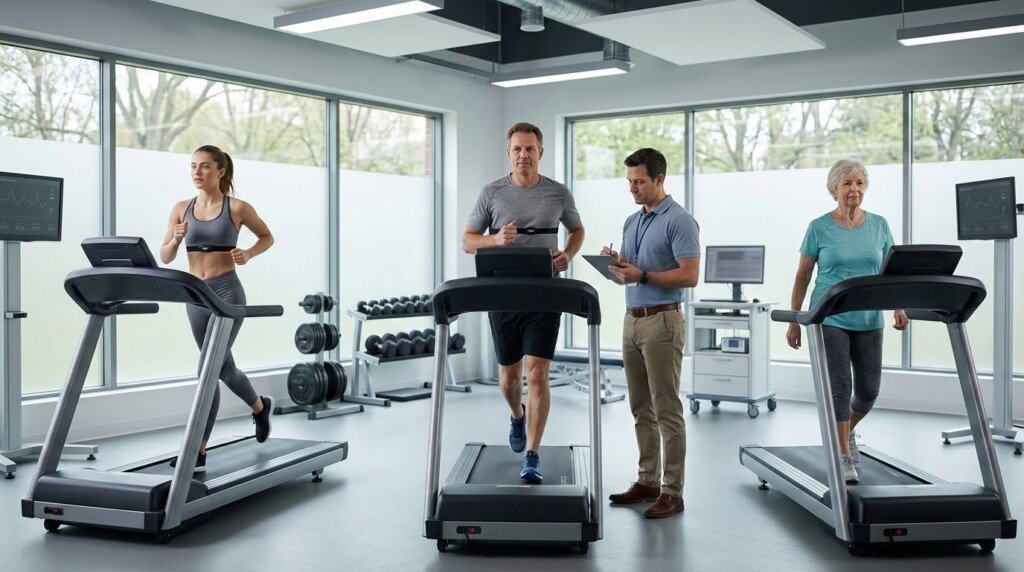
If accuracy is the priority, a laboratory cardiopulmonary exercise test with direct respiratory gas analysis is the strongest option.
During a laboratory test, you exercise on a treadmill or cycle ergometer while equipment measures the oxygen you consume and carbon dioxide you produce. The workload is progressively increased until maximal effort is reached or the test is stopped according to the testing protocol.
This is fundamentally different from a smartwatch estimating VO2 max from heart rate and movement.
A direct test can also provide information beyond the VO2 max number, including ventilatory responses and other cardiopulmonary variables.
That makes laboratory testing particularly useful when the result needs to be interpreted medically or when someone wants a more precise assessment of exercise capacity.
For ordinary fitness tracking, however, you do not necessarily need a laboratory test every few months.
A consistent wearable estimate can be useful for observing trends. If your device repeatedly estimates your VO2 max at approximately 35, then gradually moves toward 38 and later 40 under similar conditions, that trend may be useful even though the absolute numbers are not equivalent to a laboratory measurement.
The key is consistency.
A lab test and a smartwatch estimate should not automatically be treated as interchangeable numbers.
What’s an excellent VO2 Max score for men vs. women specifically?
An excellent VO2 max for men is generally higher in absolute terms than an excellent VO2 max for women when the two groups are compared at the same age.
This is reflected in large reference datasets. FRIEND data show meaningful differences between male and female VO2 max distributions across age groups.
That difference is not a judgment about who is “fitter.” It reflects physiological differences that influence oxygen transport and utilization, including differences in body composition, hemoglobin concentration, cardiac output, and other factors.
Age still matters enormously.
A VO2 max that would be exceptional for someone in their 60s may not be unusual for a well-trained person in their 20s.
This is why a useful VO2 max chart should always include age and sex rather than presenting one universal scale.
For a practical interpretation, consider two hypothetical people.
A 25-year-old woman records a VO2 max of 45 mL/kg/min. A 65-year-old woman records 35. Both numbers can represent strong aerobic fitness within their respective age groups, but the second result may be considerably more impressive relative to age.
The raw number alone does not tell the whole story.
The same principle applies to men.
A 30-year-old man with a VO2 max of 50 may be above average without being an elite endurance athlete. A 70-year-old man with the same score would be operating at an extraordinarily high level relative to his age group.
This is why percentile ranking is often more informative than a generic “good score.”
How do VO2 Max benchmarks vary between different types of athletes (runners vs. cyclists)?
Athlete type matters because the exercise used to measure VO2 max influences the result.
A highly trained cyclist may produce an excellent VO2 max on a cycle ergometer because cycling is highly specific to the muscles and movement pattern they have trained for. A runner may perform better on a treadmill.
That does not mean one athlete necessarily has a fundamentally different cardiovascular system.
It can partly reflect sport specificity.
The muscles involved, movement efficiency, training history, familiarity with the equipment, and ability to push to maximal effort can all influence the result.
This is one reason VO2 max testing is best compared under similar conditions.
If you test yourself on a treadmill one year and a bicycle the next, a change in your number may reflect the testing mode as well as your actual fitness.
The FRIEND Registry has separate reference standards for treadmill and cycle testing, reinforcing the importance of considering exercise mode when interpreting cardiorespiratory fitness results. (PubMed)
There is another interesting point here.
A high VO2 max does not automatically make someone a great runner or cyclist.
Performance depends on much more than maximal oxygen consumption. Running economy, cycling efficiency, lactate threshold, muscular endurance, pacing, technique, training volume, and race strategy all matter.
VO2 max tells you about the upper limit of aerobic oxygen use. It does not tell you exactly how efficiently you can operate below that limit.
That is why two endurance athletes with similar VO2 max values can have very different race performances.
How do I calculate or estimate my own VO2 Max?
You can estimate VO2 max without laboratory equipment, but you should understand what you are getting.
An estimate is a prediction based on measurable information. It is not a direct measurement of oxygen consumption.
Different methods use different combinations of exercise performance, heart rate, age, sex, distance, or time.
Some fitness trackers use heart rate and movement data during running, walking, or cycling to generate an estimate. Some fitness tests use a standardized exercise protocol and then apply an equation.
These approaches can be useful because they are accessible.
They are also imperfect.
If your main goal is to monitor whether your aerobic fitness is improving, using the same method repeatedly can make an estimate considerably more useful.
If your goal is to obtain the most accurate physiological measurement possible, direct laboratory testing is preferable.

Can I estimate VO2 Max at home without lab equipment?
Yes.
One common approach is to use a standardized walking or running test. The basic concept is to complete a known distance or exercise duration under controlled conditions and then use the performance data in an established equation.
Fitness watches offer another convenient option.
A compatible device may estimate VO2 max during qualifying workouts by combining information such as heart rate, pace, speed, movement, and personal characteristics.
The biggest advantage is convenience.
You can track your aerobic fitness repeatedly without booking a laboratory appointment.
The biggest disadvantage is that the number is an estimate.
Suppose your watch reports:
VO2 max: 42 mL/kg/min
That does not necessarily mean your body was directly measured consuming exactly 42 mL of oxygen per kilogram per minute.
It means the device’s algorithm believes your physiological and exercise data are consistent with approximately that level of aerobic capacity.
This distinction becomes important when people compare smartwatch numbers from different brands.
One device might report 42 while another reports 39 after similar exercise. That does not necessarily mean your fitness changed overnight.
The algorithms, sensors, exercise conditions, and calculation methods may differ.
For personal use, therefore, it is usually smarter to watch the trend from one system than to chase the highest number displayed by whichever device you happen to use.
How accurate are online calculators and fitness trackers compared to a lab test?
Laboratory testing remains the reference when direct measurement is required.
Online calculators generally have even more limitations because they rely on equations rather than directly measuring respiratory gases.
That does not make them useless.
They can provide a rough estimate and may be helpful for someone who simply wants a starting point.
Fitness trackers can be more useful for longitudinal monitoring because they collect repeated data during real-world exercise. If the device is reasonably consistent and the workouts are comparable, changes over time can provide useful information about fitness trends.
But the number should not be interpreted as though it came from a metabolic cart in a laboratory.
There are several reasons estimates can move around.
Your heart rate may be affected by heat, dehydration, stress, caffeine, poor sleep, illness, or medication. Pace can change because of hills, wind, terrain, temperature, or fatigue. Wrist-based heart-rate sensors can also be less accurate during certain activities.
Imagine running the same route on a cool morning and then again on a very hot afternoon. You may run slower at a higher heart rate during the second session. An algorithm could interpret those differences as a change in fitness even though your underlying aerobic capacity has not suddenly deteriorated.
This is why a single wearable reading should not cause panic or celebration.
Look at the broader trend.
If your estimated VO2 max stays around 36 for several weeks and then gradually rises toward 38, 40, and 41 while your training conditions remain reasonably similar, that is much more meaningful than one isolated reading of 42.
The same principle applies when comparing yourself with reference charts.
A laboratory value should be compared with laboratory reference data collected using an appropriate method. A wearable estimate should be treated as a personal tracking metric rather than directly inserted into a laboratory percentile chart.
That distinction prevents a lot of unnecessary confusion.
FAQ
1. What is a good VO2 Max score?
A good VO2 max depends on your age, sex, and testing method. Rather than using one universal cutoff, compare your result with age- and sex-specific reference values. A score above the population middle generally indicates above-average cardiorespiratory fitness, while very high percentile values indicate particularly strong aerobic capacity.
2. What’s an excellent VO2 Max for my age?
There is no single excellent score for every age. VO2 max generally declines as people get older, so a score that is exceptional for someone in their 60s may be ordinary for a highly active person in their 20s. Age-specific percentile charts provide a more meaningful comparison than a universal target.
3. How accurate are fitness tracker VO2 Max estimates?
Fitness trackers provide estimates, not direct measurements. They can be useful for monitoring trends when you use the same device and similar exercise conditions consistently, but a laboratory cardiopulmonary exercise test provides a more direct measurement of oxygen consumption.
4. Can women have a very high VO2 Max?
Absolutely. Women can have excellent or exceptional VO2 max values relative to their age and sex. The important point is to compare the result against an appropriate reference population rather than against male values.
5. Does a higher VO2 Max always mean better athletic performance?
No. VO2 max is an important component of endurance performance, but it is not the whole equation. Exercise economy, thresholds, muscular endurance, training history, technique, and pacing can all influence performance.
Conclusion
A good VO2 max score is ultimately about context, not bragging rights. Your age, sex, testing method, and percentile all matter. More importantly, your own trajectory matters. If your aerobic fitness is improving over time, that can be far more useful than obsessing over whether your number is one point above or below somebody else’s.
The best VO2 max number is not necessarily the biggest number you can find on a chart. It is a measurement you understand, track consistently, and interpret in the right context.
Disclaimer:
This post may contain affiliate links. If you purchase through them, we may earn a small commission at no extra cost to you. Also, this content is for informational purposes only and does not substitute professional medical advice.
Train Smarter, Not Harder
Use our free Fitness Toolkit to find your heart rate zones and calories burned in minutes.
Open Free Tools →