
Best AI Writing Tools for Review Articles
AI writing tools for review articles are not about speed — they are about control, judgment, and trust in buyer-focused content.
Most review articles fail for one simple reason:
They sound like they were written to rank — not to help someone decide.
That failure is amplified when AI is used incorrectly.
This guide exists to do one job only:
Explain how AI tools can be used to create high-trust, buyer-focused review articles without destroying credibility, conversions, or long-term monetization.
No SEO theory.
No pricing talk.
No free tool lists.
No rewriting tutorials.
Just review execution.
Why Review Articles Are the Hardest Content to Get Right
Review articles sit at the most sensitive point in the buyer journey.
The reader is not browsing.
They are deciding.
That means:
- Skepticism is high
- Tolerance for fluff is zero
- Trust is fragile
A mediocre informational article might still rank.
A mediocre review article never converts.
AI makes this worse when misused because AI defaults to:
- Neutral tone
- Balanced phrasing
- Soft conclusions
- Overly safe language
Those are conversion killers in review content.
So the correct question is not:
“Can AI write review articles?”
The correct question is:
“Which parts of review articles can be assisted by AI without harming trust?”
The Only Review Article Types That Matter
Before tools, you need structure.
Every profitable review site relies on three review formats — nothing else.
1. Single-Product Review Articles
(Decision Pages)
Examples:
- “Is Tool X worth it?”
- “Tool Y review”
- “Should you buy Z?”
Purpose:
- Close the decision
- Address objections
- Provide clarity
These pages convert ready buyers.
AI risk level: HIGH
2. Comparison Review Articles
(Money Pages)
Examples:
- “Tool A vs Tool B”
- “Best AI tools for X”
- “Top platforms compared”
Purpose:
- Funnel traffic
- Rank for high-intent keywords
- Drive revenue at scale
These pages decide where the money goes.
AI risk level: VERY HIGH
3. Buyer-Intent Review Guides
(Trust Builders)
Examples:
- “How to choose the right AI writing tool”
- “What to look for in review software”
- “Mistakes to avoid when buying X”
Purpose:
- Warm skeptical readers
- Build trust before selling
- Support comparison pages
AI risk level: LOW
This is the safest place to use AI aggressively.
Where AI Tools Actually Belong in Review Articles
AI must never own the article.
AI must support execution, not judgment.
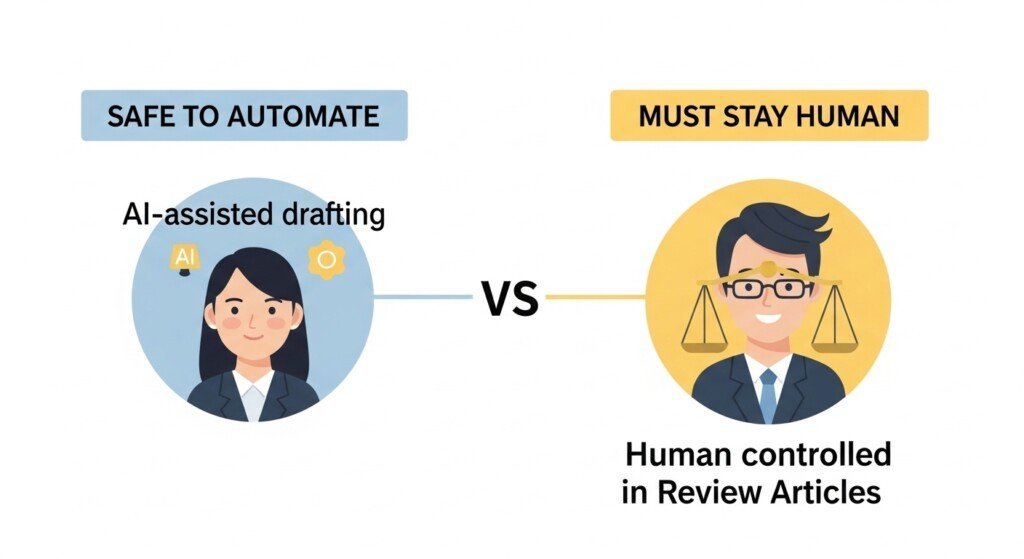
What AI Can Safely Handle
AI tools are effective at:
- Drafting feature explanations
- Expanding benefit descriptions
- Maintaining consistent section structure
- Creating neutral summaries
- Formatting comparison tables
- Rewriting repetitive sections
These are mechanical tasks.
Perfect for AI.
What Must Stay Human (Non-Negotiable)
Humans must always control:
- Final verdicts
- Product ranking order
- “Best for / Not for” judgments
- Downsides emphasis
- Risk disclosures
- Ethical positioning
If AI controls these, trust collapses immediately.
Readers feel it — even if they can’t explain why.
Review Structure That Actually Converts
Before tools, lock the structure.
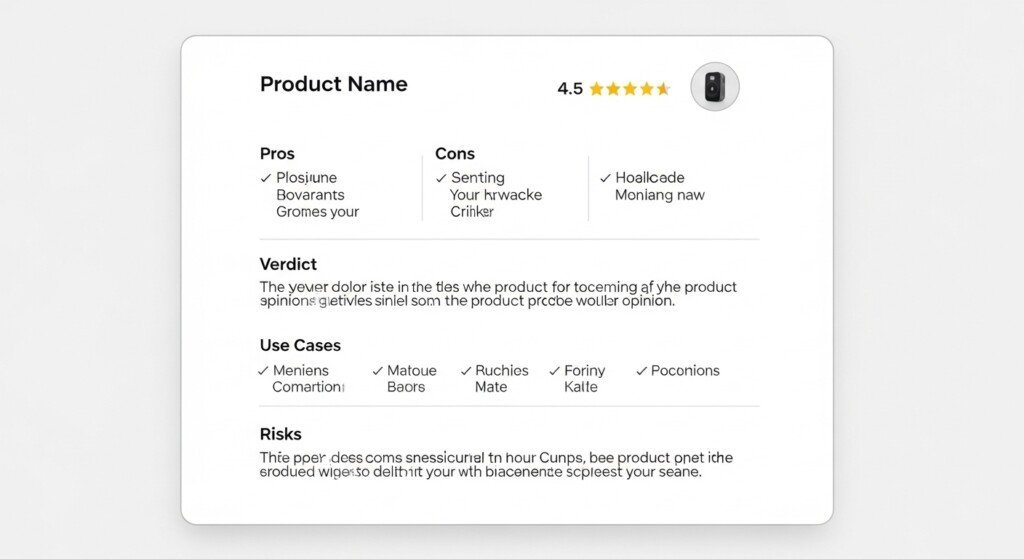
A high-converting review article follows this exact sequence:
- Acknowledge the buying hesitation
- Explain what the product claims to do
- Break down real benefits
- Surface real drawbacks early
- Clarify who the product is not for
- Match the product to specific use cases
- Deliver a clear, conditional verdict
AI can help fill text inside this structure.
AI must never design the structure itself.
Single-Product Reviews: Correct AI Usage
Single-product reviews are where most affiliate blogs die.
Why?
Because bloggers let AI:
- Invent experience
- Soften downsides
- Overstate results
- Write verdicts
Safe AI Use in Product Reviews
AI can help with:
- “What it does” explanations
- Feature breakdowns
- Interface descriptions
- Use-case summaries
- Section-level drafting
This speeds up production without touching trust.
Dangerous AI Use in Reviews
AI must never:
- Claim personal use
- Describe emotions (“I loved it”)
- Promise results
- Write verdict sections
- Compare without criteria
Your verdict must sound like judgment, not synthesis.
That judgment must be human.
Comparison Reviews: Highest Reward, Highest Risk
Comparison review articles are the backbone of affiliate revenue.
They also fail fastest when AI is misused.
Why?
Because comparisons require:
- Relative weighting
- Explicit choices
- Clear winners
- Clear losers
AI avoids decision-making by design.
Correct Use of AI in Comparison Pages
AI tools can:
- Draft individual product sections
- Normalize formatting across tools
- Rewrite repetitive descriptions
- Maintain structural consistency
- Build comparison tables
This saves enormous time.
What Must Stay Human in Comparisons
Humans must decide:
- Ranking order
- Evaluation criteria
- Weighting of features
- Who should not buy
- Final recommendations
If AI ranks products, the article feels generic and unconvincing.
Conversions drop immediately.
Buyer-Intent Review Guides: Safest AI Use Case
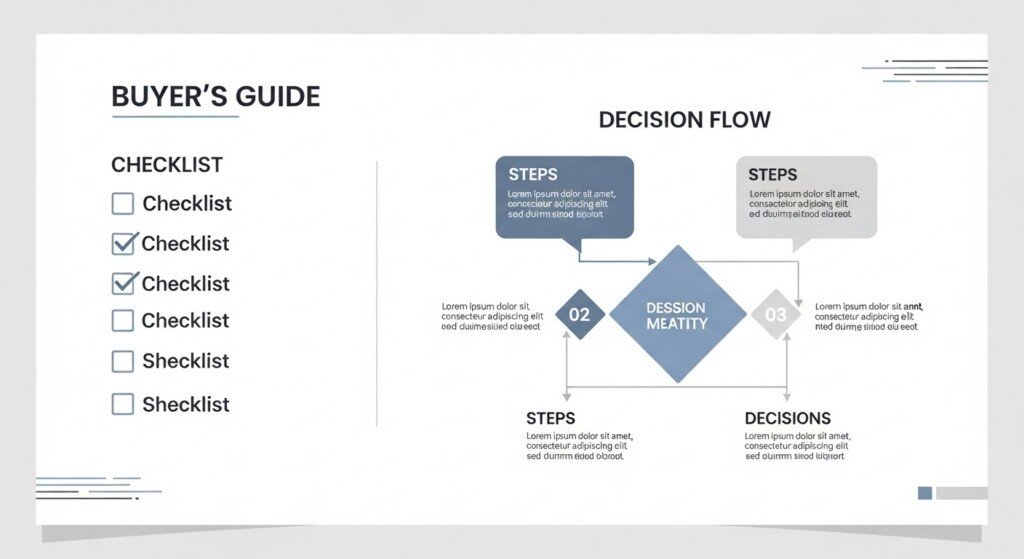
Buyer-intent guides are where AI shines.
These pages:
- Educate
- Reduce skepticism
- Prepare readers to convert
Examples:
- “How to evaluate AI writing tools”
- “What makes a review trustworthy”
- “Common mistakes when choosing X”
These pages support:
- Comparison pages
- Product reviews
- Site-wide trust
AI can be used aggressively here with minimal risk.
Buyer Psychology: Why Most AI Reviews Fail
AI reviews fail because they optimize for neutrality, not decision-making.
Buyers don’t want balance.
They want clarity.
They want:
- Trade-offs
- Conditions
- Context
- Judgment
AI avoids strong positions.
Review content requires them.
This is why AI must never control:
- Verdict language
- Ranking language
- Recommendation language
Trust Signals That Matter in Review Content
Trust is not built by:
- Word count
- Technical language
- Feature lists
Trust is built by:
- Early downsides
- Conditional recommendations
- Audience exclusion
- Clear positioning
- Consistent logic
AI can help draft.
Humans must decide what matters.
Comparison Tables: Where AI Helps and Where It Hurts
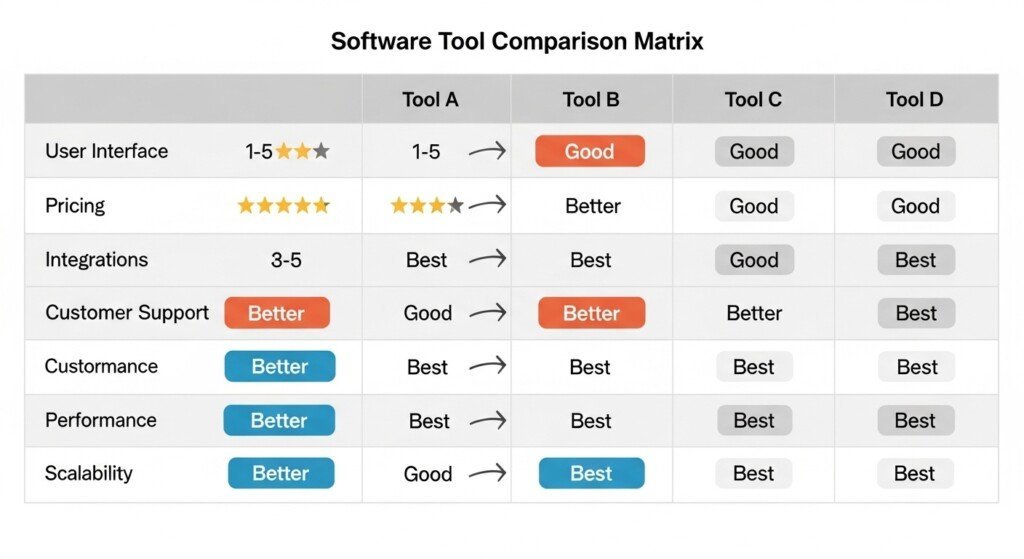
Comparison tables are conversion accelerators only when they reflect real judgment.
Most AI-generated tables fail because they:
- Equalize everything
- Avoid hard negatives
- Use vague labels (“Good”, “Strong”, “Decent”)
That destroys decision clarity.
Correct Use of AI for Comparison Tables
AI tools can safely:
- Generate table structure
- Normalize feature categories
- Populate factual attributes (pricing tiers, integrations, limits)
- Keep formatting consistent
This saves time and reduces human error.
What Must Stay Human in Tables
Humans must decide:
- Which features actually matter
- Weighting (what matters more than what)
- Who loses on which dimension
- Final “Best for X” positioning
If AI assigns “winners,” the table becomes meaningless.
Rule:
AI fills cells. Humans define value.
Review-to-Affiliate Flow (How Reviews Actually Make Money)
Affiliate revenue does not come from isolated reviews.
It comes from controlled reader movement.
A review site that converts consistently uses this flow:
- Buyer-intent educational content
- Comparison review pages
- Individual product reviews
- Contextual exits (email, alternatives, deeper guides)
AI helps you publish faster — but flow design stays human.
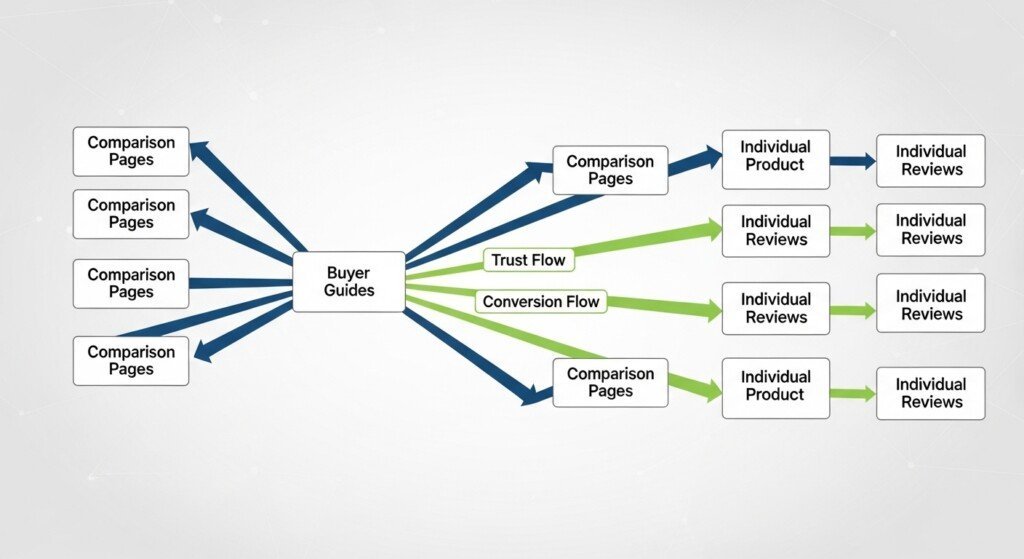
Internal Linking Logic for Review Content (Non-Optional)
Review content without internal linking is dead weight.
Here is the only structure that scales.
1. Buyer-Intent Guides → Comparison Pages
Purpose:
- Move cautious readers closer to purchase
- Transfer trust to money pages
Example logic:
- “How to choose an AI writing tool”
→ “Best AI writing tools compared”
AI can draft the transition sentence.
Humans must choose where it belongs.
2. Comparison Pages → Individual Reviews
Purpose:
- Deepen evaluation
- Capture readers who need more certainty
Every comparison page should link to:
- Full reviews
- Use-case specific breakdowns
This increases:
- Dwell time
- Conversion probability
3. Reviews → Supporting Content (Reverse Trust Loop)
This is where most affiliate blogs fail.
Readers don’t always buy immediately.
Good reviews link back to:
- Buyer guides
- “How it works” explanations
- Risk and limitation articles
This keeps hesitant readers inside your ecosystem.
Updating Review Articles: Where AI Pays You Back Long-Term
Affiliate revenue compounds only when reviews stay current.
Manual updates don’t scale.
AI-assisted updates do.
Safe AI Use for Review Updates
AI can:
- Refresh feature descriptions
- Rewrite outdated sections
- Expand new use cases
- Improve clarity
- Remove repetition
What Must Stay Human During Updates
Humans must verify:
- Pricing claims
- Policy changes
- Product availability
- Risk disclosures
- Regulatory implications
AI makes updates possible at scale — not safe by default.
Review content often exceeds 2,000 words once comparisons, updates, and objections are added, which is why choosing the right AI tools for long articles matters when maintaining reviews at scale.

Why Review Blogs Fail When AI Is Misused
Let’s be direct.
Review sites fail when AI is used to:
- Fake experience
- Avoid judgment
- Hide weaknesses
- Inflate benefits
- Replace decision-making
Common failure symptoms:
- Every product sounds identical
- No clear “who it’s for”
- No strong recommendations
- No visible trade-offs
Readers don’t analyze this consciously.
They feel it — and leave.
For a full breakdown of how review articles fit inside scalable monetization systems, see my guide on AI tools for affiliate blogs, where execution, trust, and revenue flow are mapped end-to-end.
The Correct Role of AI in Review Content
AI is not:
- A reviewer
- A decision-maker
- A trust builder
AI is:
- A drafting engine
- A consistency enforcer
- A fatigue reducer
Used correctly, AI:
- Increases content velocity
- Preserves human judgment
- Extends publishing lifespan
- Improves revenue potential
Used incorrectly, AI:
- Scales mediocrity
- Destroys trust
- Lowers conversions
- Burns domains
When used correctly, AI should support drafting, structure, and consistency — not replace judgment or decision-making.
Choosing the right platform matters because not every AI writer is suitable for long-form reviews, comparisons, or buyer-intent content.
For a broader breakdown of platforms designed specifically for blogging workflows, see my guide on Best AI writing tools for bloggers, which explains where different tools fit across reviews, comparisons, and content scaling.
Final Verdict: Best AI Writing Tools for Review Articles
AI tools do not replace reviewers.
They replace friction.
If you:
- Use AI for drafting
- Keep judgment human
- Protect verdicts
- Control structure
- Maintain internal linking
AI becomes a conversion multiplier.
If you:
- Let AI decide
- Avoid real trade-offs
- Write neutral verdicts
- Hide downsides
AI becomes a trust destroyer.
Review content is not about writing faster.
It is about earning belief at scale.
AI helps only when humans stay in control.
FAQ
1. Can AI writing tools be used for affiliate review articles without hurting conversions?
Yes, if AI is limited to drafting and structure. Conversions drop only when AI controls verdicts, rankings, or experiential claims. Human judgment must own recommendations.
2. Which parts of a review article should never be written by AI?
AI should never write:
1. Final verdicts
2. Product rankings
3. Personal experience claims
4. Risk disclosures
These elements determine trust and conversion and must stay human-written.
3. Are AI-generated comparison tables reliable for buyers?
Only when humans define the evaluation criteria and weighting. AI can format tables and fill factual data, but humans must decide what actually matters to buyers.
4. Do AI-assisted reviews rank and perform as well as human-written reviews?
Yes, when AI is used for execution and humans handle intent alignment, judgment, and internal linking. Raw AI reviews perform poorly; hybrid reviews perform best.
5. What is the biggest mistake bloggers make using AI for affiliate reviews?
Letting AI sound confident without accountability. This results in generic praise, hidden downsides, and weak differentiation—which kills trust and conversions fast.
Disclaimer
Some links on this page may be affiliate links.
If you click and purchase, I may earn a small commission at no extra cost to you.
I only recommend tools I genuinely use or believe are useful for bloggers.
This helps support the site and keep content free.