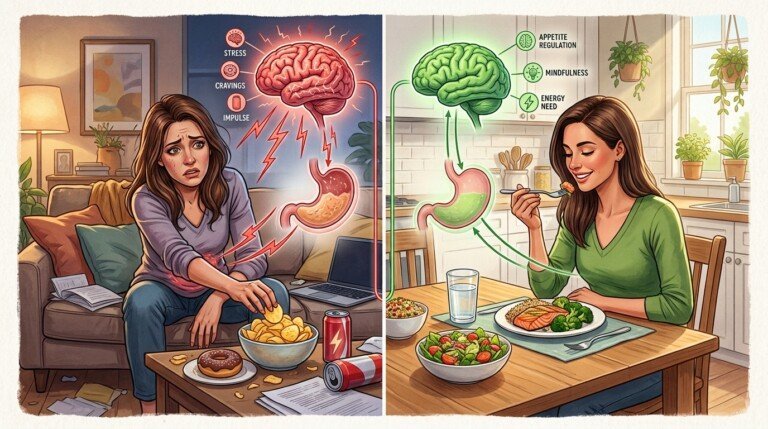
Myth: Eating Late at Night Causes Weight Gain
There is a familiar rule in the weight-loss world: stop eating after a certain hour or you will gain weight.
For some people, that rule feels convincing because late-night eating often gets associated with snacks, desserts, takeout, television, and mindless eating. Others have heard that the body “shuts down” at night and stores everything eaten in the evening as fat.
But the body does not suddenly switch from calorie-burning mode to fat-storage mode when the clock reaches a particular hour.
So, does eating late at night cause weight gain?
Not by itself.
The more important question is what that late-night eating adds to your overall eating pattern. If eating at night consistently causes you to consume more total energy than you need, it can contribute to weight gain. If a planned evening meal simply fits into your overall intake, the fact that it was eaten at 9 p.m. does not automatically turn it into body fat.
There is, however, an important nuance.
Meal timing may matter for reasons beyond a simple “late food equals fat” claim. Circadian rhythms influence many aspects of human physiology, and eating very close to bedtime can also affect digestion or sleep for some people. Your uploaded keyword research specifically identifies circadian rhythm, meal timing evidence, meal frequency, and practical guidance as important areas to address while avoiding a deep dive into meal-timing metabolism science.
That distinction makes this myth worth examining carefully.
The answer is not “timing never matters.”
The answer is that clock time alone does not determine whether you gain body fat.
Quick Answer: Does Eating Late at Night Actually Cause Weight Gain?
Does eating late at night cause weight gain? Not automatically. Weight gain is primarily influenced by sustained overall energy intake relative to energy expenditure, rather than a specific hour at which food is eaten. However, late-night eating can indirectly contribute to weight gain when it adds extra calories, encourages highly processed snacks, or becomes part of a pattern of overeating.
Eating before bed may also be uncomfortable for some people or interfere with sleep, depending on the meal and the individual.
So the better rule is not “never eat after 8 p.m.”
It is to pay attention to what you eat, how much you eat, why you are eating, and how that timing fits your sleep and overall routine.
Does Eating Late at Night Actually Cause Weight Gain?
The first thing to understand is that the clock does not contain a fat-storage switch.
Your body is continuously using and storing energy throughout the day and night. You do not suddenly stop metabolizing food because it is dark outside.
If you eat dinner at 6 p.m., your body processes that food.
If you eat the same dinner at 9 p.m., your body still processes it.
The difference in clock time does not automatically determine whether those calories become body fat.
This is why total calorie intake remains such an important part of the conversation.
Imagine two people who both need roughly the same amount of energy each day.
Person A finishes eating at 7 p.m. but consumes more food than their body needs throughout the day.
Person B eats a balanced dinner at 9 p.m. but keeps their overall intake appropriate.
The fact that Person A stopped eating earlier does not guarantee better weight control.
The timing rule has been followed, but the broader energy balance has not.
Person B technically violated the “no food after 8 p.m.” rule, yet that does not mean the late meal automatically caused fat gain.
This is why focusing exclusively on the clock can distract from the variables that matter more.
What Does the Scientific Evidence Actually Say About This Myth?
The evidence around meal timing is more complicated than the popular rule suggests.
Research has explored whether the timing of food intake may influence body weight, metabolic health, appetite, and other outcomes. Circadian biology is relevant because the body’s internal clock coordinates many physiological processes throughout the day.
However, that does not support the simplistic conclusion that eating late at night automatically causes fat gain.
The key distinction is between meal timing as one component of metabolic physiology and a specific evening eating time being inherently fattening.
Your source material specifically separates these issues. The broader meal-timing article is intended to cover questions such as whether meal timing affects metabolism, whether eating late slows metabolism, meal frequency, intermittent fasting, and what research says about meal timing.
This article has a narrower job.
It addresses the myth.
For weight management, overall calorie intake remains fundamental. If late-night eating becomes an additional eating occasion that repeatedly pushes total intake upward, weight gain can follow.
But if an evening meal simply forms part of the person’s normal daily intake, its late timing alone does not make the meal uniquely fattening.
That distinction prevents two opposite mistakes.
The first is believing that eating late automatically causes fat gain.
The second is assuming meal timing can never have any effect on health or eating behavior.
Both are oversimplifications.
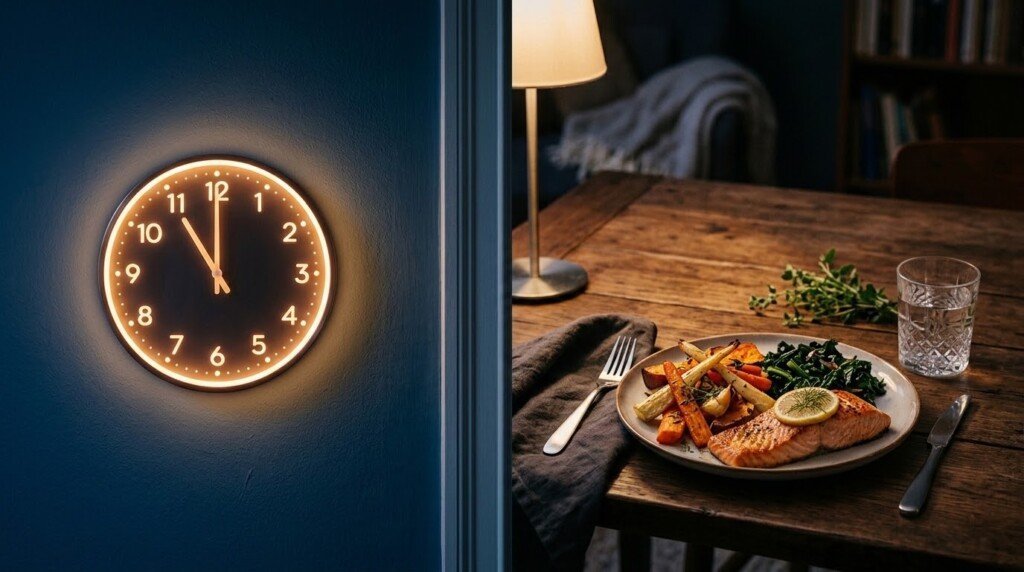
Does the Body’s Metabolism Really Change Enough at Night to Matter?
Your metabolism does not switch off at night.
You continue breathing, circulating blood, maintaining body temperature, repairing tissues, and performing countless cellular processes while asleep.
All of these require energy.
The idea that food eaten at night is automatically stored as fat because your metabolism has stopped is therefore misleading.
There are, however, daily biological rhythms.
Your body has a circadian system that helps coordinate sleep, wakefulness, hormones, temperature, digestion, and other physiological processes. This means the body is not completely indifferent to when activities occur.
But translating that fact into “late-night food makes you fat” is a major leap.
It is also why this topic should not be reduced to one laboratory mechanism.
Real people eat different foods, consume different portions, sleep at different times, exercise at different times, and have very different schedules.
A person working a night shift cannot reasonably follow the same meal clock as someone who wakes at 6 a.m. and goes to bed at 10 p.m.
A rigid cutoff time ignores that reality.
The more useful approach is to understand timing within the context of the person’s overall routine.
What Actually Contributes to Weight Gain, Regardless of Meal Timing?
The biggest issue with late-night eating is often not the clock.
It is what happens around the clock.
Late evening can be a vulnerable period for some people because structured daytime eating has ended.
The kitchen is nearby.
The television is on.
Work is finished.
Stress from the day may finally catch up.
A person may reach for snacks without being physically hungry.
A small snack can become several.
One evening may not matter.
A repeated pattern can.
Suppose someone eats a normal breakfast, lunch, and dinner, then adds 500 calories of snacks every night while believing those calories “do not count because it is late.”
That pattern can contribute to weight gain.
But the cause is not the magical fat-storage effect of nighttime.
The issue is the additional energy.
This is why a person who wants to lose weight should pay attention to total intake rather than simply imposing an arbitrary eating cutoff.
A late dinner can be completely compatible with weight management.
An unnecessary late-night grazing habit can make weight loss more difficult.
Those two statements can both be true.
Are There Legitimate Reasons to Avoid Eating Right Before Bed?
Yes, but they are not necessarily about weight gain.
Some people simply feel better when they finish eating a few hours before sleep.
A large meal shortly before lying down can feel uncomfortable.
Some people experience reflux or indigestion.
Others may notice that heavy or highly stimulating foods interfere with their ability to settle down for sleep.
This is where the conversation needs to move beyond the weight-loss myth.
Avoiding food immediately before bed can be a useful personal habit if it improves comfort or sleep.
That does not mean eating before bed automatically causes fat gain.

Can Eating Late Affect Sleep Quality or Digestion, Even Without Causing Weight Gain?
Yes, particularly when the meal is large, heavy, spicy, or otherwise uncomfortable for the individual. Because sleep and weight management are closely connected, people dealing with recurring nighttime eating and sleep problems should consider the broader relationship between their evening routine and sleep. A deeper discussion of this topic belongs in Sleep and Weight Loss.
The practical point is simple.
If you eat at 9 p.m. and sleep comfortably at 11 p.m., there is no universal reason to panic about the clock.
If you eat a huge meal at 10:30 p.m. and immediately lie down, then spend the night uncomfortable, reflux-prone, or unable to sleep well, changing the timing may make sense.
The reason for changing it is comfort and sleep quality.
Not because the meal suddenly becomes fattening at night.
What Types of Late-Night Food Choices Are More Likely to Matter, and Why?
This is where the myth contains a small piece of useful information that often gets distorted.
Late-night eating can become a problem when it consistently involves highly palatable, energy-dense foods.
Think about the typical evening snack pattern.
Cookies.
Ice cream.
Chips.
Chocolate.
Sugary drinks.
Takeout.
Large bowls of cereal.
These foods can be easy to consume quickly and may provide substantial energy without creating the same level of fullness as a balanced meal.
Again, the issue is not that these foods become uniquely fattening after dark.
A cookie does not undergo a transformation at midnight.
The issue is that repeated consumption can increase total energy intake.
Late-night eating can also be more distracted.
You may eat while watching a show.
You may eat directly from the package.
You may not notice how much you have consumed.
You may not even have planned to eat.
This is why the context surrounding nighttime eating can matter more than the actual time.
A planned evening snack that fits your overall intake is very different from an unplanned two-hour grazing session.
The clock is the least interesting part of that comparison.
What If You Are Genuinely Hungry at Night?
This is where rigid diet rules can create unnecessary problems.
If you are genuinely hungry at night, automatically forcing yourself to go to bed hungry may not be the best solution.
Instead, ask why the hunger is happening.
Did you eat enough during the day?
Was dinner too small?
Did you exercise more than usual?
Are you following an unnecessarily restrictive eating pattern?
Are you confusing thirst, boredom, stress, or habit with physical hunger?
These questions can tell you much more than the time on the clock.
For someone who regularly becomes extremely hungry at night, moving more food into the evening may actually make their routine easier to maintain.
There is no universal requirement to consume most of your food early in the day simply because weight-loss culture says so.
The goal is a sustainable eating pattern that works with your schedule and appetite.
Does Meal Timing Matter for Weight Loss at All?
It can matter as part of the bigger picture.
Meal timing can influence eating opportunities, appetite patterns, daily routines, and potentially how food intake interacts with circadian biology.
But that is different from saying that one specific eating time determines weight gain.
This distinction is important because people often confuse timing effects with energy effects.
If someone moves dinner later but keeps their total daily intake the same, that is a different situation from moving dinner later and adding an additional high-calorie meal.
The first changes timing.
The second changes both timing and total intake.
If weight changes, you cannot automatically attribute the outcome to timing alone.
This is why meal timing deserves nuance rather than another absolute rule.
For readers interested in the broader metabolic question, Meal Timing and Metabolism is the more appropriate place to examine circadian rhythms, meal frequency, and the research surrounding timing. The source plan specifically assigns those deeper questions to that article rather than this myth-focused post.
What Should You Do If You Usually Eat Dinner Late?
Do not panic.
Start by examining the pattern.
If your work schedule means dinner happens at 9 p.m., but your meals are balanced and your overall intake supports your goals, there may be no reason to force dinner into an earlier time simply because of a weight-loss rule.
Instead, look at what is actually happening.
Are you eating because you are hungry?
Are you eating because you finally have time to relax?
Are you adding snacks afterward?
Are your portions reasonable?
Are you sleeping comfortably?
Does the meal fit your daily intake?
These questions are more useful than asking whether 9 p.m. is “too late.”
For some people, an earlier dinner may work better.
For others, a later dinner may be perfectly practical.
The best eating schedule is one that supports nutrition, appetite, sleep, and long-term consistency.

A Simple Reality Check for Late-Night Eating
Before blaming your evening meal for stalled weight loss, look at five things.
First, check total intake. Are nighttime foods adding substantial energy beyond what you normally need?
Second, check food quality. Are your evening choices mostly satisfying meals, or are they repeated snacks and highly processed foods?
Third, check hunger. Are you genuinely hungry, or is nighttime eating mainly driven by habit, boredom, or stress?
Fourth, check sleep. Does eating close to bed make you uncomfortable or interfere with your sleep?
Fifth, check consistency. Is this an occasional late meal, or is it happening every night?
These questions help turn an emotionally charged weight-loss rule into an objective evaluation.
Key Takeaways
Eating late at night is not automatically responsible for weight gain.
The most important factor remains the overall energy balance created by your eating pattern and activity level. A late dinner can fit into a healthy weight-loss routine when it is part of an appropriate overall intake.
The bigger concern is what late-night eating may represent.
For some people, it is an additional eating occasion that creates a calorie surplus.
For others, it is simply their normal dinner because of work, family responsibilities, or their natural schedule.
There can also be legitimate reasons to avoid large meals immediately before bed, particularly if they cause digestive discomfort or interfere with sleep.
That does not turn late eating into a weight-gain mechanism.
It simply means meal timing can influence other aspects of health and daily comfort.
The source material for this content cluster specifically emphasizes circadian rhythm, meal timing evidence, meal frequency, and practical guidance while keeping the detailed meal-timing and sleep science in their dedicated articles.
Frequently Asked Questions
1. Does Eating Late at Night Cause Weight Gain?
Not automatically. Late-night eating can contribute to weight gain if it consistently adds excess calories to your overall diet, but the clock time itself does not cause food to automatically become body fat.
2. Is It Bad to Eat Right Before Bed?
Not necessarily. Some people tolerate food before bed without problems, while others experience indigestion, reflux, discomfort, or poorer sleep. A large meal immediately before lying down may be particularly uncomfortable for some people.
3. Does Meal Timing Matter for Weight Loss?
Meal timing can influence eating behavior and may interact with circadian biology, but overall calorie intake remains a major factor in weight management. There is no universal hour after which eating automatically prevents fat loss.
4. Why Do I Gain Weight When I Eat Late at Night?
The increase may be related to consuming additional calories, salty foods, carbohydrate-related water changes, digestive contents, or normal fluctuations in body weight. A single late meal does not automatically represent newly gained body fat.
5. Should I Stop Eating After 8 P.M. to Lose Weight?
There is no universal requirement to stop eating at 8 p.m. A more useful strategy is to manage your overall intake, choose satisfying foods, and arrange meals around your hunger, schedule, sleep, and long-term ability to stay consistent.
Conclusion
The idea that you must stop eating at a particular hour to prevent weight gain sounds simple, but human metabolism is not governed by an arbitrary clock cutoff.
Does eating late at night cause weight gain? Not by itself.
A late meal can contribute to weight gain when it becomes an additional source of excess energy. It can also be worth changing if large evening meals interfere with digestion or sleep. But those are very different explanations from the claim that food eaten after a certain hour automatically turns into fat.
If your schedule requires a late dinner, you do not need to feel that you have already ruined your weight-loss efforts.
Look at the whole pattern.
Look at what you eat.
Look at how much you eat.
Look at why you eat.
Look at how you sleep afterward.
That is where the useful information is.
The clock matters far less than the habits surrounding it.
Disclaimer:
This post may contain affiliate links. If you purchase through them, we may earn a small commission at no extra cost to you. Also, this content is for informational purposes only and does not substitute professional medical advice.
Ready to Start Your Journey?
Use our free 7-in-1 Weight Loss Toolkit to calculate your numbers and build your plan in minutes.
Open Free Tools →