
Are AI Writing Tools Worth It for Bloggers?
If you’re asking “are AI writing tools worth it?”, you’re already past the beginner stage.
Hobby bloggers don’t ask this question.
People building real sites do.
In 2026, blogging is no longer about “writing well.”
It’s about output economics.
How much content you publish
How fast you publish it
How consistently you publish
How easily you update it
And how efficiently that content turns into traffic and revenue
AI writing tools are not a creativity question.
They are a business decision.
If you’re still evaluating the overall landscape, start with my full breakdown of the best AI writing tools for bloggers to understand which platforms actually fit different blogging goals.
This article answers one thing only:
Do AI writing tools make financial sense for bloggers — or are they just another recurring expense?
If you’re still deciding which platforms bloggers actually use, this article works as a business and ROI breakdown.
For a complete overview of features, use cases, and tool categories, start with my main guide on the best AI writing tools for bloggers.
No hype.
No tools list.
No SEO theory.
Just the math, the leverage, and the reality.
The Real Cost of Blogging (That Most Bloggers Ignore)
Most bloggers calculate cost wrong.
They look at:
- Tool price
- Subscription fees
- Monthly plans
They ignore the real cost:
Time
Time is the most expensive resource in blogging.
Let’s break this down honestly.
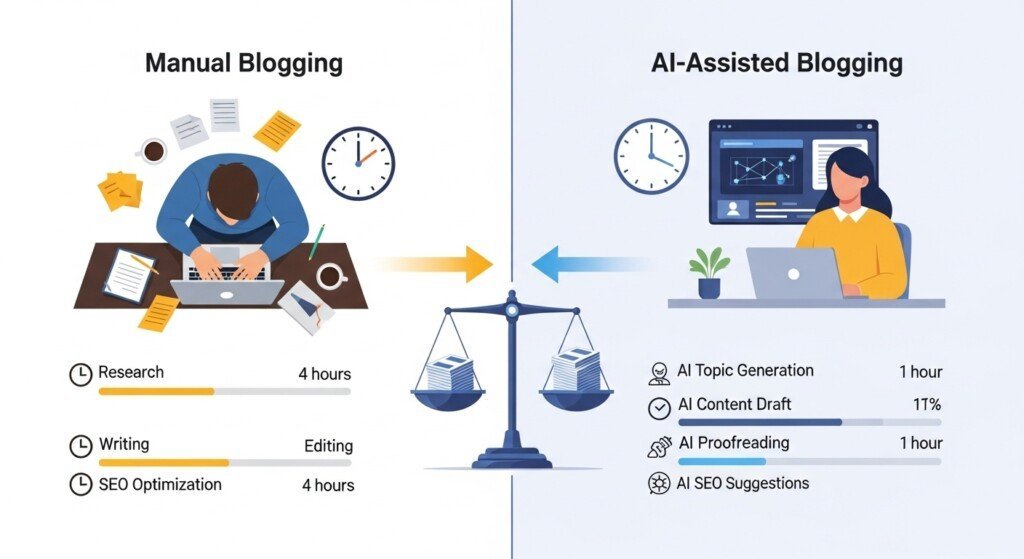
Manual Blogging Time (Per Post)
A realistic breakdown for one decent blog post:
- Topic research: 30–45 minutes
- Outline creation: 20–30 minutes
- Writing 1,500–2,000 words: 2.5–4 hours
- Editing + rewriting: 45–60 minutes
- Formatting + publishing: 20–30 minutes
Total:
➡ 4.5 to 6.5 hours per post
That’s not slow. That’s normal.
Now multiply that by scale.
Why Output Volume Is the Real Growth Lever
Traffic does not come from one “perfect” post.
It comes from:
- Content clusters
- Supporting articles
- Internal linking
- Updates
- Consistency
A blog publishing:
- 2 posts/month
vs - 12 posts/month
Is not competing in the same universe.
Manual Writing Caps Output
Most solo bloggers hit a hard ceiling at:
- 4–6 posts per month
Not because they’re lazy.
Because time runs out.
This is where ROI starts.
What AI Writing Tools Actually Change (In Practice)
AI tools don’t magically “make money.”
They change three economics of blogging:
- Time per post
- Content velocity
- Scalability
Let’s break each one down.
1. Time Savings: The Only Metric That Matters
Used correctly, AI writing tools reduce:
- Drafting time
- Rewriting time
- Structural friction
- Blank-page delay
They do not remove:
- Editing
- Judgment
- Strategy
- Decision-making
That’s important.
Realistic AI-Assisted Time (Per Post)
With a sane workflow:
- Topic + outline: 20–30 minutes
- AI drafting (section by section): 20–30 minutes
- Human refinement + expansion: 45–60 minutes
- Final polish + publish: 20–30 minutes
Total:
➡ 1.75 to 2.5 hours per post
That’s not marketing fluff.
That’s what actually happens when AI is used correctly.
Time Savings Math (No Bullshit)
Let’s be conservative.
Manual:
- 5.5 hours per post
AI-assisted:
- 2.25 hours per post
Time saved per post:
➡ 3.25 hours
Now scale.
12 posts per month:
- 39 hours saved
20 posts per month:
- 65 hours saved
That’s not “nice to have.”
That’s a second job worth of time.
The ROI Equation Most Bloggers Avoid
Now let’s put numbers on this.
Even if you value your time very low:
- $10/hour (which is extremely conservative)
40 hours saved = $400/month
Most AI tools cost:
- $20–$60/month
That’s not an expense.
That’s time arbitrage.
If you want to see how this math changes across tiers, my comparison of free vs paid AI writing tools breaks down where free plans stop scaling and when paying actually makes sense.
You’re paying $40 to reclaim $400 worth of labor.
That alone answers:
Are AI writing tools worth it?
For anyone publishing seriously: yes, mathematically.
For bloggers who want to minimize costs without sacrificing output, comparing budget AI writing tools helps clarify when free options stop being viable and paid tools start delivering real ROI.
2. Content Velocity = Traffic Leverage
Traffic does not grow linearly.
Publishing more content doesn’t double traffic.
It multiplies opportunities.
Each post is:
- Another keyword
- Another internal link
- Another entry point
- Another update target
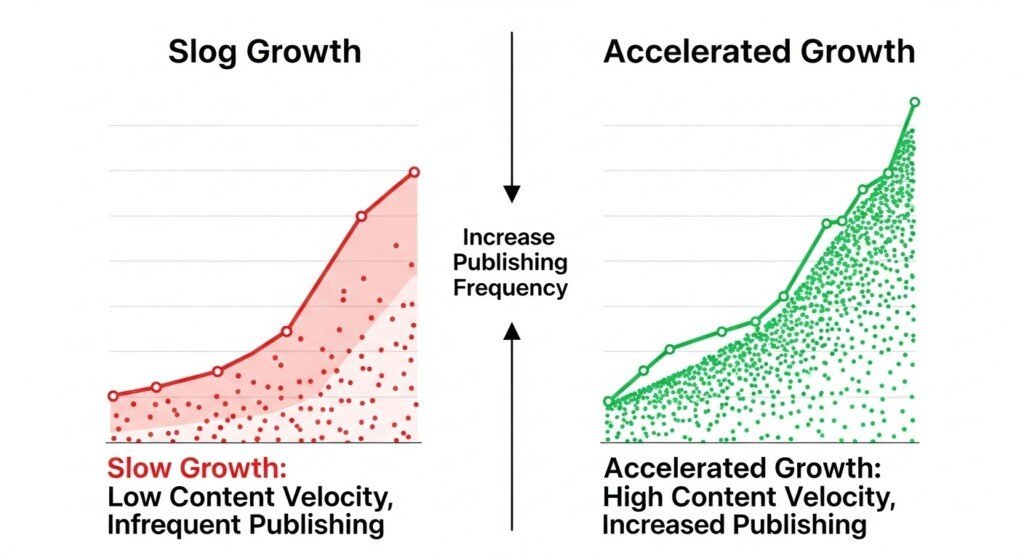
Manual Blogging Reality
- 4 posts/month = 48 posts/year
AI-Assisted Reality
- 12–20 posts/month = 144–240 posts/year
That difference is massive.
Not because of AI quality —
but because of surface area.
Why Content Velocity Beats “Perfect Writing”
Google does not reward effort.
It rewards:
- Coverage
- Depth
- Internal relationships
- Consistency over time
A site with:
- 200 solid posts
will beat - a site with 30 “perfect” posts
Almost every time.
AI tools make coverage feasible for solo bloggers.
3. Scaling Impact (Where ROI Explodes)
Here’s where most bloggers finally “get it.”
AI tools are not about today’s post.
They are about future leverage.
Updating Old Content
Without AI:
- Updating 50 posts = nightmare
With AI:
- Updating 50 posts = project
That alone affects:
- Rankings
- Stability
- Recovery after updates
Expanding Content Clusters
Without AI:
- Cluster strategy stays on paper
With AI:
- Supporting articles actually get published
Monetization Scaling
Affiliate sites don’t earn from 10 posts.
They earn from hundreds.
AI tools turn:
- “I should write this”
into - “This is live”
That’s real ROI.

When AI Writing Tools Are NOT Worth It
Now the honesty part.
AI writing tools are not worth it if:
- You publish less than 2–3 posts per month
- You don’t plan to scale content
- You write purely for fun
- You don’t monetize
- You enjoy slow, manual writing
- You don’t care about growth timelines
In those cases:
- Free tools or manual writing are fine
But that’s not most people reading this.
The Hidden ROI: Mental Bandwidth
This is never talked about, but it matters.
Manual blogging drains:
- Focus
- Energy
- Motivation
AI tools remove:
- Blank-page friction
- Repetitive writing
- Mechanical expansion work
That keeps bloggers consistent.
Consistency beats motivation.
And consistency is where money comes from.
The Business Case (Summarized)
AI writing tools are worth it when:
- You treat blogging as an asset
- You care about scale
- You want faster feedback loops
- You plan to monetize
- You value time over ideology
They are not shortcuts.
They are leverage.
Revenue Leverage: Where AI Tools Actually Pay You Back
Most bloggers think ROI comes from better writing.
That’s wrong.
ROI comes from content leverage.
AI writing tools don’t make a single post earn more.
They make more posts earn at the same time.
That difference matters.
How Blogging Revenue Actually Works
Let’s be brutally realistic.
Most blog posts earn:
- $0
- or very little
A small percentage earn:
- affiliate commissions
- display ad revenue
- email subscribers
- authority traffic
Revenue is portfolio-based, not post-based.
That means:
- More posts = more chances
- More coverage = more entry points
- More internal links = stronger money pages
AI tools increase the size of your portfolio faster.
Affiliate Blogging: The Clearest ROI Case
Affiliate blogs are the easiest example.
Manual Affiliate Scaling (Reality)
Without AI, most bloggers manage:
- 2–4 affiliate posts per month
After 6 months:
- 12–24 affiliate posts live
That’s rarely enough to see meaningful income.
AI-Assisted Affiliate Scaling
With AI-assisted writing:
- 10–20 affiliate posts per month is realistic
After 6 months:
- 60–120 affiliate posts live
Now probability changes.
Not every post converts —
but some will.
This is where AI tools become revenue multipliers.
For monetized sites, this becomes clearer when you look at how AI tools for affiliate marketing are used to scale buyer-intent content without burning out.
That’s why this page supports AI tools for affiliate marketing — because ROI is clearest when monetization is involved.
Break-Even Math (No Optimism Required)
Let’s remove all hype and optimism.
Assume:
- AI tool cost: $39/month
- Affiliate commission per sale: $40
- Conversion rate: mediocre
- Traffic: modest
Break-even target:
➡ 1 sale per month
That’s it.
If AI helps you publish:
- 3–4 extra monetized posts/month
Your odds of hitting one sale increase massively.
Anything beyond that is profit.
That’s why asking “are AI writing tools worth it?” without revenue math is pointless.
Content Velocity Compounds (Quietly)
Here’s something most bloggers miss.
Content velocity compounds without looking dramatic month to month.
Month 1:
- 10 posts → nothing happens
Month 3:
- 30 posts → impressions start
Month 6:
- 80 posts → traffic clusters form
Month 12:
- 150+ posts → authority signals appear
Manual blogging struggles to reach this stage.
AI-assisted blogging reaches it before burnout hits.
That timing difference is ROI.
Why Cheap AI Tools Sometimes Make More Sense
This is important.
More expensive tools are not always better ROI.
Early-stage blogs benefit more from:
- “Good enough” drafts
- Faster output
- Lower commitment
That’s why this page supports:
👉 budget AI writing tools
If your blog:
- Has low traffic
- Is still validating niches
- Is building initial clusters
Then:
- Cheap or mid-tier tools are often smarter
High-end tools only make sense when:
- You publish frequently
- You monetize
- You care about long-form coherence
ROI is context-dependent.
When Paying for AI Tools Is a Bad Decision
Let’s be honest again.
AI tools are a waste of money if:
- You don’t publish consistently
- You buy tools but don’t use them
- You expect AI to replace thinking
- You avoid editing
- You jump tools every month
- You don’t finish posts
In those cases:
- The problem is not the tool
- It’s discipline and workflow
AI tools magnify behavior — good or bad.
The Opportunity Cost Nobody Talks About
Here’s the real danger.
Not using AI tools doesn’t save money.
It costs opportunity.
Every month you delay scaling content:
- Competitors publish more
- SERPs fill up
- Authority consolidates
- Late entry becomes harder
AI tools don’t just save time.
They buy earlier market entry.
That is invisible ROI — but very real.
The “One Tool Only” Question
Many bloggers ask:
“Can I just use one AI tool?”
From an ROI perspective:
- Yes, at the beginning
One solid drafting tool + human editing is enough.
Multiple tools only matter when:
- You scale heavily
- You manage updates
- You rewrite old content
- You handle multiple niches
If budget is tight:
- One tool used consistently beats five unused tools
Long-Term Business Impact (The Real Answer)
Let’s zoom out.
Blogs that succeed in 2026 have:
- Large content libraries
- Strong internal linking
- Monetized clusters
- Update cycles
- Editorial systems
Manual-only blogs rarely reach this stage.
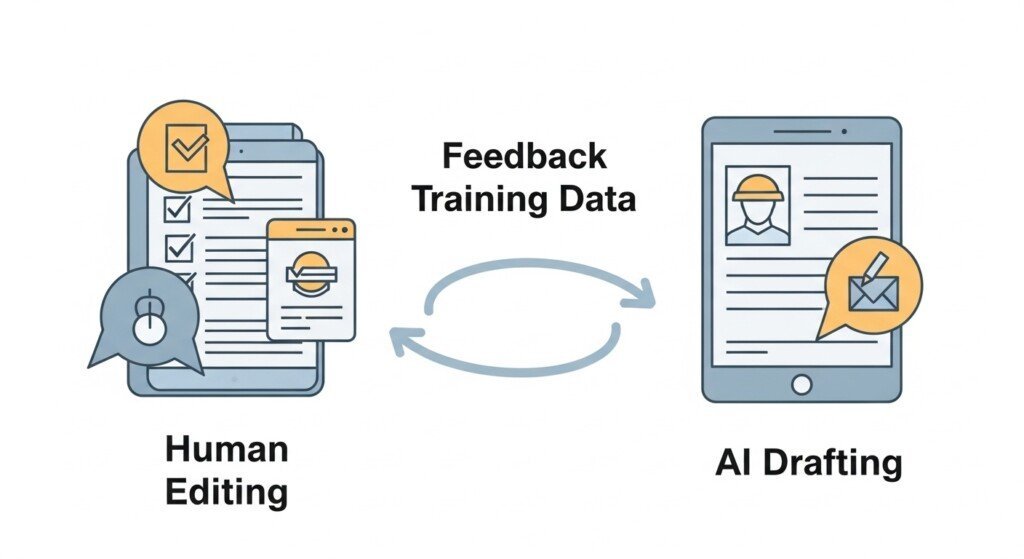
AI-assisted blogs do — if humans stay in control.
AI tools don’t replace bloggers.
They replace friction.
And friction is what kills most blogs.
Final Verdict: Are AI Writing Tools Worth It for Bloggers?
Here’s the direct answer.
AI writing tools are worth it if and only if:
- You publish consistently
- You aim to scale content
- You want faster growth cycles
- You monetize (or plan to)
- You value time over ideology
They are not magic.
They are leverage.
Used correctly:
- They save time
- Increase output
- Improve consistency
- Accelerate monetization
- Reduce burnout
Used poorly:
- They publish garbage faster
The tool doesn’t decide ROI.
The workflow does.
Bottom Line
If blogging is a hobby:
- AI tools are optional
If blogging is a business:
- AI tools are infrastructure
The question “are AI writing tools worth it?” is not philosophical.
It’s operational.
And for serious bloggers in 2026:
Yes — they’re worth it.
FAQ
1. Are AI writing tools worth it for beginner bloggers?
Yes, but only if the beginner is committed to publishing consistently. AI writing tools help beginners overcome slow writing speed and content fatigue, but they won’t fix inconsistency or lack of effort. For casual bloggers, free tools are enough. For serious beginners, even a low-cost paid tool can improve output and learning speed.
2. Do AI writing tools actually save time for bloggers?
Yes. AI writing tools reduce time spent on drafting, rewriting, and expanding content. Most bloggers save 60–80% of writing time per post. However, they do not eliminate the need for editing, structure decisions, or quality control. Time savings come from removing repetitive manual work, not from skipping thinking.
3. Can AI writing tools help bloggers make more money?
Indirectly, yes. AI writing tools don’t increase revenue per article, but they increase the number of monetizable pages a blogger can publish. More content means more traffic entry points, more affiliate opportunities, and better internal linking — which increases overall earning potential.
4. Are paid AI writing tools better than free ones for ROI?
Paid AI writing tools usually offer better long-form handling, consistency, and scalability, which improves ROI for bloggers publishing frequently. Free tools are useful for testing and light use, but they often hit limits quickly and increase editing workload. ROI depends on publishing volume and monetization goals.
5. When are AI writing tools NOT worth the money?
AI writing tools are not worth it if a blogger publishes rarely, doesn’t monetize, skips editing, or buys tools without using them consistently. AI tools amplify existing habits — they reward disciplined workflows and punish lazy ones. Without consistency, even the best tool becomes wasted cost.
Disclaimer
Some links on this page may be affiliate links.
If you click and purchase, I may earn a small commission at no extra cost to you.
I only recommend tools I genuinely use or believe are useful for bloggers.
This helps support the site and keep content free.