Foods That Help Erectile Dysfunction
Erectile dysfunction is often treated like a problem that needs a quick fix. Search online and you will quickly find claims about one food that supposedly works like Viagra, a drink that supposedly produces an instant erection, or a vitamin that promises better blood flow overnight. The reality is much less dramatic, but it is also more useful.
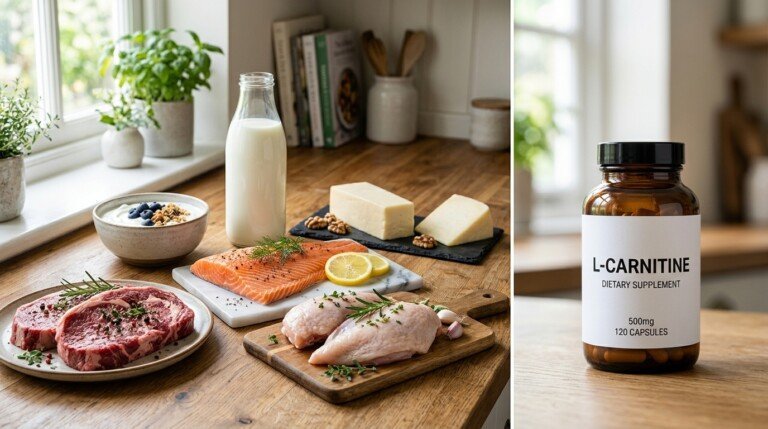
Foods That Help Erectile Dysfunction are generally the foods that support the same systems erections depend on, particularly healthy blood vessels, circulation, metabolic health, and endothelial function. That does not mean eating a particular food before sex will suddenly create a stronger erection. It means that what you regularly eat can either support or work against the cardiovascular system that makes normal erections possible.
Research increasingly points toward overall dietary patterns rather than one magical ingredient. A 2024 systematic review and meta-analysis covering 14 studies and more than 27,000 participants found associations between healthier dietary patterns, including plant-rich and Mediterranean-style diets, and lower erectile dysfunction risk. (PubMed)
That distinction matters. Food can be part of an erectile-health strategy, but it should not be presented as a replacement for medical evaluation when erection problems are persistent.
What foods are actually linked to better erections?
The strongest way to think about food and erections is through blood-vessel health rather than sexual stimulation.
An erection depends on a coordinated process. Sexual stimulation activates nerve signals, blood vessels in the penis relax, blood flows into erectile tissue, and the body temporarily restricts the outflow of blood so firmness can develop. If the vascular system is not working efficiently, getting or maintaining an erection can become more difficult.
That is why a diet that supports cardiovascular health can also support erectile function.
A large observational study of more than 21,000 men found that healthier dietary patterns were associated with a lower risk of developing erectile dysfunction. Men with higher Mediterranean Diet scores had a lower risk of incident ED, including men younger than 60. (PubMed)
This does not prove that a specific meal prevents ED. It does, however, reinforce an important idea: erectile health is closely connected to overall vascular health.
Some foods are particularly interesting because they contain compounds involved in endothelial function, antioxidant activity, or nitric oxide pathways.

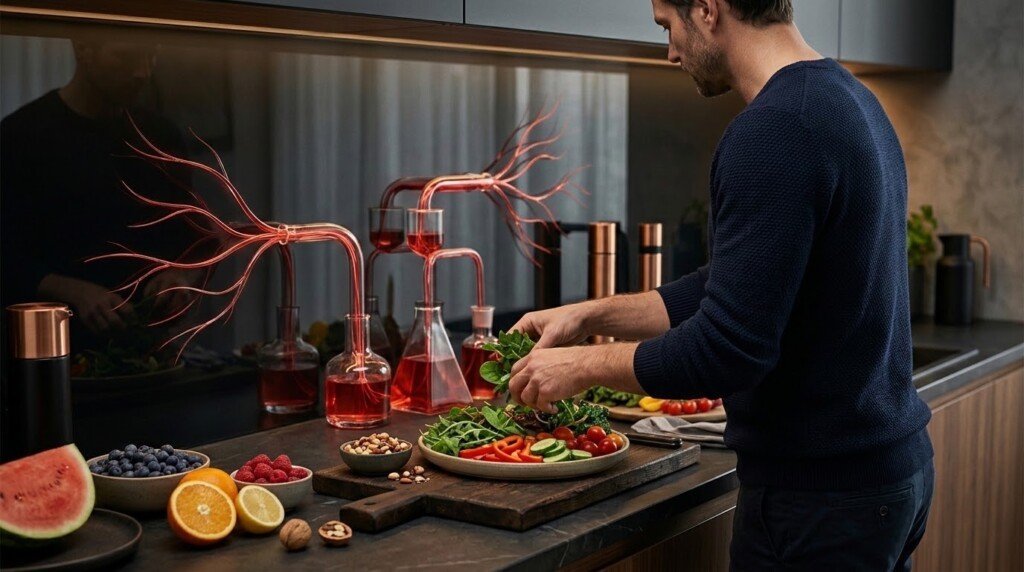
Evidence-based options (citrulline-rich foods, flavonoids)
Watermelon is one of the foods frequently mentioned in conversations about erectile function because it contains L-citrulline, an amino acid that can be converted into L-arginine and ultimately contribute to nitric oxide production.
Nitric oxide is important because it helps blood vessels relax. That makes the pathway biologically relevant to erections.
But this is where online marketing often gets ahead of the evidence.
The presence of L-citrulline in watermelon does not make watermelon a natural version of sildenafil. The amount obtained from ordinary food, the absorption of the compound, and the individual’s health all matter. Evidence involving isolated compounds or supplements should not automatically be interpreted as proof that eating a particular food will treat ED.
Watermelon is still a sensible food to include in a balanced diet. It provides fluid, potassium, and other nutrients in addition to citrulline. The mistake is turning it into an “instant Viagra food.”
Evidence grade: Promising mechanism, limited direct evidence for treating ED with ordinary servings.
Flavonoid-rich foods have a somewhat more interesting body of human observational evidence.
Flavonoids are naturally occurring compounds found in many fruits, vegetables, tea, cocoa, and other plant foods. Researchers have been interested in them because flavonoids are involved in antioxidant and vascular pathways.
A prospective study involving 25,096 men found that higher intakes of certain flavonoid subclasses were associated with a lower incidence of erectile dysfunction. Fruit intake, a major source of several flavonoids, was also associated with reduced ED incidence. The researchers were careful to point out that intervention trials were still needed. (PubMed)
That makes berries, citrus fruits, apples, pears, and other colorful plant foods reasonable choices, but not because they act like a drug.
The bigger point is variety.
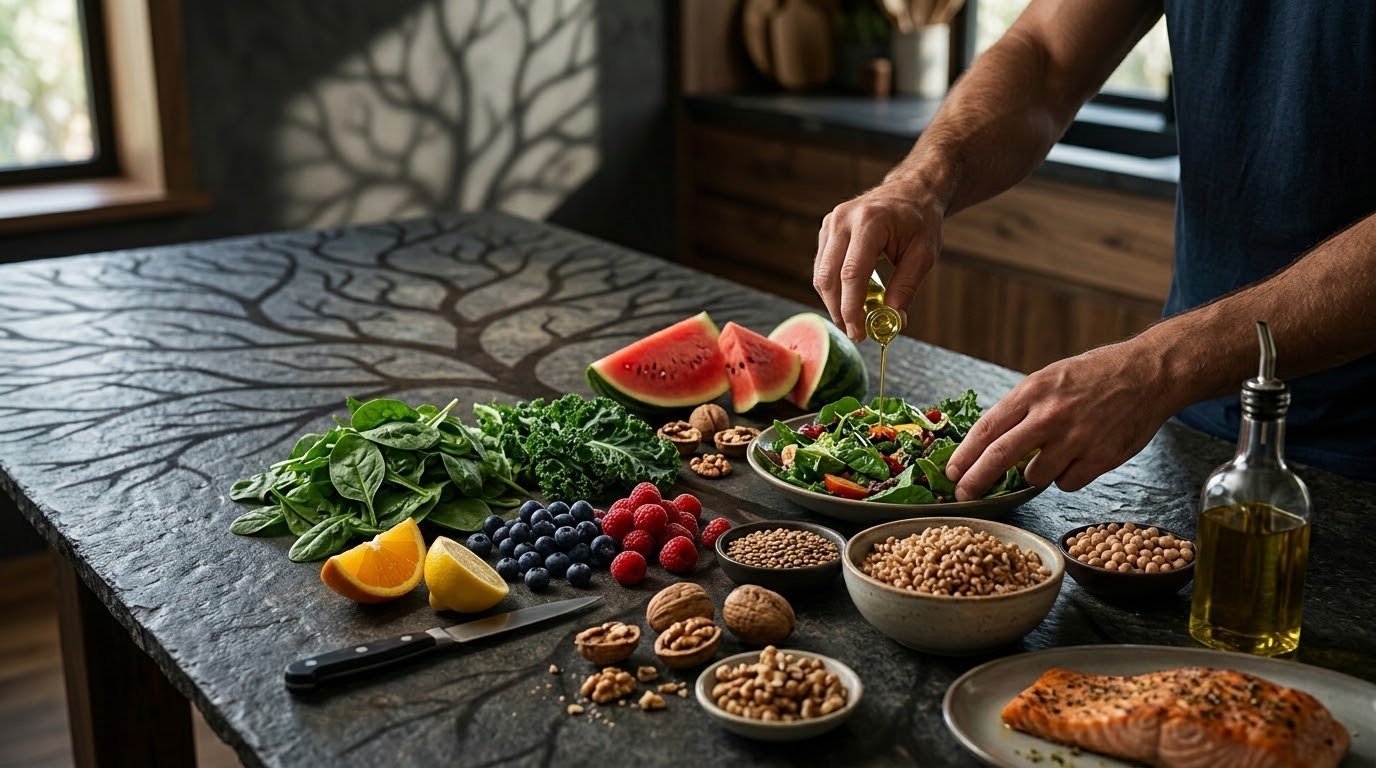
A plate containing leafy greens, colorful vegetables, fruit, legumes, whole grains, nuts, seeds, and healthy fats gives the body a broad range of nutrients and plant compounds. That approach makes more sense than searching for one ingredient that supposedly transforms sexual performance.
Nuts are another food category worth considering. A recent meta-analysis found that higher nut intake was associated with lower ED risk, although associations from dietary studies should not be treated as proof that nuts directly cure erectile dysfunction.
Leafy greens are also relevant because vegetables such as spinach, arugula, and other greens contain nitrates. Dietary nitrates can contribute to nitric oxide production through the nitrate-nitrite-nitric oxide pathway.
Again, the message should remain realistic.
Eating greens does not guarantee an erection. But regularly eating vegetables as part of a heart-supportive diet makes considerably more sense for long-term erectile health than chasing a supposedly powerful food hack.
Other useful categories include:
Berries and colorful fruit: These provide flavonoids and other plant compounds associated with vascular health.
Citrus fruit: Citrus is another source of flavonoids, including flavanones.
Nuts: Walnuts, almonds, pistachios, and similar foods provide unsaturated fats and other nutrients that fit well within cardiovascular-friendly eating patterns.
Legumes: Beans, lentils, and chickpeas provide fiber, plant protein, and micronutrients without relying heavily on saturated fat.
Whole grains: These can contribute fiber and support an overall dietary pattern associated with better metabolic health.
Extra-virgin olive oil: A major component of Mediterranean-style eating, olive oil supplies predominantly monounsaturated fat and various bioactive compounds.
Fatty fish: Fish such as salmon, sardines, and trout provide omega-3 fatty acids and fit naturally into heart-conscious dietary patterns.
None of these foods should be marketed as an ED medication.
The advantage comes from the pattern they create when they regularly replace foods that are high in refined carbohydrates, excessive saturated fat, sodium, and highly processed ingredients.
There is also a useful distinction between supporting erectile health and treating established ED.
If someone occasionally has difficulty getting fully erect after poor sleep, heavy drinking, stress, or a large meal, improving general lifestyle habits may help.
If someone consistently struggles to get or maintain an erection, food alone may not address the underlying cause. Diabetes, cardiovascular disease, medication effects, hormonal problems, psychological factors, and other medical conditions can all contribute to ED.
That is why persistent symptoms deserve more attention than simply adding a “superfood” to breakfast.
Is there a “natural Viagra” food?
No single food has been established as a natural equivalent of Viagra.
That answer is important because the phrase “natural Viagra” creates the wrong expectation. Viagra contains sildenafil, a medication designed to affect a specific physiological pathway involved in erections. Food works differently.
Some foods contain compounds that participate in pathways related to blood-vessel function, but that is not the same as producing the predictable pharmacological effect of an ED medication.

Separating real evidence from marketing claims
The phrase “natural Viagra” is often used because it is easy to understand and easy to sell. It is also medically misleading.
A food can support a biological pathway without behaving like a prescription drug.
For example, leafy vegetables contain dietary nitrates. Watermelon contains L-citrulline. Fruits contain flavonoids. Nuts contain unsaturated fats and other nutrients. These facts are real.
The leap from those facts to “eat this and get an erection” is where the claim becomes unreliable.
The evidence for dietary patterns is more convincing than the evidence for individual foods.
A systematic review examining diet and erectile dysfunction found that Mediterranean-style eating was protective in most of the studies it reviewed, although the authors also noted that more human research was needed.
A randomized trial involving people with newly diagnosed type 2 diabetes also found that a Mediterranean diet was associated with less deterioration in sexual function compared with a low-fat diet during long-term follow-up.
This is a very different claim from saying that one fruit or vegetable works like Viagra.
Think of the difference this way:
Drug-like claim: Eat one food and get an immediate erection.
Nutrition-based claim: Regularly eating a vascular-friendly diet may help support the health of the systems involved in erections.
The second statement is much closer to what the evidence can actually support.
There is another reason to be skeptical of “natural Viagra” claims. Some products marketed for sexual enhancement are not simply foods. They may be supplements or mixtures containing multiple ingredients, and supplement regulation is not equivalent to the approval process used for prescription medications.
That creates a separate safety issue.
A product marketed as “natural” is not automatically safe, effective, or free from undeclared pharmaceutical ingredients. For someone experiencing persistent ED, trying increasingly aggressive sexual-enhancement products can distract from finding the actual cause.
Food itself is generally a much simpler place to start.
The goal should be to build meals that repeatedly support cardiovascular and metabolic health rather than trying to engineer an erection from a single ingredient.
This is also why “instant hard-on food” claims should be treated cautiously.
Your body does not operate like a light switch that turns on because you ate a particular fruit. Digestion, circulation, nervous-system activity, hormones, sexual stimulation, medication effects, and psychological state all interact.
Even a genuinely nutritious food may have no noticeable immediate effect on erection quality.
That does not make the food useless. It simply means its value should be judged over the context of an overall diet and lifestyle rather than by whether it produces a dramatic sexual effect within an hour.
If your main concern is erectile function rather than libido, that distinction matters. A person can have strong sexual desire but struggle with erections. Someone else can have normal erections but low interest in sex. Nutrition may influence both areas indirectly, but they are not identical problems.
For men already working on general sexual health, nutrition can fit alongside other evidence-based approaches. Physical activity is another important part of the picture, which is why Exercise for Erectile Dysfunction: What Works has a different role from this food-focused discussion.
Likewise, if the main issue is low desire rather than erection firmness, How to Increase Sex Drive Naturally: Foods & Habits addresses a different side of sexual health.
The important thing is not to confuse appetite, arousal, and erection quality.
They overlap, but they are not interchangeable.
Which vitamins support blood flow?
There is no vitamin that reliably acts as an instant blood-flow enhancer for erections in otherwise healthy men.
That does not mean vitamins are irrelevant.
The body needs adequate micronutrients for normal vascular, neurological, metabolic, and hormonal function. If someone has a genuine nutritional deficiency, correcting it can be important for overall health and may influence sexual function indirectly.
The mistake is assuming that taking more of a vitamin automatically produces better erections.
Vitamin D is one of the nutrients frequently discussed in relation to ED.
Research has found associations between low vitamin D status and erectile dysfunction, particularly in some groups of men with more severe or vascular forms of ED. However, the evidence is not consistent enough to say that vitamin D supplementation reliably treats ED.
That distinction is worth remembering.
Association does not equal treatment.
Folate is another nutrient that has attracted research attention. A systematic review and meta-analysis found lower serum folate levels among men with ED compared with controls, with differences appearing more pronounced as ED severity increased.
But this does not establish folate as an ED treatment either.
It is possible that lower nutrient levels reflect broader dietary or health differences rather than being the direct cause of erection problems.
This is why food-first nutrition makes sense.
Leafy greens, legumes, citrus fruits, whole grains, nuts, seeds, and other minimally processed foods can contribute several vitamins and minerals at the same time. Instead of focusing on one supplement, a varied diet helps reduce the chance that nutrition becomes overly dependent on a single nutrient.
There is also an important practical point about testing.
If you suspect a vitamin deficiency because you have other symptoms or risk factors, it is more useful to discuss appropriate testing with a healthcare professional than to assume the deficiency exists and start taking large amounts of supplements.
More is not automatically better.
Some vitamins can accumulate in the body, interact with medications, or cause problems when taken in excessive amounts.
The same principle applies to erectile dysfunction.
If erection problems are persistent, the goal should not be to collect more supplements. The goal should be to understand why the problem is happening.
A nutrient-rich diet can be part of that process, but it should not become a substitute for evaluation.
What does a heart-healthy diet have to do with ED?
This may be the most important question in the entire article.
If you stop thinking about ED as an isolated sexual problem and start thinking about it as a vascular problem that can sometimes reveal broader health issues, the connection between food and erections becomes much clearer.
The blood vessels supplying the penis are relatively small. That means changes in vascular function can sometimes become noticeable through erectile symptoms before a person realizes that cardiovascular risk is becoming a problem.
This does not mean every episode of ED is caused by heart disease. Psychological factors, medication effects, hormonal issues, neurological conditions, relationship stress, and other causes are possible.
But vascular health is a major part of normal erectile function.
A healthy diet supports that system through several overlapping pathways.
It can help maintain healthier blood lipids, support blood-pressure control, provide fiber, improve overall diet quality, and reduce reliance on highly processed foods. It can also provide plant compounds involved in antioxidant and endothelial pathways.

The Mediterranean diet is especially relevant here.
It typically emphasizes vegetables, fruits, legumes, whole grains, nuts, seeds, fish, olive oil, and other minimally processed foods while limiting heavily processed foods and excessive saturated fat.
Multiple studies have linked Mediterranean-style dietary patterns with better erectile outcomes. A large prospective cohort study found that men with higher adherence to the Mediterranean diet had lower risks of developing ED. (PubMed)
The pattern is more important than any individual food.
Imagine two meals.
The first is heavily processed, high in refined carbohydrates and saturated fat, with little fiber and few plant foods.
The second contains vegetables, legumes or whole grains, a source of unsaturated fat, and a protein source such as fish.
The second meal is not an erection treatment.
But if meals resembling the second pattern become the norm over months and years, they support the cardiovascular environment in which normal erectile function is more likely to thrive.
That is the real nutritional story.
It is slower and less exciting than “eat this before sex,” but it is considerably more useful.
There is another important reason not to treat food as a standalone cure.
Suppose a man has persistent erectile difficulties and responds by eating watermelon every day. If the actual issue is uncontrolled blood pressure, diabetes, medication side effects, cardiovascular disease, or another medical condition, the watermelon is not addressing the problem.
That is why persistent ED deserves medical attention.
If erection problems are new, recurring, or getting progressively worse, discussing them with a healthcare professional is sensible. When to See a Doctor for ED can help distinguish situations where professional evaluation becomes particularly important.
Nutrition should complement that process, not replace it.
The same principle applies to the popular “salt trick” or baking-soda claims that occasionally circulate online. There is no sound basis for treating these household tricks as reliable ED solutions. They are not substitutes for evidence-based care.
The most useful nutritional takeaway is actually quite simple.
Do not ask, “Which food gives me an erection?”
Ask, “What kind of diet supports the blood vessels, metabolism, and overall health that erections depend on?”
That question leads to much better choices.
The practical takeaway
Foods that may support erectile health include:
- Leafy green vegetables
- Berries and other colorful fruits
- Citrus fruits
- Watermelon
- Beans and lentils
- Whole grains
- Nuts and seeds
- Fatty fish
- Olive oil
- Other minimally processed plant foods
The evidence is strongest for overall dietary patterns, particularly those rich in plant foods and consistent with Mediterranean-style eating. Evidence for individual foods is generally more limited.
And that distinction should remain visible in any responsible discussion of nutrition and ED.
Food can help create a healthier environment for erectile function.
It cannot promise an erection on demand.
Frequently Asked Questions ( Foods That Help Erectile Dysfunction ).
1. What’s the best thing to eat to get a hard on?
There is no single food that reliably produces an erection on demand. Foods such as leafy greens, berries, citrus fruits, watermelon, nuts, legumes, whole grains, fish, and olive oil fit into dietary patterns associated with better vascular and erectile health. Their value comes from regular consumption and overall diet quality, not an immediate Viagra-like effect.
2. What foods increase blood flow to the pennis naturally?
Foods containing dietary nitrates, such as leafy greens, and foods rich in flavonoids, such as berries and citrus fruits, are relevant to pathways involved in vascular function. Watermelon also contains L-citrulline. However, these foods should be viewed as part of a heart-healthy diet rather than guaranteed blood-flow treatments for ED.
3. What is natural Viagra food?
There is no food that is medically equivalent to Viagra. “Natural Viagra” is mainly a marketing phrase. Some foods contain nutrients or plant compounds associated with vascular health, but that does not mean they produce the predictable pharmacological effect of an ED medication.
4. Which vitamin helps blood flow to the pennis?
No vitamin has been proven to reliably improve erectile function simply by being taken in higher amounts. Vitamin D and folate have both been studied in relation to ED, but the evidence does not establish them as universal treatments. If a genuine deficiency exists, correcting it can be important, but unnecessary high-dose supplementation is not a substitute for evaluating persistent ED.
The Bottom Line
The best Foods That Help Erectile Dysfunction are not necessarily the foods with the most dramatic names or the strongest promises.
They are the foods that repeatedly support the vascular system.
That means building meals around vegetables, fruits, legumes, whole grains, nuts, seeds, fish, and healthy fats makes more sense than searching for an instant “natural Viagra.”
The research supports the broader picture. Healthier dietary patterns, particularly Mediterranean-style and plant-rich patterns, are associated with better erectile outcomes, while individual foods generally have more modest and less certain evidence. (PubMed)
So, if you want to use nutrition to support erectile health, think in terms of patterns, consistency, and cardiovascular health, not miracle ingredients.
And if erection problems keep happening despite healthy habits, do not keep changing your grocery list and hope the problem disappears. Persistent ED can have medical causes that deserve proper evaluation.
Disclaimer:
This post may contain affiliate links. If you purchase through them, we may earn a small commission at no extra cost to you. Also, this content is for informational purposes only and does not substitute professional medical advice.
Know Your Body Better
Use our free tools to track your cycle, find your fertile window, estimate your due date, and more.
Open Free Tools →