
How to Improve Your VO2 Max: Training Methods & Frequency
If you want to know how to improve VO2 max, the answer is not simply “do more cardio.” Your body responds to the type, intensity, frequency, and consistency of the training you give it. The most effective approach combines demanding aerobic work with easier endurance sessions and enough recovery to let your cardiovascular system adapt.
VO2 max is closely tied to aerobic capacity, but improving it is not about making every workout exhausting. In fact, one of the most common mistakes is treating every session like a test.
A better strategy is to make certain workouts deliberately hard, keep other sessions controlled, and gradually increase your training load. That gives your heart, lungs, blood vessels, and working muscles repeated opportunities to become more efficient at using oxygen.
If you need a refresher on what the number actually represents, the foundational explanation of VO2 max covers how it is measured and what the score means.
What types of exercise improve VO2 Max most effectively?
The best exercise for improving VO2 max is generally aerobic exercise that raises your heart rate substantially and keeps your cardiovascular system working hard enough to stimulate adaptation. Running, cycling, rowing, swimming, brisk uphill walking, and similar activities can all work.
The important distinction is between exercising and specifically training your aerobic capacity.
A casual 30-minute walk may be excellent for general health. It may also contribute to your fitness over time. However, someone trying to raise VO2 max will usually need some sessions that place a much greater demand on the cardiovascular system.
That does not mean every workout should be intense. Quite the opposite.
A well-designed week usually has different gears. Some sessions build your aerobic foundation. Some challenge your ability to sustain a high oxygen demand. Some are deliberately easy so you can recover and train again.
That variation is what makes a VO2 max program sustainable.
How does interval training specifically boost VO2 Max?
Interval training works by repeatedly exposing your cardiovascular system to periods of high demand followed by recovery. Instead of maintaining one steady pace for the entire workout, you alternate between harder and easier efforts.
This matters because the cardiovascular system has to respond quickly when exercise intensity rises. Heart rate increases, breathing becomes deeper and faster, blood flow to working muscles rises, and oxygen delivery becomes a much greater priority.
Over repeated sessions, those demands can stimulate adaptations that improve cardiorespiratory fitness.
Research supports this. A large umbrella review published in 2024 found that HIIT consistently improved cardiorespiratory fitness in adults compared with both non-exercise controls and traditional moderate-intensity continuous training. (PubMed)
However, “interval training” is not one specific workout.
There is a major difference between a recreational interval session and an all-out sprint workout. You do not need to sprint until you feel like you are going to collapse to improve VO2 max.
For many people, controlled hard intervals are a better starting point.
A simple example could look like this:
Warm up thoroughly, then perform several hard efforts lasting a few minutes each. Recover with easy movement between efforts. Finish with a gradual cooldown.
The hard portions should feel genuinely challenging. You should be breathing heavily and concentrating on maintaining your effort. At the same time, the session should remain controlled enough that you can complete all planned intervals without your performance falling apart.
The exact duration and intensity should depend on your fitness level.
A beginner does not need to copy an advanced runner’s interval session. Someone returning to exercise after months away may get a strong training stimulus from considerably less work than an experienced athlete.
There is also evidence that longer intervals can be particularly useful for spending more time near VO2 max during a workout. A recent systematic review found that intervals lasting at least two minutes produced more time at high percentages of VO2 max than very short intervals.
That does not make short intervals useless. It simply shows why the details of the workout matter.
The goal is not to collect the most painful minutes possible.
The goal is to accumulate enough high-quality work to give your aerobic system a reason to adapt.

Is steady-state cardio still effective, or is HIIT strictly better?
Steady-state cardio is still valuable.
The idea that HIIT has made traditional cardio obsolete is one of the more misleading fitness trends. Moderate continuous exercise can improve cardiovascular fitness, build an aerobic base, increase exercise tolerance, and provide a form of training that is easier to recover from than repeated maximal efforts.
For example, a 40-minute cycling session at a controlled pace may not feel nearly as dramatic as a short interval workout. Yet it can still contribute meaningfully to your overall fitness.
The biggest advantage of steady-state training is that you can accumulate useful aerobic work without constantly pushing your body toward its limits.
That matters because VO2 max improvement is not produced by one heroic workout. It is produced by repeated training over time.
Imagine two people.
Person A performs three brutal HIIT sessions every week. Each workout leaves them exhausted. Their legs remain sore, their motivation drops, and they eventually start skipping sessions.
Person B performs one demanding interval workout, two easier aerobic sessions, and keeps at least some days relatively light. They continue doing this for months.
Person B may make better long-term progress despite doing fewer “hard” workouts.
HIIT can be highly effective, but effective does not mean “use it for everything.”
Steady-state cardio can also make your harder sessions more productive because it builds the aerobic foundation needed to tolerate and recover from intense work.
For someone starting from a low fitness level, even basic continuous exercise can be an important first step. You do not need to jump directly into advanced intervals.
A practical progression might be:
Start with consistent moderate aerobic activity. Build your ability to exercise regularly. Then introduce controlled intervals once your body is ready to handle them.
That approach is much more realistic than treating every workout as a race.
Does strength training play any role in improving VO2 Max?
Strength training is not usually the primary tool for directly raising VO2 max, but that does not make it irrelevant.
Stronger muscles can help you perform aerobic activities more efficiently. Strength training can also support joint health, movement quality, muscle retention, and overall physical capacity.
There is another practical benefit.
Suppose running is your preferred way to train your cardiovascular system, but your legs fatigue before your cardiovascular system is properly challenged. Improving muscular strength may help you tolerate the activity better.
For some people, strength training also provides an alternative when repetitive impact from running becomes uncomfortable.
However, strength training should not replace aerobic training if your specific goal is to improve VO2 max.
If you spend your entire week lifting weights but rarely perform sustained aerobic work, you should not expect your VO2 max to rise dramatically simply because you are getting stronger.
Think of the two forms of exercise as serving different purposes.
Aerobic training directly challenges the systems responsible for oxygen transport and utilization. Strength training develops force production and muscular capacity.
Together, they create a more complete fitness program.
The broader physical activity guidelines also support including both aerobic activity and muscle-strengthening work rather than treating them as competing forms of exercise. (CDC)
How often should I train, and at what intensity?
The right training frequency depends on your current fitness, age, training history, recovery capacity, and goals.
There is no single number of weekly sessions that guarantees a VO2 max improvement.
What matters more is creating enough repeated stimulus without accumulating so much fatigue that your performance and consistency deteriorate.
For most people, the mistake is not doing too little hard training. It is doing too much of it.
A VO2 max workout should be demanding enough to challenge your aerobic system. It should not become a test of how much suffering you can tolerate.
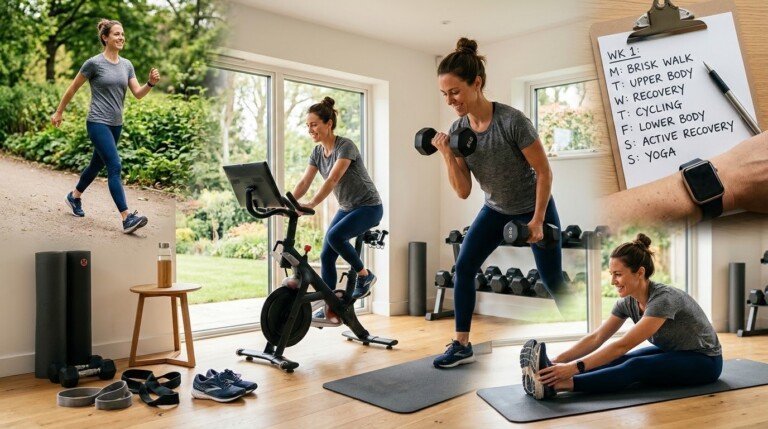
A useful weekly structure could include one or two higher-intensity aerobic sessions surrounded by easier training.
For example, someone with an established aerobic base might use:
- One interval-focused session
- Two or three easier aerobic sessions
- One or two strength sessions
- At least one genuinely easy or recovery day
That is only a framework, not a prescription.
A beginner may need much less.
An experienced endurance athlete may tolerate considerably more.
The important principle is to earn the right to increase intensity.
What training intensity zones are optimal for VO2 Max gains?
Training zones can make VO2 max programming easier to understand, but they should not become an excuse to obsess over one exact heart-rate number.
Heart rate varies between individuals and can also change because of heat, dehydration, stress, sleep, caffeine, medication, and accumulated fatigue.
Instead, think about intensity in terms of purpose.
Easy aerobic work should feel controlled. You can maintain a conversation and finish without feeling destroyed. This type of training supports your aerobic base and allows you to accumulate volume.
Moderate to hard work requires more concentration and breathing becomes noticeably heavier. It can help bridge the gap between easy endurance work and high-intensity training.
VO2-focused intervals are genuinely hard. Breathing is heavy, and speaking comfortably is difficult. These intervals are designed to place a substantial demand on oxygen transport and utilization.
The mistake is assuming that the hardest possible intensity is automatically the most effective.
It is not.
If you turn every interval into an all-out sprint, you may spend less useful time at the intended aerobic intensity because the workout becomes limited by muscular fatigue, technique, or the ability to recover between efforts.
Quality matters more than brutality.
Your goal is to perform the hard portions strongly and consistently rather than having the first interval look impressive and the final intervals collapse.
Another useful principle is to avoid changing several variables simultaneously.
If you increase your interval intensity, add more repetitions, extend the workout, and increase your weekly mileage at the same time, you make it difficult to know what caused the fatigue.
Progress one variable at a time.
What common mistakes should I avoid when training for VO2 Max?
The first mistake is doing hard workouts too frequently.
More intensity does not automatically equal faster progress. Your body needs recovery after demanding exercise. If every session becomes a high-intensity session, the quality of those sessions eventually declines.
The second mistake is skipping the warm-up.
Going directly from sitting at a desk to hard intervals is not a smart way to begin a demanding workout. A gradual warm-up prepares your body for the increased workload and gives you time to assess how you feel that day.
The third mistake is starting too fast.
This is particularly common with running. Someone sees a target pace and tries to hit it immediately, only to slow dramatically halfway through the session.
A better approach is controlled aggression. Start the first hard interval at an intensity you believe you can repeat. If you finish the workout with good form and consistent efforts, you have created a much better training stimulus.
The fourth mistake is ignoring easy days.
Easy training can feel unproductive because it does not provide the same dramatic sensation as HIIT. That does not mean it has no purpose.
Recovery is part of training.
The fifth mistake is judging progress only by your watch.
Wearable devices can be useful for tracking trends, but they do not directly measure everything happening inside your body. Estimated VO2 max can be affected by the quality of heart-rate data, activity type, terrain, pacing, and the algorithm used by the device.
Use technology as a tool, not as the final authority.
Finally, do not compare your VO2 max journey with someone else’s.
Your starting point, genetics, body size, age, training history, and recovery capacity are different. The person running beside you may have spent ten years developing their aerobic system.
Your job is to improve your own baseline.
Does nutrition affect how quickly VO2 Max improves?
Nutrition does matter, but it is easy to exaggerate its role.
There is no special food that suddenly raises VO2 max. Training provides the primary stimulus, while nutrition helps you support that training, recover from it, and maintain the energy needed to exercise consistently.
If you are chronically under-fueled, demanding workouts can become much harder to complete well.
You may notice that your usual pace feels unusually difficult. Your recovery may suffer. You may feel unusually tired between sessions. Over time, this can interfere with the consistency required for fitness improvements.
That does not mean you need an elaborate sports nutrition plan.
For most recreational exercisers, the basics matter far more.
Eat enough overall. Include adequate protein. Consume carbohydrates appropriate to your activity level. Include fruits, vegetables, whole grains or other nutrient-dense carbohydrate sources, healthy fats, and enough fluids.
If you train hard, carbohydrates can be particularly useful because they provide readily available fuel for higher-intensity exercise.
This is where another common mistake appears.
Some people become so focused on improving VO2 max that they dramatically restrict food while simultaneously increasing training. That combination can leave them exhausted rather than fitter.
The objective is not to become as light as possible.
The objective is to become more aerobically capable.
If your training load is increasing, your nutrition and recovery need to support that workload.
What are the risks of trying to improve VO2 Max too aggressively?
Trying to accelerate progress is understandable. Nobody wants to spend months training without seeing improvement.
The problem is that cardiovascular fitness does not improve according to your impatience.
Your body needs time to adapt.
If you increase training volume and intensity too quickly, several things can happen. Your performance may stagnate. Your legs may remain constantly fatigued. Minor aches can become persistent injuries. Sleep can deteriorate. Motivation can disappear.
You may also begin interpreting normal fatigue as evidence that you need to train harder.
That creates a cycle:
Hard workout. Poor recovery. Worse performance. More frustration. Even harder workout.
Eventually, the person who wanted faster progress ends up training less.
A smarter approach is progressive overload.
Increase your workload gradually. Allow your body to adjust. Then increase the challenge again.
Progress does not always mean running faster.
It could mean completing the same interval session with better consistency. It could mean recovering more quickly between efforts. It could mean maintaining your pace at a lower perceived effort. It could mean completing a longer aerobic session without excessive fatigue.
These changes can appear before a dramatic change in your VO2 max estimate.
Another important point is that not every workout needs to produce a personal record.
Some sessions exist to build capacity. Others exist to recover. Some exist to challenge the system.
The combination is what creates progress.
If you have known cardiovascular disease, unexplained chest pain, fainting, severe shortness of breath, or other concerning symptoms during exercise, do not use a generic VO2 max program as a substitute for medical evaluation. Likewise, if you are returning to vigorous exercise after a long period of inactivity or have a significant medical condition, professional guidance may be appropriate.

What devices or methods help track progress along the way?
You do not need expensive equipment to monitor whether your aerobic fitness is improving.
The most useful approach is to track several signals rather than obsess over one number.
A fitness watch can provide estimates of VO2 max, heart rate, pace, distance, and training load. These measurements can be useful for identifying trends over several weeks.
However, treat estimated VO2 max as an estimate.
For more meaningful tracking, combine it with actual performance.
For example, record a repeatable route or workout. Note your pace, heart rate, perceived effort, and recovery. Then repeat the same type of session periodically under reasonably similar conditions.
Suppose you run the same route at roughly the same pace.
At the beginning, your average heart rate might be relatively high and the workout might feel difficult. Several weeks later, the same pace may feel easier, with a lower average heart rate.
That is useful information even if your watch’s VO2 max number barely changes.
You can also track recovery.
How quickly does your breathing settle after a hard interval? Can you maintain your pace more consistently? Do you feel ready for your next workout sooner?
These are practical signs that your fitness may be improving.
For a highly accurate measurement, laboratory testing with respiratory gas analysis remains a different category from a wearable estimate. A lab test can directly measure oxygen consumption while you exercise under controlled conditions.
That level of testing is useful for athletes, researchers, or people who specifically need precise physiological assessment.
For the average person, however, consistency in training and sensible trend tracking are usually more important than knowing whether their VO2 max is 42 or 43.
The number is useful.
The trend is more useful.
Frequently Asked Questions (How to improve VO2 max).
1. How can I improve my VO2 Max?
The most effective approach combines regular aerobic exercise with strategically placed higher-intensity intervals. Start with a sustainable amount of training, build an aerobic foundation, and gradually introduce harder sessions. Strength training can complement aerobic work, while adequate nutrition and recovery help you maintain consistency.
2. What exercise is best for VO2 Max?
Running, cycling, rowing, swimming, and other aerobic activities can improve VO2 max. Interval training is particularly effective for challenging cardiorespiratory fitness, but steady-state cardio remains valuable for building aerobic capacity and supporting recovery between harder sessions.
3. How often should I train to raise my VO2 Max?
There is no universal frequency that works for everyone. Many people can benefit from one or two challenging aerobic sessions per week alongside easier aerobic training. Beginners may need less intensity, while experienced athletes can tolerate more. Recovery should always be part of the plan.
4. Is HIIT better than steady-state cardio for VO2 Max?
HIIT can produce strong improvements in cardiorespiratory fitness and may be more time-efficient than moderate continuous training. However, steady-state cardio remains useful and should not automatically be replaced. The best program uses different intensities for different purposes.
5. Can I improve VO2 Max without running?
Yes. Running is not required. Cycling, rowing, swimming, uphill walking, elliptical training, and other aerobic activities can provide a strong cardiovascular stimulus. Choose an activity you can perform consistently and safely at an appropriate intensity.
The Bottom Line
If you want to improve your VO2 max, stop looking for one perfect workout.
The bigger advantage comes from building a training week that has structure.
Use challenging intervals to push your aerobic ceiling. Use easier cardio to build your foundation and support recovery. Add strength training for broader physical capacity. Eat enough to support the work. Then repeat the process consistently.
You do not need to destroy yourself every time you exercise.
In fact, the ability to train hard, recover, and come back ready for the next session is one of the most valuable skills you can develop.
VO2 max improves when your body repeatedly receives a reason to become better at delivering and using oxygen. Give it that reason consistently, increase the challenge gradually, and give your body enough recovery to actually adapt.
For the next step, understanding the factors that influence VO2 max can help explain why two people following similar training programs may progress at different rates.
Disclaimer:
This post may contain affiliate links. If you purchase through them, we may earn a small commission at no extra cost to you. Also, this content is for informational purposes only and does not substitute professional medical advice.
Train Smarter, Not Harder
Use our free Fitness Toolkit to find your heart rate zones and calories burned in minutes.
Open Free Tools →