Portion Control vs. Calorie Counting: Which Actually Works Better?
If you’ve ever searched for a sustainable way to eat healthier, you’ve probably come across two popular approaches. One encourages you to estimate balanced portions without worrying about numbers. The other asks you to track every calorie you consume throughout the day. Both methods have passionate supporters, and both have helped many people achieve their health goals.
So which one actually works better?
The honest answer is more nuanced than many articles suggest. The debate around portion control vs calorie counting is not about deciding which method is universally superior. It is about understanding how each approach works, what its strengths and limitations are, and which one fits your lifestyle well enough that you can actually maintain it.
Calorie counting offers precision. It provides measurable data and helps people understand exactly how much energy they consume. Portion control, on the other hand, focuses on developing practical eating habits that can be maintained without constantly tracking numbers. One emphasizes accuracy, while the other emphasizes simplicity.
Neither approach succeeds simply because it exists. Success depends on consistency. A perfectly calculated nutrition plan that feels exhausting after two weeks is unlikely to outperform a simpler approach that someone can comfortably follow for years.
That is why the conversation should move beyond asking, “Which one is better?” Instead, a more useful question is, “Which approach helps me make healthier decisions consistently without making food dominate my daily life?”
In this article, you’ll see an honest comparison of portion control vs calorie counting, including accuracy, sustainability, convenience, and situations where combining both methods may produce the best long-term results.
Quick Answer
When comparing portion control vs calorie counting, neither method is automatically better for everyone. Calorie counting generally offers greater accuracy because it measures energy intake more precisely. Portion control is often easier to maintain because it relies on practical habits instead of continuous tracking. For many people, the most sustainable approach combines the awareness gained from calorie counting with the simplicity of portion control over the long term.
What’s the Real Difference Between Portion Control and Calorie Counting?
Although both methods aim to support healthier eating, they approach the goal from completely different directions.
Calorie counting is based on numbers.
Every food contains a measurable amount of energy. By tracking those numbers throughout the day, people estimate whether they are consuming more or fewer calories than their bodies require.
Portion control focuses less on numerical precision and more on appropriate serving sizes.
Instead of recording every calorie, people learn what balanced portions generally look like and use those visual references to guide everyday meals.

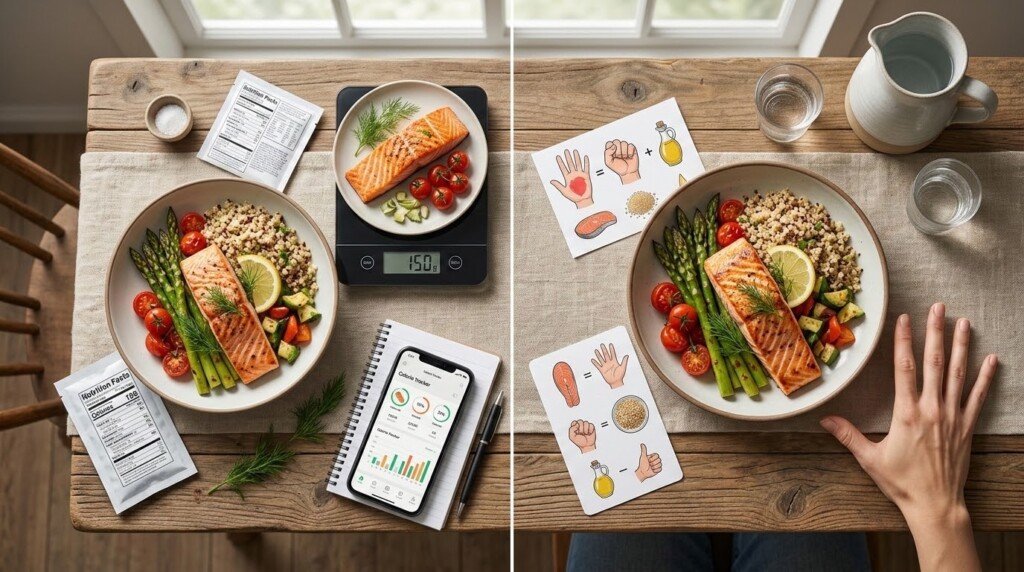
Think of the difference this way.
Calorie counting answers the question:
“Exactly how much energy am I eating?”
Portion control answers the question:
“Does this amount of food match what my body likely needs?”
One relies heavily on measurement.
The other relies on practical awareness.
Neither method changes how the body processes food.
Instead, both simply offer different tools for helping people regulate overall food intake.
Another distinction involves flexibility.
Calorie counting often requires food labels, nutrition databases, kitchen scales, or mobile applications.
Portion control can usually be practiced almost anywhere, including restaurants, vacations, family gatherings, and workplace lunches without needing special equipment.
This difference becomes particularly important for people looking for lifelong habits rather than temporary dieting strategies.
Which Approach Is More Accurate for Weight Management?
If accuracy alone were the deciding factor, calorie counting would clearly win.
Measuring food, recording intake, and comparing total calories against estimated energy needs provides considerably more detail than visually estimating portions.
For people who enjoy data, numbers can be extremely useful.
Tracking makes hidden eating patterns more visible.
Small snacks become noticeable.
Restaurant meals become easier to compare.
High-calorie beverages no longer go unnoticed.
Athletes, bodybuilders, and individuals pursuing highly specific nutrition goals often benefit from this level of precision because relatively small dietary differences may influence performance or body composition.
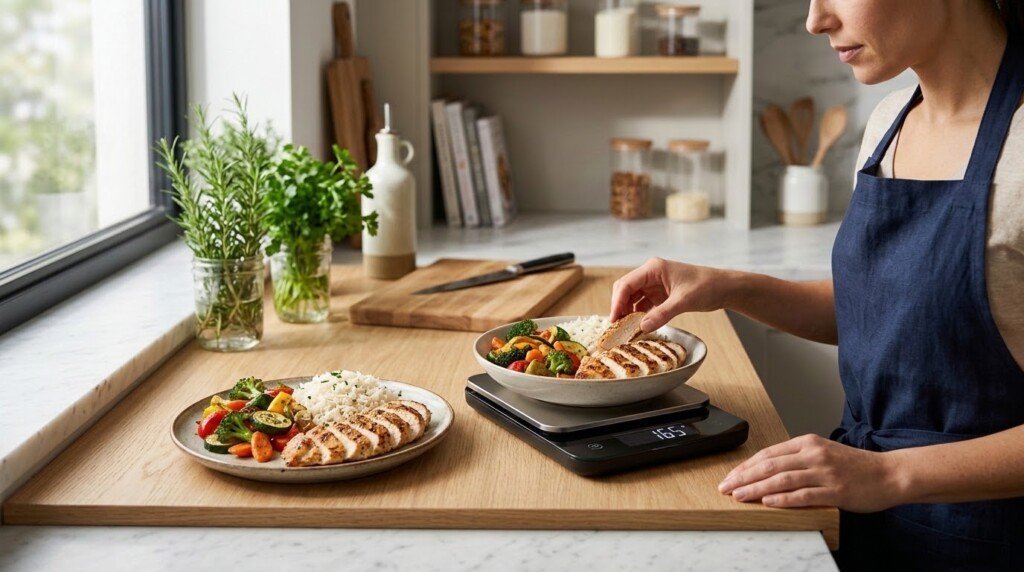
However, greater accuracy does not automatically guarantee better results.
Tracking introduces opportunities for human error.
People sometimes underestimate restaurant meals.
Food labels may contain small variations.
Portions may not be measured precisely.
Some ingredients are forgotten altogether.
Even highly motivated individuals rarely maintain perfect tracking indefinitely.
Portion control sacrifices some precision but gains practicality.
Rather than attempting to calculate every calorie, it encourages consistently reasonable meals.
For many people, consistently reasonable decisions outperform perfectly accurate plans that become difficult to maintain after several weeks.
Accuracy therefore depends on two separate questions.
Which method measures food more precisely?
Calorie counting.
Which method are you more likely to continue using six months from now?
The answer varies from person to person.
This distinction explains why the most accurate method is not always the most successful one.
Which Approach Is Easier to Sustain Long-Term?
Long-term success depends less on choosing the perfect strategy and more on choosing one that comfortably fits everyday life.
This is where portion control often has a practical advantage.
Most people eventually become tired of tracking everything they eat.
Breakfast.
Lunch.
Dinner.
Snacks.
Condiments.
Cooking oils.
Restaurant meals.
Drinks.
Even when mobile apps simplify the process, recording every meal still requires consistent attention.

Many people describe this as tracking fatigue.
Initially, the information feels empowering.
Eventually, the routine may begin feeling repetitive or mentally exhausting.
Portion control usually requires less ongoing effort.
Once balanced serving sizes become familiar, daily eating often becomes more automatic.
People rely on visual estimation rather than constant measurement.
This simplicity becomes especially valuable during vacations, holidays, business travel, restaurants, and family gatherings where detailed tracking is less practical.
Another advantage involves flexibility.
Missing one tracked meal sometimes causes people to abandon tracking for the rest of the day.
Portion awareness rarely creates the same all-or-nothing mindset because meals continue following familiar serving patterns without requiring perfect records.
That said, sustainability remains highly individual.
Some people genuinely enjoy data.
Tracking provides reassurance rather than stress.
Others feel mentally freer once numbers disappear entirely.
The best approach is therefore not necessarily the simplest one.
It is the one you can imagine following comfortably years from now rather than only during periods of high motivation.
Can You Combine Portion Control and Calorie Counting?
Many people assume they have to choose one method and ignore the other. In reality, the most practical long-term approach often combines the strengths of both.
Think of calorie counting and portion control as different tools rather than competing philosophies.
Calorie counting helps you understand.
Portion control helps you apply that understanding every day.
Imagine someone who has never paid attention to nutrition before. During the first few weeks, tracking calories can be surprisingly educational. Foods that appear similar may contain very different amounts of energy. Restaurant meals often contain much larger portions than expected. Snacks, drinks, cooking oils, and sauces may contribute far more calories than most people realize.
This awareness creates valuable learning.

After gaining that knowledge, many people gradually rely less on detailed tracking because they have developed a much better understanding of appropriate portions.
Instead of recording every meal forever, they begin recognizing balanced serving sizes almost automatically.
In this way, calorie counting becomes a learning tool while portion control becomes the long-term habit.
Neither method replaces the other completely.
They simply contribute different strengths.
Combining both approaches also reduces unnecessary pressure.
You may choose to track during periods when you want greater precision, such as learning new eating habits or returning to routine after a vacation.
At other times, portion awareness alone may feel entirely sufficient.
This flexibility often produces greater consistency than rigidly committing to only one strategy.
When Does It Make Sense to Use Both Together?
There are many situations where combining both methods provides practical advantages without making eating feel complicated.
One common example is the beginner who wants to understand nutrition more clearly.
Tracking meals for several weeks provides valuable insight into serving sizes, meal composition, and hidden sources of extra calories. Once these patterns become familiar, portion awareness often replaces the need for constant tracking.
Another situation involves people who eat at home most of the time but frequently dine out on weekends.
During home meals, calorie tracking may be relatively straightforward.
At restaurants, however, estimating portions often becomes much more practical than attempting perfect calculations.
Athletes and physically active individuals sometimes combine both methods as well.
Training periods requiring greater nutritional precision may involve calorie tracking, while recovery periods or vacations rely more heavily on portion awareness to reduce mental fatigue.
Busy professionals often benefit from this flexibility too.
During particularly demanding workweeks, maintaining balanced portions may be considerably more realistic than finding time to log every meal.
The combination also works well for long-term maintenance.
Someone who has already achieved their health goals may no longer need detailed tracking every day but still benefit from occasionally returning to it when routines change.
This approach recognizes an important reality.
Nutrition does not need to look exactly the same every month of your life.
The most effective strategy often adapts as your circumstances change.
Who Should Choose One Over the Other?
There is no universally correct answer because different personalities thrive with different systems.
People who enjoy structure, numbers, and measurable progress often appreciate calorie counting.
Seeing data provides reassurance.
Tracking creates accountability.
Detailed information feels motivating rather than burdensome.
Others experience the exact opposite.
Recording every meal quickly becomes mentally exhausting.
Numbers create unnecessary stress.

They prefer a simpler approach that allows eating to remain flexible without constant measurement.
These individuals often find portion control easier to maintain because it fits naturally into restaurants, vacations, family dinners, and social events.
Lifestyle also matters.
Someone preparing meals at home every day may find calorie tracking relatively convenient.
A person who travels frequently for work may benefit far more from learning practical portion awareness that functions anywhere.
Experience should also influence the decision.
Beginners frequently benefit from temporary tracking because it teaches serving sizes.
Over time, many transition toward portion awareness as confidence develops.
Neither choice represents success or failure.
The best method is the one that quietly fits into your life without making food the center of every day.
If your goal is understanding the energy balance behind weight management, Calorie Deficit explains that concept in greater depth. If you want to calculate your personal calorie needs, How to Calculate a Calorie Deficit walks through the process step by step. For readers who prefer building lifelong eating habits instead of relying primarily on numbers, Portion Control for Weight Loss explores practical approaches that emphasize consistency over precision.
Quick Comparison Table
| Feature | Portion Control | Calorie Counting |
|---|---|---|
| Primary focus | Balanced serving sizes | Measuring energy intake |
| Accuracy | Moderate | High |
| Daily effort | Low to moderate | Moderate to high |
| Learning curve | Easy | Moderate |
| Restaurant friendly | Excellent | More difficult |
| Travel friendly | Excellent | Moderate |
| Long-term sustainability | Often high | Varies by individual |
| Best for | Everyday healthy eating | Precision and detailed tracking |
| Biggest strength | Simplicity | Accuracy |
| Biggest limitation | Less precise | Tracking fatigue |
Key Takeaways
The debate around portion control vs calorie counting is not about identifying a single winner. Calorie counting provides greater precision and can be an excellent educational tool, particularly for people who enjoy tracking data or have specific nutritional goals. Portion control offers simplicity, flexibility, and practicality, making it easier for many people to maintain healthy eating habits across restaurants, holidays, travel, and everyday life.
For many individuals, the most effective solution is not choosing one approach over the other. Instead, it is using calorie counting to build nutritional awareness while allowing portion control to become the long-term habit that supports consistency. Sustainable eating rarely depends on perfect numbers. It depends on finding an approach that fits naturally into your lifestyle.
Frequently Asked Questions
1. Is portion control better than counting calories?
Neither method is universally better. Calorie counting offers greater accuracy, while portion control is often easier to maintain over the long term. The best choice depends on your goals, lifestyle, and personal preferences.
2. Can I lose weight with portion control alone?
Yes. Many people successfully manage their weight through balanced portion awareness without tracking every calorie. The key is maintaining consistent eating habits over time rather than relying on short-term perfection.
3. Should I count calories and control portions at the same time?
For many people, yes. Tracking calories temporarily can improve awareness of serving sizes, while portion control provides a practical long-term strategy once those habits become familiar.
4. Which method is easier for beginners?
Beginners often benefit from learning both. Calorie counting teaches nutritional awareness, while portion control helps apply that knowledge in everyday situations without requiring constant tracking.
5. Which method works better for long-term healthy eating?
Long-term success depends on consistency rather than the method itself. Many people find portion control easier to sustain, while others enjoy the structure provided by calorie counting. The most effective approach is the one you can realistically maintain for years.
Conclusion
When comparing portion control vs calorie counting, the most important lesson is that success comes from sustainability rather than perfection. Calorie counting offers valuable precision and helps many people understand their eating habits more clearly, while portion control provides a flexible framework that fits naturally into everyday life without requiring constant measurement. Each approach has strengths, limitations, and situations where it works particularly well.
Rather than viewing them as competing strategies, consider them complementary tools. Calorie counting can build awareness and confidence, while portion control helps transform that knowledge into lifelong habits that remain practical through busy schedules, restaurant meals, holidays, and changing routines. The best nutrition plan is rarely the most detailed one. It is the one that supports healthier choices consistently while still allowing food to remain an enjoyable part of life rather than a daily mathematical exercise.
Disclaimer:
This post may contain affiliate links. If you purchase through them, we may earn a small commission at no extra cost to you. Also, this content is for informational purposes only and does not substitute professional medical advice.
Ready to Start Your Journey?
Use our free 7-in-1 Weight Loss Toolkit to calculate your numbers and build your plan in minutes.
Open Free Tools →