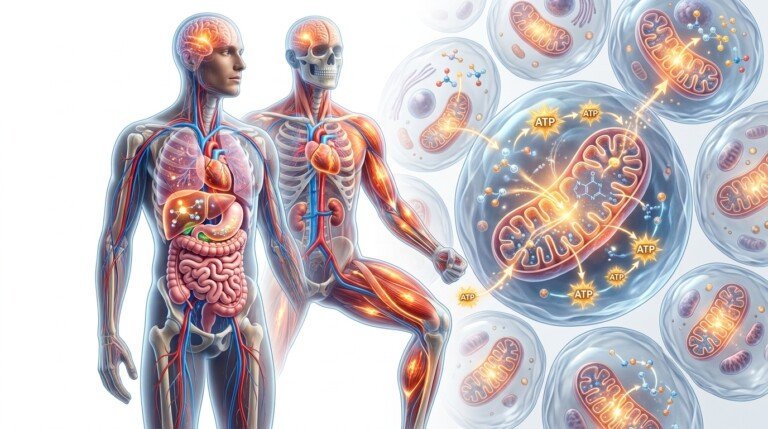
How Does Sugar Addiction Affect the Brain?
The phrase sugar addiction and the brain sounds straightforward until you look closely at what researchers actually know.
Sweet foods clearly interact with brain systems involved in taste, reward, motivation, learning, and food-seeking behavior. Dopamine is involved. Brain regions associated with reward respond to sweet tastes. Repeated exposure to highly palatable foods can influence learned responses and food preferences.
But there is an important line that should not be crossed too quickly.
A brain response to sugar does not automatically mean sugar is an addictive drug.
Dopamine release does not automatically mean addiction.
And evidence from rats does not automatically prove that the same process produces addiction in humans.
That distinction is especially important because some of the strongest findings about sugar-related tolerance, withdrawal, and addiction-like behavior come from animal studies. Human research is more cautious and, in several areas, considerably less conclusive. One review of the evidence concluded that there was little support for treating sugar itself as an addictive substance in humans, while acknowledging that highly palatable foods can produce powerful reward-related effects.
So what is actually happening inside the brain?
The answer involves a conversation between taste receptors, reward pathways, dopamine, learning, memory, and the brain’s ability to adapt to repeated experiences.
How Does Sugar Affect Dopamine and the Brain’s Reward System?
When you taste something sweet, your brain does not simply receive a message saying “sugar detected.”
A much larger network becomes involved.
Sweet taste information travels from receptors in the mouth through sensory pathways toward brain regions responsible for processing taste. From there, information reaches areas involved in reward, motivation, learning, and food-related decision-making. Research on sweet taste has identified regions including the insula, opercular cortex, striatum, and other areas involved in processing taste and reward.
Dopamine is one component of this system.
It is often described as the brain’s “pleasure chemical,” but that description is too simplistic.
Dopamine is involved in motivation, reinforcement learning, reward prediction, and the process of assigning importance to particular cues and outcomes.
That means dopamine can help teach the brain:
“This mattered. Remember it.”
That is extremely useful when the reward is food.
Humans evolved in environments where finding energy-rich food was important. A brain that learned quickly which foods were valuable had an obvious survival advantage.
Modern food environments can provide highly concentrated sweet and highly palatable foods far more easily than the environments in which these systems evolved.
That does not mean the reward system is broken.
It means an ancient system is operating in a very different environment.
What Dopamine Pathways Does Sugar Consumption Activate?
The pathway most often discussed in food reward research is the mesolimbic dopamine system.
It includes dopamine-producing neurons associated with the ventral tegmental area and projections toward regions such as the nucleus accumbens. The nucleus accumbens is part of the ventral striatum and plays an important role in motivation, reinforcement, and reward-related behavior.
When you encounter a rewarding food, the system does not merely respond to the food after you eat it.
It can also respond to cues that predict the food.
That distinction explains something people experience every day.
Imagine you regularly eat chocolate after dinner.
After enough repetitions, the brain may begin connecting several things:
Dinner ending.
A particular time of night.
The kitchen.
The sight of the chocolate wrapper.
The smell of chocolate.
The expectation of sweetness.
The eventual taste.
The reward system is therefore involved in learning the sequence, not simply reacting to the final bite.
This is one reason food cues can become powerful.
The brain is constantly predicting what is likely to happen next.
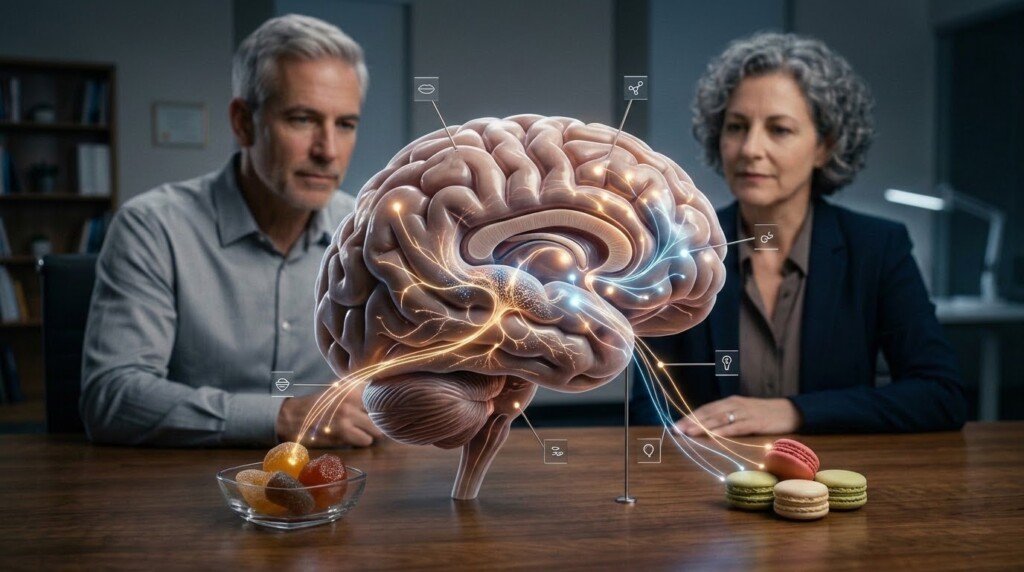
Research in animals has shown that palatable foods can increase dopamine in the nucleus accumbens, and human research has found that sweet taste activates brain regions involved in taste and reward. However, human neuroimaging evidence is not completely consistent, and a systematic review of human fMRI studies described the evidence for reward-related caudate activity as tentative rather than definitive.
That is an important qualification.
The reward system is real.
The uncertainty concerns exactly how strongly different sugar exposures alter that system in humans and whether those changes should be interpreted as addiction.
How Does Chronic Sugar Intake Alter Dopamine Receptor Sensitivity Over Time?
This is where the popular explanation becomes much more complicated.
You will often hear that eating a lot of sugar “damages dopamine receptors” or “depletes dopamine.”
Those statements are too crude.
The brain is constantly adjusting its sensitivity to repeated stimulation. This general principle is called neuroadaptation.
If a particular signal occurs repeatedly, neural systems can change their response to it.
Researchers studying animal models of excessive or intermittent sugar intake have reported changes involving dopamine signaling and receptor-related processes. Some experiments have found patterns that resemble aspects of adaptations seen with addictive substances.
But these findings need context.
Much of this evidence comes from animals exposed to specific experimental conditions, including intermittent access to highly concentrated sugar.
That is not the same thing as a human eating dessert after dinner.
The distinction matters because the conditions of an experiment can influence the biological response.
There is also a major difference between saying:
“Repeated exposure can produce neuroadaptation.”
and saying:
“Normal sugar consumption permanently reduces your dopamine receptors.”
The first is a reasonable description of biological adaptation.
The second is an unsupported generalization.
The brain is plastic.
Plasticity means it can adapt to repeated experiences, but it also means those adaptations are not necessarily permanent.
What Are the Long-Term Neurological Consequences on the Reward System?
There is no simple answer that applies to everyone.
Research into highly palatable diets has raised questions about changes in reward signaling, motivation, cognitive control, and food-related learning. Recent reviews have proposed that prolonged exposure to high-fat, high-sugar dietary patterns may alter reward-related neural circuits, including dopamine signaling and communication between reward and control regions.
But proposed mechanisms are not the same as established clinical consequences.
This distinction becomes particularly important when discussing humans.
A laboratory finding showing altered receptor expression in an animal model does not automatically mean a person eating a high-sugar diet will develop a measurable neurological disorder.
Human nutrition research is affected by many variables.
People eat mixed diets.
They differ in sleep, stress, activity, body composition, metabolic health, medications, and overall dietary patterns.
They also encounter food cues constantly.
For this reason, researchers cannot simply isolate sugar’s neurological effects from everything else happening in a person’s life.
The strongest conclusion is therefore more modest:
Repeated exposure to highly rewarding foods can interact with brain reward and learning systems, and researchers are investigating whether persistent overconsumption can produce meaningful neuroadaptations.
That is very different from claiming that sugar inevitably causes permanent brain damage.
Why Does the Brain Develop a Tolerance to Sugar and Can It Be Reversed?
The word “tolerance” needs careful handling.
In addiction research, tolerance generally refers to needing more of a substance to achieve the same effect.
With food, the situation is not that simple.
You might notice that a dessert you once found intensely sweet no longer seems quite as exciting.
That does not automatically mean your brain has developed a clinical addiction tolerance.
Taste perception can adapt.
Reward responses can change.
Familiarity can reduce novelty.
Appetite can fluctuate.
And repeated exposure can alter learned expectations.
All of these processes can contribute to changes in how rewarding a particular food feels.
Animal research has reported neurochemical adaptations after repeated intermittent sugar consumption, including changes involving dopamine and opioid systems.
However, translating these findings into a universal human “sugar tolerance” model is not justified.
The human evidence is more limited.
How Does the Brain’s Reward System Adapt to Frequent Sugar Consumption?
The brain is designed to adapt.
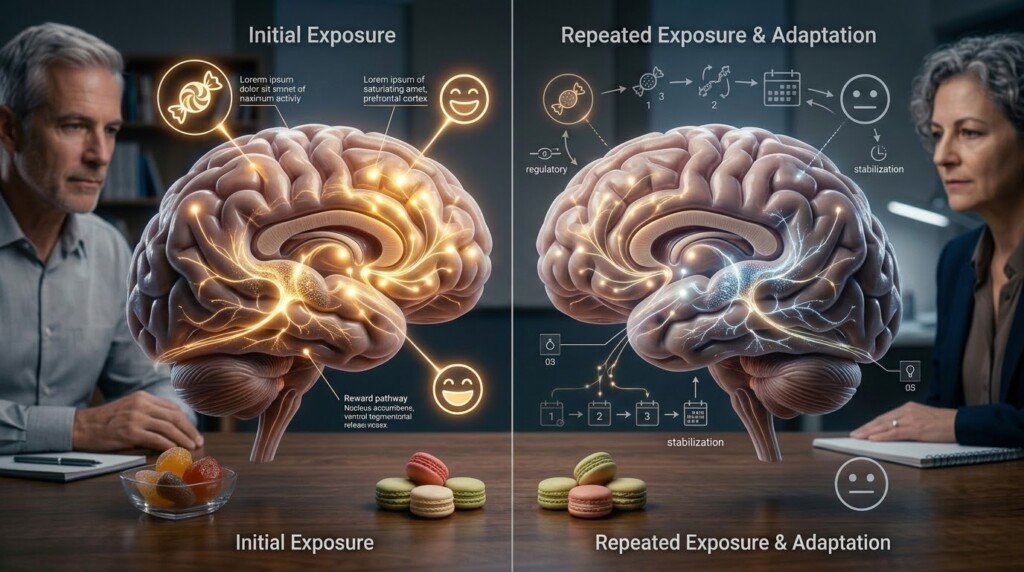
If every meal produces the exact same sensory and reward signal, the response does not necessarily remain identical forever.
This is part of normal neural processing.
Imagine eating your favorite dessert for the first time.
The experience may be highly memorable because it is new.
Now imagine eating the same dessert every night for six months.
You may still enjoy it, but the experience may feel less novel.
That does not necessarily mean you need increasing amounts of dessert to experience pleasure.
It may simply reflect familiarity.
Food reward also involves learning.
The brain learns which foods provide energy and which environmental cues predict them.
The smell of freshly baked cookies can trigger anticipation before you take a bite.
A restaurant menu can create expectations before food arrives.
A television show can become associated with evening snacking.
A particular time of day can become linked to a familiar eating routine.
Over time, these learned associations can influence behavior independently of conscious hunger.
This is one reason the brain cannot be understood by looking at dopamine in isolation.
Reward is not simply a chemical switch.
It is a network involving sensory information, memory, prediction, motivation, and behavioral learning.
What Are the Consequences of This Tolerance on Appetite and Metabolism?
It is tempting to say that dopamine adaptation directly causes overeating or slows metabolism.
The evidence does not support such a simple chain.
Brain reward systems influence food motivation, but metabolism is regulated by a much larger network.
Hormones, energy availability, gastrointestinal signals, the hypothalamus, physical activity, body composition, and many other factors contribute to energy regulation.
The brain also receives signals from the digestive system that help regulate hunger and satiety.
This means the reward system is only one part of a larger control system.
A person can experience strong food reward without automatically gaining weight.
Conversely, a person can gain weight without experiencing anything that should be described as sugar addiction.
This is why it is dangerous to turn neuroscience into a single-cause explanation for obesity.
There are multiple systems operating simultaneously.
Can Sugar Tolerance in the Brain Actually Be Reversed?
The evidence does not support a universal timeline such as “your dopamine receptors reset in seven days.”
Those claims are usually far more confident than the research allows.
The brain is capable of adaptation, and neural plasticity means that responses to repeated experiences can change when the experience changes.
Animal research has shown that some neurochemical effects associated with intermittent sugar intake can change when the experimental conditions change. But this does not give us a precise human protocol for “resetting” the brain.
That distinction is worth remembering whenever you see a dopamine-reset program advertised online.
The brain is not a computer with a single reset button.
It is a living system continuously responding to sensory input, behavior, sleep, stress, learning, hormones, and environment.
A reduction in exposure to highly rewarding foods may change learned associations and food preferences over time.
But claiming that the brain requires a specific number of days to completely reset is not supported by the evidence.
Why Does the Brain Crave Sugar So Intensely in the First Place?
There is a deeper question behind the attraction to sweetness.
Why does the brain care so much about sweet taste?
Part of the answer lies in evolutionary biology.
Sweetness historically provided useful information.
Foods containing readily available carbohydrates could provide energy.
A preference for sweetness therefore had potential survival value.
The brain did not evolve in an environment containing convenience stores, candy aisles, soda machines, and unlimited access to highly concentrated sweets.
It evolved in environments where obtaining energy could be difficult.
A system that encouraged humans to notice and value energy-rich foods made sense.
Modern food technology changed the environment dramatically.
We can now concentrate sweetness, fat, flavor, and texture into foods that are extremely easy to consume.
The brain still recognizes the reward.
It does not necessarily know that the food environment has changed.
Are There Evolutionary Reasons the Brain Is Wired to Prefer Sweet Tastes?
Yes, although the exact evolutionary story is more complicated than “humans evolved to eat sugar.”
Sweet taste is broadly attractive across species, and research suggests that neural systems connecting sweet taste with reward are deeply conserved.
There is an obvious biological advantage to detecting energy-rich foods.
However, humans also learn food preferences through experience.
Early exposure, culture, family habits, availability, and repeated eating experiences can shape what foods people find appealing.
So the attraction to sweetness is not purely genetic destiny.
It is an interaction between biology and learning.
That distinction matters because it means the modern preference for extremely sweet foods cannot be explained solely by ancient survival instincts.
The brain comes with a basic attraction to sweetness.
The environment teaches it what foods to expect.
Repeated experiences strengthen associations.
Marketing increases exposure.
Convenience increases availability.
And social habits can reinforce the behavior.
The result is a food environment very different from the one in which our reward systems developed.
Why Does Sugar Feel Rewarding Even When You Know You Have Had Enough?
This is one of the most interesting parts of food neuroscience.
Hunger and reward are related, but they are not identical.
You can be physically full and still want dessert.
That does not necessarily mean something is wrong with your brain.
It means different motivational systems can be active at the same time.
Homeostatic eating is largely concerned with meeting energy needs.
Hedonic eating involves pleasure, reward, sensory appeal, and motivation.
The two systems interact.
A person can therefore experience:
“I am not physically hungry.”
and simultaneously:
“I really want that dessert.”
The second statement does not automatically override the first because the brain is not governed by one single hunger switch.
Food reward can remain relevant after energy needs have been met.
This is one reason highly palatable foods can be particularly compelling.
The brain is responding not only to calories but also to sensory properties, learned expectations, and reward value.
Research on sweet taste shows activation across taste and reward-related brain regions, although the precise relationship between sweet taste, caloric content, and reward responses remains an active research area.
Does Sugar Affect the Brain Like Drugs?
This is where careful wording matters most.
Sugar and addictive drugs can involve overlapping reward-related neural systems.
Both can influence dopamine signaling.
Both can interact with learning and reinforcement.
And some animal experiments have found addiction-like behaviors following specific patterns of sugar exposure.
But overlap does not mean equivalence.
The brain uses many of the same signaling systems for normal rewards and for drugs.
Food is a natural reward.
Sex is a natural reward.
Social interaction can be rewarding.
Exercise can be rewarding.
The fact that these experiences involve dopamine does not make them drugs.
The more meaningful question is whether sugar produces the same type and magnitude of neurobiological and behavioral effects as addictive substances in humans.
Current evidence does not justify a simple yes.
A critical review of the sugar addiction literature concluded that human evidence for sugar addiction is limited and argued that findings from animal models should not be prematurely treated as proof of human sugar addiction.
That is a much stronger scientific position than either extreme.
Why Does Highly Palatable Food Matter More Than Sugar Alone?
One reason the sugar addiction debate has become confusing is that many studies and real-world foods do not involve sugar in isolation.
Think about cookies.
They are not simply sugar.
They can contain refined flour, fat, salt, flavor compounds, and a texture designed to be highly appealing.
Ice cream combines sweetness with fat and a specific temperature and texture.
Chocolate combines sugar with fat and distinctive flavor compounds.
Sweetened beverages provide sweetness in an extremely convenient form.
This matters because the brain responds to the entire sensory and nutritional experience.
Research increasingly examines highly processed foods rather than isolating one nutrient as the sole cause of addictive-like eating. Recent reviews have proposed that combinations of sensory properties and nutrients may be especially relevant to compulsive eating patterns.
That does not mean every highly processed food is addictive.
It means the question may be more complicated than:
“Does sugar cause addiction?”
A better scientific question may sometimes be:
“Why do some highly palatable foods produce unusually strong reinforcement and loss-of-control eating in some people?”
That question leaves room for the complexity that human eating actually involves.
What Does the Brain Research Mean for Someone Who Struggles With Sugar?
It means your experience is not necessarily a simple matter of willpower.
The brain is designed to learn from rewarding experiences.
If a particular food repeatedly provides a strong sensory reward, the brain can remember that experience and learn the cues associated with it.
That does not mean you are permanently “hijacked.”
It does not mean your dopamine system is broken.
And it does not mean you are medically addicted to sugar.
It means eating behavior involves biology, learning, environment, and decision-making.
That is a more useful way to understand the problem.
If you are trying to understand whether your own behavior fits a broader pattern of problematic eating, the signs of sugar addiction article looks at the behavioral side rather than repeating the neuroscience here.
The broader question of why some people may be more vulnerable to problematic sugar-related eating is covered separately in why people become addicted to sugar.
And if your immediate concern is what to do about persistent cravings, how to stop sugar cravings focuses on practical strategies rather than the underlying brain science.
That separation matters.
Understanding the mechanism is not the same as knowing what intervention will work for you.
What Is the Most Honest Way to Understand Sugar and the Brain?
Think of sugar as one input into a very complicated biological system.
Sweet taste activates sensory pathways.
Those signals interact with reward-related brain regions.
Dopamine contributes to motivation, reinforcement, and learning.
Repeated experiences can strengthen associations between foods and environmental cues.
The brain can adapt to repeated stimulation.
But none of those statements, individually or together, proves that ordinary sugar consumption causes a clinical addiction.
The strongest evidence for addiction-like neurochemical changes comes from specific animal experiments.
Human neuroimaging confirms that sweet taste engages taste-related regions and provides tentative evidence for reward-related activation, but the human literature has limitations and inconsistent findings.
That is why the responsible conclusion is nuanced.
The brain absolutely responds to sweetness.
The reward system absolutely matters to eating behavior.
Dopamine absolutely participates in food motivation and learning.
But the popular claim that sugar simply “hijacks your brain like cocaine” goes beyond what current human evidence can establish.
Frequently Asked Questions
1. How Does Sugar Affect the Brain?
Sugar and sweet taste activate brain systems involved in taste, reward, motivation, and learning. Human neuroimaging research consistently identifies activation in primary taste regions and provides some evidence of reward-related activity, although the strength and interpretation of that reward response remain areas of research.
2. Does the Brain Build a Tolerance to Sugar?
Repeated exposure to highly palatable foods can produce adaptations in reward-related systems, and animal studies have reported changes in dopamine and opioid signaling after specific patterns of excessive or intermittent sugar intake. However, evidence for a universal clinical “sugar tolerance” in humans is limited, so claims about a precise dopamine reset or tolerance timeline should be treated cautiously.
3. Why Does Sugar Feel So Rewarding?
Sweet taste activates sensory pathways that communicate with brain regions involved in food reward and motivation. Dopamine is part of this system and helps reinforce learning and motivation around rewarding experiences. This does not mean dopamine simply creates pleasure or that sugar is automatically addictive.
4. Does Sugar Affect the Brain Like Drugs?
Sugar and addictive drugs can involve some overlapping reward-related pathways, but that does not make their effects equivalent. Evidence for sugar addiction in humans remains limited, and animal findings cannot automatically be translated into a human diagnosis.
5. Can Changes in the Brain From Frequent Sugar Intake Be Reversed?
The brain is capable of adaptation and plasticity, but there is no scientifically established universal “sugar reset” timeline. Some adaptations observed in animal studies can change when exposure patterns change, but human research does not support a simple seven-day, 14-day, or 30-day dopamine-reset rule.
The Bottom Line on Sugar Addiction and the Brain
The brain does not treat sweetness as irrelevant.
It notices it.
It processes it.
It can find it rewarding.
It can learn the cues that predict it.
And repeated exposure to highly palatable foods can interact with the neural systems involved in reward, motivation, and learning.
That part is not controversial.
The controversy begins when those facts are turned into a much bigger claim.
Dopamine is not proof of addiction.
A reward response is not proof of addiction.
Animal withdrawal behavior is not proof that humans are addicted to sugar.
And a brain scan showing activation in a reward-related region does not tell us that a person has developed a psychiatric disorder.
The human evidence is considerably more nuanced.
A systematic review of human sweet-taste neuroimaging studies found strong evidence for activation of primary taste areas and only tentative evidence for reward-related caudate activity, with researchers emphasizing that larger datasets are needed for firm conclusions.
Meanwhile, animal studies have shown that specific patterns of excessive or intermittent sugar exposure can produce striking behavioral and neurochemical changes, including changes involving dopamine and opioid systems.
Those findings are worth studying.
They simply need to remain in their proper context.
The most useful way to think about sugar addiction and the brain is therefore not as a story about a single ingredient taking control of your mind.
It is a story about a highly adaptive brain interacting with a highly rewarding food environment.
Taste, reward, memory, expectation, learning, energy regulation, and behavior all meet in that system.
And that is precisely why the neuroscience is more interesting than the slogan.
Sugar does not need to be called a drug for the brain’s response to sweetness to matter.
It is enough to understand that the brain evolved to value energy-rich foods, learned to associate rewarding foods with their surrounding cues, and can adapt to repeated experiences.
Once you understand that, the conversation becomes more useful.
Less sensational.
More accurate.
And much closer to what the research actually tells us.
Disclaimer:
This post may contain affiliate links. If you purchase through them, we may earn a small commission at no extra cost to you. Also, this content is for informational purposes only and does not substitute professional medical advice.
Ready to Start Your Journey?
Use our free 7-in-1 Weight Loss Toolkit to calculate your numbers and build your plan in minutes.
Open Free Tools →