
Calorie Deficit Calculator Guide: How to Estimate Your Daily Calories Accurately
You have probably searched for a calorie calculator, entered your age, weight, height, and activity level, and instantly received a daily calorie target. It seems simple enough. But then you try another calculator and get a completely different number.
So which one is correct?
That’s exactly why understanding a Calorie Deficit Calculator Guide is more valuable than relying on any single calculator. Online calorie calculators are useful starting points, but they estimate your energy needs rather than calculate them with perfect precision. Knowing how these tools work, what information they use, and their limitations allows you to make better decisions about your calorie intake and long-term weight management.
Rather than treating a calculator as an exact answer, it’s better to think of it as a practical estimate that should be adjusted as your body, activity level, and goals change over time.
In this article, you’ll learn how calorie deficit calculators estimate daily calorie needs, what information produces the most accurate results, common mistakes that reduce accuracy, and how to use calculator results as part of a sustainable weight-loss strategy.
Quick Answer
A Calorie Deficit Calculator Guide helps estimate how many calories your body needs each day by using information such as your age, sex, height, weight, and activity level. Most calculators estimate your Total Daily Energy Expenditure (TDEE), then subtract calories to suggest a calorie target for gradual fat loss. Because these are estimates, the results should be reviewed and adjusted based on real-world progress.
What Is a Calorie Deficit Calculator?
A calorie deficit calculator is an online tool designed to estimate how many calories your body uses each day.
Once your estimated daily calorie needs are calculated, the tool suggests a lower calorie intake that may support gradual weight loss.
Although different websites use different formulas, the overall goal is the same.
Estimate daily energy expenditure and provide a practical calorie target.
A Calculator Estimates, Not Measures
One of the biggest misconceptions is believing a calculator can determine your exact calorie needs.
It cannot.
Instead, it estimates calorie requirements using mathematical equations based on average population data.
Your actual energy needs may be slightly higher or lower depending on your lifestyle, body composition, and genetics.
Why People Use Calorie Deficit Calculators
These tools are popular because they provide a simple starting point for people who want to:
- Lose body fat
- Maintain weight
- Understand daily calorie needs
- Set realistic calorie goals
- Track long-term progress
Readers new to energy balance may also find Calorie Deficit helpful for understanding why eating fewer calories than you burn supports fat loss.
How Do Calorie Deficit Calculators Work?
Most calorie calculators follow a similar process.
They estimate how many calories your body uses at rest, then adjust that estimate according to your daily activity level.
The result is an estimate of your Total Daily Energy Expenditure (TDEE).

Step 1: Estimate Daily Energy Needs
Every day your body burns calories through:
- Breathing
- Circulation
- Digestion
- Brain activity
- Physical movement
- Exercise
These activities combine to create your total daily calorie expenditure.
Step 2: Estimate Maintenance Calories
Maintenance calories represent the approximate number of calories needed to maintain your current body weight.
If calorie intake closely matches calorie expenditure over time, body weight generally remains stable.
Step 3: Estimate a Calorie Deficit
Once maintenance calories are estimated, the calculator subtracts calories to create a calorie deficit.
The goal is to encourage gradual fat loss while maintaining enough energy to support normal body functions.
Readers wanting to understand this calculation manually may also enjoy How to Calculate a Calorie Deficit, which explains the process step by step.
Which Information Do You Need Before Using One?
The quality of a calculator’s estimate depends largely on the information entered.
More accurate inputs generally produce more useful estimates.
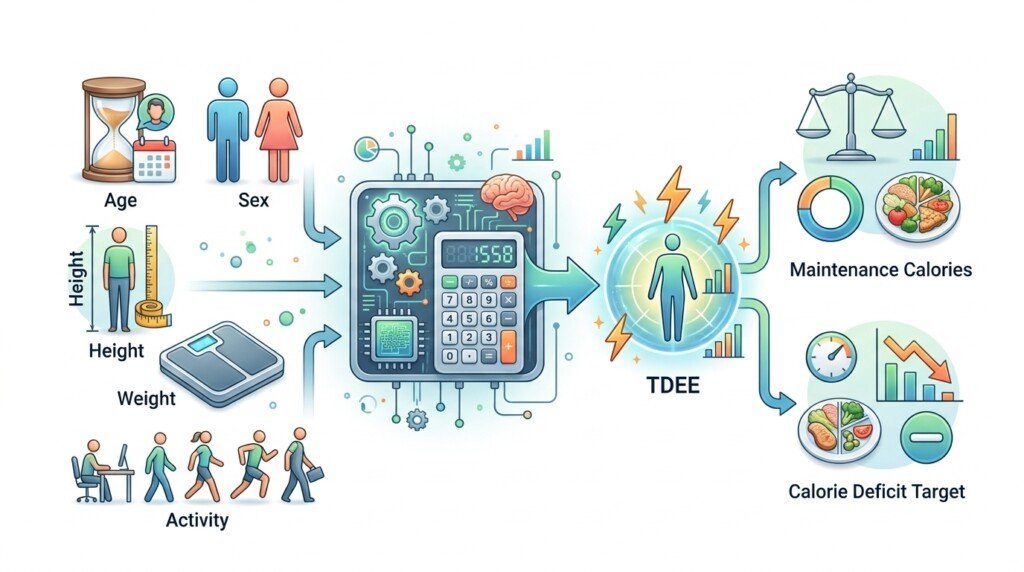
Age
Energy needs gradually change throughout adulthood.
Including your current age helps improve the estimate.
Sex
Biological sex influences average body composition and daily calorie expenditure, making it an important factor in most calculator formulas.
Height and Weight
Current height and body weight help estimate overall energy requirements.
Keeping these values updated is important because calorie needs change as body weight changes.
Activity Level
One of the biggest factors affecting calculator accuracy is activity level.
Most calculators ask users to choose between categories such as:
- Sedentary
- Lightly active
- Moderately active
- Very active
- Extra active
Selecting a category that best reflects your average lifestyle generally produces a better estimate.
Be Honest About Activity
Many people unintentionally overestimate how active they are.
Choosing a higher activity level than your actual routine can result in an inflated calorie target.
Being realistic usually leads to more accurate estimates.
How Accurate Are Online Calorie Calculators?
Online calculators are useful tools, but they should never be viewed as perfect predictions.
They estimate calorie needs using equations that work well for many people but cannot account for every individual difference.
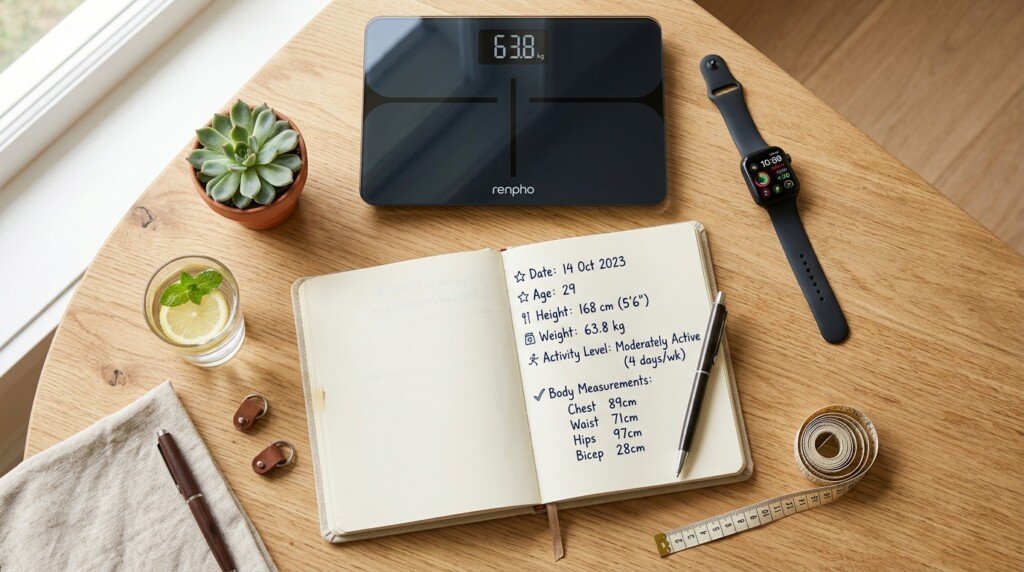
Everyone Has a Unique Metabolism
Although calculators use well-established research, factors such as body composition, genetics, occupation, and daily movement vary from person to person.
This explains why two people with similar height and weight may have slightly different calorie needs.
Readers interested in energy expenditure may also find Resting Metabolic Rate useful for understanding one component of daily calorie needs.
Activity Can Change From Day to Day
Most calculators assume your activity level remains relatively consistent.
In reality, daily movement often changes because of:
- Work schedules
- Exercise routines
- Travel
- Illness
- Lifestyle changes
These variations naturally affect calorie expenditure.
Think of the Result as a Starting Point
Instead of expecting perfect accuracy, use calculator results as an initial estimate.
Real-world progress provides the most valuable feedback.
If your weight remains stable for several weeks despite following the suggested calorie target, your maintenance calories may differ slightly from the estimate.
Readers interested in measuring metabolism through additional methods may also enjoy Metabolism Test, which discusses other approaches used to assess metabolic function.
How Should You Adjust Your Calorie Target Over Time?
Your calorie target should not remain exactly the same throughout your entire weight-loss journey.
As your body changes, so do your energy requirements.
Reviewing your calorie target from time to time helps ensure your estimate continues to reflect your current body weight and activity level.
Recalculate After Meaningful Weight Changes
As you lose weight, your body generally requires fewer calories to maintain itself.
A calorie target that worked well several months ago may gradually become less accurate.
Many people benefit from recalculating their calorie needs after noticeable changes in body weight rather than continuing to use the same number indefinitely.
Review Changes in Activity Level
Daily energy expenditure is influenced by more than planned exercise.
Changes such as:
- Starting a new job
- Walking more
- Sitting more
- Increasing workout frequency
- Reducing physical activity
can all affect your calorie needs.
Updating your activity level helps keep your estimate realistic.
Compare Calculator Results With Real Progress
The best way to evaluate a calculator is to compare its estimate with what actually happens over several weeks.
If your body weight remains relatively stable while consistently following the estimated maintenance calories, the estimate is likely close to your true maintenance needs.
If results differ, small adjustments may improve accuracy over time.
Readers wanting practical long-term strategies may also enjoy Sustainable Weight Loss, which focuses on adapting healthy habits as your body changes.
What Mistakes Reduce Calculator Accuracy?
Even a high-quality calorie calculator cannot produce reliable results if the information entered is inaccurate.
Fortunately, most mistakes are easy to avoid.

Overestimating Activity Level
This is probably the most common mistake.
Many people choose a higher activity category because they exercise several times each week.
However, calculators consider total daily movement, not just scheduled workouts.
If most of the day is spent sitting, selecting a highly active category may overestimate calorie needs.
Forgetting That Body Weight Changes
Some people continue using the same calorie estimate for months without updating their body weight.
Since calorie needs gradually change during weight loss, recalculating periodically improves accuracy.
Expecting Exact Precision
A calculator is designed to estimate, not predict, your exact calorie needs.
Small differences between estimated and actual calorie expenditure are completely normal.
Using the calculator as a flexible starting point generally produces better long-term results than treating every calorie as an exact measurement.
Ignoring Lifestyle Changes
Major lifestyle changes often influence calorie expenditure.
Examples include:
- New exercise routines
- Seasonal activity changes
- Job changes
- Travel
- Recovery from illness
Updating your information after these changes helps maintain a more realistic calorie estimate.
Should You Rely Only on a Calculator?
No.
A calorie calculator is an excellent starting point, but it should never become the only tool guiding your decisions.
Your own progress provides equally valuable information.
Your Body Provides Real-World Feedback
Pay attention to indicators such as:
- Body weight trends
- Waist measurements
- Clothing fit
- Exercise performance
- Energy levels
- Overall consistency
These observations often provide better long-term guidance than relying only on a calculator.
Healthy Habits Still Matter
Even the most accurate calorie estimate cannot replace healthy lifestyle habits.
Successful weight management also depends on:
- Balanced nutrition
- Regular physical activity
- Adequate sleep
- Stress management
- Consistency
Readers beginning their weight-loss journey may also find Weight Loss Guide helpful because it explains how these habits work together.
Think of the Calculator as a Navigation Tool
A navigation app suggests the best route based on current information, but you still adjust if road conditions change.
A calorie calculator works in much the same way.
It provides a useful direction, while your progress determines whether small adjustments are needed.
Future readers may also benefit from Safe Calorie Deficit, which explains how to choose an appropriate calorie target, and When Does a Calorie Deficit Stop Working?, which explores why calorie needs change during long-term weight loss.
Key Takeaways
| Topic | What You Should Know |
|---|---|
| Calorie deficit calculator | Estimates daily calorie needs using personal information and activity level. |
| TDEE | Most calculators estimate Total Daily Energy Expenditure before suggesting a calorie target. |
| Activity level | Choosing an accurate activity category improves calculator reliability. |
| Calculator accuracy | Results are estimates and should be adjusted using real-world progress. |
| Recalculation | Updating body weight and activity level helps keep calorie targets accurate over time. |
| Healthy habits | Long-term success depends on consistency, not the calculator alone. |
| Practical use | Use the calculator as a starting point, then refine your calorie target based on actual progress. |

Frequently Asked Questions
1. Which calorie deficit calculator is most accurate?
No calculator is perfectly accurate for everyone. Most reputable calculators provide useful estimates when you enter accurate information and realistic activity levels.
2. How often should I recalculate my calories?
Recalculate after meaningful changes in body weight, activity level, or lifestyle to keep your calorie estimate aligned with your current energy needs.
3. Why do different calorie calculators give different results?
Different calculators may use different prediction equations and activity assumptions, which can produce slightly different calorie estimates.
4. Can a calorie calculator predict weight loss exactly?
No. A calculator estimates calorie needs, but individual differences in metabolism, activity, and body composition affect actual results.
5. What is TDEE?
TDEE stands for Total Daily Energy Expenditure. It represents the estimated number of calories your body uses during an average day.
6. Why is choosing the correct activity level important?
Selecting an activity level that accurately reflects your daily lifestyle improves the quality of the calorie estimate.
7. Should I change my calorie goal after losing weight?
Yes. As body weight changes, calorie needs usually change as well. Periodically updating your information helps maintain a realistic calorie target.
8. Are calorie calculators useful for maintaining weight?
Yes. They can estimate maintenance calories as well as calorie targets for weight loss or weight maintenance.
9. Should I rely only on a calorie calculator?
No. Combine calculator estimates with body weight trends, measurements, exercise performance, and overall well-being for better long-term decision-making.
10. What is the biggest mistake people make when using calorie calculators?
One of the most common mistakes is overestimating activity level, which can lead to calorie targets that are higher than actual energy needs.
Conclusion
A Calorie Deficit Calculator Guide provides a practical starting point for estimating your daily calorie needs, but it should never be viewed as an exact measurement. These calculators use information such as age, weight, height, and activity level to estimate Total Daily Energy Expenditure, helping you set an initial calorie target for weight management. While the calculations are based on well-established formulas, individual differences in metabolism, body composition, and lifestyle mean that the results should always be treated as estimates rather than guarantees.
The most effective way to use a calorie calculator is to combine it with real-world feedback. Updating your body weight, reviewing changes in activity level, and monitoring long-term progress allow you to refine your calorie target as your needs change. When paired with balanced nutrition, regular physical activity, and sustainable habits, a calorie calculator becomes a valuable tool for supporting healthy, long-term weight management rather than simply providing a number to follow.
Disclaimer:
This post may contain affiliate links. If you purchase through them, we may earn a small commission at no extra cost to you. Also, this content is for informational purposes only and does not substitute professional medical advice.
Ready to Start Your Journey?
Use our free 7-in-1 Weight Loss Toolkit to calculate your numbers and build your plan in minutes.
Open Free Tools →