

What Is Resting Metabolic Rate (RMR)? How It Affects Weight Loss
When people think about calorie burning, they usually picture running, lifting weights, or spending hours at the gym. What many do not realize is that your body is burning calories every single minute, even while you are sleeping, reading, or simply sitting on the couch.
This constant energy use is largely explained by your Resting Metabolic Rate. It represents the calories your body needs to keep you alive by supporting essential functions such as breathing, circulation, brain activity, and maintaining normal body temperature. Understanding Resting Metabolic Rate can help you make more informed decisions about weight loss, calorie intake, and long-term metabolic health.
Contrary to popular belief, exercise is only one part of your daily calorie expenditure. In fact, for many people, Resting Metabolic Rate accounts for the largest portion of calories burned each day. That is why learning how it works is far more valuable than relying on metabolism myths or quick fixes.
This article explains what Resting Metabolic Rate is, how it differs from Basal Metabolic Rate (BMR), what influences it, and why it plays such an important role in healthy weight management.
Quick Answer
Resting Metabolic Rate is the number of calories your body burns each day while at rest to perform essential life-sustaining functions such as breathing, circulation, brain activity, and cell maintenance. For most adults, it accounts for approximately 60 to 75 percent of total daily energy expenditure, making it one of the biggest factors influencing calorie needs and weight management.
What Is Resting Metabolic Rate?
Imagine spending an entire day lying comfortably in bed without exercising.
Even then, your body would continue burning a significant number of calories.
That energy keeps your organs functioning normally and supports countless biological processes that never stop.
This ongoing calorie use is known as Resting Metabolic Rate.

Your Body Never Truly Rests
Although you may feel inactive, your body remains remarkably busy.
Every minute it continues to:
- Pump blood through your body
- Deliver oxygen to tissues
- Support brain activity
- Maintain body temperature
- Repair damaged cells
- Produce hormones
- Support immune function
Each of these processes requires energy.
Resting Metabolic Rate Is Your Baseline Energy Requirement
Think of RMR as the minimum amount of energy your body needs to stay alive while resting.
It does not include calories burned through:
- Exercise
- Walking
- Household chores
- Digestion
- Recreational activities
Those activities contribute additional energy expenditure beyond your resting needs.
RMR Makes Up Most Daily Calorie Burn
Many people are surprised to learn that resting metabolism usually accounts for the largest share of total daily calorie expenditure.
While the exact percentage varies between individuals, RMR generally represents the majority of calories burned each day.
That is why understanding it is so valuable for long-term weight management.
RMR Changes Throughout Life
Your resting calorie needs are not fixed forever.
They gradually change alongside:
- Body composition
- Lean muscle mass
- Age
- Overall health
- Physical activity
The broader relationship between aging and metabolism is explored throughout Metabolism by Age.
What Is the Difference Between RMR and BMR?
People often use Resting Metabolic Rate (RMR) and Basal Metabolic Rate (BMR) as though they mean exactly the same thing.
Although they are closely related, they are measured under slightly different conditions.
Understanding the distinction helps avoid unnecessary confusion.

Basal Metabolic Rate Is a Laboratory Measurement
BMR represents the minimum amount of energy your body needs under extremely controlled conditions.
To measure BMR accurately, researchers typically require:
- Complete physical rest
- Overnight fasting
- Controlled room temperature
- No recent exercise
- Specialized laboratory conditions
Because these requirements are very strict, BMR is rarely measured outside research settings.
Resting Metabolic Rate Reflects Everyday Conditions
RMR is measured under less restrictive circumstances.
Although you are still resting, the testing conditions are more practical and easier to achieve.
For that reason, RMR is used much more frequently in clinical practice and nutrition planning.
The Numbers Are Usually Similar
For most healthy adults, RMR and BMR differ only slightly.
In everyday conversations about metabolism, either measurement provides a useful estimate of resting calorie needs.
Focus on Understanding Rather Than Memorizing
Knowing the exact difference between RMR and BMR is less important than understanding what both measurements represent.
They both estimate how much energy your body requires simply to stay alive.
How Is Resting Metabolic Rate Calculated?
Most people never measure their RMR directly.
Instead, healthcare professionals often estimate it using formulas based on several personal characteristics.

Body Size Matters
Larger bodies generally require more energy.
This is because maintaining more tissue demands additional calories.
Lean Muscle Has an Important Role
Muscle contributes significantly to resting energy expenditure.
Individuals with greater lean muscle often have higher resting calorie requirements than those with less muscle.
This is one reason Strength Training for Fat Loss supports long-term metabolic health.
Age Influences Estimates
As body composition changes throughout adulthood, estimated RMR usually changes as well.
These adjustments reflect gradual biological changes rather than a sudden decline.
Sex Also Plays a Role
Men often have slightly higher estimated RMR values than women because they generally possess greater amounts of lean muscle.
Individual variation, however, remains substantial.
Height and Weight Are Included
Most RMR estimation equations also consider:
- Height
- Current body weight
These measurements help estimate overall energy requirements more accurately.
Estimated Values Are Starting Points
Calculated RMR should be viewed as an estimate rather than an exact number.
Many additional factors influence real-world calorie expenditure.
Future discussions throughout Metabolism Test explain professional assessment methods in greater detail.
Which Factors Affect Resting Metabolic Rate?
Although genetics contribute to metabolism, several biological characteristics influence RMR throughout life.
Understanding these factors explains why calorie needs differ so much between individuals.
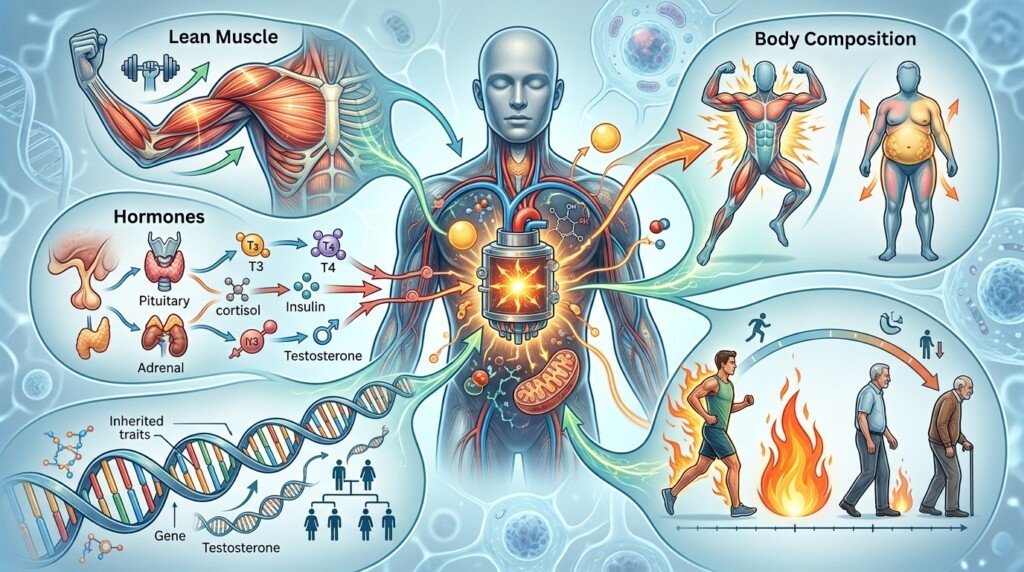
Lean Muscle Mass
Muscle remains one of the strongest influences on resting calorie expenditure.
Maintaining healthy muscle supports greater energy requirements even while resting.
Body Composition
Two individuals weighing exactly the same may have very different RMR values depending on the proportion of:
- Lean muscle
- Body fat
- Bone mass
Body composition often matters more than body weight alone.
Age
Gradual changes in muscle and body composition influence resting calorie needs over time.
These changes are discussed more extensively throughout Metabolism by Age.
Biological Sex
Average differences in lean muscle contribute to small differences in resting metabolism between men and women.
However, lifestyle and body composition remain equally important.
Genetics
Each person inherits a unique metabolic profile.
Genetics influence metabolism, but they do not completely determine long-term metabolic health.
Healthy habits still play an important role.
Hormonal Regulation
Several hormones help regulate how efficiently your body uses energy.
Normal hormonal changes throughout life contribute to gradual differences in resting calorie expenditure.
Physical Activity
Although exercise itself is not part of RMR, regular activity helps preserve lean muscle, indirectly supporting healthier resting metabolism over time.
This relationship becomes especially important during long-term weight management.
Can You Increase Your Resting Metabolic Rate?
Many people hope there is a simple way to permanently increase the number of calories they burn at rest. While advertisements often promise dramatic results, the reality is much more practical.
Your Resting Metabolic Rate is influenced by biology, body composition, and long-term lifestyle habits. Although you cannot completely transform it overnight, there are healthy ways to support it over time.

Build and Preserve Lean Muscle
The most effective long-term strategy is maintaining lean muscle.
Because muscle requires energy for normal maintenance, preserving muscle helps support a higher resting calorie expenditure than losing muscle through inactivity or repeated crash dieting.
This is one reason Strength Training for Fat Loss remains an important part of sustainable weight management.
Stay Physically Active
Exercise does not directly increase your RMR forever after every workout.
Instead, regular physical activity helps maintain muscle, improve body composition, and support healthy metabolic function over time.
Avoid Repeated Crash Dieting
Long periods of severe calorie restriction may encourage the body to conserve energy.
Choosing realistic, sustainable approaches often supports healthier long-term metabolism than repeatedly following restrictive diets.
Healthy long-term strategies are discussed throughout Sustainable Weight Loss.
Focus on Long-Term Habits
There is no permanent metabolism shortcut.
Consistent healthy behaviors practiced for months and years have a much greater influence than temporary challenges or viral trends.
Does Muscle Mass Increase RMR?
Among all the factors influencing resting metabolism, lean muscle consistently plays one of the most important roles.
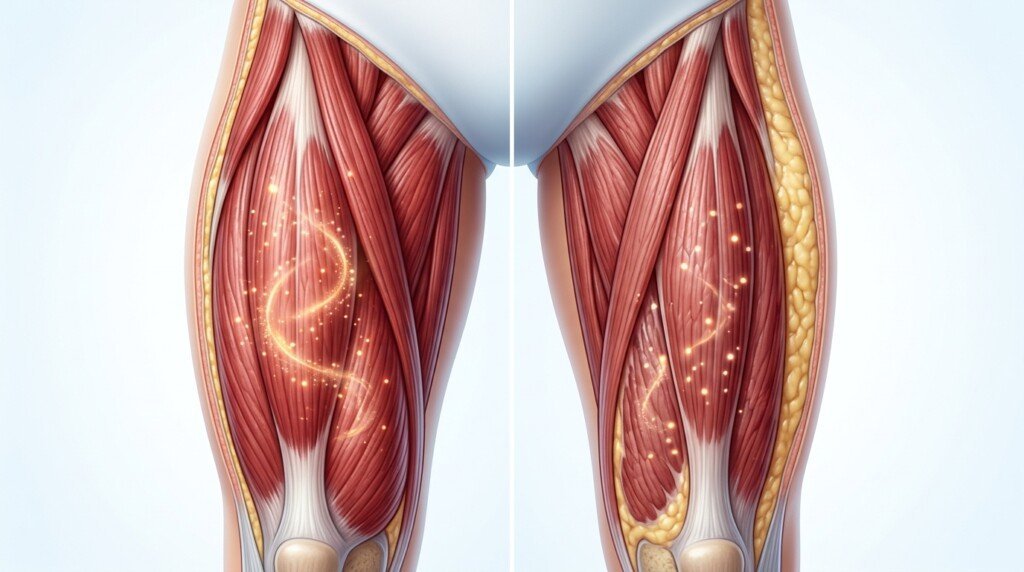
Muscle Requires Ongoing Energy
Even while resting, muscle tissue continuously undergoes:
- Protein turnover
- Cellular repair
- Tissue maintenance
These processes require energy throughout the day.
This is why people with greater amounts of lean muscle often have higher resting calorie needs.
Muscle Supports Healthy Aging
Maintaining muscle becomes increasingly valuable throughout adulthood.
Healthy muscle contributes to:
- Strength
- Balance
- Mobility
- Physical independence
- Healthy body composition
These benefits extend far beyond calorie burning alone.
More Muscle Does Not Mean Unlimited Calorie Burning
One common myth is that gaining a small amount of muscle dramatically increases metabolism.
The increase is real, but it is often more modest than social media suggests.
The greatest benefit comes from preserving muscle throughout life rather than expecting dramatic calorie-burning changes.
Muscle Supports Sustainable Weight Management
Preserving lean tissue helps support healthy metabolism during both weight maintenance and fat loss.
Combined with consistent physical activity, muscle maintenance creates one of the strongest foundations for long-term metabolic health.
Is RMR Important for Weight Loss?
Absolutely.
Understanding Resting Metabolic Rate helps explain why different people require different numbers of calories.

RMR Determines Most Daily Energy Needs
For many adults, resting metabolism accounts for the majority of total daily calorie expenditure.
That means your body burns more calories supporting essential life functions than it does during formal exercise.
Understanding this relationship creates more realistic expectations for weight management.
Weight Loss Depends on Total Energy Balance
RMR is only one part of the equation.
Daily calorie expenditure also includes:
- Physical activity
- Exercise
- Digestion
- Daily movement
Together, these determine your total energy expenditure.
Knowing Your RMR Helps Set Realistic Goals
People often underestimate how many calories their body naturally requires.
Understanding resting metabolism helps avoid setting unnecessarily restrictive calorie targets.
Healthy Habits Matter More Than One Number
Although RMR provides useful information, successful weight management still depends on consistent behaviors.
Daily movement, resistance training, sustainable eating habits, and realistic expectations remain essential.
Many of these long-term behaviors are explored throughout Weight Loss Habits and the broader Weight Loss Guide.
Should You Measure Your Resting Metabolic Rate?
Not everyone needs to know their exact RMR.
For many healthy adults, estimated values provide sufficient guidance when combined with healthy lifestyle habits.
Estimates Work Well for Most People
Common prediction formulas provide reasonable starting points for understanding calorie needs.
Although they are not perfect, they are often accurate enough for practical weight management.
Measurements May Be Helpful in Certain Situations
Some individuals benefit from more personalized assessment, particularly when working with healthcare professionals.
Examples include:
- Complex medical conditions
- Professional athletic training
- Specialized nutrition planning
Numbers Should Never Replace Healthy Habits
Even the most accurate RMR measurement cannot produce results by itself.
Healthy routines remain far more important than knowing an exact calorie estimate.
A more detailed discussion of professional assessment methods is provided separately throughout Metabolism Test.
RMR at a Glance
If you only remember a few points from this article, focus on these key ideas.
- Resting Metabolic Rate is the energy your body uses to stay alive.
- RMR usually represents the largest portion of daily calorie expenditure.
- RMR is similar to BMR but measured under less restrictive conditions.
- Lean muscle is one of the strongest influences on resting calorie needs.
- Age, body composition, height, weight, sex, and genetics all contribute to RMR.
- Regular exercise supports RMR by helping preserve muscle.
- Sustainable habits matter more than searching for quick metabolism fixes.
- RMR is one important part of successful long-term weight management.

Frequently Asked Questions
1. What is Resting Metabolic Rate?
Resting Metabolic Rate is the number of calories your body burns while resting to support essential functions such as breathing, circulation, and organ function.
2. Is RMR the same as BMR?
No. They are closely related, but BMR is measured under stricter laboratory conditions, while RMR reflects more practical resting conditions.
3. Why is RMR important?
RMR accounts for most of your daily calorie expenditure, making it one of the biggest influences on overall energy needs.
4. What affects Resting Metabolic Rate?
Lean muscle, body composition, age, sex, height, weight, genetics, hormones, and overall health all contribute.
5. Can exercise increase RMR?
Exercise supports RMR primarily by preserving lean muscle rather than dramatically increasing resting calorie burn.
6. Does muscle increase resting calorie burn?
Yes. Muscle requires ongoing maintenance, so individuals with more lean muscle generally have higher resting energy needs.
7. Is RMR useful for weight loss?
Yes. Understanding RMR helps estimate calorie needs and supports realistic weight management goals.
8. Should everyone measure their RMR?
Not necessarily. Estimated values are sufficient for many healthy adults, while professional assessment may benefit certain individuals.
9. Does RMR decrease with age?
It often changes gradually as body composition, muscle mass, and activity levels evolve throughout adulthood.
10. Can healthy habits support RMR?
Yes. Maintaining muscle, staying active, following sustainable lifestyle habits, and supporting overall metabolic health all contribute to healthier resting metabolism.
Final Thoughts
Understanding Resting Metabolic Rate gives you a clearer picture of how your body uses energy every day, even when you are completely at rest. Because RMR represents the largest share of your daily calorie expenditure, it plays an important role in weight management, body composition, and long-term metabolic health. While factors such as age, body size, genetics, and sex influence your resting calorie needs, lean muscle remains one of the most important factors you can actively support through healthy lifestyle habits.
Rather than viewing Resting Metabolic Rate as just another number, think of it as the foundation of your body’s daily energy requirements. Preserving muscle, staying physically active, and following sustainable habits are far more valuable than chasing quick metabolism hacks. As you continue through this metabolism series, you’ll also explore Metabolism, Metabolism Test, Metabolism by Age, Can You Speed Up Your Metabolism Naturally, and Metabolic Adaptation, helping you build a complete understanding of how metabolism works and how to support it throughout every stage of life.
Disclaimer:
This post may contain affiliate links. If you purchase through them, we may earn a small commission at no extra cost to you. Also, this content is for informational purposes only and does not substitute professional medical advice.
Ready to Start Your Journey?
Use our free 7-in-1 Weight Loss Toolkit to calculate your numbers and build your plan in minutes.
Open Free Tools →