
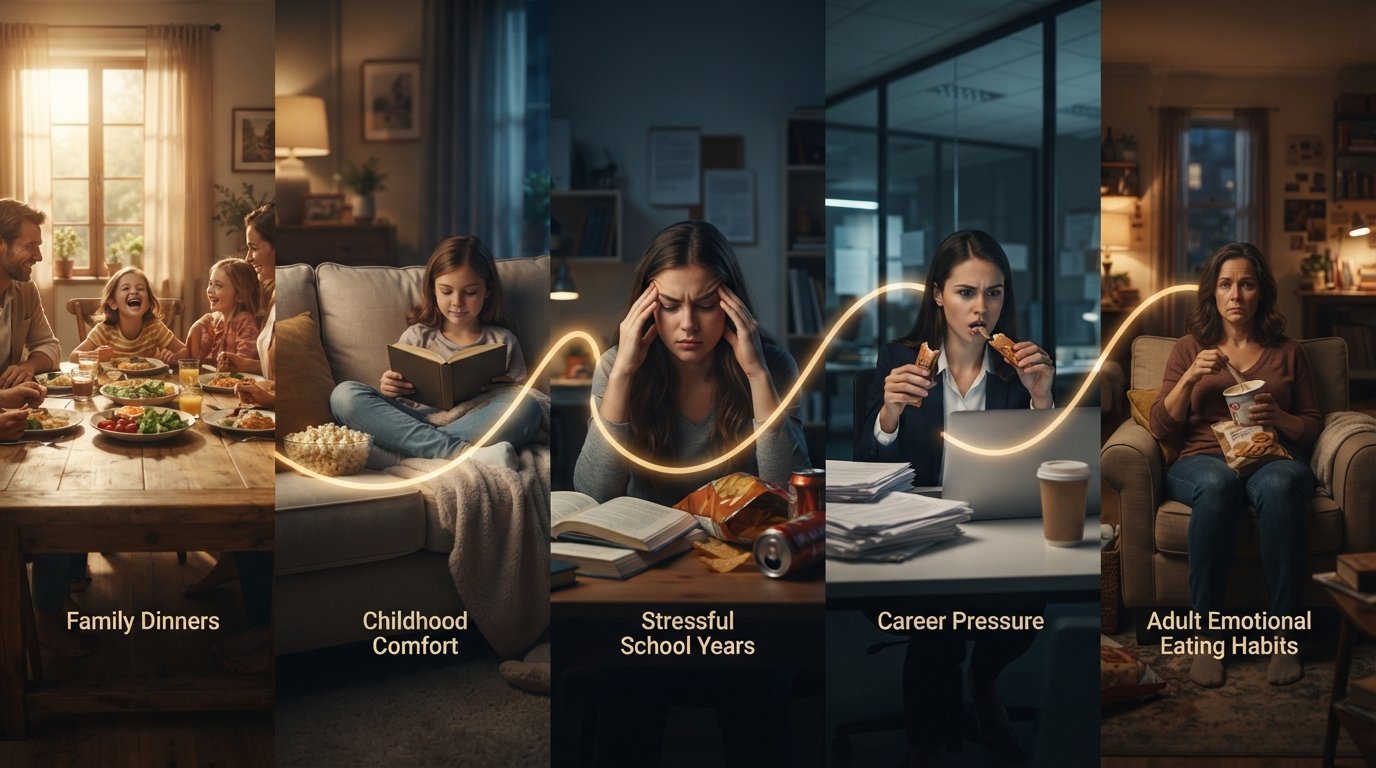
When Do Emotional Eating Patterns Typically Develop?
Most people assume emotional eating begins the first time someone reaches for food during a stressful day. In reality, the pattern usually starts much earlier and develops gradually through repeated life experiences. Emotional eating rarely appears overnight. Instead, it grows through learned behaviors, emotional associations, family influences, major life events, and the brain’s natural ability to remember what provides comfort during difficult moments.
Understanding when does emotional eating develop helps explain why it can feel so automatic in adulthood. Many people are surprised to discover that their eating habits were quietly shaped years before they ever recognized emotional eating as a pattern. Childhood experiences, family routines, adolescence, and significant life transitions all contribute to how someone eventually responds to emotions around food.
At the same time, emotional eating is not something people are destined to develop because of their childhood alone. Some individuals grow up with healthy eating environments yet begin emotionally eating later in life after prolonged stress, grief, illness, relationship changes, or other major challenges. Others experience difficult childhoods but never develop emotional eating at all.
This article explores when emotional eating patterns most commonly begin, how family experiences influence those patterns, why adolescence can become a vulnerable period, and how emotional eating can also emerge for the first time during adulthood.
Quick Answer
When does emotional eating develop? Emotional eating can begin at almost any stage of life. For many people, early family experiences, childhood learning, and adolescence help shape emotional associations with food. Others first develop emotional eating during adulthood after major life events, prolonged stress, trauma, or significant emotional changes. Rather than one single cause, emotional eating usually develops gradually through repeated experiences.
When Do Emotional Eating Patterns Typically Begin?
Unlike many habits that are intentionally practiced, emotional eating often develops without people realizing it. No one consciously decides that food will become their primary way of coping with emotions. Instead, the brain gradually learns this relationship through repetition.
Every time food accompanies comfort, celebration, stress relief, or emotional reassurance, the connection becomes slightly stronger. Eventually, the brain begins expecting food whenever similar emotional situations arise again.

Importantly, this learning process is completely normal. Food naturally plays an important role in family traditions, celebrations, holidays, and caring for loved ones. Problems arise only when emotional comfort becomes the primary purpose of eating rather than one small part of a healthy relationship with food.
The developmental story of emotional eating often begins much earlier than most people expect.
Are Certain Age Groups More Prone to Developing Emotional Eating Habits?
Although emotional eating can begin at any age, certain stages of life create greater opportunities for these patterns to develop because emotional regulation is still evolving or because life circumstances become especially demanding.
Early childhood represents one of the first opportunities for emotional learning. Young children have not yet developed sophisticated ways to regulate disappointment, frustration, fear, or sadness. During these years they naturally depend on parents and caregivers to help them manage emotions. The responses children repeatedly receive during emotionally difficult moments gradually influence how they learn to comfort themselves in the future.
As children grow into adolescence, emotional development becomes increasingly complex. Teenagers experience rapid biological changes, increasing academic pressure, evolving friendships, greater independence, and stronger emotional reactions. This period often includes significant social comparison and heightened sensitivity to acceptance or rejection. Because emotions become more intense during adolescence, eating behaviors may also become more emotionally influenced if healthier coping skills are not fully established.
Early adulthood introduces another period of vulnerability. Moving away from home, beginning university, starting careers, financial responsibilities, marriage, parenting, or major life uncertainty all increase emotional demands. During these transitions, many people discover that familiar childhood coping habits quietly reappear because the brain naturally returns to behaviors that previously provided comfort.
Later adulthood can present entirely different emotional challenges. Career changes, caregiving responsibilities, relationship difficulties, chronic illness, grief, retirement, or social isolation may all create circumstances where emotional eating develops despite decades of previously balanced eating habits.
These observations do not mean emotional eating inevitably begins during any particular life stage. Instead, they illustrate that emotional eating often develops during periods when emotional demands exceed existing coping resources.
How Do Childhood Experiences Influence the Onset of Emotional Eating?
Childhood does not determine a person’s future relationship with food, but it often lays the foundation for how emotions and eating become connected.
Children learn far more from repeated experiences than from formal instruction. They watch how adults respond to stress, celebrations, disappointment, illness, and everyday emotions. These observations quietly shape expectations about the role food plays in emotional life.
For example, imagine a child who repeatedly receives sweets after becoming upset. The caregiver’s intention is usually kind. They want to comfort the child or reduce distress as quickly as possible. However, if this pattern occurs frequently, the child may gradually begin associating emotional relief with eating. Years later, similar emotional situations may automatically trigger cravings because the brain has already learned that food previously provided comfort.

The opposite can also occur. Some children grow up in homes where food becomes a reward for achievement.
Good grades earn dessert.
Sporting success leads to restaurant meals.
Special accomplishments are consistently celebrated with treats.
Again, these experiences are usually loving and well intentioned. Yet repeated associations teach the brain that food symbolizes reward and emotional satisfaction.
Family routines around eating also matter. Homes where meals are relaxed opportunities for conversation may foster a very different relationship with food than homes where eating happens hurriedly, emotionally, or inconsistently. Children often absorb these patterns without consciously recognizing them.
It is equally important to acknowledge that many families model exceptionally healthy emotional relationships with food. Parents who comfort children through conversation, affection, reassurance, or problem solving alongside regular meals help demonstrate that food can be enjoyable without becoming the primary emotional solution.
Childhood therefore provides opportunities for learning rather than permanent programming. These early experiences influence emotional eating, but they never guarantee it.
Can Stress and Trauma Be Primary Causes for Emotional Eating to Emerge?
While family experiences often influence emotional eating, they are not the only developmental pathway. Significant stress and trauma can also shape the relationship between emotions and food.
Stress affects emotional regulation by increasing the desire for immediate comfort and predictability. During prolonged stressful periods, the brain naturally searches for reliable sources of relief. If eating consistently provides temporary emotional comfort, repeated stress may gradually reinforce emotional eating even in someone who previously had little difficulty separating emotions from food.

Trauma introduces additional complexity because it often changes how individuals experience safety, control, and emotional regulation. Following traumatic experiences, some people notice increased emotional eating because familiar foods create a temporary sense of stability during emotionally overwhelming periods. Others experience reduced appetite instead. Human responses vary considerably, and no single reaction should be considered universal.
Importantly, trauma does not automatically lead to emotional eating. Many individuals develop entirely different coping patterns depending on personal resilience, support systems, previous experiences, and available resources. Emotional eating represents one possible response rather than an inevitable outcome.
Major stressful experiences can occur at any point in life. Loss of a loved one, divorce, financial hardship, chronic illness, workplace burnout, caregiving responsibilities, or prolonged uncertainty may all gradually strengthen emotional eating if food repeatedly becomes part of the coping process.
Understanding these developmental influences helps remove unnecessary self-blame. Emotional eating is rarely the result of one isolated event. More often, it develops through many repeated experiences where food quietly becomes associated with comfort, security, or temporary emotional relief.
Can Emotional Eating Patterns Start in Adulthood?
Many people assume emotional eating always begins during childhood, but that is not true. While early life experiences can influence how someone relates to food, emotional eating can develop for the first time during adulthood, even in people who previously had a healthy relationship with eating.
Adulthood often brings a completely different set of emotional demands than childhood or adolescence. Careers become more demanding, relationships become more complex, financial responsibilities increase, family caregiving roles emerge, and major life transitions occur with greater frequency. These changes require emotional flexibility, and when healthy coping resources become overwhelmed, the brain naturally searches for reliable sources of comfort.

Food is particularly appealing because it is easily available, socially acceptable, familiar, and capable of providing immediate emotional relief. Unlike many other coping behaviors, eating rarely requires planning or preparation. A favorite snack can be available within minutes, making it one of the fastest ways to temporarily reduce emotional discomfort.
What makes adult-onset emotional eating unique is that people often notice it suddenly. They may say things like, “I never used to eat like this,” or “This only started after my divorce,” or “Ever since working from home, I constantly snack.” These observations are often accurate because emotional eating frequently develops after significant life changes rather than appearing gradually over an entire lifetime.
The important message is that emotional eating does not require a childhood history to develop. New environments, new responsibilities, and new emotional challenges can all reshape eating behaviors later in life.
What Life Events Can Lead to Emotional Eating Patterns Emerging in Adulthood?
Major life transitions frequently change daily routines, emotional stability, and stress levels. During these periods, the brain often seeks predictable sources of comfort while adjusting to uncertainty. If food consistently provides that comfort, emotional eating may gradually become part of the person’s routine.
Relationship changes are among the most common examples. Divorce, separation, relationship conflict, or the loss of a loved one can create prolonged emotional distress. Food may become a source of companionship during lonely evenings or a temporary distraction from grief. Initially, these behaviors may seem harmless, but repeated reliance on food during emotionally difficult periods can gradually strengthen the emotional eating pattern.
Career changes also play a significant role. Starting a demanding new job, experiencing workplace burnout, losing employment, or working long hours under constant pressure may increase emotional fatigue. Many adults discover that stress-related eating becomes more frequent during these periods because meals and snacks provide brief moments of relaxation in otherwise demanding days.

Parenthood introduces another important transition. Caring for young children often involves disrupted sleep, increased responsibility, limited personal time, and ongoing emotional demands. Some parents begin emotionally eating simply because food becomes one of the few easily accessible forms of comfort during exhausting days.
Working from home has also changed eating behaviors for many adults. Constant proximity to the kitchen, fewer structured meal times, social isolation, and blurred boundaries between work and personal life create an environment where emotional eating may gradually develop without people fully noticing.
Retirement can be another unexpected trigger. Although retirement is often viewed positively, it also represents a major identity shift. Changes in routine, reduced social interaction, and increased unstructured time may contribute to boredom eating or emotional eating for some individuals.
Chronic illness, caregiving responsibilities, financial uncertainty, and prolonged periods of emotional stress can produce similar effects. In each situation, emotional eating develops not because food solves the problem, but because it consistently provides a short period of emotional comfort while the larger life challenge continues.
Do Childhood Experiences Still Impact the Likelihood of Developing It Later in Life?
Childhood experiences do not disappear simply because someone becomes an adult. The emotional lessons learned early in life often remain quietly present, influencing how people respond to new situations decades later.
Someone who repeatedly associated food with comfort during childhood may find those old patterns resurfacing during particularly stressful adult experiences. The connection may remain inactive for years before a major life event reactivates it. This sometimes surprises adults who believed emotional eating had never been part of their lives.
However, it is equally important to avoid assuming that childhood determines the future. Many adults with emotionally supportive childhoods develop emotional eating later because of prolonged stress, while others with difficult childhood experiences build exceptionally healthy relationships with food throughout adulthood.
The relationship is better understood as influence rather than destiny.
Early experiences create tendencies.
Adult experiences strengthen, weaken, or reshape those tendencies.
Protective factors also matter. Strong relationships, healthy coping skills, emotional awareness, supportive family members, access to mental health care, and balanced daily routines can all reduce the likelihood that childhood vulnerabilities become long-term emotional eating habits.
This perspective is important because it replaces blame with understanding. Childhood experiences help explain why emotional eating may develop, but they never eliminate the possibility of building healthier habits later in life.
How Does Stress Specifically Influence the Onset of Emotional Eating in Adults?
Stress deserves special attention because it is one of the most common reasons adults begin emotionally eating.
Unlike childhood influences that develop gradually, adult stress can create noticeable changes in eating behavior over relatively short periods. Long working hours, caregiving responsibilities, financial pressure, relationship difficulties, or prolonged uncertainty increase emotional demands while reducing the mental energy available for thoughtful decision-making.
When stress becomes chronic, the brain naturally looks for efficient ways to reduce emotional discomfort. If eating consistently provides temporary relief, even for a few minutes, the brain gradually begins recommending food whenever similar stressful situations appear again.
Importantly, the stress itself is not the direct cause of emotional eating. Many people experience significant stress without emotionally eating. The critical factor is whether food becomes repeatedly associated with emotional relief during those stressful periods.
Repeated stress strengthens the habit because it creates frequent opportunities for learning. Each stressful day followed by comfort food slightly reinforces the connection between the emotional experience and eating. Over time, stress alone may begin triggering cravings before the person has consciously considered whether they are physically hungry.
The biological mechanisms connecting stress hormones and emotional eating are explored in greater detail in Stress and Food Cravings, but from a developmental perspective, repeated stressful experiences provide fertile ground for emotional eating to emerge if alternative coping strategies are not consistently practiced.
Key Takeaways
Understanding when does emotional eating develop reveals that there is no single starting point shared by everyone. Emotional eating is best viewed as a learned behavioral pattern that can emerge during childhood, adolescence, or adulthood depending on personal experiences, emotional development, family dynamics, and major life events. While early family environments often influence the relationship between emotions and food, adult stress, trauma, and significant life transitions can also create emotional eating patterns even in people with no previous history.
Perhaps the most important insight is that emotional eating develops gradually through repetition rather than appearing suddenly. Every experience where food consistently provides emotional comfort slightly strengthens the brain’s expectation that eating is an effective response to emotional discomfort. Recognizing how these patterns begin encourages greater self-understanding and reminds us that emotional eating reflects learned behavior rather than personal weakness.
| Topic | Main Insight |
|---|---|
| Childhood | Early family experiences and parental feeding practices may influence emotional associations with food. |
| Adolescence | Emotional development, social pressure, and hormonal changes can increase vulnerability to emotional eating. |
| Adulthood | Major life events, chronic stress, and changing routines may trigger emotional eating for the first time. |
| Family influence | Parents model emotional coping behaviors, but childhood experiences do not determine future outcomes. |
| Stress | Repeated stressful experiences strengthen emotional eating when food consistently provides temporary comfort. |
Frequently Asked Questions
1. When does emotional eating usually start?
Emotional eating can begin during childhood, adolescence, or adulthood. It usually develops gradually as emotions become repeatedly associated with eating rather than beginning on one specific day.
2. Can emotional eating develop in adulthood with no childhood history?
Yes. Many adults first develop emotional eating after major life changes such as prolonged stress, grief, relationship changes, parenting responsibilities, or workplace burnout, even if they had a healthy relationship with food earlier in life.
3. Do parents influence emotional eating habits?
Parents can influence how children connect food with emotions through feeding practices, family routines, and the emotional behaviors they model. However, these influences are not permanent, and healthier relationships with food can develop later in life.
4. Is childhood trauma the only cause of emotional eating?
No. Trauma is one possible influence, but emotional eating may also develop through everyday family experiences, repeated stress, major life transitions, or prolonged emotional challenges without a history of trauma.
5. Can emotional eating patterns change after they develop?
Yes. Emotional eating is a learned behavior rather than a fixed personality trait. Although it may feel deeply established, learned patterns can gradually change as healthier emotional coping skills are developed over time.
Conclusion
Understanding when does emotional eating develop reminds us that emotional eating is rarely the result of one isolated event. It usually grows through repeated experiences where food becomes associated with comfort, reassurance, celebration, or temporary emotional relief. For some people those experiences begin during childhood through family routines and parental feeding practices, while for others they emerge much later after significant life changes or prolonged periods of stress.
Recognizing where emotional eating began is not about assigning blame to parents, childhood, or difficult life events. Instead, it provides valuable context for understanding why the behavior feels so automatic today. Once the developmental story becomes clearer, emotional eating becomes easier to view as a learned pattern shaped by experience rather than a personal flaw or failure of willpower.
Disclaimer:
This post may contain affiliate links. If you purchase through them, we may earn a small commission at no extra cost to you. Also, this content is for informational purposes only and does not substitute professional medical advice.
Ready to Start Your Journey?
Use our free 7-in-1 Weight Loss Toolkit to calculate your numbers and build your plan in minutes.
Open Free Tools →