

Why Does My Body Crave Food When I’m Stressed?
You finish a long day of work feeling mentally drained. Dinner wasn’t that long ago, yet you’re suddenly standing in front of the pantry looking for chips, chocolate, cookies, or something comforting. You’re not necessarily hungry, but eating feels like it might make the stress easier to handle.
If you’ve experienced this, you’re far from alone.
Stress and food cravings are closely connected through a combination of biological and psychological processes. While many people think stress eating is simply a lack of self-control, research shows that stress changes the way your brain and body regulate appetite. Hormones shift, energy priorities change, and highly palatable foods often become much more appealing.
Importantly, not everyone responds to stress in the same way. Some people lose their appetite during difficult periods, while others experience intense cravings for comforting foods. Both responses are considered normal biological variations.
Understanding why stress influences eating is the first step toward recognizing these cravings without automatically acting on them.
This article focuses specifically on the biological connection between stress and food cravings, including the roles of cortisol, ghrelin, and the body’s stress response. Broader discussions about food cravings can be found in What Are Food Cravings? Causes, Types & How to Manage Them, while emotional eating itself is explored separately in What Are Emotional Cravings?
Quick Answer
Stress and food cravings are linked through the body’s stress response. During stressful situations, hormones such as cortisol and ghrelin can influence appetite, while the brain often becomes more responsive to rewarding foods. This combination may increase cravings for energy-dense comfort foods, although individual responses vary considerably.
What Does My Body Crave Food When I’m Stressed?
Stress affects far more than your emotions.
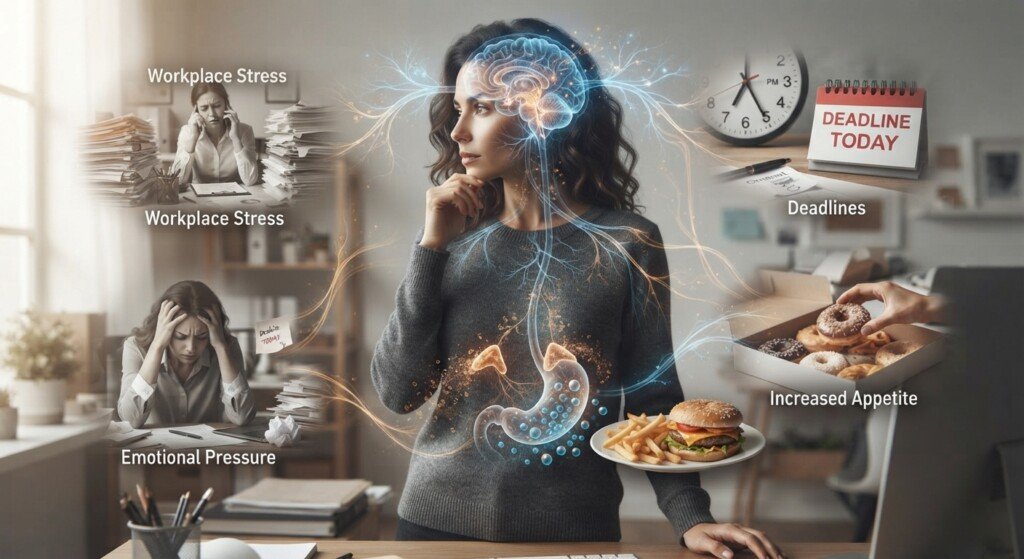
Within seconds of encountering a stressful situation, the brain begins coordinating a complex biological response involving the nervous system, endocrine system, and digestive system.
These systems evolved to help humans survive danger.
Modern stressors, however, are often psychological rather than physical.
Deadlines.
Financial worries.
Relationship problems.
Poor sleep.
Long working hours.
Although these situations rarely require immediate physical action, the body still activates many of the same stress pathways.
One result can be noticeable changes in appetite.
What Are the Biological Mechanisms Linking Stress to Increased Cravings?
When the brain detects stress, it activates the hypothalamic-pituitary-adrenal (HPA) axis.
This system coordinates the release of several hormones that prepare the body to respond.
Initially, appetite may temporarily decrease during acute stress because the body prioritizes immediate survival.
However, when stress continues for longer periods, the pattern often changes.
As cortisol remains elevated, appetite frequently returns and may even increase.
At the same time, the brain becomes more attentive to foods that provide comfort or rapid energy.
Rather than craving vegetables or plain grains, many people begin thinking about foods that combine:
- Sugar
- Fat
- Salt
- Refined carbohydrates
Researchers believe this happens because these foods provide stronger reward signals during stressful situations.
The result is not simply “being hungry.”
It is a shift in food preference.
The Brain Prioritizes Energy During Stress
Stress requires energy.
Although sitting at a computer may not seem physically demanding, the brain still interprets prolonged psychological stress as a state requiring additional resources.
Historically, periods of stress were often followed by physical activity.
Modern life rarely works that way.
Instead, many people remain seated while their stress hormones remain elevated.
This combination may increase the desire for foods that are easy to consume and highly rewarding.
Importantly, this does not mean stress creates cravings in everyone.
Individual responses differ depending on genetics, previous experiences, sleep quality, eating habits, and overall health.
Habit Reinforces Biological Responses
Biology alone does not explain stress-related cravings.
Habits strengthen them over time.
Imagine someone who repeatedly eats chocolate after difficult workdays.
Eventually, the brain begins connecting stress relief with chocolate.
The next stressful event automatically activates that learned expectation.
Over months or years, the biological stress response and learned behavior become closely linked.
This explains why stress eating often follows recognizable patterns.
How Do Hormones Like Cortisol and Ghrelin Influence Appetite During Stress?
Among the many hormones involved in appetite regulation, two receive particular attention in stress research:
- Cortisol
- Ghrelin
Although they have different roles, both influence eating behavior during stressful periods.
Cortisol
Cortisol is often called the body’s primary stress hormone.
It helps:
- Mobilize energy.
- Regulate metabolism.
- Maintain blood pressure.
- Coordinate the stress response.
During prolonged stress, cortisol levels may remain elevated longer than usual.
Researchers believe higher cortisol exposure can increase appetite in some individuals while also influencing preferences toward calorie-dense foods.
Importantly, cortisol does not directly “cause” someone to eat cookies or chocolate.
Instead, it changes the body’s internal environment, making rewarding foods more appealing under certain circumstances.
This effect varies greatly between individuals.
Some people experience noticeable appetite increases.
Others experience very little change.
Ghrelin
Ghrelin is commonly called the “hunger hormone.”
It is produced mainly in the stomach and helps signal the brain that it is time to eat.
Interestingly, research suggests ghrelin may also increase during certain stressful situations.
This creates an interesting interaction.
Stress may simultaneously:
- Increase cortisol.
- Alter ghrelin signaling.
- Change appetite.
- Influence reward pathways.
Together, these changes may strengthen cravings even when energy needs have not changed dramatically.
Hormones Never Work Alone
Although cortisol and ghrelin receive much attention, they operate alongside many other hormones involved in appetite regulation.
These include:
- Leptin
- Insulin
- GLP-1
- Peptide YY
The brain integrates all of these signals before influencing appetite and food preferences.
This complexity explains why stress affects different people differently.
Acute Versus Chronic Stress
Short-term stress and long-term stress do not always produce identical effects.
Acute stress may briefly suppress appetite.
Examples include:
- Public speaking.
- Sudden emergencies.
- Accidents.
- Intense athletic competition.
Chronic stress is different.
Ongoing work pressure, caregiving responsibilities, financial concerns, and sleep deprivation often produce a much different hormonal environment.
Over time, this prolonged stress may contribute more strongly to increased cravings.
Are Specific Types of Food More Likely to Be Craved During Stressful Periods?
Yes.
Although individual preferences vary, stress-related cravings often involve foods that combine multiple rewarding characteristics.
Examples include:
- Chocolate
- Ice cream
- Cookies
- Pizza
- Potato chips
- Pastries
- Fast food
- Sweetened coffee drinks
These foods typically contain combinations of:
- Sugar
- Fat
- Refined carbohydrates
- Salt
Rather than craving one isolated nutrient, the brain often prefers foods that deliver multiple rewarding sensory experiences at once.
Comfort Foods Are Personal
Interestingly, comfort foods differ greatly between individuals.
For one person, stress may trigger chocolate cravings.
For another, it may be:
- Pasta.
- Bread.
- Fried chicken.
- Popcorn.
- Macaroni and cheese.
- Family recipes.
Personal memories strongly influence these preferences.
Foods repeatedly associated with comfort, celebration, or emotional relief become more likely to appear during stressful periods.
Stress Does Not Always Increase Eating
An important point often overlooked is that stress does not increase appetite for everyone.
Some individuals experience the opposite response.
During highly stressful situations they may:
- Skip meals.
- Lose interest in food.
- Feel nauseated.
- Forget to eat.
Both responses represent normal variations in the human stress response.
Researchers continue studying why these individual differences occur.
How Can I Manage Stress-Driven Cravings?
Understanding why stress increases cravings is useful, but most people eventually ask a practical question:
“What should I do when those cravings appear?”
The answer is not to eliminate stress completely. That simply isn’t realistic.
Instead, the goal is to reduce how strongly stress influences eating decisions while recognizing that occasional stress-related cravings are part of normal human behavior.
Unlike a structured emotional eating program, this section focuses on broad, evidence-informed principles that help reduce the biological conditions encouraging stress-related cravings.

What Are Effective Strategies for Managing Stress-Induced Cravings?
There is no single technique that works for everyone because stress and food cravings develop through multiple pathways.
For some people, improving sleep makes the biggest difference.
Others notice improvements after managing work stress or establishing more consistent meal patterns.
The most effective approach usually addresses several contributing factors rather than searching for one perfect solution.
Recognize the Difference Between Stress and Hunger
One helpful habit is pausing long enough to ask a simple question:
“Am I physically hungry, or am I mentally overwhelmed?”
Physical hunger usually:
- Develops gradually.
- Makes many foods appealing.
- Improves after eating.
Stress-related cravings often:
- Appear suddenly.
- Focus on specific comfort foods.
- Occur after emotional events.
- Continue even after a recent meal.
Simply recognizing the difference creates an opportunity to respond more intentionally.
A deeper explanation of this distinction can be found in What Are Emotional Cravings?
Build More Predictable Eating Patterns
Long periods without eating may amplify appetite while making highly palatable foods even more attractive during stressful situations.
Many people find that eating balanced meals at reasonably consistent times helps reduce the intensity of stress-related cravings throughout the day.
The goal is not rigid meal timing.
Rather, it is avoiding large swings between extreme hunger and complete fullness.
Prioritize Sleep
Sleep and stress are closely connected.
Poor sleep can:
- Increase fatigue.
- Alter appetite-regulating hormones.
- Reduce decision-making capacity.
- Increase perceived stress.
These changes often make comfort foods more appealing the following day.
Improving sleep quality therefore supports both stress management and appetite regulation simultaneously.
Reduce Decision Fatigue
Stress often weakens decision-making.
After making hundreds of choices throughout a busy day, preparing a balanced meal may feel mentally exhausting.
One simple strategy is reducing unnecessary food decisions.
Examples include:
- Planning meals ahead of time.
- Keeping balanced snacks available.
- Preparing ingredients in advance.
- Maintaining regular grocery routines.
These habits reduce reliance on impulse decisions during stressful moments.
Move Your Body Regularly
Physical activity influences both stress and overall well-being.
Importantly, this does not mean every stressful day requires an intense workout.
Even moderate movement such as:
- Walking.
- Cycling.
- Gardening.
- Stretching.
- Recreational sports.
may help many people manage stress more effectively.
Movement also provides an alternative way to interrupt stress before eating automatically becomes the default response.
Practice Awareness Instead of Perfection
One of the biggest mistakes people make is treating every craving as failure.
This mindset often increases guilt.
Ironically, guilt itself may become another source of stress.
Instead, notice patterns.
Questions worth asking include:
- Do cravings appear after difficult meetings?
- Are they stronger after poor sleep?
- Do weekends look different from weekdays?
- Are cravings linked to certain people or environments?
Patterns provide valuable information.
Self-criticism rarely does.
How Can Stress Management Reduce Reliance on Food?
Stress management is often misunderstood.
Its purpose is not eliminating negative emotions.
Instead, it helps reduce the frequency and intensity of biological stress responses that influence eating behavior.
When stress becomes more manageable, many people naturally notice fewer episodes of stress-driven eating.
Address the Source of Stress When Possible
Although not every stressor can be removed, some can be modified.
Examples include:
- Improving work organization.
- Setting clearer boundaries.
- Asking for support.
- Managing time more effectively.
- Creating realistic daily expectations.
Reducing chronic stress often benefits eating behavior indirectly because fewer stress responses are triggered throughout the day.
Expand Your Stress Relief Toolbox
If eating has become the primary response to stress, expanding the number of available coping strategies may reduce dependence on food over time.
Examples include:
- Going for a short walk.
- Calling a friend.
- Listening to music.
- Reading.
- Deep breathing.
- Spending time outdoors.
- Journaling.
- Practicing mindfulness.
The objective is not replacing food with another rigid rule.
It is increasing flexibility so food is no longer the only available response.
Remember That Occasional Stress Eating Is Normal
Perhaps the most reassuring message from current research is this:
Occasional stress eating is part of normal human behavior.
Most people have comfort foods.
Most people occasionally eat emotionally.
Most people sometimes crave familiar foods during difficult periods.
The concern arises only when stress-driven eating becomes so frequent that it consistently interferes with health, well-being, or quality of life.
Recognizing this difference allows people to approach cravings with curiosity rather than guilt.
Key Takeaways
| Topic | Main Insight |
|---|---|
| Stress response | Psychological stress activates biological pathways that can influence appetite and food preferences. |
| Cortisol | Prolonged elevations in cortisol may increase appetite and make highly palatable foods more appealing for some people. |
| Ghrelin | Ghrelin may also change during stress, contributing to increased hunger signals in certain individuals. |
| Comfort foods | Stress often increases cravings for familiar, energy-dense foods rather than specific nutrients. |
| Managing cravings | Better sleep, consistent meals, stress reduction, physical activity, and recognizing craving patterns may help reduce stress-driven eating. |
Frequently Asked Questions
1. Why does stress make me crave food?
Stress activates hormonal and neurological pathways that can increase appetite and make comforting, highly palatable foods seem more rewarding.
2. Does cortisol cause cravings?
Cortisol does not directly cause cravings, but prolonged elevations may increase appetite and influence food preferences, especially during chronic stress.
3. Why do I want comfort foods when I’m overwhelmed?
Many comfort foods become associated with emotional relief through repeated experiences. During stressful periods, the brain often recalls these familiar foods because of those learned associations.
4. Does everyone eat more during stress?
No. Some people experience increased appetite, while others temporarily lose interest in food during stressful situations. Both responses are recognized in research.
5. Can reducing stress help reduce food cravings?
For many people, improving stress management supports healthier appetite regulation and may reduce the frequency or intensity of stress-related cravings over time.
Conclusion
The relationship between stress and food cravings is far more complex than simply reaching for comfort food after a difficult day. Stress influences appetite through biological pathways involving cortisol, ghrelin, and the brain’s response to reward, while personal habits and emotional experiences shape the foods that become most appealing.
Understanding these mechanisms helps explain why cravings during stressful periods are common and why they vary from one person to another. Rather than viewing stress-related eating as a lack of willpower, it is more accurate to recognize it as the result of interacting biological and psychological processes.
Although stress cannot always be avoided, becoming more aware of your own patterns, supporting healthy routines, and managing chronic stress where possible can gradually reduce how strongly stressful situations influence your eating decisions over time.
Disclaimer:
This post may contain affiliate links. If you purchase through them, we may earn a small commission at no extra cost to you. Also, this content is for informational purposes only and does not substitute professional medical advice.
Ready to Start Your Journey?
Use our free 7-in-1 Weight Loss Toolkit to calculate your numbers and build your plan in minutes.
Open Free Tools →