

Condom Broke — What to Do Next
A Condom Broke — What to Do Next situation can feel much more serious than it actually is, but the first few hours do matter. A broken condom does not automatically mean pregnancy or an STI will occur. It means the barrier may no longer have provided the protection you expected, so the next step is to assess what happened and whether emergency contraception, HIV post-exposure prophylaxis, or STI follow-up is appropriate.
The most important thing is not to panic or wait several days hoping the worry will disappear.
If the break happened during vaginal or anal sex, the relevant risks depend on what type of exposure occurred, whether ejaculation happened, your partner’s pregnancy potential or STI status, whether either person is using preventive medication, and how much time has passed.
For HIV specifically, the CDC recommends seeking medical care promptly when there may have been a substantial exposure. HIV post-exposure prophylaxis, or PEP, needs to be started as soon as possible and no later than 72 hours after exposure. (CDC)
Pregnancy prevention is also time-sensitive. Emergency contraception is intended for situations such as contraceptive failure, including a condom breaking. The appropriate option depends on the person who could become pregnant, the time since intercourse, and individual medical circumstances.
The key is simple: stop, assess, act on the time-sensitive risks, and arrange appropriate follow-up.
What to do immediately if a condom breaks
The first few minutes are mainly about stopping further exposure and figuring out what actually happened.
Do not immediately assume that the worst possible outcome has occurred.
A condom can tear, split, slip, or partially come off. The details matter because they determine what kind of exposure took place.
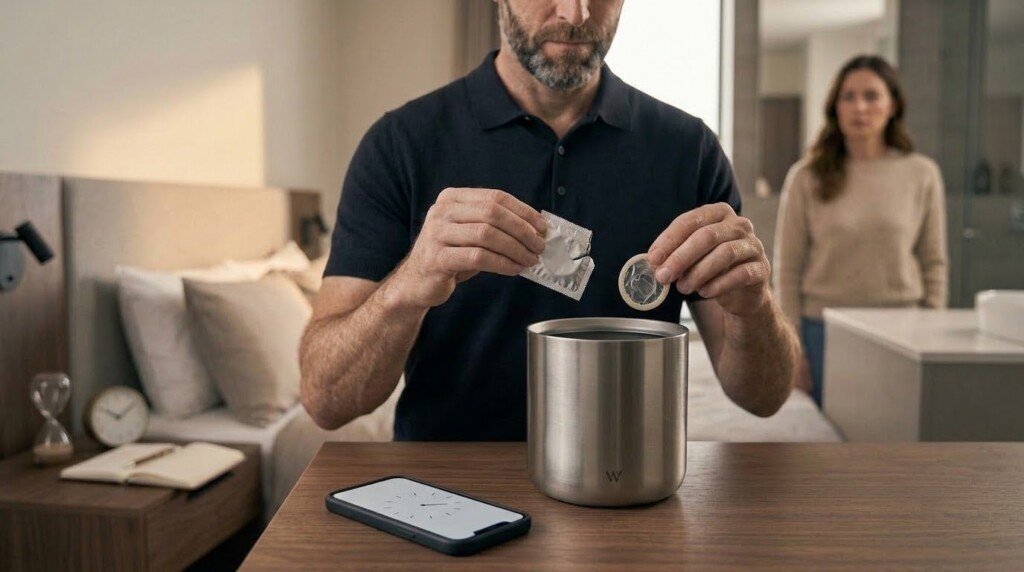
If you felt the condom break during sex, stop sexual activity and remove the damaged condom. The CDC specifically advises stopping immediately if a condom breaks, pulling out, removing the broken condom, and replacing it with a new one if sex is going to continue. (HIV Risk Calculator)
After that, the question becomes more important than the broken condom itself:
What exposure occurred after the condom stopped providing protection?
Step 1: Stop and assess
Start by establishing a basic timeline.
When did the condom break?
Was the penis inside the vagina, rectum, or another area when it happened?
Did ejaculation occur before or after the break?
Did the condom slip completely off?
Was there visible semen outside the condom?
Was the partner someone whose pregnancy could be possible?
Do either of you know your current STI and HIV status?
These questions are not about assigning blame. They help determine whether anything time-sensitive needs to happen.
If the condom broke during vaginal sex and pregnancy is possible, emergency contraception may be worth considering.
If the exposure could have involved HIV, especially if the partner has HIV, does not know their status, or has a status associated with meaningful transmission risk, PEP may need to be considered urgently.
If there was exposure to another STI, testing and clinical advice may be appropriate.
The CDC’s current HIV guidance specifically includes condom breakage as an example of a possible exposure for which someone who is HIV-negative and not taking PrEP should seek advice about PEP promptly.
One important point is that PEP is not something to start casually without an exposure assessment. A healthcare professional evaluates the type of exposure and the likelihood that HIV transmission could have occurred.
If the exposure happened within the previous 72 hours and HIV is a realistic concern, do not wait for symptoms. HIV PEP is time-sensitive, and current CDC guidance recommends starting it as soon as possible, ideally within 24 hours and no later than 72 hours when indicated.
Step 2: Consider emergency contraception
If the condom broke during vaginal sex and pregnancy is possible, emergency contraception is the next major time-sensitive question.
A broken condom is a recognized reason to consider emergency contraception.
The appropriate choice depends on how long ago the intercourse occurred and the individual’s medical circumstances.
Emergency contraception works best when used promptly. Oral emergency contraception can be used within a defined time window after unprotected intercourse, while a copper intrauterine device can also be used as emergency contraception and is highly effective when placed within the appropriate window by a healthcare professional.
Because options differ in effectiveness, availability, and eligibility, the person who could become pregnant should speak with a pharmacist, clinician, sexual health service, or other qualified healthcare provider as soon as possible.
Do not assume that “morning-after pill” means there is only one option.
There are different emergency contraception methods, and timing matters.
If pregnancy prevention is important, waiting until the next day to decide is unnecessary when access is available sooner.
There is also an important distinction between emergency contraception and abortion medication.
Emergency contraception is intended to prevent pregnancy after intercourse. It is not the same thing as medication used to terminate an established pregnancy.
If the person who could become pregnant has questions about which emergency contraception is appropriate, a healthcare professional can help determine the best option based on timing and individual factors.

Step 3: Consider STI testing timeline
STI testing is slightly different from emergency contraception and PEP because many infections cannot be reliably detected immediately after exposure.
A test taken too soon can be falsely reassuring because the infection may not yet be detectable.
That does not mean you should ignore the exposure.
It means the testing plan should account for the infection being tested for, the type of test, and the time since exposure.
The CDC recommends discussing STI testing with a healthcare professional based on sexual history and exposure risk. Its testing resources also emphasize that testing availability includes HIV, chlamydia, gonorrhea, syphilis, herpes, and other infections depending on the situation.
If you have symptoms, do not wait for an arbitrary testing date.
Symptoms such as unusual discharge, sores, genital ulcers, burning during urination, pelvic or testicular pain, rash, or other new genital symptoms should be evaluated.
If there are no symptoms, a clinician can help determine which tests are appropriate and when they are most useful.
This is also why it is not helpful to search for one universal “STI test day.”
Different infections and tests have different detection windows.
For HIV, for example, a laboratory antigen/antibody test can usually detect infection around 18 to 45 days after exposure, while other HIV tests have different window periods. The CDC emphasizes that a negative result obtained during a test’s window period may need to be repeated.
If you need broader information about the testing process, STI Testing for Men: What to Expect can cover that topic without confusing the immediate condom-break response with general screening.
What’s the actual chance of pregnancy?
There is no single percentage that can accurately describe every condom break.
Pregnancy risk depends on whether sperm entered the vagina, whether ejaculation occurred, where the person was in their menstrual cycle, whether another contraceptive method was being used, and whether emergency contraception was taken.
A condom breaking does not automatically result in pregnancy.
But if semen entered the vagina, pregnancy is biologically possible.
Withdrawal before ejaculation may reduce exposure compared with ejaculation inside the vagina, but it does not make the risk zero. Pre-ejaculatory fluid can sometimes contain sperm, and it is difficult to determine exposure with certainty after a condom failure.
The timing of intercourse also matters.
Pregnancy is more likely during the fertile window because sperm can survive for several days in the reproductive tract and an egg is available for fertilization for a limited period.
But trying to calculate the exact risk from a menstrual calendar alone is unreliable.
Cycles can vary.
Ovulation can shift.
And people often do not know precisely when ovulation occurred.
That is why emergency contraception exists.
The purpose is not to calculate whether the chance is exactly 2%, 5%, or 10%.
The purpose is to provide an additional pregnancy-prevention option after a contraceptive failure.
If pregnancy would be a serious concern, the practical question is whether emergency contraception is appropriate and whether enough time remains to use it.
The earlier that decision is made, the more options may be available.
Another important consideration is whether the person who could become pregnant is already using an effective contraceptive method such as an IUD, implant, injection, or hormonal contraception correctly.
If another highly effective contraceptive method was being used consistently, the pregnancy risk from a single condom failure may be considerably different from the risk after condom failure with no other contraception.
This is one reason why a clinician or pharmacist may ask questions that seem unrelated to the broken condom.
They are assessing the whole exposure rather than simply seeing the words “condom broke.”
Should you take Plan B?
Plan B is an emergency contraceptive option containing levonorgestrel.
Whether someone should take it after a condom breaks depends on the circumstances.
If vaginal intercourse occurred, pregnancy is possible, and there is no reliable contraception covering the exposure, emergency contraception may be appropriate.
The sooner an appropriate emergency contraception method is used, the better.
But Plan B is not automatically the best emergency contraception for every situation.
The choice can depend on timing, body factors, medication interactions, and access to other emergency contraception options.
A healthcare professional or pharmacist can help determine what is appropriate.
One reason not to treat Plan B as the universal answer is that emergency contraception includes more than one method.
Emergency contraception can include oral options and an intrauterine device placed by a qualified clinician.
The copper IUD is particularly effective as emergency contraception and can also provide ongoing contraception afterward.
The important thing is not to delay simply because you are unsure which option is ideal.
Ask a qualified healthcare professional as soon as possible.
There is also a common misunderstanding that emergency contraception is only useful the morning after intercourse.
That is not correct.
Some emergency contraception options can be used several days after unprotected intercourse, although effectiveness and suitability vary by method and timing.
That means the question should not be “Is it too late because it happened yesterday?”
The better question is:
Which emergency contraception options are still appropriate based on how much time has passed?
What if the condom broke several days ago?
Do not automatically assume that nothing can be done.
The available options become more limited as time passes, but the correct response depends on exactly how long it has been and whether pregnancy is possible.
If it is still within the appropriate emergency contraception window, seek advice promptly.
If the window has passed, pregnancy testing and appropriate follow-up become more relevant.
A home pregnancy test taken immediately after intercourse cannot tell you whether that particular encounter caused a pregnancy.
Pregnancy tests need time to detect the hormonal changes associated with pregnancy.
If there is uncertainty about timing, a healthcare professional can help establish when testing is most useful.
This is another reason why waiting for symptoms is not a good strategy.
Pregnancy does not necessarily produce immediate symptoms, and the absence of symptoms shortly after sex does not tell you whether pregnancy occurred.
How likely is STI transmission?
A condom breaking increases STI exposure compared with a condom that remained intact, but it does not mean transmission definitely occurred.
The actual risk depends on the infection, the infected partner’s status, the type of sexual contact, whether bodily fluids or mucous membranes were exposed, and whether the infected partner is receiving effective treatment.
There is no single “STI risk percentage” that applies to every broken condom.
For HIV, the exposure risk differs substantially depending on the type of sex and whether the source partner has HIV with a detectable viral load.
The CDC notes that condoms are highly effective at reducing HIV risk when used correctly and consistently, while also recognizing that condoms can break or slip.
If a partner with HIV is on treatment and maintains an undetectable viral load, they do not transmit HIV through sex. (HIV Risk Calculator)
That is important context because simply knowing that a condom broke does not tell you whether HIV exposure actually occurred.
The same principle applies to other STIs.
Chlamydia, gonorrhea, syphilis, herpes, HPV, and other infections have different transmission patterns and different testing approaches.
Some infections can be transmitted without obvious symptoms.
That means “I feel fine” is not a reliable way to rule out an STI after a meaningful exposure.
When is HIV PEP worth asking about?
PEP is specifically designed for possible HIV exposure after the event has already happened.
The timing is critical.
Current CDC guidance recommends that HIV PEP be started as soon as possible when indicated, ideally within 24 hours and no later than 72 hours after exposure.
If you are within that 72-hour window and there is a realistic possibility of HIV exposure, seek medical care immediately.
Do not wait for an HIV test result before seeking an assessment.
The CDC’s 2025 recommendations state that the initial PEP dose should not be delayed while waiting for certain laboratory results when PEP is indicated.
PEP is not a general STI medication.
It is specifically used to prevent HIV after a possible exposure.
It also does not protect against pregnancy.
So a condom break during vaginal sex could potentially create two separate questions:
Is emergency contraception needed?
Is HIV PEP needed?
Those decisions are separate.

When should you get tested after a break?
There is no single testing day that works for every STI.
The right timing depends on what infection is being considered and which test is being used.
That is why a good post-exposure plan often involves more than one point of contact with healthcare services.
You may have an initial evaluation soon after the exposure.
Some tests may be appropriate at that point depending on symptoms and circumstances.
Other tests may need to be repeated later because the infection may not yet be detectable.
For HIV, the CDC explains that different tests have different window periods. A laboratory antigen/antibody test using blood from a vein can usually detect HIV 18 to 45 days after exposure, while antibody-only tests can take longer.
If you receive a negative HIV result during the relevant window period, follow-up testing may be necessary.
This is particularly important if PEP was indicated because the medication and follow-up testing schedule should be managed with a healthcare professional.
For other STIs, the timing can differ again.
A person who develops symptoms should not wait for the “ideal” testing window.
Symptoms change the situation.
A healthcare professional can decide whether testing or treatment should happen immediately.

What if you have no symptoms?
No symptoms does not necessarily mean no infection.
Many STIs can be asymptomatic.
This is why testing decisions should be based on exposure rather than symptoms alone.
If the partner has a known STI, if their status is unknown and the exposure was significant, or if the sexual contact involved a higher-risk exposure, professional advice is worthwhile.
The CDC’s testing resources recommend discussing sexual history and STI testing with a healthcare professional and provide access to confidential testing services. (Get Tested)
If you are unsure which tests you need, do not order a random “full panel” simply because a condom broke.
The relevant tests depend on the exposure.
For example, oral or anal exposure can change which body sites need consideration.
That is one reason clinical sexual health services ask detailed questions.
They are not being intrusive for the sake of it.
They are trying to match the testing strategy to the actual exposure.
When should you seek urgent medical care?
Some situations should not wait for routine testing.
Seek urgent medical advice if:
- The condom broke within the last 72 hours and HIV exposure is realistically possible.
- Pregnancy is possible and emergency contraception may still be appropriate.
- There was sexual assault or the sexual activity was not consensual.
- You develop severe genital pain, significant swelling, heavy bleeding, fever, or other concerning symptoms.
- You believe a partner has a diagnosed STI and you may have been exposed.
- You have a medical condition or medication situation that makes emergency contraception or PEP more complicated.
A sexual health clinic, emergency department, urgent care service, primary care clinician, or qualified pharmacist may be able to direct you to the appropriate next step depending on the situation and your location.
Do not let embarrassment become the reason you miss a time-sensitive treatment window.
What if the condom broke but you are not sure when?
This is common.
Sometimes people only realize afterward that the condom was damaged.
Maybe the condom looked different after sex.
Maybe it slipped.
Maybe semen was noticed outside the condom.
Maybe the partner noticed the condom had split.
In that situation, treat the exposure conservatively.
Establish the earliest possible time the break could have occurred.
If pregnancy is possible, seek emergency contraception advice based on that timeline.
If HIV exposure is possible and the event could have occurred within 72 hours, seek PEP assessment immediately rather than trying to determine the exact minute of exposure.
If STI exposure is possible, arrange appropriate testing and clinical advice.
You do not need perfect information before seeking care.
In fact, waiting for perfect information can be the mistake.
The healthcare professional can help reconstruct the exposure from the information available.
Frequently Asked Questions (Condom Broke — What to Do Next).
1. What to do immediately if a condom breaks?
Stop sexual activity, remove the broken condom, and assess what exposure occurred. If pregnancy is possible, consider emergency contraception promptly. If HIV exposure is possible, seek urgent medical advice about PEP because it must be started within 72 hours when indicated. STI testing may also be appropriate based on the exposure.
2. Should I take Plan B if my condom broke?
Plan B may be appropriate when a condom breaks during vaginal sex and pregnancy is possible, but it is not automatically required in every situation. Emergency contraception options differ, so the person who could become pregnant should speak with a pharmacist or healthcare professional promptly about the best option and timing.
3. How likely is it to get an STD if a condom breaks?
There is no single percentage because STI transmission risk depends on the infection, type of sexual contact, partner’s infection status, viral or bacterial factors, and whether treatment or prevention is already in place. A broken condom increases exposure compared with an intact condom, but transmission is not inevitable.
4. Can a girl tell if the condom broke?
Sometimes a partner may feel a sudden change in sensation, notice the condom slipping, or see that it has torn. But a condom can sometimes break without either person immediately noticing. Checking the condom afterward can help, but uncertainty about whether a break occurred should be handled based on the possible exposure and the time since sex.
The Bottom Line
A broken condom is a risk event, not a guaranteed pregnancy or STI.
The smartest response is to act according to the clock.
If pregnancy is possible, consider emergency contraception promptly.
If HIV exposure is possible and the event happened within 72 hours, seek urgent medical advice about PEP. Current CDC guidance emphasizes starting PEP as soon as possible when indicated, ideally within 24 hours and no later than 72 hours. (CDC Stacks)
For other STIs, do not rely on symptoms alone. Testing may need to happen at specific times because infections have different detection windows.
Most importantly, do not spend the first day repeatedly searching for an exact pregnancy or STI percentage. You usually cannot calculate that accurately from a condom break alone.
Instead, establish what happened, when it happened, what protection was lost, and what options are still available.
That turns an anxious situation into a practical health decision.
Disclaimer:
This post may contain affiliate links. If you purchase through them, we may earn a small commission at no extra cost to you. Also, this content is for informational purposes only and does not substitute professional medical advice.
Know Your Body Better
Use our free tools to track your cycle, find your fertile window, estimate your due date, and more.
Open Free Tools →