STI Testing for Men: What to Expect
Getting tested for an STI can feel more complicated than it actually is. Many men do not know what sample will be collected, whether a “full panel” really includes everything, or how long they should wait after a sexual encounter before testing.
STI Testing for Men: What to Expect is usually straightforward once you understand what the clinician is actually looking for. Depending on your sexual history and the type of contact you have had, testing may involve urine, blood, or swabs from the throat or rectum. The important point is that the right test depends on the site of exposure, not simply on whether you have symptoms.
That distinction matters because many sexually transmitted infections can exist without obvious symptoms. CDC guidance emphasizes screening based on sexual behavior and exposure, particularly for men who have sex with men, while routine screening recommendations differ for heterosexual men at lower risk. (CDC)
If you are worried because of a recent condom problem, the situation is slightly different from routine screening. The timing and type of follow-up can depend on the exposure, which is why Condom Broke — What to Do Next is useful for that specific situation.
How do you get tested for STIs as a man?
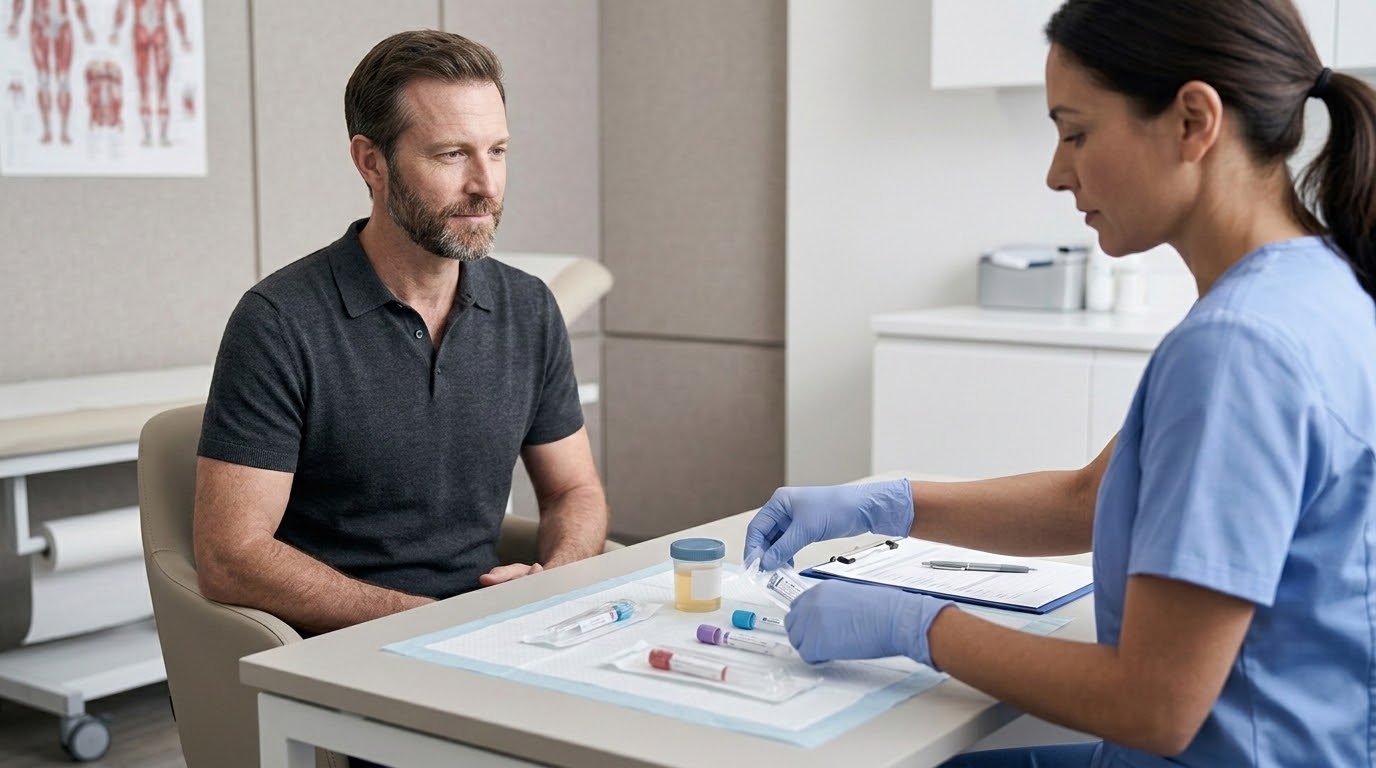
The first step is usually much less dramatic than people imagine. You tell a healthcare professional why you want testing, answer a few questions about recent sexual activity, and then provide the samples that match the infections and body sites that need to be checked.
You do not necessarily need a complicated physical examination.
A clinician may ask when you last had sex, whether you have had a new partner, what types of sexual contact you have had, whether condoms were used, whether you have noticed symptoms, and whether you have previously been diagnosed with an STI. These questions are not there to judge you. They help determine which tests make sense.
That last part is important. STI testing is not one universal test.
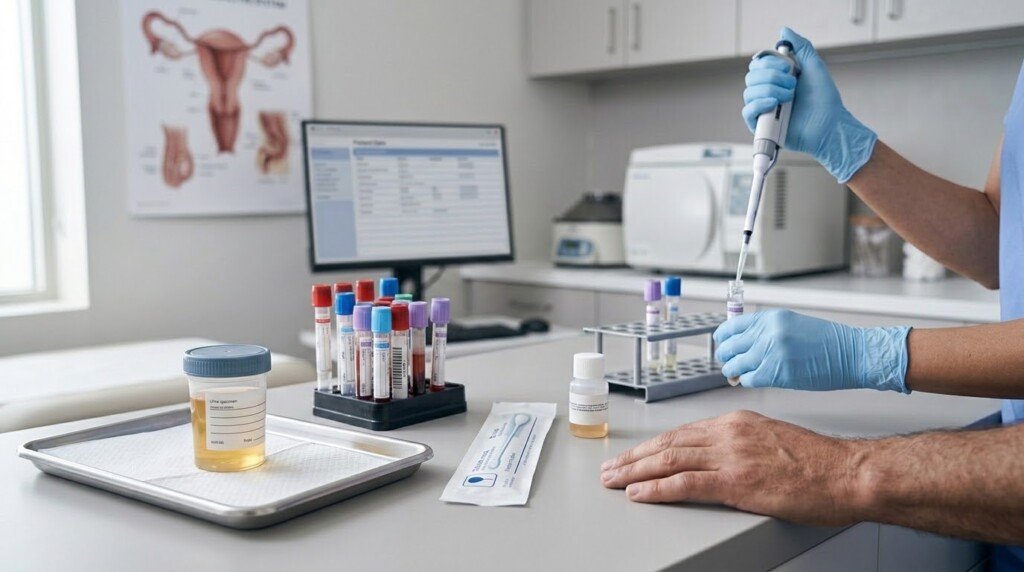
A urine test may be appropriate for detecting urethral chlamydia or gonorrhea. Blood testing may be used for infections such as HIV or syphilis. If you have had oral or receptive anal exposure, testing may also need to involve the throat or rectum.
So if you had oral sex, telling the clinician matters. If you had receptive anal sex, telling the clinician matters. A urine test alone may not answer every question created by those exposures.
What a full panel test includes
The phrase “full panel” sounds precise, but it is not a standardized medical package that contains every possible STI test.
Different clinics and laboratories use the term differently. One facility might offer testing for HIV, syphilis, chlamydia, and gonorrhea. Another might include hepatitis testing. Herpes testing may be handled separately because routine blood screening for herpes in people without symptoms is not generally recommended for the general population.
That means you should not assume that ordering a “full panel” automatically means you have been tested for every STI that exists.
A better approach is to ask what is actually included.
For example, a clinician may consider testing for:
- Chlamydia
- Gonorrhea
- Syphilis
- HIV
- Hepatitis B or C when appropriate
- Herpes in selected circumstances
- Other infections when symptoms, exposure history, or local recommendations make testing appropriate
The exact combination depends on the person.
For chlamydia and gonorrhea, urine-based nucleic acid amplification testing, often called NAAT, is commonly used for urethral infection. If there has been rectal exposure, a rectal specimen may be appropriate. For certain oral exposures, a throat specimen can be relevant, particularly for gonorrhea.
This is one of the biggest misunderstandings about STI testing. A negative urine test does not necessarily rule out an infection at a different anatomical site.
The goal is not to order the largest possible number of tests. The goal is to order the tests that answer the right clinical questions.
At-home testing can also be an option for some infections.
If a result comes back positive, follow-up with a healthcare professional is important. Testing is the beginning of the process, not the entire process.
Testing window periods
Timing is one of the easiest parts of STI testing to misunderstand.
A test cannot necessarily detect an infection immediately after exposure. Different infections and different tests have different window periods, meaning the amount of time between exposure and when a test can reliably detect the infection.
This is why getting a negative result very soon after a sexual encounter does not always settle the question.
HIV is a good example. CDC explains that different HIV tests have different detection windows. A laboratory antigen/antibody test using blood from a vein can usually detect HIV approximately 18 to 45 days after exposure. A NAT can usually detect it earlier, around 10 to 33 days, while antibody tests generally have a longer window. (CDC)
The lesson is not that you should memorize every testing number. It is that the test type and timing both matter.
Other STIs have their own testing considerations. There is no single universal “wait exactly X days and everything will be accurate” rule that applies to every infection.
If the exposure was recent, tell the clinician the actual date. That allows them to decide whether testing now is useful, whether another test should be done later, or whether additional evaluation is appropriate.
This is also why repeatedly testing yourself at random intervals can create more confusion than reassurance. A properly timed testing plan is more useful than simply collecting multiple negative results taken too early.
What are the warning signs of an STI?
STIs can produce symptoms, but symptoms are not a reliable screening system.
Some men notice burning during urination, unusual discharge, genital sores, blisters, itching, irritation, pain, swelling, or changes around the penis or testicles. Others may notice rectal discomfort, bleeding, discharge, or pain after receptive anal exposure. A sore throat can occur in some infections involving the throat, although it is not specific enough to diagnose an STI on its own.
The important point is that symptoms can vary significantly between infections.
A man with symptoms should not try to identify the infection simply by matching the symptom to something found online. Several conditions can cause similar symptoms, and some infections can produce very subtle symptoms.
There is another problem that makes STI testing especially important: you can feel completely normal and still have an STI.

Common symptoms
There is no single symptom that proves an STI.
Possible warning signs include unusual penile discharge, burning or discomfort while urinating, genital sores, blisters, unexplained lesions, itching, irritation, testicular discomfort, or swelling. Depending on the type of sexual exposure, symptoms can also occur in the throat or rectum.
Some infections may cause systemic symptoms such as fever, swollen lymph nodes, rash, or feeling generally unwell.
But symptoms are not enough to determine which infection is present.
For example, genital sores can have several causes. Discharge can occur with different infections. Burning during urination can also occur for reasons unrelated to an STI.
That is why a clinician may recommend testing rather than making a diagnosis from symptoms alone.
The same principle applies if symptoms disappear.
Feeling better does not automatically mean the infection has disappeared. Some infections fluctuate, while others can remain present without obvious symptoms.
If you have symptoms following sexual contact, especially symptoms involving discharge, sores, significant pain, or unusual lesions, it is sensible to seek medical evaluation rather than waiting to see what happens.
And if you are concerned about whether your sexual activity exposed you to an STI, you do not need to wait until symptoms appear before considering testing.
Why many STIs are asymptomatic
This is the part of STI testing that catches many people off guard.
An infection can be present without producing a noticeable warning signal.
That changes the way you should think about testing.
Testing is not only something you do when something feels wrong. In the right circumstances, testing is a preventive health decision.
This is especially relevant when there is a new sexual partner, multiple partners, a known STI exposure, inconsistent barrier use, or sexual contact involving sites that are not covered by a standard urine test.
It also explains why judging someone’s STI status by appearance, sexual history assumptions, or whether they “look healthy” is unreliable.
An asymptomatic person can feel perfectly healthy.
That does not mean they have an STI, but it also does not prove they do not.
The same principle applies to partners. Someone may genuinely believe they are STI-free because they have never experienced symptoms. They may not realize that they have never been tested for a particular infection or that a previous test did not cover a particular exposure site.
Testing replaces guesswork with information.
If you are concerned about a previous exposure, there is no benefit in feeling ashamed about getting checked. Sexual health clinics and healthcare professionals deal with these questions routinely.
How often should sexually active men get tested?
There is no single testing schedule that applies to every sexually active man.
Your appropriate screening frequency depends on factors such as your sexual partners, types of sexual contact, number of partners, condom use, previous STIs, HIV status, use of PrEP, and local STI prevalence.
For heterosexual men at low risk, CDC guidance does not recommend routine chlamydia or gonorrhea screening in the same way it does for certain higher-risk groups because evidence is insufficient to support universal screening in that population. However, testing may be appropriate based on symptoms, exposure, partner status, or the setting in which care is provided. (CDC)
For men who have sex with men, the recommendations are more specific. CDC recommends at least annual screening for chlamydia and gonorrhea at relevant sites of contact and at least annual syphilis screening. For those at increased risk, screening every 3 to 6 months may be appropriate. (CDC)
The location of exposure matters here.
Someone who has had only insertive vaginal sex may have a different testing profile from someone who has had oral and receptive anal sex. A person with repeated exposure at multiple anatomical sites may need specimens from multiple locations.
That is why a good STI appointment starts with an honest sexual history.
You do not need to provide graphic details. You do need to provide enough information for the clinician to understand where exposure occurred.
A practical way to think about testing frequency
Instead of asking, “How often should every man get an STI test?” ask:
“Based on the sex I am having and the partners I have, what testing schedule makes sense for me?”
That question is much more useful.
If you have a new partner, a known exposure, symptoms, multiple partners, or concerns about a previous sexual encounter, do not wait for your routine testing date simply because you tested several months ago.
Likewise, someone in a mutually monogamous relationship with both partners recently tested and no new exposures may have a very different screening need.
Testing should reflect actual exposure rather than an arbitrary calendar.
HIV screening also has broader recommendations. CDC and USPSTF recommend at least one HIV screening for people in the relevant adult age range, with more frequent testing for people at higher risk. CDC recommends at least annual HIV screening for sexually active gay, bisexual, and other men who have sex with men, with consideration of testing every 3 to 6 months for those at increased risk. (CDC)
If you have already been diagnosed with an STI, your clinician may also recommend testing for other infections because one STI diagnosis can change the overall risk assessment.
There is no shame in needing testing more frequently. The schedule is about exposure and prevention, not about someone’s character.
Which STIs are hardest to detect?
The hardest STI to detect is not necessarily the one with the most complicated test.
Often, the real difficulty is an infection that produces few or no symptoms, has a testing window that matters, or occurs at an anatomical site that was not tested.
This is why “I got a urine test and it was negative” is not always the same as “I cannot have any STI.”
Chlamydia and gonorrhea can be asymptomatic, and infections at the throat or rectum may require testing from those sites rather than relying solely on urine.
HIV presents a different testing challenge because the window period depends on the test used. A negative test performed too early may not rule out a recent infection.
Herpes is another example where testing needs context. When genital lesions are present, a sample from the lesion can be used for testing. Blood testing can sometimes help in specific circumstances.
This is why the idea of a single “hardest STI to detect” can be misleading.
The better question is:
“Which infections could I have based on my exposure, and which tests can actually detect them at the sites and time points involved?”
That is the question a clinician can answer properly.
Another common mistake is assuming that an STI must produce obvious symptoms before it becomes important.
It does not.
A person can have no discharge, no pain, no visible lesions, and no obvious change in sexual function while still carrying an infection.
That is particularly important when considering oral sex. Transmission risk varies substantially by infection and exposure, but oral sex is not automatically risk-free. Some infections can affect the throat or genital area following oral exposure, which is another reason the clinician needs to know what type of sexual contact occurred.
The solution is not panic.
The solution is appropriate testing.
If you are concerned about a recent condom failure, that situation should be handled according to the timing and type of exposure rather than by simply ordering a random panel. Condom Broke — What to Do Next covers the immediate post-break scenario, while Thin & Sensitivity Condoms: What Actually Feels Best focuses on choosing condoms rather than diagnosing an infection.

What happens after the test?
Most of the anxiety around STI testing comes from the waiting period rather than the sample collection itself.
Once the sample has been collected, the next step depends on the test. Some rapid tests can provide results quickly, while laboratory testing may take longer. HIV testing, for example, can involve antibody, antigen/antibody, or nucleic acid testing, and the timing of results and detection varies by method.
If your result is negative, that result needs to be interpreted alongside the timing of the test.
If you tested very soon after a potential exposure, a healthcare professional may recommend repeat testing after the relevant window period.
If your result is positive, do not try to interpret the result through internet searches alone. Follow the healthcare provider’s instructions for confirmation, evaluation, treatment, and partner notification where appropriate.
The important thing is not to disappear after receiving a result you did not expect.
STIs are medical conditions. They are not a verdict on someone’s character or relationship.
A diagnosis can be uncomfortable, but knowing your status gives you the ability to make informed decisions about your health and your partners’ health.
FAQ: STI Testing for Men
1. How do you test for STDs in males?
Testing depends on the infection and the type of sexual exposure. Common methods include urine testing, blood tests, and swabs from exposed areas such as the throat or rectum. Chlamydia and gonorrhea are commonly tested with NAAT-based methods, while HIV and syphilis commonly involve blood testing. The exact tests should be selected according to your symptoms, exposure, and risk factors.
2. What is a full panel STD test for men?
There is no universal definition of a “full panel.” A panel may include tests for infections such as chlamydia, gonorrhea, HIV, and syphilis, with hepatitis or herpes testing considered separately when appropriate. A standard panel may also fail to include testing at an exposed throat or rectal site, so ask exactly which infections and anatomical sites are being tested.
3. What are the 7 warning signs of STI?
Possible warning signs include unusual penile discharge, burning when urinating, genital sores, blisters or lesions, genital itching or irritation, testicular discomfort or swelling, and unusual rectal symptoms such as pain or discharge. However, symptoms alone cannot rule an STI in or out because many infections can be asymptomatic.
4. How common is STD transmission from oral sex?
There is no single transmission rate that applies to all oral-sex exposures. The risk varies by the specific STI, the infected site, the type of oral contact, and whether barriers were used. Some infections can infect the throat or genital area following oral exposure, so oral sex should be included when discussing your sexual history with a clinician.
5. Which STI is hardest to detect?
There is no single STI that is always the hardest to detect. In practice, infections can be difficult to identify when they produce no symptoms, when testing occurs during a window period, or when the exposed anatomical site is not tested. Chlamydia, gonorrhea, HIV, and herpes all have testing considerations that make timing, test type, symptoms, and exposure history important.
Regular STI testing is not about assuming something is wrong. It is about replacing uncertainty with information. If you are sexually active and your partners or sexual practices have changed, a private conversation with a healthcare professional can help determine which tests actually make sense for you.
Disclaimer:
This post may contain affiliate links. If you purchase through them, we may earn a small commission at no extra cost to you. Also, this content is for informational purposes only and does not substitute professional medical advice.
Know Your Body Better
Use our free tools to track your cycle, find your fertile window, estimate your due date, and more.
Open Free Tools →