


Erectile Dysfunction in Your 20s: Is It Normal?
If you are dealing with Erectile Dysfunction in Your 20s, the first thing to know is that having trouble getting or keeping an erection does not automatically mean something is seriously wrong with you.
It also does not mean you are too young to experience erection problems.
A man in his 20s can occasionally lose an erection, struggle to get fully hard, or have difficulty during a particular sexual situation. Stress, anxiety, low confidence, relationship pressure, alcohol, recreational drugs, medications, sleep problems, and other factors can interfere with erections. Physical causes are possible too, including conditions affecting blood vessels, nerves, hormones, or general health.
The important distinction is between an occasional problem and a persistent pattern.
One difficult night is not the same thing as ongoing erectile dysfunction.
And being young does not mean you should simply ignore repeated changes.
This article focuses specifically on what erection problems can mean in your 20s, how common they are, what tends to cause them at this age, and why many cases can improve once the underlying issue is identified.
Is it normal for a 20-year-old to experience ED?
It can happen, but persistent erectile dysfunction should not simply be dismissed as “normal for your age.”
There is an important difference between saying that ED can occur in your 20s and saying that ED is an inevitable or ordinary part of being a young man.
It is not.
Erectile dysfunction is defined by difficulty getting or keeping an erection firm enough for sex.
A 20-year-old might experience one of these situations occasionally without having a chronic sexual disorder.
You could be exhausted.
You could be nervous with a new partner.
You could have had too much alcohol.
You could be distracted by work, college, money, or relationship problems.
You might simply not have been sufficiently aroused at that particular moment.
None of those automatically means you have ED.
The situation becomes more meaningful when the problem happens repeatedly.
For example, if you consistently struggle to get hard with a partner, regularly lose your erection during sex, or notice that erections are weaker across different situations, it is reasonable to look more closely at what is happening.
Young men sometimes make the opposite mistake too.
They experience one or two disappointing sexual encounters, immediately label themselves as having ED, and then become hyperaware of every erection afterward.
That can create another problem.
Instead of focusing on sexual stimulation, you start monitoring yourself.
“Am I hard enough?”
“Is it going away?”
“Why isn’t it happening?”
“Is something wrong with me?”
That mental pressure can make sexual arousal more difficult.
So the first step is not to diagnose yourself from one experience.
Look at the pattern.

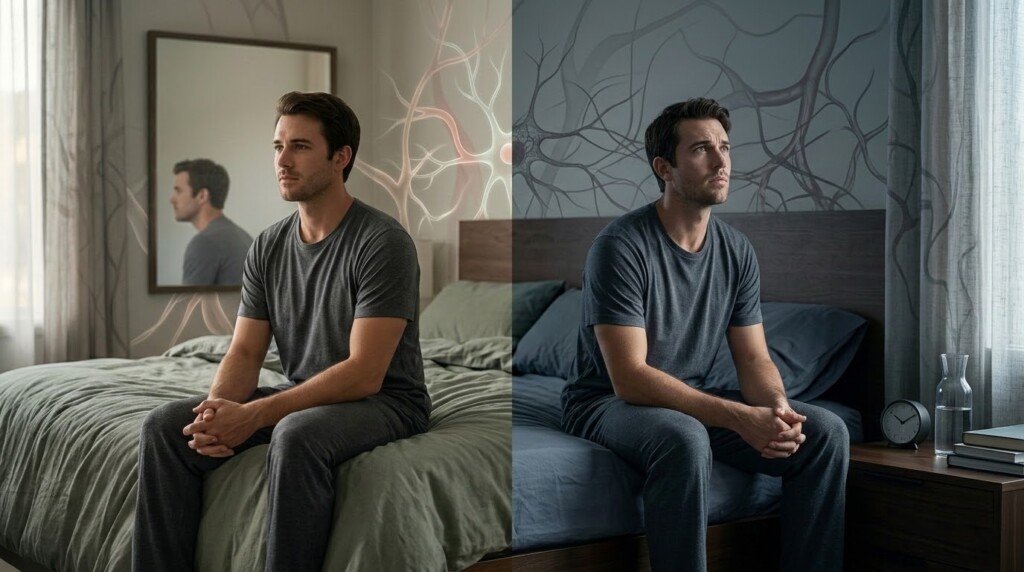
Why age does not make erection problems impossible
Your age protects you from some conditions that become more common later in life, but it does not make your cardiovascular, psychological, neurological, hormonal, or sexual systems immune to problems.
NIDDK lists anxiety, depression, stress, low self-esteem, lack of confidence, certain medications, alcohol, smoking, recreational drugs, insufficient physical activity, diabetes, obesity, cardiovascular disease, hormone problems, and nerve disorders among potential contributors to ED. (NIDDK)
Some of those causes may be less common in a healthy 20-year-old than in an older man.
They are still possible.
That is why “You’re young, so it must be psychological” is also an oversimplification.
A young man can have psychological factors.
He can also have physical factors.
And he can have both at the same time.
How common is ED in men in their 20s?
Erectile dysfunction is less common in younger men than in older age groups, but it is not rare enough to assume that a man in his 20s cannot experience it.
The exact prevalence depends heavily on how researchers define ED, which age range they study, whether participants are sexually active, and whether researchers measure symptoms with a validated questionnaire or simply ask men whether they believe they have ED.
One US study examined 2,660 sexually active men between ages 18 and 31. About 14% reported some degree of ED, with 11.3% reporting mild ED and 2.9% reporting moderate-to-severe ED. The researchers also found associations between more significant ED and factors including anxiety, antidepressant use, tranquilizer use, and relationship status. (PubMed Central (PMC))
That number needs context.
It does not mean that 14% of every man in his 20s has a permanent medical condition.
The study involved sexually active young men and used a questionnaire-based definition. Mild symptoms can also be very different from persistent, clinically significant ED.
More recent population research similarly shows that ED symptoms can occur among younger adults, although estimates vary substantially depending on the definition and population studied.
This is why internet statistics can be misleading.
One website may say ED in young men is extremely rare.
Another may claim that almost one in three young men has it.
Both numbers may come from studies asking slightly different questions.
What the numbers really tell you
The useful takeaway is simpler.
You are not the only young man experiencing erection difficulties.
At the same time, persistent ED in your 20s is worth understanding rather than automatically accepting as your new normal.
That distinction is especially important because younger men may be more likely to experience situational factors that change from one sexual encounter to another.
A man may have no difficulty masturbating but struggle with a partner.
He may get erections during sleep but lose them during sex.
He may get fully hard initially but lose the erection after becoming distracted.
He may experience problems only after drinking.
These patterns can provide useful clues, although they do not diagnose the cause by themselves.
A healthcare professional can evaluate the full picture using medical, sexual, and mental health history, physical examination, and testing when appropriate.
What usually causes ED at this age?
There is no single cause of erectile dysfunction in young men.
That is worth emphasizing because online discussions often reduce the issue to one explanation.
Some say it is anxiety.
Others blame pornography.
Others blame testosterone.
Others blame masturbation.
Others blame poor circulation.
Real life is more complicated.
For a man in his 20s, psychological and situational factors can be particularly relevant, but physical contributors should not be ignored.
The useful approach is to ask what changed, when the problem occurs, and whether the pattern is consistent.

Psychological vs. physical causes in young men
Psychological and physical ED are not two completely separate boxes.
They can overlap.
Consider a young man who has one unsuccessful sexual experience.
He becomes worried that it will happen again.
During his next encounter, he starts monitoring his erection instead of focusing on intimacy and stimulation.
The worry increases.
His arousal drops.
His erection becomes less reliable.
The experience then reinforces the fear.
That is a real physiological response to psychological pressure.
This is where Performance Anxiety vs. ED: How to Tell the Difference becomes relevant. The key issue is not simply whether anxiety exists, but whether the erection problem follows a situational pattern associated with sexual pressure or fear of failure.
Why confidence can affect erections
Confidence is not a magic hormone.
But sexual arousal involves the brain, and anxiety can interfere with that process.
If you are constantly evaluating your erection, worrying about satisfying your partner, comparing yourself with unrealistic sexual expectations, or fearing that your partner will judge you, your attention can move away from arousal.
The result can be a weaker erection.
That does not mean the problem is imaginary.
The erection is genuinely weaker.
The psychological factor simply becomes part of the mechanism.
This is one reason repeated reassurance can sometimes help, but it is not always enough. If anxiety has become a persistent part of your sexual experience, professional counseling can be useful.
What about physical causes?
Physical ED can occur in younger men too.
Diabetes, obesity, cardiovascular risk factors, hormonal problems, nerve disorders, certain medications, smoking, excessive alcohol, and recreational drugs can all contribute to erectile problems.
Young-onset ED research also shows that physical and metabolic factors deserve attention rather than being automatically dismissed.
A study examining men aged 20 to 40 with ED found associations between ED and cardiovascular risk markers, illustrating why physical contributors can exist even in relatively young men. (PubMed Central (PMC))
This does not mean every young man with ED has a hidden cardiovascular disease.
It means persistent symptoms deserve a proper assessment when the pattern suggests a physical contributor.
Lifestyle can quietly influence erection quality
Young adulthood can involve habits that are rough on sexual function.
Irregular sleep.
Heavy drinking.
Smoking.
Recreational drug use.
Very little physical activity.
High levels of stress.
These factors can overlap and compound each other.
The important point is not to turn this into another “perfect lifestyle” checklist.
You do not need to become a professional athlete to have healthy erections.
You do need to take persistent changes seriously.
If you are barely sleeping, drinking heavily several nights a week, smoking regularly, and experiencing significant stress, those factors deserve attention before you assume you need an exotic sexual solution.
What about pornography?
Pornography deserves a careful discussion because online claims often go far beyond what the evidence can establish.
Some young men report that their erections or arousal feel different with a partner compared with highly stimulating pornography.
That experience can be real.
But the label “porn-induced ED” should not be used as a universal diagnosis for every young man with erection problems.
The relationship between pornography use, sexual conditioning, arousal patterns, and erectile function is more complicated than many internet claims suggest.
If you notice a clear relationship between your pornography habits and your partnered sexual response, the topic deserves its own focused discussion rather than being reduced to a slogan.
That is why Porn-Induced ED: Signs and Recovery should remain separate from this broader age-specific article.
Medication can be part of the picture
Some medications can interfere with erections.
If your erection problems started after beginning a medication, do not simply stop taking it.
Discuss the timing with the prescribing clinician.
The medication may not actually be responsible, or there may be an alternative approach.
Can ED in your 20s be fixed?
In many cases, erectile difficulties can improve significantly once the underlying contributor is identified.
But “fixed” is not a single treatment.
If anxiety is driving the problem, addressing the anxiety may be the central step.
If alcohol or recreational drugs are contributing, changing those habits may help.
If a medication is involved, a clinician can review it.
If a physical condition is contributing, treating that condition becomes important.
And if several factors overlap, improvement may require addressing several of them together.

What you can do without turning sex into a performance test
The first goal should be reducing the pressure surrounding the problem.
Do not constantly test yourself to see whether you can get hard.
Do not turn masturbation into a daily erection examination.
Do not compare your erection quality with pornography.
Do not treat one unsuccessful sexual encounter as proof that you have permanent ED.
Instead, look for patterns.
Does the problem happen every time?
Does it happen only with a partner?
Do you still experience erections during sleep or when waking?
Does it happen after drinking?
Did it start after a stressful period?
Did it begin after taking a new medication?
Has your general health changed?
These questions provide much more useful information than simply asking whether you are “man enough.”
Lifestyle changes can help
You do not need a specialized young-man ED diet.
Basic health behaviors can support erectile function because erections depend partly on healthy blood vessels and nervous-system function.
These changes are not instant erection hacks.
They are longer-term health measures.
That distinction matters.
If your erection problem is mainly driven by performance anxiety, changing your diet alone may not solve it.
If your problem has a significant vascular component, however, improving cardiovascular health can be relevant.
If you are experiencing both anxiety and physical risk factors, both may need attention.
When should a young man see a doctor?
Do not wait until you are older to ask about persistent erectile problems.
Consider speaking with a healthcare professional if:
- You repeatedly cannot get or maintain an erection firm enough for sex.
- The problem continues rather than resolving on its own.
- Erections have become noticeably weaker across different situations.
- You have other symptoms such as reduced libido, significant fatigue, pain, or changes in the penis.
- You have diabetes, high blood pressure, obesity, or other relevant health conditions.
- You take medications that may affect sexual function.
- You use significant amounts of alcohol or recreational drugs.
- The problem is causing substantial anxiety or affecting your relationship.
A clinician can take a sexual and medical history, ask about mental health and medications, perform a physical examination, and order tests when appropriate. (NIDDK)
That evaluation is not an admission that something is seriously wrong.
It is simply a better way to stop guessing.
Why persistent ED should not be ignored
Young men sometimes assume that because they are young, persistent ED must be psychological.
That can delay appropriate evaluation.
ED can sometimes be associated with health conditions affecting blood vessels, hormones, nerves, or metabolism.
At the same time, assuming that every young man’s erection problem is a sign of serious disease can create unnecessary fear.
Neither extreme is useful.
The right response is proportionate.
An occasional problem is usually very different from a persistent pattern.
A persistent pattern deserves evaluation.
That is the middle ground.
Frequently Asked Questions ( Erectile Dysfunction in Your 20s )
1. Is it normal for a 20-year-old to not get hard?
Occasional difficulty getting an erection can happen at any age and may be related to stress, anxiety, fatigue, alcohol, medications, or the sexual situation. Persistent difficulty getting or maintaining an erection should be discussed with a healthcare professional rather than dismissed because of age.
2. Can erectile dysfunction be fixed at 20?
In many cases, erection problems can improve when the underlying cause is addressed. Depending on the situation, this may involve lifestyle changes, counseling, medication review, or medical treatment.
3. How many men in their 20s have ED?
There is no single percentage that applies to every man in his 20s because studies use different definitions and populations. One US study of sexually active men aged 18 to 31 found about 14% reported some degree of ED, including mild through severe symptoms.
4. Can ED be caused by lack of confidence?
Yes. Low self-esteem, lack of confidence, anxiety, stress, and negative body image can cause or worsen erectile dysfunction. Confidence-related anxiety can also create a cycle in which worrying about erections makes sexual arousal more difficult.
The Bigger Picture for Men in Their 20s
Erectile problems in your 20s can feel disproportionately frightening because many young men assume that erections should simply work automatically.
Human physiology does not work that way.
Erections depend on the interaction between the brain, nervous system, blood vessels, erectile tissue, hormones, psychological state, and sexual context.
A problem with any part of that system can affect the final result.
That does not mean you should panic.
It means you should stop treating the issue as a referendum on your masculinity.
If it happened once, pay attention without catastrophizing.
If it happens repeatedly, look for patterns.
If anxiety appears to be driving the cycle, address the anxiety rather than simply trying harder during sex.
If your symptoms suggest a physical contributor, get evaluated rather than assuming you are “too young” for a medical problem.
And if you are comparing your sexual performance against pornography or exaggerated stories from other men, stop using those comparisons as your baseline.
There is no universal requirement that every sexual encounter end with a perfect erection.
There is, however, a good reason to investigate a persistent change in sexual function.
A young man with ED is not broken.
He is dealing with a symptom that can have multiple causes, many of which can be addressed.
The goal is not to find the fastest trick.
The goal is to understand why your erection is changing and deal with that cause directly.
That is a much more useful starting point for getting your sexual confidence and function back.
Disclaimer:
This post may contain affiliate links. If you purchase through them, we may earn a small commission at no extra cost to you. Also, this content is for informational purposes only and does not substitute professional medical advice.
Know Your Body Better
Use our free tools to track your cycle, find your fertile window, estimate your due date, and more.
Open Free Tools →