

How to Improve Metabolic Flexibility: Diet & Exercise
Your metabolism is not supposed to run on one fuel all day.
After a meal, your body has more readily available nutrients to work with. Between meals, it increasingly draws on stored energy. During exercise, fuel use changes again depending on intensity, duration, fitness, and what you have eaten.
That ability to adjust is the foundation of how to improve metabolic flexibility.
Metabolic flexibility is not about forcing your body to burn fat constantly. It is about improving its ability to respond appropriately when fuel availability and energy demands change. Researchers commonly study this by looking at how carbohydrate and fat oxidation change under controlled conditions.
The practical question is what you can do to support that adaptability.
The answer is less dramatic than many metabolic-health advertisements suggest. You do not need to eliminate carbohydrates forever, survive on butter and coffee, or spend every workout doing all-out intervals.
A more useful strategy is to combine regular physical activity with a nutritious eating pattern, adequate recovery, and enough variation in energy demands to give your body opportunities to adapt.
This article focuses on those practical changes.
How Can Diet Improve Metabolic Flexibility?
Food changes the metabolic environment your body operates in, but there is no single “metabolic flexibility diet.”
Your body responds to the amount, type, and timing of nutrients, as well as your overall energy balance and activity level. Research on metabolic flexibility has examined fasting, high-carbohydrate diets, high-fat diets, ketogenic diets, exercise, and energy restriction, but the results do not support the idea that one eating pattern is universally superior for everyone.
The practical goal is therefore not to find the most extreme diet.
It is to build an eating pattern that gives your body a variety of fuel conditions while supporting good metabolic health.
Which Macronutrients or Eating Patterns Have the Biggest Effect on Flexibility?
Carbohydrates and fats are the two major fuels most often discussed when researchers study metabolic flexibility.
After carbohydrate intake, glucose availability rises and the body generally increases carbohydrate oxidation. During fasting or lower carbohydrate availability, fat oxidation tends to increase. The ability to make these adjustments is part of what researchers mean by fuel flexibility.
That does not make either carbohydrate or fat inherently better.
Carbohydrates are useful fuels, especially when exercise intensity is higher. Dietary fats are energy-dense and important for normal physiological functions. The body is designed to use both.
The problem comes when internet nutrition turns this into a competition.
You will sometimes see claims that eating carbohydrates makes the body “forget” how to burn fat. Other claims suggest that eating fat automatically makes the metabolism more efficient.
Neither is an adequate description of human metabolism.
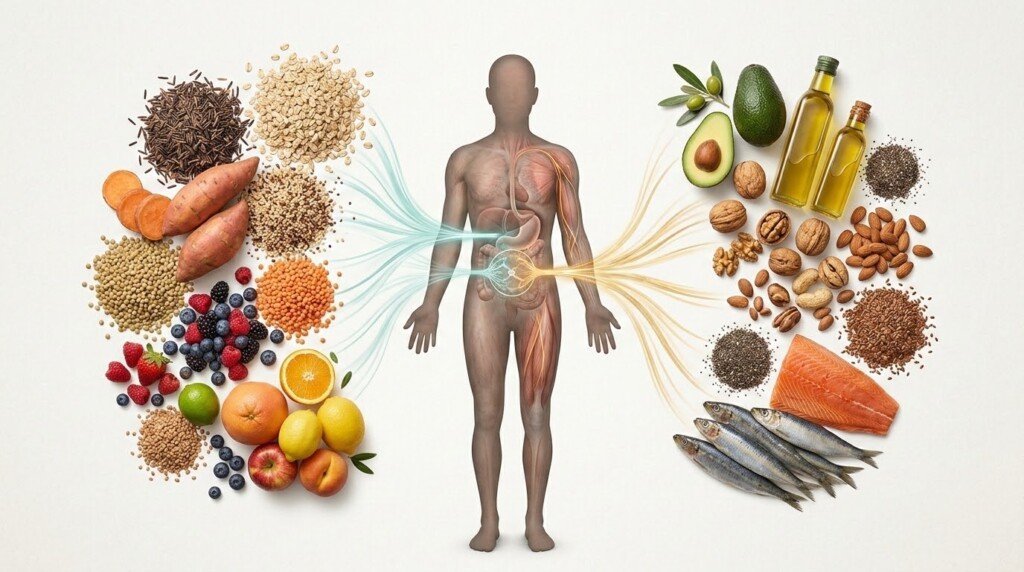
A better approach is to build meals around minimally processed foods, adequate protein, vegetables and fruit, fiber-rich carbohydrate sources, and appropriate dietary fats.
Whole grains, beans, lentils, potatoes, fruits, vegetables, nuts, seeds, eggs, fish, dairy products, and other minimally processed foods can all fit into a metabolic-health-oriented diet.
You also do not need to avoid carbohydrates at dinner.
Nor do you need to deliberately consume huge amounts of dietary fat simply to increase fat oxidation.
The body will adjust fuel use according to the situation.
What matters more is the overall pattern.
A diet that consistently provides excessive energy can contribute to weight gain and metabolic dysfunction regardless of whether those calories come primarily from carbohydrate or fat. Conversely, a nutritionally adequate diet combined with regular activity can support metabolic health without requiring extreme macronutrient manipulation.
Is Eating Fewer Carbohydrates the Best Way to Become More Metabolically Flexible?
Not necessarily.
Lower-carbohydrate diets can increase reliance on fat as a fuel, particularly when carbohydrate availability is substantially reduced. But increased fat oxidation under a low-carbohydrate condition is not automatically the same thing as improved metabolic flexibility.
That distinction is critical.
If your body is using more fat because carbohydrate availability is very low, that demonstrates a shift in fuel use. But true flexibility is about the ability to shift appropriately when conditions change.
A person who can use fat during fasting and increase carbohydrate oxidation after eating may demonstrate flexibility.
The goal is not to lock the body permanently into fat oxidation.
This is why the phrase “fat adaptation” should not be treated as synonymous with metabolic flexibility.
Fat adaptation refers to physiological adaptations associated with sustained low-carbohydrate or ketogenic diets, including greater reliance on fat and ketone bodies. Metabolic flexibility is the broader concept of switching fuel use according to changing conditions.
Those ideas overlap, but they are not identical.
How Do Keto or Intermittent Fasting Influence Fuel Switching?
Ketogenic diets and fasting can change the fuels available to the body.
During prolonged carbohydrate restriction or fasting, carbohydrate availability falls and fat oxidation increases. Ketone production also becomes more important as the fasting period continues.
That makes fasting and ketogenic diets useful research tools for studying fuel switching.
But this does not mean everyone needs to use them.
A 2024 network meta-analysis comparing different dietary interventions combined with exercise found that calorie restriction combined with exercise was particularly effective for reducing body weight and body fat across the interventions studied, while different combinations produced different outcomes for lean mass and body composition.
The lesson is important.
There are multiple ways to create useful metabolic adaptations.
You do not have to choose the most restrictive option.
If intermittent fasting helps you manage your eating pattern and you can follow it comfortably, it may be a reasonable tool.
If it makes you excessively hungry, interferes with training, encourages overeating later, or makes social eating unnecessarily difficult, it may not be the right tool.
The quality of the entire routine matters more than whether your eating window looks impressive.
For readers who specifically want to understand the fasting approach, intermittent fasting for weight loss goes deeper into that subject without making fasting the entire definition of metabolic flexibility.
What Physiological Mechanisms Explain How a High-Fat or High-Carb Diet Can Impair Flexibility?
This is one of the areas where nuance matters.
Metabolic flexibility can be influenced by the interaction between nutrient availability, insulin signaling, skeletal muscle metabolism, mitochondrial function, energy balance, and physical activity.
Research has found that people with obesity and type 2 diabetes can show reduced changes in fuel oxidation in response to insulin compared with lean individuals, suggesting reduced metabolic flexibility under those experimental conditions.
But that does not mean a particular macronutrient automatically causes metabolic inflexibility.
A high-fat diet, for example, can increase fat oxidation in the short term. That does not automatically mean it has damaged the metabolism.
Likewise, a high-carbohydrate diet can increase carbohydrate oxidation. That does not mean the body has lost the ability to burn fat.
The issue is adaptability.
Problems can arise when poor diet quality, chronic energy excess, physical inactivity, and impaired insulin sensitivity occur together.
This is why metabolic flexibility should be viewed as part of a broader metabolic system rather than as a single nutritional score.
Could Constant Grazing Make Fuel Switching Less Noticeable?
The idea that eating every few hours “turns off fat burning” is too simplistic.
Your body is constantly using a mixture of fuels.
After eating, nutrient availability changes. Between meals, it changes again. The body does not suddenly stop burning fat because you ate an apple, nor does it instantly switch to pure fat oxidation because you skipped breakfast.
However, your feeding pattern does influence the metabolic environment.
If you are eating continuously throughout the day, particularly energy-dense snacks and drinks, you may spend more time in a fed state.
That is not automatically unhealthy.
The bigger concern is whether frequent eating makes it easier to consume more energy than you need.
For some people, three structured meals work well.
For others, meals plus a snack are more practical.
Some prefer a shorter eating window.
There is no universal schedule that proves superior metabolic flexibility.
The better question is whether your eating pattern supports appropriate energy intake, good nutrition, stable energy, and a lifestyle you can maintain.
What Does a Metabolically Supportive Day of Eating Look Like?
It does not need to look like a laboratory experiment.
A typical day might include a protein-rich breakfast, a balanced lunch containing vegetables and a fiber-rich carbohydrate, an optional snack depending on hunger and activity, and a balanced dinner containing protein, vegetables, and an appropriate carbohydrate or fat source.
For example, breakfast could be eggs with whole-grain toast and fruit.
Lunch might be chicken, lentils, or tofu with rice and vegetables.
A snack could be Greek yogurt with berries or a piece of fruit with nuts.
Dinner might include fish, potatoes, and vegetables.
The exact foods are not the important part.
What matters is that the pattern provides adequate nutrition without requiring extreme restriction.
You are creating a diet your metabolism can operate within, not trying to trick your metabolism with a collection of special foods.
How Does Exercise Improve Metabolic Flexibility?
Exercise may be one of the most useful tools for supporting metabolic adaptability because it repeatedly challenges the body to meet changing energy demands.
When you walk, cycle, run, swim, or perform resistance training, your muscles need more energy.
The body responds by increasing energy production and changing fuel utilization.
Over time, repeated exercise can produce adaptations in skeletal muscle, cardiorespiratory fitness, mitochondrial function, glucose handling, and substrate oxidation.
Research consistently supports physical activity as an important contributor to insulin sensitivity and metabolic health.
And you do not need every workout to be brutally hard.
Why Is Interval Training Specifically Effective for Improving Fuel Switching?
Interval training creates repeated changes in exercise intensity.
You may move from a relatively easy effort into a harder interval and then recover before repeating the process.
That creates rapidly changing energy demands.
High-intensity exercise places substantial demands on carbohydrate metabolism, while recovery periods and lower-intensity activity allow other fuel systems to contribute.
Over time, this type of training can produce meaningful physiological adaptations.
A systematic review and meta-analysis found that HIIT and sprint interval training increased fat oxidation during exercise, with benefits observed after training periods of at least four weeks.
Another meta-analysis found that both HIIT and moderate-intensity continuous training improved maximal fat oxidation in adults with overweight or obesity compared with no training.
That second finding is particularly important.
HIIT is not the only effective option.
Moderate continuous exercise can also improve the body’s capacity to oxidize fat.
So if you dislike intervals, you have not lost your opportunity to improve metabolic health.
You can walk briskly.
You can cycle.
You can swim.
You can jog.
You can perform resistance training.
The best exercise is ultimately the one that provides a useful stimulus and that you can repeat consistently.

Does More Intense Exercise Always Mean Better Metabolic Flexibility?
No.
This is one of the easiest mistakes to make when reading about interval training.
If HIIT can improve metabolic outcomes, it is tempting to conclude that more HIIT must produce even better results.
But recovery matters.
Repeated high-intensity sessions create substantial stress on the cardiovascular and muscular systems.
If you perform hard intervals every day, you may accumulate fatigue, reduce training quality, sleep poorly, or simply stop enjoying exercise.
That can undermine the consistency that matters more than any single workout.
A better strategy is to use intensity strategically.
For example, someone who is new to exercise may begin with regular walking and basic resistance training before adding intervals.
A more experienced exerciser might include one or two interval sessions each week while using easier sessions for additional activity.
The exact frequency should reflect fitness level, recovery capacity, age, training history, and medical status.
There is no physiological prize for making every workout miserable.
What Type of Interval Training Should a Beginner Use?
Beginners do not need all-out sprints.
A simple interval session could alternate a few minutes of comfortable walking with a shorter period of faster walking.
As fitness improves, the faster interval can become a light jog, faster cycling effort, incline walk, or another activity appropriate to the person.
The goal is to create changes in intensity without turning the session into a test of survival.
For example, a beginner might spend five minutes warming up, alternate one minute of faster movement with two minutes of easier movement several times, then cool down.
That is interval training.
It does not need to involve sprinting.
If someone has cardiovascular disease, significant obesity, joint problems, diabetes, or another medical condition that affects exercise safety, they should discuss appropriate exercise intensity with a qualified healthcare professional.
Can Intermittent Fasting Improve Metabolic Flexibility?
Intermittent fasting can create longer periods without food, which changes the availability of incoming nutrients and encourages greater reliance on stored fuels during the fasting period.
That makes it biologically plausible as one tool for influencing fuel utilization.
But “biologically plausible” is not the same as “necessary.”
Research on fasting combined with exercise suggests that these strategies can influence body composition and metabolic outcomes, but the effects depend on the specific protocol, population, diet, exercise program, and adherence.
If fasting works well for you, it can be part of a broader strategy.
If it makes you ravenous, reduces training quality, causes you to overeat later, or creates an unhealthy relationship with food, it may be counterproductive.
There is no requirement to fast in order to have a metabolically healthy lifestyle.
And because detailed fasting schedules belong to a separate topic, the practical approach here is simple: treat fasting as an optional tool rather than the definition of metabolic flexibility.
What Role Does Resistance Training Play?
Resistance training deserves more attention in metabolic-flexibility discussions.
Your skeletal muscles are major sites of glucose disposal and energy metabolism.
When you build or maintain muscle through resistance exercise, you are not simply changing your appearance.
You are maintaining metabolically active tissue and improving your physical capacity.
Exercise research consistently shows improvements in insulin sensitivity with regular physical activity, and both aerobic and resistance exercise can contribute to metabolic health.
A balanced program can therefore include both resistance training and aerobic activity.
Resistance training provides a stimulus for muscle.
Aerobic exercise challenges cardiovascular fitness and energy metabolism.
Intervals add periods of higher intensity.
Walking adds low-impact daily movement.
These forms of activity do not need to compete.
They can complement one another.
What Are Realistic Long-Term Benefits of Improving Metabolic Flexibility?
Do not expect a dramatic sensation that tells you your metabolism has suddenly become “flexible.”
There is no special feeling that reliably confirms the adaptation.
The benefits are more likely to appear as improvements in broader health and fitness.
You may become better conditioned.
You may tolerate exercise more comfortably.
Your fitness may improve.
Your ability to perform different types of physical activity may increase.
Your insulin sensitivity may improve with regular exercise.
Your body composition may improve if nutrition and activity support appropriate energy balance.
A systematic review of HIIT found improvements in cardiorespiratory fitness and several body-composition measures compared with no exercise, although HIIT was not consistently superior to other aerobic training for every outcome.
This is a useful reality check.
The goal is not to become obsessed with a metabolic-flexibility score.
The goal is to create a body that is capable, active, and metabolically healthy.
Can Walking Really Help?
Yes.
Walking is often overlooked because it does not look impressive on social media.
But walking increases energy expenditure, provides regular muscular activity, supports cardiovascular fitness, and is easy to repeat.
Its biggest advantage may be adherence.
A person who walks for 30 minutes most days may accumulate more useful activity over a month than someone who attempts brutal workouts and repeatedly quits.
Walking also works well alongside resistance training and interval sessions.
You can use it for recovery days, daily movement, warm-ups, or additional low-intensity activity.
There is no requirement that every exercise session be intense enough to leave you exhausted.
What Does a Practical Metabolic-Flexibility Exercise Week Look Like?
A balanced week might include several forms of movement rather than relying on one training style.
For example, you could have three resistance-training sessions, two easier aerobic sessions, one optional interval session, and regular walking throughout the week.
That is only an example, not a universal prescription.
A beginner could start with much less.
Someone already exercising regularly could handle more.
The principle is what matters.
Give your body different energy demands.
Include some strength work.
Include aerobic movement.
Use higher intensity when appropriate.
Allow recovery.
Repeat the process consistently.
That combination is more defensible than chasing a single “best metabolic flexibility workout.”

Should You Cycle Between High-Carb and High-Fat Days?
There is no strong reason for most people to deliberately cycle macronutrients simply to improve metabolic flexibility.
The body already responds dynamically to changes in food availability.
You do not need to create artificial extremes to make it adapt.
Macronutrient cycling can have specific uses in certain athletic or dietary contexts, but it adds complexity.
If your primary goal is general metabolic health, the basics deserve priority.
Eat an appropriate amount of food.
Choose mostly nutritious foods.
Get enough protein.
Include fiber-rich carbohydrates.
Include appropriate dietary fats.
Exercise regularly.
Sleep adequately.
Manage your overall activity.
Then consider more specialized strategies only if there is a specific reason to use them.
What Lifestyle Habits Support Metabolic Flexibility Besides Diet and Exercise?
Sleep deserves a place in the conversation.
Research has linked insufficient sleep with reduced insulin sensitivity, increased hunger, and increased energy intake.
That does not make sleep a direct metabolic-flexibility treatment.
It simply means that sleep influences the broader metabolic environment.
Stress also matters because it can affect sleep, appetite, physical activity, and eating behavior.
So the most useful metabolic strategy may look surprisingly ordinary.
Exercise regularly.
Eat mostly nutritious foods.
Sleep enough.
Avoid chronically excessive energy intake.
Maintain a healthy level of physical activity.
And give your body enough recovery to adapt.
The boring basics are often the foundation on which the more interesting physiology depends.
What Should You Avoid If You Want Better Metabolic Flexibility?
Avoid turning metabolic flexibility into another extreme diet challenge.
You do not need to eliminate all carbohydrates.
You do not need to stay in ketosis permanently.
You do not need to fast every day.
You do not need to perform HIIT six days a week.
You do not need to buy a supplement marketed as a “metabolic switch.”
You also should not assume that feeling hungry means you are becoming more metabolically flexible.
These strategies may produce short-term changes in fuel use, but the larger goal is metabolic adaptability and overall health.
If a strategy damages your sleep, makes training worse, creates excessive hunger, or becomes impossible to maintain, it deserves reconsideration.
When Should You Expect to Notice a Difference?
There is no universal timeline.
Exercise adaptations can begin relatively quickly, while measurable changes in body composition and fitness generally require repeated training over weeks and months.
Research on interval training has found improvements in fat oxidation after training periods of at least four weeks, but the magnitude of change varies between individuals and protocols.
Do not interpret this as a promise that four weeks will transform your metabolism.
It means that physiological adaptations can be measurable within relatively short training periods, while meaningful long-term health improvements depend on continued participation.
Think in months, not days.
Your goal is not to feel different tomorrow morning.
Your goal is to make your body more capable over time.
A Simple Strategy for Improving Metabolic Flexibility
If you want to put everything together without overcomplicating it, start here.
Eat mostly minimally processed foods and build meals around adequate protein, vegetables or fruit, fiber-rich carbohydrates, and appropriate fats.
Do not fear carbohydrates or dietary fat.
Use a moderate eating pattern that supports your energy needs rather than forcing extreme restriction.
Include resistance training regularly.
Add aerobic activity that you enjoy.
Introduce intervals gradually if your fitness level allows them.
Walk regularly.
Prioritize sleep.
Treat intermittent fasting as an optional eating pattern, not a requirement.
Give your routine enough time to work before constantly changing it.
Most importantly, stop measuring success by how much fat you can burn during one particular hour.
Metabolic flexibility is about the ability to adapt.
The body should be able to use different fuels under different conditions.
Exercise can help create those changing demands.
Nutrition can influence the fuel environment.
Sleep and recovery can support the larger metabolic system.
And consistency gives those adaptations time to develop.
Frequently Asked Questions
1. How Can I Improve Metabolic Flexibility?
You can support metabolic flexibility through regular physical activity, resistance training, aerobic exercise, adequate sleep, and a nutritious eating pattern that provides a sensible balance of carbohydrates, fats, and protein. Interval training may improve fat oxidation, but it is not the only effective exercise approach.
2. Does Intermittent Fasting Help Metabolic Flexibility?
Intermittent fasting can change fuel availability and increase reliance on stored fuels during fasting periods, so it may influence aspects of fuel switching. However, it is not necessary for improving metabolic health, and research does not establish fasting as universally superior to other sustainable eating approaches.
3. What Exercise Is Best for Metabolic Flexibility?
There is no single best exercise. A combination of resistance training, aerobic activity, regular walking, and appropriately used interval training can provide different metabolic demands. Both HIIT and moderate-intensity continuous training have been shown to improve fat oxidation compared with no exercise.
4. Do I Need a Low-Carb or Keto Diet?
No. Low-carbohydrate and ketogenic diets can increase fat oxidation, particularly when carbohydrate availability is low, but increased fat oxidation is not identical to metabolic flexibility. A balanced diet can support metabolic health without requiring permanent carbohydrate restriction.
5. How Long Does It Take to Improve Metabolic Flexibility?
There is no fixed timeline. Some exercise-related adaptations can be measurable within several weeks, while broader changes in fitness, body composition, and metabolic health generally require consistent habits over longer periods. Individual responses vary considerably.
The Bottom Line (How to improve metabolic flexibility).
Improving metabolic flexibility does not require turning your diet into a metabolic experiment.
Your body already knows how to switch fuels.
The goal is to support that ability through regular movement, appropriate nutrition, and healthy recovery.
Resistance training gives your muscles a reason to adapt.
Aerobic exercise increases your capacity to use energy.
Interval training adds periods of changing energy demand and can improve fat oxidation.
A balanced diet provides different fuel sources without forcing your metabolism into one permanent state.
Intermittent fasting can be useful for some people, but it is an optional tool rather than a requirement.
And sleep matters because metabolic health does not exist separately from the rest of your physiology.
The most useful shift in thinking is this:
Do not try to make your body burn one fuel all the time. Help it become better at using the right fuel for the situation.
That is a much more realistic interpretation of metabolic flexibility, and it gives you something practical to work toward.
Instead of chasing a metabolic “switch,” build a body that can walk, lift, run, recover, eat, fast between meals, and respond to changing energy demands without requiring extreme interventions.
That is the kind of flexibility worth improving.
Disclaimer:
This post may contain affiliate links. If you purchase through them, we may earn a small commission at no extra cost to you. Also, this content is for informational purposes only and does not substitute professional medical advice.
Fuel Your Body Right
Use our free Nutrition Toolkit to find your protein target, fasting window, and net carbs in minutes.
Open Free Tools →