

What Is Metabolic Flexibility? And Why It Matters More Than You Think
Your body is constantly making decisions about fuel.
After you eat, more glucose becomes available and your body adjusts how it handles and stores that energy. Hours later, when you have not eaten, the balance shifts. During exercise, your energy demands change again. The fuel being used can change with the situation.
That ability to adjust is the basic idea behind metabolic flexibility.
Metabolic flexibility describes the body’s capacity to adapt its fuel use to changing conditions, particularly the availability of carbohydrates and fats and the amount of energy being demanded. Researchers commonly describe it as the ability to shift between different fuel sources rather than relying on one fuel pattern regardless of circumstances.
This sounds technical, but the concept is actually easier to understand than the name suggests.
Think of your metabolism as a flexible fuel system. When circumstances change, a flexible system can change how it produces and uses energy. When that adaptability is reduced, researchers often use the term metabolic inflexibility.
That does not mean your metabolism has “stopped working.” It does not mean you have a diagnosis. And it does not mean every tired afternoon or strong carbohydrate craving proves that your metabolic flexibility is poor.
In fact, there is currently no universally accepted clinical cutoff that allows someone to diagnose themselves as metabolically inflexible based on everyday symptoms. Researchers use specialized methods, often involving measurements of respiratory exchange or respiratory quotient under controlled conditions.
So why should an ordinary person care about metabolic flexibility?
Because the concept provides a useful way to understand how the body responds to meals, fasting periods, physical activity, and changing energy demands. It also overlaps with several areas of metabolic health, including insulin sensitivity, obesity, and type 2 diabetes research.
The important thing is to understand what metabolic flexibility actually means before turning it into another internet health label.
What Is Metabolic Flexibility?
At its simplest, metabolic flexibility means being able to change the fuel your body uses as conditions change.
Your body can use carbohydrates and fats for energy, among other substrates. The relative contribution of each fuel changes depending on factors such as whether you recently ate, what you ate, how active you are, and how much energy your body needs.
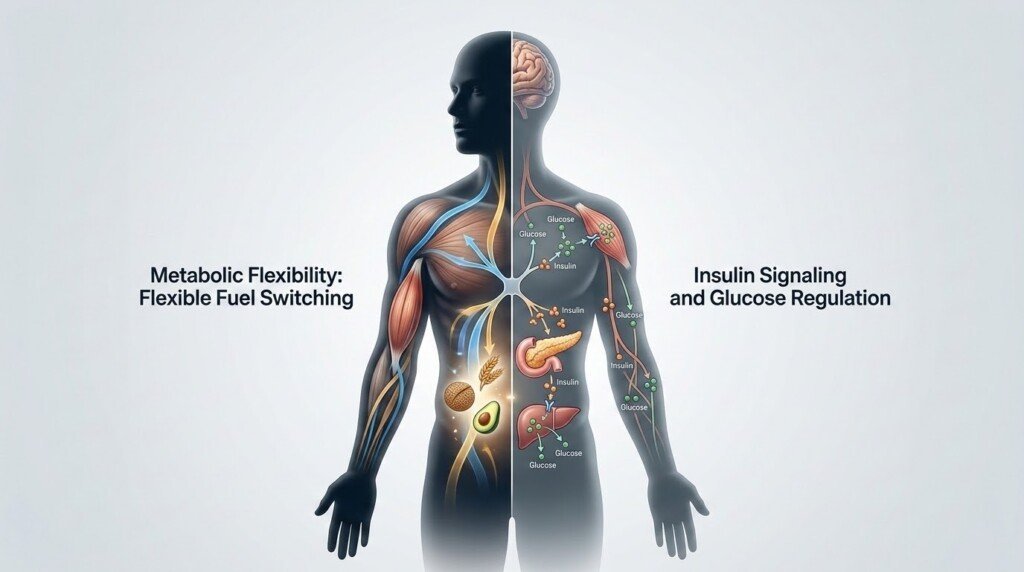
After a meal containing carbohydrates, glucose availability increases and insulin helps coordinate the movement and storage of nutrients. During fasting, the body shifts toward greater reliance on stored fuels, including fatty acids. During exercise, fuel use changes according to exercise intensity, duration, fitness, and available energy.
A metabolically flexible system is therefore not one that burns fat all day.
That is an important distinction.
The goal is not to permanently maximize fat burning. The goal is adaptability.
A person who can use carbohydrate efficiently when carbohydrate is readily available and increase reliance on fat when conditions favor fat use is displaying the basic characteristic researchers are interested in.
This is why metabolic flexibility is sometimes described as fuel switching.
What Does Metabolic Flexibility Mean in Simple, Non-Technical Terms?
Imagine your car had access to two fuel sources but could only use one of them efficiently.
You would not necessarily say the car had no fuel.
You would say it had trouble adapting.
Your metabolism works differently from a car, but the analogy helps.
When you eat, the body receives a different supply of nutrients than it has during a fasting period. When you exercise, energy demand changes again. A flexible metabolism can adjust its fuel use to meet those changing circumstances.
So metabolic flexibility is less about “burning fat” and more about switching appropriately.
That distinction matters because online discussions often reduce the concept to claims such as “If you are metabolically flexible, you burn fat all day.”
That is not what the scientific term means.
Researchers typically study metabolic flexibility by examining how fuel oxidation changes when the body’s nutritional or energetic conditions change. The classic concept involves shifting between greater lipid oxidation during fasting and greater carbohydrate utilization after insulin stimulation or feeding.
In other words, flexibility is about the response, not one permanent metabolic state.

How Does It Relate to How Your Body Uses Energy From Food?
Every meal creates a temporary change in the metabolic environment.
Carbohydrates can be broken down into glucose, which can be used for energy or stored as glycogen. Dietary fat can be stored or oxidized for energy. Protein contributes amino acids needed for tissues and other physiological functions, while some amino acids can also be used as energy.
Your body is continually coordinating these processes.
Insulin is one important part of that coordination. After eating, insulin helps promote glucose uptake and storage and changes how the body handles fat. During fasting, different hormonal signals encourage the release and use of stored energy.
Metabolic flexibility describes part of this larger system of adaptation.
It is therefore not a separate “switch” sitting somewhere in your body.
It is an observable characteristic of how tissues and the whole body respond to changes in nutrient availability and energy demand.
Skeletal muscle is particularly important because it is a major site of glucose and fatty-acid metabolism. Researchers have therefore studied how muscle changes its fuel use in response to insulin, meals, exercise, and dietary conditions.
What Factors Can Impair Metabolic Flexibility?
Several factors have been associated with altered metabolic flexibility, including obesity, insulin resistance, physical inactivity, and changes in skeletal-muscle metabolism.
However, the relationship is complicated.
It would be misleading to say that one lifestyle factor automatically “breaks” metabolic flexibility.
Metabolism is influenced by multiple interacting factors, including body composition, physical activity, dietary conditions, energy balance, insulin sensitivity, mitochondrial function, and potentially genetic factors.
Research also shows that metabolic flexibility is not a simple yes-or-no characteristic.
A 2025 systematic review and meta-analysis found differences in metabolic flexibility across weight-status groups, but also emphasized that no distinct threshold currently defines metabolic inflexibility in people with type 2 diabetes.
That is why the phrase should be used carefully.
It is useful for understanding physiology and metabolic health research.
It is much less useful as a self-diagnosis based on one symptom.
What Are the Signs of Poor Metabolic Flexibility?
This is where the subject becomes tricky.
People often search for “signs of poor metabolic flexibility” expecting a checklist similar to symptoms of a medical condition.
There is no validated everyday symptom checklist that can diagnose metabolic inflexibility.
Researchers typically assess metabolic flexibility using controlled metabolic testing rather than asking someone whether they feel tired after lunch or crave carbohydrates at night. Some testing approaches use indirect calorimetry to estimate changes in fuel oxidation under specific nutritional or exercise conditions.
Still, there are patterns that can make it reasonable to pay more attention to your overall metabolic health.
These are not proof of poor flexibility.
They are reasons to look at the bigger picture.
How Does Diet Impact Metabolic Flexibility Day to Day?
Your metabolism responds to what you eat.
That does not mean one meal can make you metabolically flexible or inflexible.
Instead, your habitual dietary pattern influences the metabolic environment in which your body operates.
A diet dominated by highly processed, energy-dense foods can make it easier to consume more energy than your body needs. At the same time, low dietary quality may displace foods that provide fiber, protein, vitamins, minerals, and other nutrients.
On the other hand, a varied diet that includes minimally processed foods, adequate protein, fiber-rich carbohydrates, healthy fats, and an appropriate amount of energy provides a very different nutritional environment.
But there is an important nuance here.
Metabolic flexibility is not simply a reward for eating “clean.”
The body can adapt its fuel use under many different dietary patterns.
Researchers have found that metabolic flexibility can be influenced by the type and amount of nutrients available, energy balance, and recent dietary conditions. Even short-term changes in diet can affect measurements used to assess flexibility.
This is another reason not to turn metabolic flexibility into a simplistic diet score.
Can Stress or Poor Sleep Affect It?
Sleep and stress deserve attention because they influence several metabolic processes, although they should not be presented as direct diagnostic tests for metabolic flexibility.
Insufficient sleep has been associated with changes in insulin sensitivity and appetite regulation. A systematic review and meta-analysis of randomized trials found that sleep restriction reduced insulin sensitivity and increased subjective hunger and energy intake.
That matters because insulin sensitivity and metabolic flexibility are closely related concepts, even though they are not identical.
Sleep also influences obesity and type 2 diabetes risk through several interacting pathways.
Stress can influence eating behavior, physical activity, sleep, and hormonal responses. Chronic stress may therefore affect metabolic health indirectly as well as through physiological pathways.
But avoid the common internet shortcut:
“Stress is making you metabolically inflexible.”
That is far too definite.
A more accurate statement is that chronic sleep disruption, stress, inactivity, and other lifestyle factors can contribute to an environment associated with poorer metabolic health.

What Are the Long-Term Health Consequences of Staying Metabolically Inflexible?
Metabolic inflexibility is not itself a standard medical diagnosis with a universally agreed disease progression.
Instead, researchers are interested in it because impaired fuel switching has been associated with metabolic conditions such as obesity, insulin resistance, and type 2 diabetes.
This relationship is not necessarily one-directional.
Insulin resistance can alter fuel handling, while altered lipid metabolism and excess lipid accumulation in tissues may also contribute to insulin signaling problems.
That makes cause-and-effect difficult to reduce to one sentence.
The older literature on metabolic flexibility and insulin resistance specifically cautioned against assuming that impaired flexibility is simply the root cause of insulin resistance. Researchers noted that the relationship can depend on how metabolic flexibility is measured and on the amount of glucose available for oxidation.
The practical takeaway is straightforward.
Do not treat “metabolic inflexibility” as a condition you can diagnose from symptoms alone.
Instead, view it as one concept within the much larger picture of metabolic health.
If you are concerned about blood glucose, insulin resistance, diabetes risk, unexplained weight changes, or other persistent health issues, those concerns should be evaluated using appropriate clinical assessment rather than a social-media metabolic checklist.
How Is Metabolic Flexibility Different From Insulin Resistance?
Metabolic flexibility and insulin resistance overlap, but they are not the same thing.
Metabolic flexibility describes how well the body adapts fuel use when nutritional or energy conditions change.
Insulin resistance describes a reduced biological response to insulin, particularly in tissues such as skeletal muscle, liver, and adipose tissue.
Someone can have impaired metabolic flexibility without that automatically meaning they have a clinical diagnosis of insulin resistance.
Likewise, insulin resistance can influence metabolic flexibility because insulin plays a major role in directing fuel use after eating.
Research has repeatedly examined the two concepts together, but the relationship is more complicated than “poor flexibility equals insulin resistance.”
If your primary concern is insulin resistance, the distinction matters because insulin resistance has established clinical markers and management approaches.
You can read more about the condition at insulin resistance.
How Is Insulin Resistance Related to, but Distinct From, Poor Metabolic Flexibility?
Think of the difference this way.
Metabolic flexibility asks:
“How well can the body change its fuel use when circumstances change?”
Insulin resistance asks:
“How strongly do tissues respond to insulin’s signals?”
Those questions are related because insulin helps regulate fuel selection and storage.
After a meal, insulin promotes glucose uptake and changes the body’s handling of fat. During fasting, the hormonal environment changes and the body increasingly relies on stored fuels.
If tissues become less responsive to insulin, the normal shift toward glucose utilization after insulin stimulation can be altered.
This is one reason metabolic flexibility is frequently studied in connection with insulin resistance.
But researchers have also pointed out measurement problems.
There is no single universally accepted test that tells a person, “Your metabolic flexibility is 72 percent and therefore you are healthy.”
Different studies use different nutritional conditions, exercise protocols, metabolic chambers, clamps, or respiratory measurements. Recent research continues to call for greater standardization in how metabolic flexibility is measured.
So if you have been told online that a particular symptom proves you are metabolically inflexible, be skeptical.
The science does not support that level of certainty.
What Does Good Metabolic Flexibility Look Like in Everyday Life?
This is a useful question, but it needs a careful answer.
You cannot look at someone and reliably determine their metabolic flexibility.
You also cannot prove good metabolic flexibility because you can skip breakfast without feeling weak, because you lose weight easily, or because you do not experience an afternoon energy crash.
Those observations may tell you something about your individual response to food and activity, but they are not a metabolic-flexibility test.
The more useful everyday concept is metabolic adaptability.
Can your body and lifestyle handle different energy demands?
Can you eat a meal and continue your day without feeling that every carbohydrate has caused a dramatic problem?
Can you exercise and gradually improve your fitness?
Can you maintain reasonably stable energy without relying constantly on stimulants?
Can your body respond appropriately to changes in food intake and physical activity?
These are broad health observations, not diagnostic criteria.
And they should remain in that category.
Why Does Metabolic Flexibility Matter Beyond Fat Burning?
The biggest mistake in online discussions is reducing metabolic flexibility to one question:
“Am I burning fat?”
That is too narrow.
Your body needs to use different fuels at different times.
Carbohydrates are valuable fuels, particularly during higher-intensity activity. Fat provides substantial energy during lower-intensity conditions and fasting. The body also has sophisticated systems for storing, mobilizing, and using these fuels according to physiological demands.
A healthy metabolism is therefore not one that maximizes one fuel.
It is one capable of responding appropriately.
This broader interpretation is why researchers have investigated metabolic flexibility in relation to exercise, insulin sensitivity, obesity, diabetes, and other metabolic conditions.
It also explains why “fat-burning mode” is a poor substitute for understanding actual metabolic physiology.
Your body is not choosing one fuel forever.
It is constantly adjusting the mix.
Can You Measure Metabolic Flexibility at Home?
Not reliably.
Wearable devices can estimate various aspects of activity, heart rate, sleep, and sometimes other physiological variables.
They cannot currently provide a simple home measurement that establishes whether you have clinically meaningful metabolic inflexibility.
Researchers may use indirect calorimetry to estimate energy expenditure and substrate utilization by measuring respiratory gases. Some protocols compare fuel oxidation during fasting and after insulin stimulation or during different exercise intensities.
These methods are useful for research because they allow scientists to study how fuel use changes under controlled conditions.
They are not equivalent to a consumer app saying “Your metabolic flexibility is poor.”
If a product promises to diagnose metabolic flexibility from a single wearable metric, treat the claim cautiously.
The field itself still has questions about standardized testing protocols and interpretation.
What Does Metabolic Flexibility Have to Do With Exercise?
Exercise changes energy demand dramatically.
When you are sitting quietly, your energy requirements are relatively low.
When you begin walking, jogging, cycling, or lifting weights, energy demand increases and the relative contribution of different fuels changes.
Training can also change skeletal muscle.
Regular physical activity affects mitochondrial function, muscle oxidative capacity, glucose handling, and the body’s ability to respond to different energy demands. These adaptations are part of why exercise is so important to metabolic health research.
This does not mean you need a special “metabolic flexibility workout.”
It means that regular movement gives the metabolic system opportunities to adapt to changing demands.
That is a much less glamorous message than many fitness advertisements offer, but it is also much more useful.
What Should You Take Away If You Think Your Metabolic Flexibility Is Poor?
Start by questioning the assumption.
Ask yourself why you believe it is poor.
Is it because you feel tired after meals?
Because you struggle with weight?
Because someone online told you that carbohydrate cravings indicate metabolic inflexibility?
Because you saw a wearable score?
None of those observations can independently diagnose metabolic inflexibility.
Instead, look at the broader picture of metabolic health.
Consider physical activity.
Consider sleep quality.
Consider dietary quality.
Consider body composition.
Consider family and medical history.
Consider blood pressure and clinically measured blood glucose markers when appropriate.
And if you have persistent symptoms or concerns about diabetes, insulin resistance, or another metabolic condition, talk with a qualified healthcare professional.
This approach prevents metabolic flexibility from becoming another vague label that makes people anxious without giving them useful information.
If your broader concern is metabolic health, metabolic health is the more appropriate place to understand the larger picture.
Why Should You Not Confuse Metabolic Flexibility With Being “Metabolically Healthy”?
A person can have apparently normal body weight and still have metabolic risk factors.
A person with a higher body weight can also have many favorable metabolic markers.
That is why one characteristic should not be used as a complete health score.
Metabolic flexibility is an interesting physiological concept, but it is only one piece of a much larger system.
The same principle applies to insulin.
Insulin is essential for normal physiology. Having insulin is not a problem. Eating carbohydrates is not a problem. Burning carbohydrates instead of fat at a particular moment is not a problem.
The important question is whether the body’s regulatory systems are functioning appropriately overall.
This is where metabolic flexibility becomes useful as a concept rather than a buzzword.
It encourages us to think about adaptability instead of obsessing over a single fuel.
Frequently Asked Questions
1. What Is Metabolic Flexibility?
Metabolic flexibility is the body’s ability to adjust which fuels it uses as conditions change. This includes shifting between greater carbohydrate and fat utilization depending on factors such as feeding, fasting, exercise, and energy demand. Researchers generally study this response under controlled conditions rather than diagnosing it from everyday symptoms.
2. What Are Signs of Poor Metabolic Flexibility?
There is no validated everyday symptom checklist that can diagnose poor metabolic flexibility. Researchers typically assess it using specialized metabolic testing. Tiredness, cravings, weight changes, or afternoon energy dips may have many possible causes and should not automatically be interpreted as evidence of metabolic inflexibility.
3. Is Metabolic Flexibility the Same as Insulin Resistance?
No. They are related but distinct concepts. Metabolic flexibility describes the ability to adapt fuel use to changing conditions, while insulin resistance describes reduced responsiveness to insulin. Insulin resistance can affect metabolic flexibility, but the two terms should not be used interchangeably.
4. Does Poor Sleep Affect Metabolic Health?
Yes, poor or insufficient sleep can affect several aspects of metabolic health. Research has linked sleep restriction with reduced insulin sensitivity, increased hunger, and higher energy intake. However, poor sleep alone does not establish that someone has impaired metabolic flexibility.
5. Can Metabolic Flexibility Be Tested?
Yes, metabolic flexibility can be studied using specialized methods such as indirect calorimetry and controlled nutritional or exercise challenges. However, there is no simple universally accepted home test or single cutoff that can diagnose metabolic inflexibility in an individual. Researchers are still working toward more standardized assessment methods.
The Bottom Line
Metabolic flexibility is the body’s ability to adapt its fuel use as circumstances change.
That means using available carbohydrate when carbohydrate availability and demand favor it, increasing reliance on fat under conditions that favor fat use, and adjusting energy metabolism as activity, feeding, and fasting change.
It does not mean burning fat constantly.
It does not mean carbohydrates are bad.
It does not mean every energy crash is evidence of metabolic dysfunction.
And it does not mean you can diagnose insulin resistance from a list of internet symptoms.
The most important distinction is adaptability.
Your metabolism is supposed to change.
After a meal, it changes.
During an overnight fast, it changes.
When you exercise, it changes.
When your energy demands change, it changes.
Metabolic flexibility is the scientific concept used to describe part of that adaptability. Researchers have linked altered flexibility with metabolic conditions including obesity, insulin resistance, and type 2 diabetes, while also acknowledging that the relationship is complex and that measurement methods are not yet completely standardized.
For everyday health, that means you do not need to chase a “fat-burning state” or buy a device promising to reveal your metabolic score.
A better approach is to pay attention to the fundamentals that support metabolic health overall: regular physical activity, adequate sleep, a nutritious and sustainable eating pattern, appropriate energy intake, and appropriate medical evaluation when genuine metabolic concerns arise.
Metabolic flexibility is interesting because it shows just how dynamic the human metabolism really is.
Your body is not locked into one fuel.
It is constantly adapting.
And that adaptability, rather than permanent fat burning, is the real idea behind metabolic flexibility.
Disclaimer:
This post may contain affiliate links. If you purchase through them, we may earn a small commission at no extra cost to you. Also, this content is for informational purposes only and does not substitute professional medical advice.
Ready to Start Your Journey?
Use our free 7-in-1 Weight Loss Toolkit to calculate your numbers and build your plan in minutes.
Open Free Tools →