Best Portion Control Tools (Plates, Scales, Apps & More)
Trying to eat appropriate portions can feel surprisingly difficult. One day you’re carefully measuring breakfast, the next you’re guessing how much rice is on your plate at dinner, and by the weekend you’re staring at a restaurant meal wondering whether it’s one serving or three.
This is exactly why portion control tools have become so popular. Rather than relying on guesswork alone, these tools provide structure that helps people understand how much food they’re actually eating. Some tools focus on precision, others make healthy eating more convenient, and some simply make portion awareness easier without requiring constant measuring.
The important thing to understand is that no single tool magically controls portions for you. A digital food scale cannot decide when you’re hungry. A divided plate won’t prevent emotional eating. A smartphone app won’t automatically create healthy habits. These tools are simply resources that reduce uncertainty and make consistent choices easier.
Choosing the right tool depends on your goals. Someone tracking nutrition for athletic performance may benefit from a digital food scale. Someone managing diabetes might prefer a portion control plate. A busy professional who eats away from home frequently may find a smartphone app far more practical than carrying measuring cups.
Instead of searching for the “perfect” tool, it is far more helpful to understand what each option actually does well and where its limitations begin. That realistic perspective prevents unnecessary spending while helping you build habits that are easier to maintain.
This guide explores the most useful portion control tools, explains who benefits most from each one, and discusses how they compare in everyday life.
Quick Answer
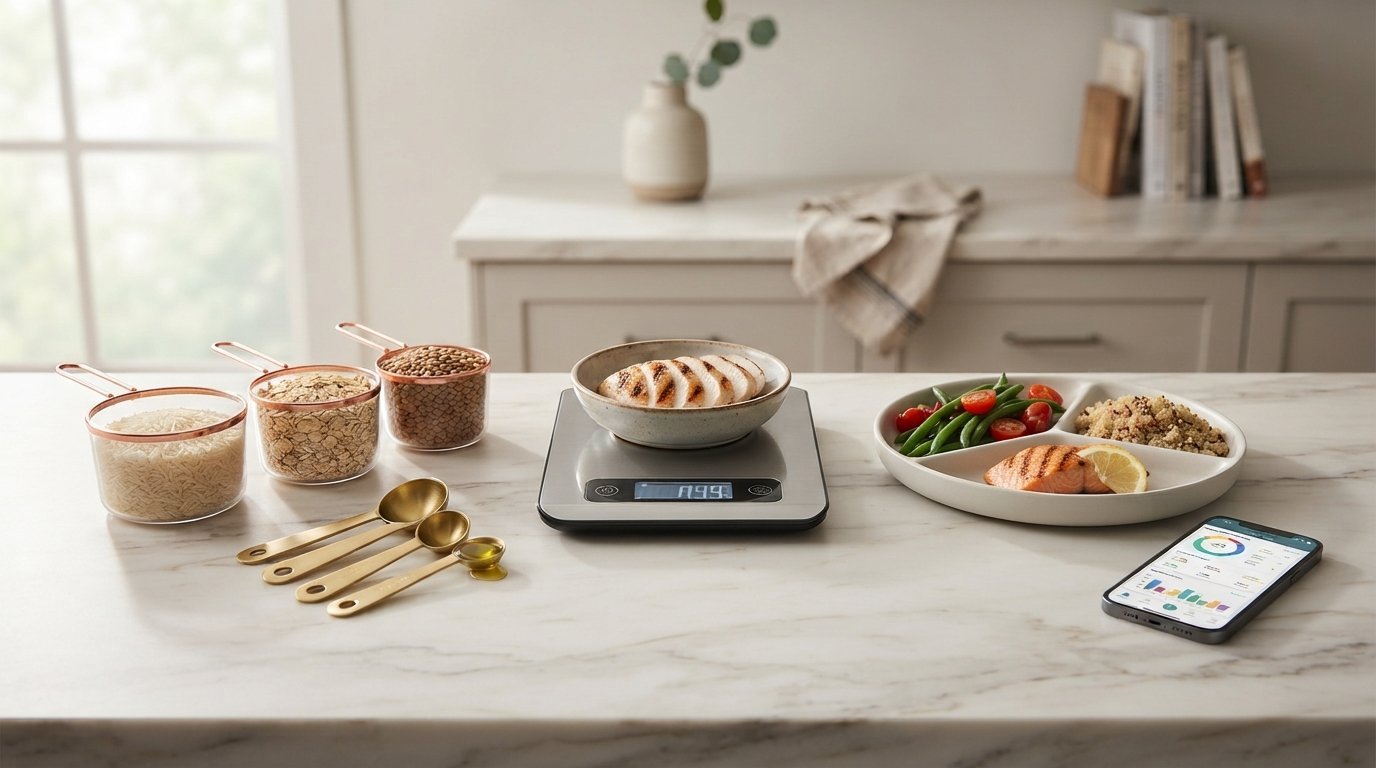
The best portion control tools include digital food scales, measuring cups and spoons, portion control plates, meal-prep containers, and nutrition tracking apps. Each serves a different purpose. Food scales offer the greatest precision, measuring cups improve consistency for home cooking, portion plates simplify meal planning, and smartphone apps help monitor long-term eating patterns. The most effective tool depends on your lifestyle rather than one universal solution.
What Kitchen Tools Help Most With Portion Control?
The kitchen offers more portion-control resources today than ever before.
Some tools emphasize measurement.
Others focus on meal structure.
Some help organize meal preparation for the week.
Others track nutrition digitally.
While each has advantages, their usefulness depends on how naturally they fit into daily routines. A tool sitting unused inside a drawer provides little benefit regardless of how accurate it may be.
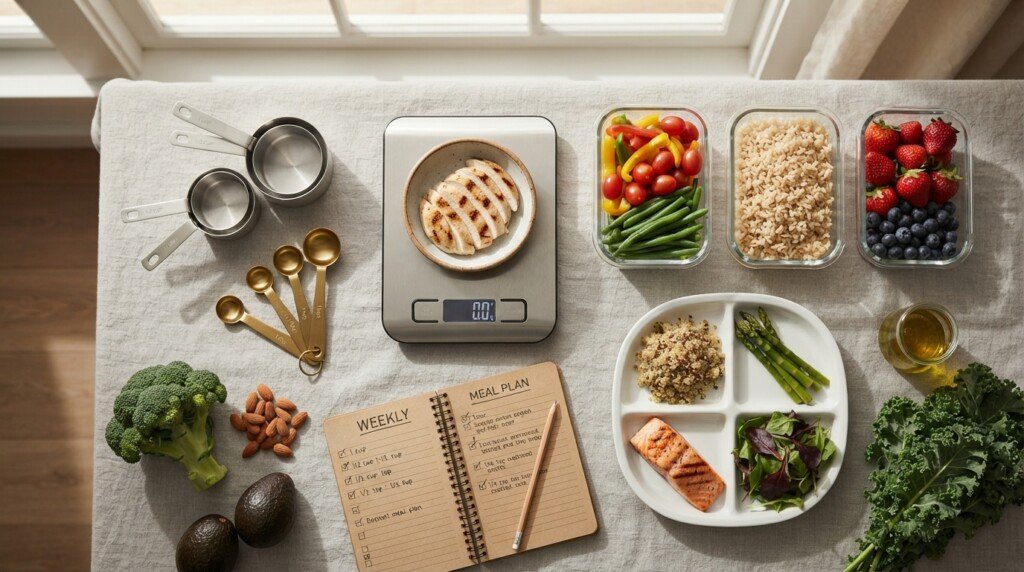
For most people, portion-control tools fall into three broad categories.
The first includes measuring tools such as food scales, measuring cups, measuring spoons, and portion containers. These improve accuracy when preparing food at home.
The second includes meal-guidance tools such as divided plates that visually organize balanced meals without requiring every ingredient to be weighed.
The third includes digital resources such as nutrition tracking apps that record food intake, estimate portions, and monitor long-term eating habits.
Rather than viewing these categories as competing methods, many people eventually combine them. They might use a food scale while learning portion sizes, rely on measuring cups for staple foods like rice or oats, and occasionally use an app to monitor overall eating patterns.
The goal is not lifelong dependence on tools but gradually developing confidence in portion awareness.
How Do Food Scales Help With Precise Portion Control?
Among all portion-control tools, digital food scales provide the highest level of accuracy.
Instead of estimating by sight, a food scale measures the exact weight of food before or after cooking, depending on the food being prepared. This eliminates much of the uncertainty that comes from visual estimation.
For foods with highly variable shapes or densities, this precision becomes particularly useful.
A tablespoon of peanut butter can vary significantly depending on how generously it is scooped.
A bowl of cereal may look modest while containing much more than expected.
Chicken breasts differ dramatically in size from one package to another.
Weighing these foods removes much of the guesswork.
Food scales are especially valuable for people following structured nutrition programs, athletes monitoring macronutrients, individuals managing medical nutrition plans, or anyone learning what standard serving sizes actually look like.
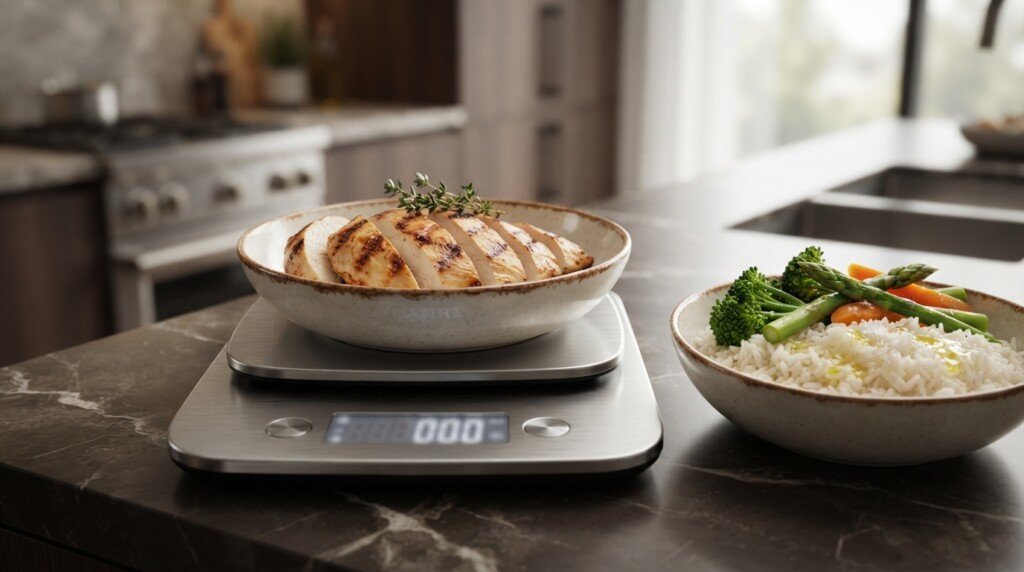
However, food scales also have limitations.
They require preparation time.
They are practical at home but not during restaurant meals.
Some people become overly dependent on exact measurements, making eating outside familiar environments unnecessarily stressful.
For these reasons, many nutrition professionals recommend using food scales primarily as educational tools. After repeatedly weighing common foods, most people naturally become much better at recognizing realistic portions without measuring every meal forever.
Accuracy is their greatest strength.
Convenience is not.
What Role Do Measuring Cups and Spoons Play?
While food scales measure weight, measuring cups and spoons measure volume.
For many everyday foods, this approach is both practical and sufficiently accurate.
Dry oats, cooked rice, pasta, beans, vegetables, yogurt, milk, salad dressing, cooking oil, and breakfast cereal are all examples of foods that can be measured quickly using standard kitchen utensils.
Unlike digital scales, measuring cups require no batteries, minimal setup, and almost no learning curve.
Most households already own them.
This familiarity makes them excellent starting tools for anyone beginning to improve portion awareness.
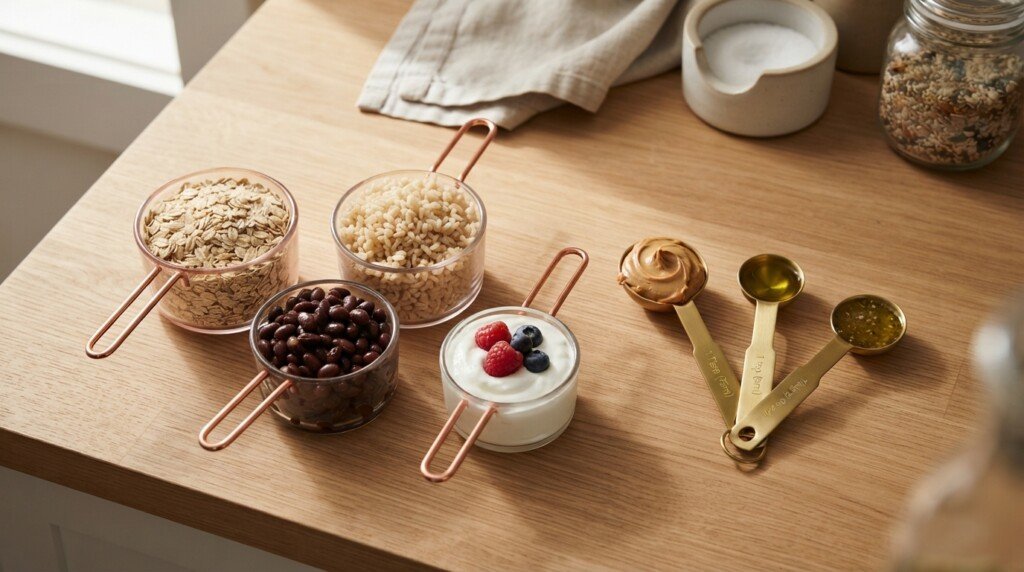
Measuring spoons become especially valuable for calorie-dense ingredients.
Cooking oils.
Nut butters.
Honey.
Salad dressings.
Butter.
These foods often appear harmless because their portions look small, yet slight increases can substantially change total calorie intake.
Using measuring spoons for these ingredients helps maintain consistency without feeling restrictive.
Of course, measuring cups also have disadvantages.
Foods with irregular shapes do not always fit neatly into volume measurements.
Packing ingredients tightly or loosely changes accuracy.
Some foods simply weigh differently despite filling the same measuring cup.
Even so, for everyday home cooking, measuring cups strike an excellent balance between convenience and consistency.
They provide enough accuracy for most healthy adults without requiring the precision of laboratory-style measurements.
What Digital Apps or Resources Can Assist Beyond Physical Tools?
Technology has transformed portion awareness in ways that were impossible only a decade ago.
Modern nutrition apps allow users to record meals, estimate serving sizes, scan product barcodes, monitor nutrient intake, and review eating patterns over weeks or months.
Rather than replacing physical measuring tools, these apps complement them.
For example, someone might weigh oatmeal with a food scale while simultaneously recording it in an app that automatically calculates calories, carbohydrates, protein, fiber, and fat.
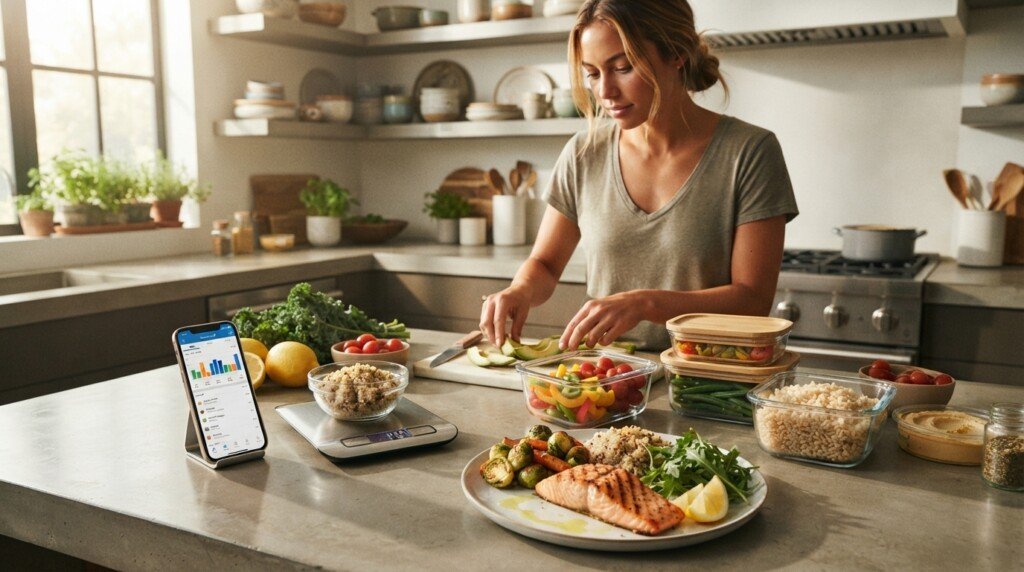
Many applications also store frequently eaten meals, making future tracking much faster.
Barcode scanners simplify packaged foods by importing nutritional information directly from product databases.
Meal-planning features help organize grocery shopping and weekly meal preparation.
Some apps provide reminders for hydration or meal timing.
Others generate nutrition summaries that reveal long-term patterns rather than focusing on individual meals.
However, digital tracking should remain a supportive resource rather than becoming an obsession.
Logging every bite indefinitely is unnecessary for many people.
Instead, apps work best as educational tools that increase awareness during periods when someone wants better insight into eating habits.
Once healthier routines become established, many users naturally reduce how often they log meals while maintaining the awareness they developed.
Ultimately, the value of any nutrition app depends less on advanced features and more on whether it encourages realistic, sustainable habits rather than constant perfection.
What Are Portion Control Plates, and Do They Actually Work?
Walk into any kitchen store or browse online nutrition products, and you’ll quickly notice plates divided into colorful sections labeled for vegetables, protein, and grains. These are portion control plates, and they’re often marketed as an easy solution for healthier eating.
The idea is certainly appealing.
Instead of measuring every ingredient or calculating calories, you simply fill each section of the plate according to its intended food group. The plate itself becomes a visual reminder of how a balanced meal should look.
For many people, this simplicity is exactly what makes portion control plates attractive. They reduce decision fatigue. Rather than wondering whether the meal contains too much rice or not enough vegetables, the plate provides a consistent visual framework every time food is served.
That said, portion control plates are not magic.
They cannot determine whether someone is truly hungry.
They cannot prevent emotional eating.
They cannot replace an understanding of nutrition.
Most importantly, they cannot compensate for food choices that consistently exceed nutritional needs simply because they fit within the plate’s sections.
Their greatest strength lies in helping people build balanced meal patterns without requiring constant measuring.
For beginners especially, that consistency often becomes far more valuable than chasing perfect accuracy.
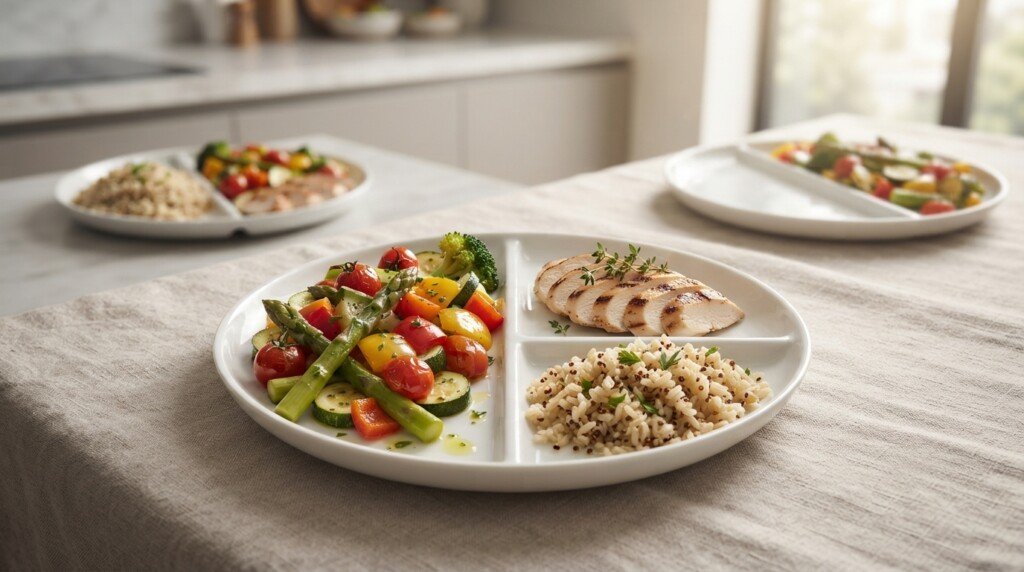
How Do the Sections on a Portion Control Plate Guide Food Choices?
Most portion control plates follow a remarkably similar design.
Approximately half of the plate is reserved for vegetables.
One quarter is allocated to lean protein.
The remaining quarter is intended for grains, rice, potatoes, pasta, or other carbohydrate-rich foods.
This arrangement naturally encourages greater vegetable intake while preventing carbohydrates or proteins from gradually expanding to fill the entire plate.
Unlike restrictive meal plans, the plate does not dictate exactly which vegetables or proteins you must choose.
Instead, it focuses on balance.
Someone might fill the vegetable section with roasted broccoli one day and mixed salad the next.
Protein could come from grilled chicken, baked fish, tofu, beans, or lean beef.
The carbohydrate section may contain brown rice, sweet potato, quinoa, or whole grain pasta.
This flexibility makes portion control plates practical for many eating styles because the structure remains the same even as meals change.
Some plates also include smaller sections for fruit or healthy fats, while others provide serving reminders directly on the plate itself.
However, the most effective designs avoid becoming overly complicated.
The easier the plate is to understand, the more likely people are to continue using it over time.
Rather than creating another complicated nutrition system, these plates simplify everyday decisions.
That simplicity often explains why they remain popular among individuals beginning healthier eating habits.
Are There Specific Plates Designed for Diabetic or Low-Carb Diets?
Yes.
Although the general concept remains similar, several specialized portion control plates are designed for people following particular nutritional goals.
Diabetic portion plates are among the most common.
These typically emphasize non-starchy vegetables while providing clearly defined spaces for lean protein and controlled portions of carbohydrate-rich foods. Their design reflects common meal-planning strategies used to support more consistent blood glucose management without requiring complicated calculations during every meal.
Low-carbohydrate portion plates use a slightly different layout.
They often dedicate a larger section to vegetables, maintain a moderate protein area, and reduce the space allocated for grains or starches. This arrangement naturally encourages meals that emphasize vegetables and protein while limiting carbohydrate portions.
Some portion plates are also marketed toward weight management, heart health, Mediterranean-style eating, or children’s nutrition.
Despite these variations, the underlying principle remains remarkably consistent.
The plate provides visual structure rather than rigid rules.
It encourages balanced meals while reducing the tendency to allow one food group to dominate the entire plate.
Choosing between these specialty plates depends more on individual health needs than on finding a universally superior design.
For someone without diabetes, a standard balanced portion plate may work perfectly well.
For someone managing blood sugar under professional guidance, a diabetes-specific design may better complement their meal planning.
The important point is selecting a tool that supports your personal goals rather than following marketing claims alone.
How Effective Are Portion Control Plates Compared to Other Methods?
No portion-control tool is effective simply because it exists.
Its value depends on how consistently it fits into everyday life.
Compared with digital food scales, portion control plates sacrifice some precision.
A food scale provides exact measurements.
A portion plate offers visual guidance.
Compared with measuring cups, portion plates require less preparation but also provide less detailed information.
Compared with smartphone apps, portion plates require almost no learning but cannot track long-term eating patterns.
This means each tool solves a different problem.
Someone preparing meals for athletic nutrition may appreciate the precision of weighing food.
Someone who dislikes measuring everything may find a divided plate much easier to maintain over months or years.
Many people eventually discover that combining simple tools works better than depending on one alone.
For example, a food scale may help establish accurate serving sizes during the first few weeks of learning.
After those portions become familiar, a portion control plate often provides enough structure for everyday meals without continued measuring.
Apps can occasionally be used to review eating patterns when needed.
This flexible approach avoids unnecessary complexity while still encouraging consistent habits.
If your long-term goal is improving portion awareness rather than measuring every meal indefinitely, portion control plates can become valuable teaching tools that gradually make balanced eating feel automatic.
Portion Control Tool Comparison
| Tool | Best For | Main Strength | Limitation |
|---|---|---|---|
| Digital Food Scale | Precise measurement | Highest accuracy | Less practical away from home |
| Measuring Cups & Spoons | Home cooking | Quick and inexpensive | Measures volume, not weight |
| Portion Control Plate | Everyday balanced meals | Simple visual guidance | Less precise than weighing food |
| Portion Containers | Meal preparation | Convenient portion consistency | Limited flexibility |
| Nutrition Apps | Tracking eating habits | Long-term awareness | Requires regular logging |
Key Takeaways
The best portion control tools are the ones that match your lifestyle rather than the ones with the longest feature list. Digital food scales provide excellent accuracy, measuring cups simplify home cooking, portion control plates create balanced meals with minimal effort, and nutrition apps help identify long-term eating patterns. Each tool serves a different purpose, making them complementary rather than competing options.
Most people do not need every tool available. A beginner may gain enough confidence using measuring cups and a portion plate, while someone pursuing athletic goals or medical nutrition therapy may benefit from the additional precision of a digital scale. The objective is not becoming dependent on tools forever but using them to build lasting awareness that eventually makes healthy portions feel natural.
Frequently Asked Questions
1. Do portion control plates work?
Yes. Portion control plates can be effective because they provide simple visual guidance for building balanced meals. While they are not as precise as food scales, many people find them easier to use consistently.
2. What’s the best tool for measuring food portions?
A digital food scale provides the greatest accuracy, particularly for foods that vary in size or density. Measuring cups and spoons are also excellent options for everyday home cooking.
3. Are there apps for portion control?
Yes. Many nutrition apps allow users to log meals, scan food barcodes, estimate serving sizes, and monitor long-term eating habits. They work best as educational tools rather than permanent requirements.
4. Should I use multiple portion control tools?
Many people benefit from combining tools. For example, a food scale can help establish accurate serving sizes, while a portion control plate makes everyday meals easier to manage without constant measuring.
5. Do I need portion control tools forever?
Not necessarily. Many people use these tools to develop portion awareness and gradually rely on them less as balanced serving sizes become familiar through experience.
Conclusion
Using portion control tools is not about making eating more complicated. The right tools simplify decisions, reduce guesswork, and help create balanced meals that fit naturally into everyday life. Whether you prefer the precision of a digital food scale, the convenience of measuring cups, the simplicity of a portion control plate, or the long-term insights offered by nutrition apps, each tool has strengths that suit different lifestyles and goals.
Rather than searching for one perfect solution, think of these tools as temporary guides that build confidence over time. As your understanding of portions improves, many healthy serving habits begin to feel automatic, allowing you to enjoy meals with less uncertainty and greater consistency without depending on measurements at every opportunity.
Disclaimer:
This post may contain affiliate links. If you purchase through them, we may earn a small commission at no extra cost to you. Also, this content is for informational purposes only and does not substitute professional medical advice.
Fuel Your Body Right
Use our free Nutrition Toolkit to find your protein target, fasting window, and net carbs in minutes.
Open Free Tools →