How Strength Training Preserves Muscle During Weight Loss
When body weight starts falling, the scale cannot tell you what you are losing. You may be losing body fat, water, glycogen, muscle tissue, or a combination of all four.
That is why strength training preserve muscle weight loss is an important concept for anyone who wants to become leaner without simply becoming smaller and weaker.
A calorie deficit creates the conditions for weight loss, but it does not give your body a reason to keep every gram of muscle. Resistance training provides that reason. It places a demand on your muscles and tells your body that this tissue is still needed.
This does not mean lifting weights makes muscle loss impossible. It also does not mean you need to train like a bodybuilder while dieting. The goal is different during a calorie deficit. You are primarily trying to maintain the muscle and strength you already have while your body uses stored energy.
That distinction changes how you should approach training.
You do not necessarily need more exercises, longer workouts, or endless sets. You need a training stimulus that is strong enough to matter, recoverable enough to sustain, and consistent enough to keep giving your body the same message throughout your weight-loss phase.
How does resistance training physiologically preserve muscle during a calorie deficit?
A calorie deficit changes the environment in which your muscles operate.
When you eat fewer calories than your body uses, your body has to draw on stored energy. That is necessary for losing body fat, but the process does not exclusively affect fat tissue. Lean tissue can also be affected, particularly when the deficit is large, prolonged, or combined with inadequate nutrition and insufficient physical stimulus.
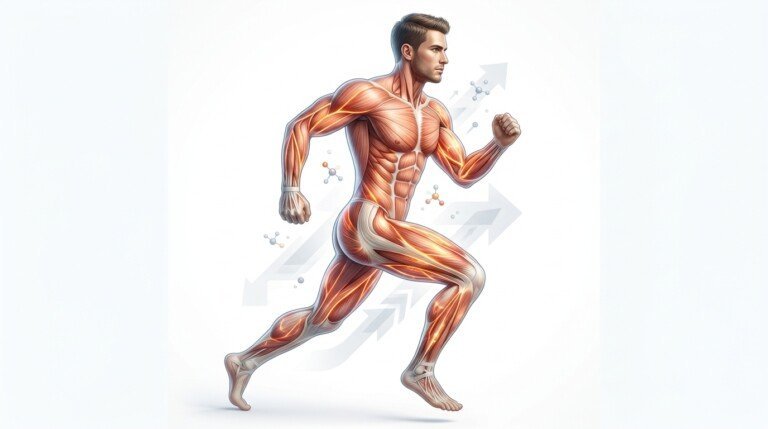
Resistance training changes the equation by giving skeletal muscle a reason to remain.
When you lift weights, use resistance bands, perform challenging bodyweight exercises, or work against another form of resistance, your muscles experience mechanical tension. This creates a signal associated with maintaining and remodeling muscle tissue.
The result is not simply about making muscles bigger.
During a calorie deficit, maintaining existing muscle can be a more realistic and valuable goal than trying to maximize muscle growth.
A recent systematic review and meta-analysis of randomized trials found that adding resistance exercise to dietary weight loss helped protect fat-free mass and produced greater strength improvements compared with dietary weight loss alone. The review also found greater fat-mass reduction with resistance exercise. (PubMed)
That is an important distinction because the scale may not show the benefit clearly.
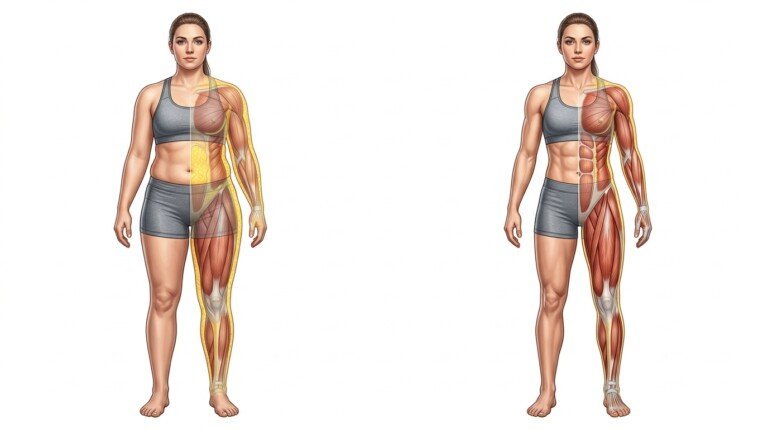
Two people could lose a similar amount of body weight while ending up with different body compositions.
One loses more fat while retaining more lean tissue.
The other loses fat but also gives up more muscle.
The scale could show similar progress.
Their bodies, strength, and long-term physical capacity could be very different.


How does muscle protein synthesis respond to strength training even when calories are restricted?
Muscle is constantly being broken down and rebuilt.
This is not a sign that something is wrong. It is part of normal tissue maintenance. Your body continually repairs and remodels muscle in response to daily activity, exercise, nutrition, and other physiological signals.
Muscle protein synthesis refers to the process of building new muscle proteins. Resistance exercise stimulates this process, which is one reason strength training is such an important tool for maintaining muscle.
A calorie deficit complicates that environment.
When energy availability is reduced, the body has fewer resources available for growth and recovery. Research shows that energy deficiency can impair the ability to gain lean mass from resistance training, even when strength improvements can still occur.
This is where expectations matter.
If you are eating in a calorie deficit, the purpose of resistance training is not necessarily to build as much muscle as possible.
It is to provide a strong enough stimulus that your body has a reason to preserve the muscle it already has.
Think of the difference between building a house and protecting an existing house.
Muscle growth requires resources for construction.
Muscle preservation requires a reason not to dismantle the structure.
A calorie deficit makes the construction process more difficult. Resistance training helps reinforce the message that the existing structure remains useful.
This is also why simply moving more is not the same thing as providing a muscle-preservation stimulus.
Walking is excellent for general activity and energy expenditure. Running can improve cardiovascular fitness. Cycling can increase endurance. But resistance training directly challenges muscles to produce force.
The stimulus is different.
The same principle applies regardless of whether your resistance comes from dumbbells, barbells, machines, cables, resistance bands, or challenging bodyweight movements.
The equipment is not the important part.
The important part is whether the muscles are being challenged enough to receive a meaningful training signal.
Nutrition also matters, particularly adequate protein, but protein and resistance training solve different parts of the problem. If you are interested in the nutritional side, your protein intake during weight loss should support the training rather than replace it.
What role do anabolic hormones like testosterone and growth hormone play in preventing breakdown?
Hormones are often presented as the master switch controlling muscle, but the real picture is more complicated.
Testosterone, growth hormone, insulin, insulin-like growth factor, cortisol, and other hormonal signals interact with nutrition, exercise, sleep, energy availability, age, and overall health.
It is tempting to look at a hormone such as testosterone and conclude that higher levels automatically mean better muscle preservation.
Human physiology does not work that simply.
Resistance training creates a complex hormonal and cellular response, but temporary increases in circulating hormones after a workout should not be treated as the sole explanation for long-term muscle retention.
The muscle-preserving effect of training is better understood as the result of repeated mechanical and cellular signals over time, supported by adequate nutrition and recovery.
This matters because you do not need to chase hormonal spikes.
You need to train consistently.
A workout that leaves you exhausted for two days is not automatically better because it produces a bigger hormonal response. Likewise, a complicated training routine does not necessarily preserve more muscle than a straightforward program performed consistently.
Energy availability also matters.
When calorie restriction becomes excessively aggressive, the body has fewer resources for recovery and tissue maintenance. A meta-analysis examining resistance training during energy deficiency found that larger energy deficits impaired lean-mass outcomes, while strength gains could still be maintained or improved.
That creates an important lesson for weight loss.
If you want to preserve muscle, the answer is not simply “lift harder.”
The entire environment matters.
A reasonable calorie deficit, sufficient protein, appropriate resistance training, adequate sleep, and manageable recovery demands work together.
Trying to compensate for an extreme diet with increasingly hard workouts can move you in the opposite direction.
What types and intensities of strength training work best for muscle preservation?
There is no single exercise that magically protects muscle during weight loss.
You also do not need a bodybuilding-style program with dozens of exercises.
A muscle-preservation program should challenge the major muscle groups regularly and provide enough resistance to make the work meaningful.
That can include movements such as squats, presses, rows, hinges, lunges, pulldowns, and other exercises appropriate to your ability and equipment.
The specific exercise selection should reflect your experience, mobility, injury history, and training environment.
A beginner might preserve muscle effectively with a relatively simple full-body routine.
Someone with years of lifting experience may need a more structured program to maintain performance.
The key is not complexity.
It is sufficient stimulus and consistency.
During weight loss, your training may also need to change slightly from what you would do during a dedicated muscle-gain phase.
If recovery is reduced because you are eating fewer calories, trying to maintain the same high training volume you used while eating at maintenance may become unnecessarily difficult.
You may not need to do more.
You may need to do enough.

Does training volume or intensity matter more when the goal is preservation, not growth?
For muscle preservation, maintaining a meaningful training intensity can be more important than endlessly increasing volume.
This does not mean every set needs to be maximal or that you should constantly train to failure.
It means the resistance needs to remain challenging enough that the muscle continues receiving a reason to adapt or maintain itself.
Imagine someone who previously squatted 100 pounds but gradually reduces the resistance to a level that requires almost no effort because they are dieting.
They are still technically exercising.
But the training signal has changed.
Now imagine that the same person keeps resistance reasonably challenging while slightly reducing unnecessary volume because recovery is becoming harder.
That can be a more sensible strategy during a calorie deficit.
Training volume matters too, but there is no strong evidence that simply piling on more sets is always better for preserving lean mass during dieting. A review of resistance-trained athletes found that the available evidence was insufficient to conclude that higher training volume is universally superior for lean-mass preservation during calorie restriction.
Another controlled study in resistance-trained men found no clear advantage of high-volume training over moderate-volume training for maintaining lean mass during moderate calorie restriction.
So what should you actually do?
Start with a sustainable amount of training.
Train the major muscle groups consistently.
Keep resistance challenging.
Maintain good technique.
Track your performance.
Then adjust volume based on recovery rather than assuming more is always better.
Progressive overload still has a place, but the meaning of “progress” changes during weight loss.
When you are eating enough calories to support growth, you may deliberately chase increases in weight, repetitions, sets, or training frequency.
During a deficit, maintaining your current performance can itself be a successful outcome.
If you can continue using a similar load and performing a similar number of quality repetitions while your body weight decreases, that is meaningful.
You do not need to set a personal record every week.
In fact, a prolonged calorie deficit can make that expectation unrealistic.
A useful way to structure your training is to identify a handful of movements that give you a reliable picture of your strength.
For example, you might monitor a squat variation, a pressing movement, a pulling movement, and a hip-hinge movement.
If those remain reasonably stable over time, you have evidence that your physical capacity is being maintained.
If several movements decline dramatically for weeks, that may be a sign that your recovery, nutrition, training load, or calorie deficit needs to be reconsidered.
This is where good programming becomes less about destroying yourself in the gym and more about sending a consistent signal.
You want your body to keep receiving the message:
This muscle is still required.
You do not need to turn every workout into a test of willpower.
Why is preserving muscle mass so important beyond just aesthetics?
The biggest mistake people make when discussing muscle preservation is treating it as an appearance issue.
Muscle affects much more than how defined your arms or legs look.
It contributes to movement, strength, balance, physical independence, exercise capacity, and the ability to perform everyday tasks.
That becomes especially important as people get older.
Losing weight can improve health for people who have excess body fat, but losing substantial amounts of lean tissue at the same time can undermine some of the physical benefits you were trying to achieve.
This is why body composition matters.
A smaller body is not automatically a stronger or healthier body.
The better outcome is often a body that carries less excess fat while maintaining as much useful lean tissue and physical function as possible.

What are the functional and metabolic benefits of maintaining strength during weight loss?
Strength is a practical form of physical insurance.
It helps you carry groceries.
It helps you climb stairs.
It helps you get up from a chair.
It helps you move objects around your home.
It helps you participate in recreational activities.
It gives you a larger physical reserve when illness, injury, or periods of inactivity occur.
That is particularly important with aging, when declines in strength can eventually affect independence.
There is also a metabolic reason to care about lean tissue.
Muscle is metabolically active tissue, although the popular claim that muscle dramatically increases daily calorie expenditure is often exaggerated. Gaining or preserving muscle is not a shortcut to burning hundreds of extra calories while sitting on the couch.
The bigger advantage is that maintaining muscle helps preserve the physical capacity needed to stay active.
A person who remains strong may be more capable of walking, exercising, climbing stairs, playing sports, and performing everyday movement.
That creates a practical feedback loop.
Strength supports activity.
Activity supports physical function.
Physical function makes continued movement easier.
This is one reason a weight-loss plan that relies entirely on calorie restriction can be incomplete.
A recent systematic review of resistance exercise during dietary weight loss found that resistance training protected fat-free mass and improved strength compared with diet alone. (PubMed)
The benefit is therefore not simply cosmetic.
There is another psychological advantage.
When your only measure of progress is body weight, you can become discouraged by normal fluctuations.
Strength provides another metric.
If your waist is shrinking and your strength is broadly stable, that is a meaningful sign that your body is adapting in a useful direction.
It also changes the mindset around exercise.
You are no longer exercising only to burn calories.
You are training because you want your body to remain capable.
That difference matters.
A 30-minute strength workout does not need to “burn off” a meal to be worthwhile. Its value can come from the signal it sends to your muscles and the physical capacity it helps you maintain.
This is also why relying exclusively on cardio during weight loss can be an incomplete strategy. Cardio has major benefits and can absolutely be part of a successful fat-loss plan, but treating it as the only form of exercise can leave the muscle-preservation side underdeveloped.
If your current routine is dominated by running, cycling, or other cardiovascular work, it is worth understanding the cardio-only mistake during weight loss before assuming that more cardio is always the answer.
There is no need to turn this into an argument between cardio and weights.
They do different jobs.
Cardiovascular exercise supports cardiovascular fitness and can contribute to energy expenditure.
Resistance training directly challenges muscle.
A well-designed weight-loss strategy can use both.
The key is understanding what each form of training is contributing.
A practical way to use strength training while losing weight
The simplest approach is to stop thinking about your weight-loss workout as a calorie-burning competition.
Your goal is not to leave the gym as exhausted as possible.
Your goal is to provide your muscles with a consistent reason to stay.
For many people, training the major muscle groups around two to four times per week can provide a practical framework, depending on experience, schedule, recovery, and the structure of the program.
A beginner might do three full-body sessions each week.
Someone with more experience might use an upper-body and lower-body split.
Another person may prefer shorter sessions spread across the week.
There is no universal schedule.
What matters is that your muscles receive regular resistance stimulus and that the program is sustainable during your calorie deficit.
Keep an eye on performance.
If your weight is dropping and your strength is reasonably stable, that is encouraging.
If your weight is dropping rapidly while your strength is collapsing across multiple exercises, that deserves attention.
If you are constantly sore, exhausted, sleeping poorly, and dreading your next workout, the problem may not be a lack of discipline.
Your overall recovery demands may simply be too high for the amount of energy you are consuming.
This is where many people make the same mistake.
They see slower weight loss and add more cardio.
Then they see declining gym performance and add more supplements.
Then they feel exhausted and cut calories further.
The cycle continues.
A better approach is to look at the whole system.
Your calorie deficit should be appropriate.
Your protein intake should be adequate.
Your resistance training should be challenging but recoverable.
Your sleep should support recovery.
Your activity level should be realistic.
And your expectations should match the fact that a calorie deficit is not an ideal environment for unlimited performance gains.
The purpose of strength training during weight loss is not to prove how much discomfort you can tolerate.
It is to preserve something valuable while you reduce something you do not need as much of.
That is the real reason lifting belongs in a muscle-conscious weight-loss plan.
FAQ (Strength training preserve muscle weight loss).
1. Does strength training prevent muscle loss while dieting?
Strength training cannot guarantee that you will lose zero muscle, but strong evidence supports its use for reducing lean-mass loss during dietary weight loss. Resistance exercise provides a direct stimulus for muscle while a calorie deficit creates pressure to use stored energy. The combination can therefore help shift the composition of weight loss toward greater fat loss and better muscle retention.
2. How often should I lift weights during weight loss?
There is no single frequency that works for everyone. Many people can effectively train the major muscle groups two to four times per week depending on experience, exercise selection, recovery, and schedule. The important point is consistent resistance training rather than maximizing the number of gym sessions.
3. Is cardio or strength training better for preserving muscle?
Strength training has the more direct role in preserving muscle because it provides resistance against which muscles must produce force. Cardio remains valuable for cardiovascular fitness, health, and energy expenditure. For many people, combining appropriate cardiovascular activity with resistance training is more useful than treating the two as competing choices.
4. Can I build muscle while losing weight?
It is possible in some circumstances, particularly for beginners, people returning to training, and individuals with higher levels of body fat. However, a calorie deficit generally makes muscle gain more difficult. The more realistic goal for many experienced lifters during weight loss is to preserve existing muscle and strength rather than expecting rapid muscle growth.
5. Should I reduce my strength-training volume while dieting?
You may not need to increase volume during a calorie deficit, and reducing unnecessary volume can sometimes make recovery easier. The best approach depends on your training history and how your performance responds. Keep the resistance sufficiently challenging, monitor your strength, and adjust volume when recovery consistently becomes a problem rather than automatically adding more work.
Disclaimer:
This post may contain affiliate links. If you purchase through them, we may earn a small commission at no extra cost to you. Also, this content is for informational purposes only and does not substitute professional medical advice.
Train Smarter, Not Harder
Use our free Fitness Toolkit to find your heart rate zones and calories burned in minutes.
Open Free Tools →