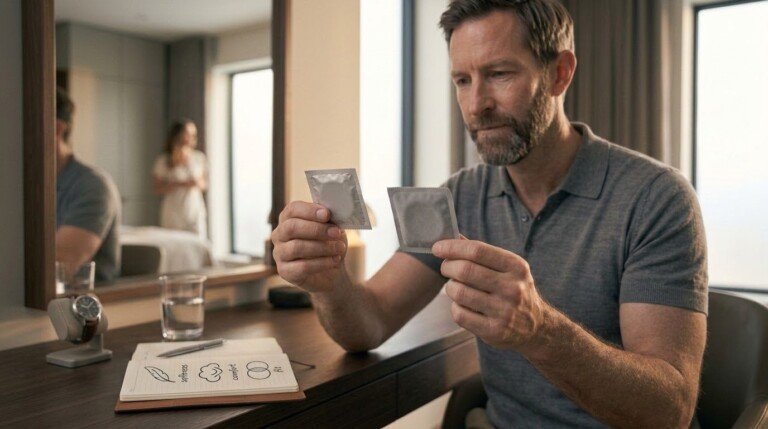


Stress and Libido: How Anxiety Kills Sex Drive
Sexual desire does not exist in a vacuum. When your mind is overloaded, your sleep is poor, your body stays tense, and you are constantly thinking about the next problem, sex can move surprisingly far down the priority list.
That is where Stress and Libido becomes important. Stress can affect sexual desire through both physical and psychological pathways, and research suggests that higher day-to-day stress is associated with lower sexual desire and arousal. (PubMed Central (PMC))
This does not mean every stressful week will cause low libido. It also does not mean cortisol is a simple “sex drive killer.” Sexual desire is influenced by several interacting factors, and people respond differently to stress.
But if you have noticed that your interest in sex has faded during a period of constant pressure, anxiety, burnout, or emotional exhaustion, the connection is plausible and worth taking seriously.
The encouraging part is that stress-related changes in sexual desire can often improve when the underlying pressure is addressed.
Can stress and anxiety actually cause low libido?
Yes. Stress and anxiety can contribute to lower libido, although they are not the only possible causes.
Sexual desire requires attention, emotional availability, physical energy, and a sense of safety or relaxation. Chronic stress can interfere with several of those at once.
Imagine trying to become sexually interested while mentally calculating tomorrow’s deadlines, worrying about money, replaying an argument, checking work messages, and wondering why you have not felt interested in sex lately.
Your body may be physically capable of sexual activity.
Your mind simply may not be available for it.
Research on male sexual desire supports a broader biopsychosocial model in which biological, psychological, sexual, relationship, and cultural factors interact rather than operating independently.
That distinction matters because it prevents a common mistake: assuming that every reduction in libido means something is physically wrong.
Sometimes the most obvious change is the amount of pressure a person is carrying.
A recent review published in 2026 also describes both physiological and psychological pathways connecting stress with male sexual health, including effects involving the stress response, endocrine regulation, and sexual desire. (PubMed)
The cortisol/hormone connection
Cortisol is one of the hormones involved in the body’s stress response.
When you encounter a stressful situation, your body does not immediately ask whether you would like to have sex later that evening. It prioritizes responding to the challenge in front of you.
That response is useful in the short term.
The problem is what can happen when the stress response becomes part of everyday life.
Chronic stress can affect sleep, mood, concentration, energy, and other aspects of health.
The hormonal story is more complicated than the phrase “high cortisol lowers testosterone.”
It is tempting to reduce male libido to a single hormone, but research does not support such a simple explanation. Testosterone and sexual desire are related in complex ways, and stress can change that relationship depending on the individual and context.
Stress can influence the body’s hypothalamic-pituitary-adrenal system and interact with other endocrine pathways. It can also affect energy availability and sleep.
So the practical takeaway is not that you need to “lower cortisol” at all costs.
The better takeaway is that a prolonged stress state can interfere with several systems that contribute to normal sexual wellbeing.
That is a much more accurate way to understand the connection.


The mental-distraction factor
This may be the part you notice first.
You can be physically healthy and still have very little sexual interest when your attention is consumed by everything else.
Think about the difference between being physically tired after a demanding day and being mentally overloaded.
Physical tiredness may make you want to sleep.
Mental overload can make it difficult to switch off at all.
Your brain keeps scanning for unfinished tasks.
The unfinished email.
The conversation you need to have.
The financial problem.
The work presentation.
The family responsibility.
The notification you have not answered.
Sexual desire competes poorly with that level of mental noise.
Research tracking daily stress and sexual experiences found that higher subjective stress was associated with a lower likelihood of concurrent sexual desire and arousal. Interestingly, sexual desire and activity were also associated with lower subsequent stress, suggesting that the relationship can work in both directions.
That creates an important possibility.
Stress can reduce desire.
Reduced intimacy can then affect connection or satisfaction.
That can create more stress.
Eventually, someone may start thinking, “Something is wrong with my libido,” when the original problem was a prolonged period of psychological overload.
This is one reason not to judge yourself based on a few low-desire days.
Look at the pattern.

How do you get your libido back when stressed?
You do not need to force yourself to feel horny.
That usually creates another performance demand.
A better strategy is to reduce the conditions that are suppressing desire and give your nervous system opportunities to move out of constant alertness.
Start with the basics.
If you are sleeping badly, address sleep.
If work follows you into every evening, create a boundary.
If your phone is constantly demanding attention, create periods when it is out of reach.
If you have been isolated, reconnect with people.
If you are carrying relationship tension, address the tension instead of pretending it does not exist.
If you feel overwhelmed by anxiety, consider professional support rather than treating it as a character flaw.
The goal is not to manufacture desire.
It is to stop making desire compete with an environment that constantly suppresses it.
Give your brain an actual transition period
One overlooked problem is the absence of a transition between work mode and personal life.
A person can close a laptop at 6 p.m. while their brain remains at work until midnight.
That makes “relax and be intimate” sound much easier than it actually is.
Create a short transition between demanding activities and personal time.
It could involve a walk, shower, changing clothes, quiet music, reading, stretching, or simply sitting somewhere without a screen.
The activity itself is less important than the message it sends.
The day is changing gears.
Stop checking whether your libido is back
This sounds strange, but constant monitoring can become counterproductive.
If you repeatedly ask yourself:
“Am I horny yet?”
“Why don’t I want sex?”
“Is my testosterone low?”
“Why am I not like I used to be?”
“Is something wrong with me?”
you are turning sexual desire into another test.
Desire is not supposed to appear on command.
It can be spontaneous, but it can also emerge in response to closeness, affection, context, attraction, touch, or simply having enough mental space.
Give yourself room for that process.
Protect sleep instead of trying to compensate for it
Sleep is one of the first things people sacrifice when life becomes stressful.
It is also one of the first things worth rebuilding.
Poor sleep can make stress harder to manage, worsen fatigue, and affect mood. Chronic stress itself can also interfere with sleep, creating a cycle in which each problem reinforces the other.
Trying to compensate with caffeine, alcohol, late-night scrolling, or an endless weekend lie-in does not necessarily solve the underlying problem.
A more consistent sleep routine is usually a better foundation.
Keep moving
You do not need an extreme exercise program to address stress.
Regular movement can provide a useful break from mental rumination while supporting general physical health.
Walking, resistance training, cycling, swimming, sports, or another activity you can sustain can all give your day a physical component.
The objective is not to exercise specifically for libido.
It is to create a healthier environment for your physical and psychological wellbeing.
Make intimacy less performance-focused
If sex has become another area where you evaluate yourself, take the pressure off.
There is a major difference between:
“I need to perform tonight.”
and:
“I want to spend time being close to my partner.”
The first creates a test.
The second creates space.
This distinction becomes particularly important when anxiety is involved.
Sexual anxiety and sexual dysfunction can reinforce each other, and psychological factors can become part of the cycle.
If your primary concern is erection-related performance anxiety rather than a general loss of desire, Performance Anxiety vs. ED: How to Tell the Difference addresses that distinction more directly.
What are practical stress-reduction techniques that help?
There is no single stress-reduction technique that works for everyone.
The best technique is usually the one you can actually repeat.

Try deliberate breathing when your body feels switched on
Slow, controlled breathing can be used as a simple transition tool when you feel physically tense or mentally overstimulated.
The point is not to “hack cortisol.”
The point is to give yourself a brief period in which you are not reacting to the next demand.
Sit somewhere quiet.
Relax your shoulders.
Breathe slowly and comfortably.
Let your attention remain on the sensation of breathing rather than on the list of problems waiting for you.
Even a few minutes can create a useful interruption in a stressful day.
Use mindfulness without turning it into another task
Mindfulness does not have to mean sitting cross-legged for an hour.
It can be as simple as paying attention to what you are doing without simultaneously consuming another stream of information.
Take a walk without checking your phone.
Eat without watching videos.
Take a shower without answering messages.
Sit with your partner without both people looking at separate screens.
These small periods of uninterrupted attention can be valuable when your normal day consists of constant switching.
Create boundaries around work
If your workday has no clear ending, your nervous system may never receive the message that work is finished.
A boundary might be as simple as:
No work email after a certain point.
No laptop in the bedroom.
A short walk immediately after work.
Changing clothes when you finish.
Keeping weekends genuinely separate from work where possible.
The exact rule matters less than having one.
Talk rather than carrying everything privately
Stress becomes heavier when you have nowhere to put it.
Talking with a trusted partner, friend, counselor, or therapist can help you process the problem rather than repeatedly carrying it around in your head.
This is particularly important when anxiety, depression, relationship conflict, or persistent emotional distress is involved.
Therapy is not an admission that you are incapable of handling your life.
For some people, it is simply a structured way to understand patterns that are difficult to see alone.
Protect time for relationships
If stress has consumed your schedule, your relationship may receive whatever energy is left over.
That can quietly reduce intimacy.
Make time for conversation that is not about bills, chores, children, work, or problems.
Make room for affection without assuming it has to lead to sex.
This can help remove the pressure surrounding intimacy.
Sexual desire is influenced by relationship and emotional factors as well as biological ones.
That means improving the environment around intimacy can matter even when there is no obvious physical problem.
Do not turn stress management into a libido challenge
This is another trap.
You start meditating because you want more sex.
Then you measure whether meditation is “working.”
You exercise because you want more sex.
Then you measure your libido.
You improve your sleep because you want more sex.
Then you worry because your desire has not returned after three nights.
Now stress management itself has become stressful.
Use these habits because they improve your life.
A healthier sex drive is a potential benefit, not the only measurement of success.
When does stress-related low libido need professional support?
Stress may explain a change in libido, but you should not automatically assume it explains everything.
Professional support becomes more important when low desire is persistent, distressing, worsening, or accompanied by other significant symptoms.
Consider speaking with a healthcare professional if:
- Your libido has changed substantially without an obvious reason.
- Low desire continues even after the stressful period has improved.
- You are also experiencing persistent sadness or loss of interest in other parts of life.
- Anxiety is interfering with work, sleep, relationships, or daily functioning.
- Sexual problems are causing significant relationship distress.
- You have other physical symptoms alongside the change in libido.
- A medication change occurred around the same time.
- You are worried about a hormonal or other medical condition.
This does not mean stress is not responsible.
It means stress should not become a convenient explanation for every sexual-health problem.
Male sexual desire is multidimensional. Biological factors matter, but psychological, relational, and sexual factors matter too.
That is why persistent low libido deserves a broader look.
If you are unsure whether stress is actually the main issue, Low Libido in Men: Causes and How to Get It Back provides the wider context around hormonal, psychological, medication-related, lifestyle, and health-related contributors.

When therapy or counseling makes sense
Therapy can be particularly useful when the problem is not simply “I have too much work.”
Maybe you are dealing with chronic anxiety.
Maybe you cannot switch your mind off.
Maybe there is relationship conflict.
Maybe you feel pressure to perform sexually.
Maybe your self-esteem has changed.
Maybe stress has become your normal state.
These are not problems that a special food or libido supplement can necessarily solve.
A therapist or counselor can help identify the thought patterns and behaviors that keep the cycle going.
For some people, couples counseling may also make sense when relationship tension and sexual desire have become intertwined.
The objective is not to convince yourself to want sex.
It is to understand what is standing between you and feeling like yourself again.
Frequently Asked Questions ( Stress and Libido ).
1. How do I get my libido back when stressed?
Start by addressing the stress itself rather than forcing sexual desire. Prioritize sleep, regular physical activity, mental breaks, relationship connection, and practical boundaries around work and digital distractions. If low libido persists, consider medical or psychological support.
2. Is stress killing my libido?
Stress can contribute to lower sexual desire, especially when it becomes persistent or overwhelming. Research has found an association between higher subjective stress and lower concurrent sexual desire and arousal, although individual responses vary.
3. Can anxiety cause low libido?
Yes. Anxiety can interfere with attention, relaxation, mood, and sexual arousal, and psychological factors are recognized contributors to male sexual desire.
4. How can I reactivate my libido?
There is no guaranteed instant method. Focus on removing common barriers such as chronic stress, poor sleep, mental overload, relationship tension, and excessive pressure around sex. If the change is persistent, look for an underlying cause rather than repeatedly trying quick fixes.
The Bigger Picture
Stress does not always announce itself as panic.
Sometimes it looks like being permanently busy.
Sometimes it looks like sleeping but never feeling rested.
Sometimes it looks like checking your phone every few minutes.
Sometimes it looks like becoming emotionally distant from your partner.
And sometimes it looks like losing interest in sex and wondering what happened.
That last change can be unsettling, especially when you remember how easily desire used to come to you.
But a lower libido during a stressful period does not automatically mean that something is permanently wrong with you.
Your sexual desire exists within the rest of your life.
When the rest of your life is overloaded, sexual desire can change with it.
The practical goal is therefore not to chase the fastest libido booster.
It is to reduce the conditions that keep your mind and body locked into stress.
Sleep.
Movement.
Mental space.
Healthy boundaries.
Connection.
Less performance pressure.
And professional support when you need it.
If those changes do not restore your desire, that is useful information too. It means the problem may deserve a broader evaluation rather than another attempt to manage stress alone.
Most importantly, do not turn libido into another number you have to achieve.
You do not need to feel sexually interested every day to be healthy.
What matters is whether the change is persistent, unwanted, distressing, or significantly different from your usual pattern.
When it is, investigate it.
When stress is clearly part of the picture, address the stress.
And when the problem feels bigger than lifestyle changes can handle, getting professional help is not overreacting. It is the sensible next step.
Disclaimer:
This post may contain affiliate links. If you purchase through them, we may earn a small commission at no extra cost to you. Also, this content is for informational purposes only and does not substitute professional medical advice.
Know Your Body Better
Use our free tools to track your cycle, find your fertile window, estimate your due date, and more.
Open Free Tools →