
How to Visually Estimate Portion Sizes (No Scale Needed)
There are plenty of situations where measuring food simply isn’t practical. You might be eating at a restaurant, attending a family gathering, traveling for work, enjoying a buffet, or grabbing lunch at the office. In moments like these, pulling out a kitchen scale or measuring cups is neither convenient nor realistic.
That doesn’t mean you’re forced to guess blindly.
Learning to visually estimate portion sizes is one of the most practical nutrition skills you can develop. It allows you to make reasonable decisions almost anywhere without carrying special equipment or turning every meal into a math exercise. While visual estimation will never be as precise as weighing food, it is often accurate enough for everyday eating, especially when your goal is maintaining balanced portions rather than tracking every gram.
Many people assume they have poor portion awareness, but the reality is that they have simply never been taught reliable visual references. Once you understand how everyday objects and your own hand can act as convenient measuring tools, estimating portions becomes much easier. Over time, these references become second nature, allowing you to serve meals with greater confidence whether you’re at home or away from your kitchen.
This guide explains how to visually estimate portion sizes using common household objects and simple hand-based methods. You’ll also learn where visual estimation works well, where it becomes less accurate, and how to avoid the mistakes that cause many people to unintentionally overestimate or underestimate their meals.
Quick Answer
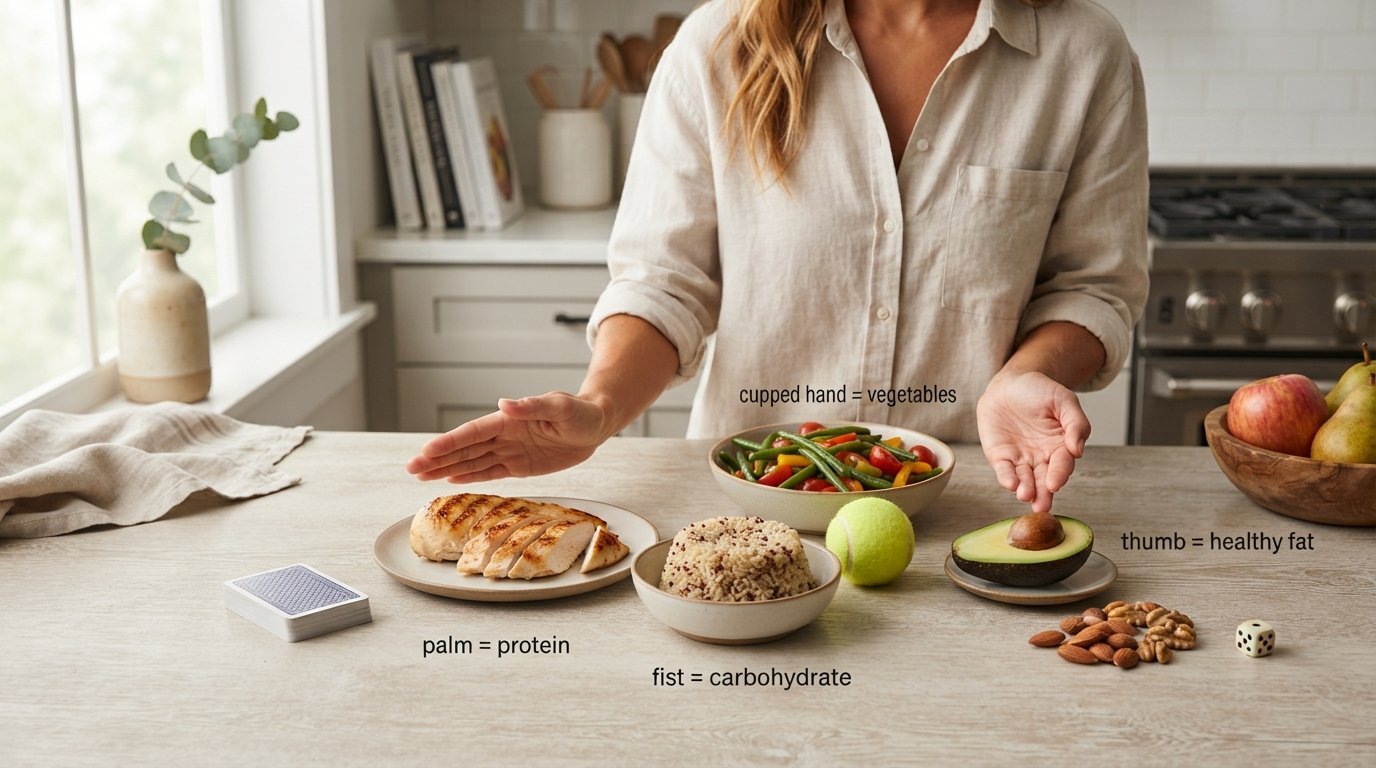
The easiest way to visually estimate portion sizes is by comparing food with familiar objects or using your own hand as a measuring guide. For example, a palm often represents a serving of protein, a cupped hand estimates cooked carbohydrates, a fist approximates vegetables or fruit, and a thumb helps estimate healthy fats. Although these methods are not perfectly precise, they provide practical estimates when scales and measuring tools are unavailable.
What Household Objects Can I Use to Estimate Portion Sizes?
One of the simplest ways to estimate food portions is by comparing them with objects you already recognize. Your brain naturally understands the size of everyday items, making them useful reference points when measuring tools are unavailable.
For example, imagine ordering grilled chicken at a restaurant. Without a scale, it can be difficult to know whether the serving is appropriate or twice as large as you expected. However, if you know that a standard serving of cooked chicken is often close to the size of a deck of playing cards, you immediately have a practical reference.
The same idea works across many food groups.
A tennis ball offers a useful comparison for many fruits.
A baseball helps visualize larger fruit portions.
A pair of dice represents approximately one serving of hard cheese.
A ping-pong ball provides a reasonable reference for nut butter.

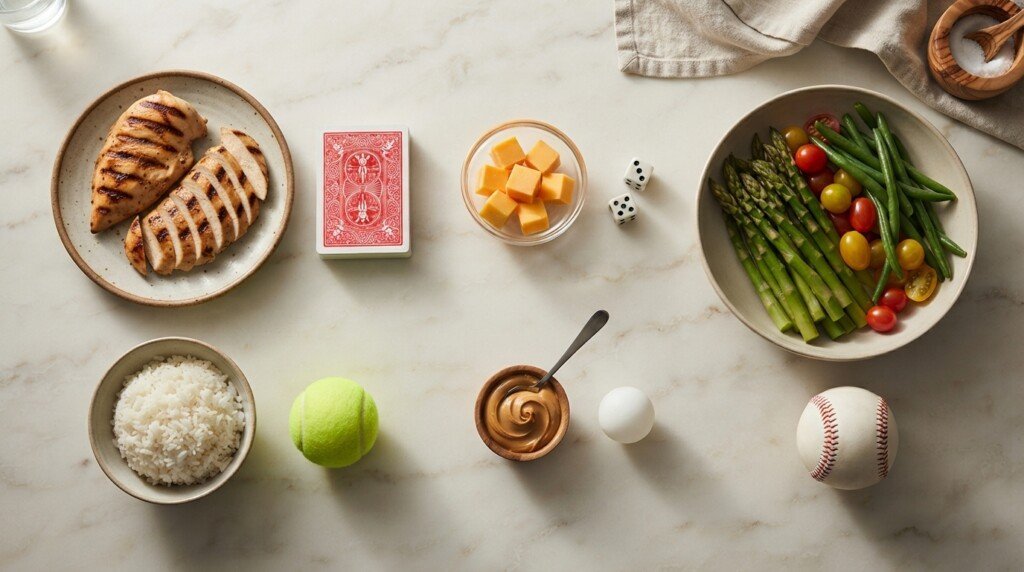
These comparisons are not intended to replace actual measurements forever. Instead, they help your brain build a mental library of realistic serving sizes. After enough repetition, many people naturally become better at estimating portions without consciously thinking about reference objects at all.
Another advantage of household comparisons is their usefulness while traveling. You may not have measuring cups during a vacation, but you will almost certainly recognize the size of a smartphone, computer mouse, hockey puck, or standard coffee mug. These familiar objects allow you to make reasonable estimates almost anywhere.
The goal is consistency rather than perfection. A portion that is slightly larger or smaller occasionally is unlikely to affect long-term eating habits. What matters is avoiding the gradual portion inflation that often occurs when there are no reference points at all.
What Common Objects Represent a Serving of Carbohydrates, Protein, or Fat?
Different food groups require different reference objects because they vary greatly in density, shape, and volume.
Protein foods such as chicken, turkey, fish, lean beef, or tofu are commonly compared with a deck of playing cards or the palm of your hand. This provides a reasonable estimate for a standard serving while remaining simple enough to remember during everyday meals.
Cooked carbohydrates such as rice, pasta, quinoa, oatmeal, or mashed potatoes are often compared with a tennis ball or a rounded handful. These references help people recognize that many restaurant servings contain considerably more than one standard portion.
Healthy fats require much smaller comparisons because they are more calorie-dense. Nut butter is often similar in size to a ping-pong ball when measuring two tablespoons, while butter and soft spreads may be estimated using the tip of your thumb. Oils are more difficult to judge visually because they spread easily across pans and salads, making them one of the easiest foods to underestimate.
Cheese provides another interesting example. Hard cheese is frequently compared with a pair of dice, offering a quick mental image that is easy to recall while preparing meals or assembling snack plates.
Fruits and vegetables generally allow for more generous visual estimates because of their larger volume and lower energy density. A baseball-sized apple, a tennis-ball-sized orange, or a fist-sized serving of chopped vegetables provides practical everyday references without requiring exact measurements.
The value of these comparisons lies in familiarity. Rather than memorizing ounces or grams, you simply compare your meal with an object your brain already understands.
How Do Different Food Groups Compare in Terms of Visual Portion Estimation?
Not every food group is equally easy to estimate visually.
Some foods naturally maintain consistent shapes.
Others vary enormously from one meal to the next.
Proteins generally estimate reasonably well because chicken breasts, fish fillets, pork chops, and steaks retain recognizable forms after cooking. Although thickness varies, visual comparisons remain relatively reliable.
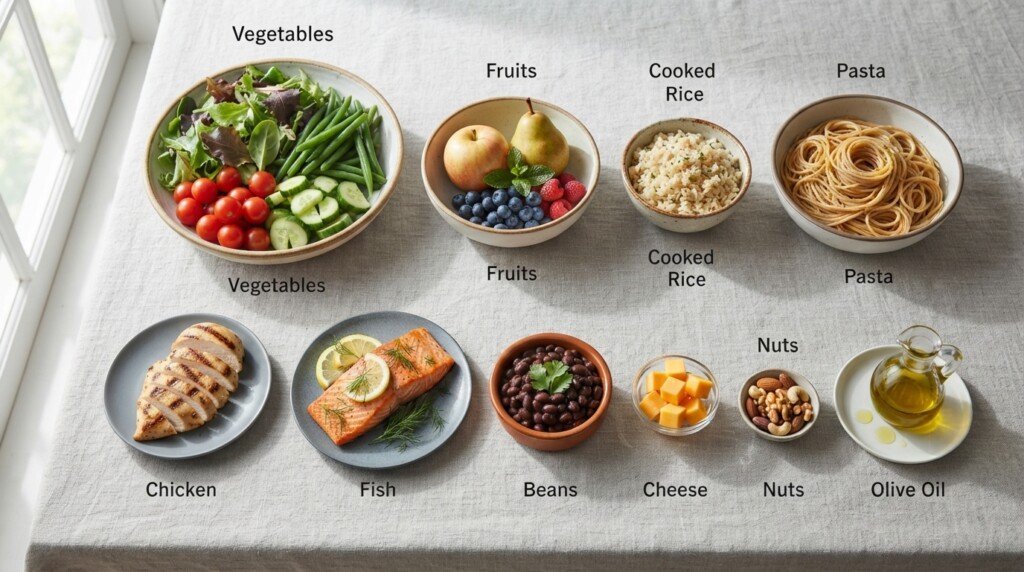
Whole fruits are also straightforward because nature already provides individual serving units. A medium apple or orange is much easier to estimate than foods that are scooped or poured.
Cooked grains become more difficult.
Rice spreads across a plate.
Pasta changes shape depending on the variety.
Oatmeal expands during cooking.
Because these foods occupy containers rather than maintaining fixed shapes, people often underestimate how much they have served.
Mixed dishes create an even greater challenge.
Casseroles, curries, stir-fries, burrito bowls, pasta salads, and soups combine multiple food groups into one serving. Estimating the protein, grains, vegetables, and fats separately becomes considerably more complicated.
Snack foods also deserve caution.
Pretzels, crackers, chips, popcorn, and trail mix are often eaten directly from large packages, making portion estimation much less accurate than foods served onto plates or bowls.
Recognizing which foods are naturally easier or harder to estimate allows you to pay closer attention only when necessary rather than worrying about every meal equally.
What Are the Pitfalls of Relying Only on Visual Estimation?
Although visual estimation is extremely practical, it is not perfect.
Several factors influence how accurately we judge portions, even when using familiar comparisons.
Plate size is one of the biggest influences.
The same amount of food appears smaller on a large dinner plate than on a smaller plate. This illusion often encourages people to serve additional food before they even begin eating.
Restaurant presentations create similar challenges.
Large serving bowls, oversized platters, decorative garnishes, and layered foods make accurate estimation much more difficult than simple home-cooked meals.
Food shape also matters.
A thick chicken breast may contain substantially more food than a thinner one despite appearing similar from above.
Dense foods such as granola, nuts, dried fruit, cheese, and peanut butter are particularly easy to underestimate because relatively small volumes provide considerable energy.
Finally, familiarity affects accuracy.
People estimate foods they eat regularly far better than unfamiliar dishes.
Someone who prepares oatmeal every morning may judge its serving size quite accurately while struggling to estimate portions of sushi, curry, or risotto.
Visual estimation should therefore be viewed as a practical approximation rather than an exact measurement.
It works exceptionally well for everyday eating but should remain flexible rather than rigid.
How Does the Hand-Based (“Fist”) Method Work for Portion Sizes?
When people hear about estimating food portions without measuring cups or a kitchen scale, the hand method is usually the first technique they encounter. Its popularity comes from one simple advantage: your hand is always available.
Unlike household objects, your hand travels with you. Whether you’re eating at home, ordering at a restaurant, attending a business lunch, or enjoying a vacation buffet, you always have a consistent reference that is roughly proportional to your own body size.
The hand method is not intended to provide laboratory-level precision. Instead, it offers practical consistency when exact measurements are impossible. It allows you to build reasonably balanced meals without constantly weighing food or calculating serving sizes.
The most common version of the hand method assigns different parts of the hand to different food groups.
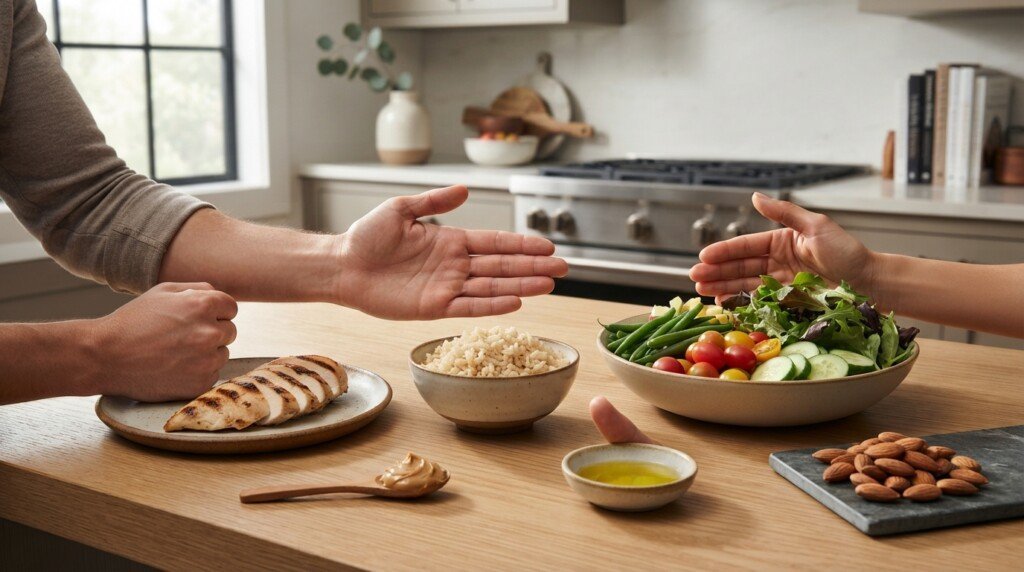
A closed fist is often used to estimate vegetables, fruit, or other bulky foods.
A cupped hand represents cooked grains and other carbohydrate-rich foods.
The palm estimates lean protein.
The thumb helps estimate healthy fats.
Because hand size generally scales with body size, these references naturally become more individualized than using fixed household objects alone. A larger person typically has larger nutritional needs than someone smaller, making this approach surprisingly practical for everyday eating.
The hand method also encourages flexibility.
Rather than worrying whether a serving weighs exactly 90 grams or 100 grams, it shifts attention toward building balanced meals using simple visual references that are easy to remember.
This simplicity explains why many dietitians, fitness professionals, and nutrition coaches recommend the hand method as one of the easiest long-term strategies for portion awareness.
What Are Common Visual Cues for Estimating a Protein Serving Specifically?
Protein is often the food group people find most difficult to estimate because meat, poultry, seafood, tofu, and plant proteins vary considerably in size and shape.
Fortunately, several visual cues make estimating protein much easier.
The most widely used reference is the palm of your hand.
A serving of cooked chicken, turkey, lean beef, pork, or fish that covers the palm without extending far beyond it generally represents an appropriate portion for many adults.
Thickness also matters.
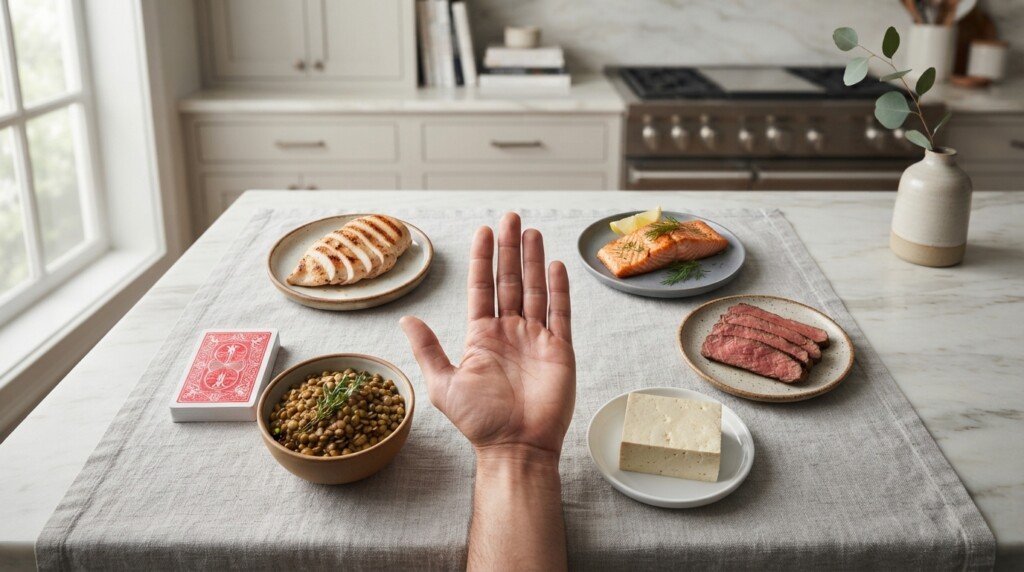
A thin chicken breast covering your palm may differ substantially from a very thick restaurant chicken breast occupying the same surface area. This is why the hand method should always be viewed as an estimate rather than an exact measurement.
Fish follows similar principles.
A salmon fillet or white fish portion roughly matching the size of your palm often provides a practical serving.
Eggs use a different reference because they naturally come in standardized sizes. Two large eggs typically provide one protein serving for many meal-planning purposes.
Plant proteins require slightly different thinking.
Half a cup of cooked beans or lentils may appear smaller than a palm-sized piece of chicken, but both contribute meaningful amounts of protein while differing in carbohydrate and fiber content.
Tofu and tempeh generally estimate well using palm-sized portions because they maintain solid shapes similar to animal proteins.
When eating mixed dishes such as casseroles, burrito bowls, curries, or stir-fries, estimating protein becomes more difficult because ingredients are distributed throughout the meal rather than served separately.
In these situations, looking for the overall amount of visible protein rather than attempting perfect precision usually provides the most realistic approach.
How Do Visual Estimations Differ for Meat, Fish, and Plant-Based Proteins?
Although protein foods share similar nutritional roles, they do not always behave the same visually.
Chicken breasts, steaks, pork chops, and fish fillets usually maintain recognizable shapes after cooking, making them relatively easy to compare with your palm or other familiar references.
Ground meats introduce slightly more uncertainty because they spread differently depending on preparation. A burger patty is easier to estimate than crumbled ground beef mixed into pasta sauce or tacos.
Fish often appears larger because many fillets are thinner than cuts of beef or chicken. Two foods covering the same area on a plate may differ slightly in weight depending on thickness and moisture content.
Plant proteins create additional variation.
Beans, lentils, and chickpeas are typically measured by volume rather than surface area because they are served loose rather than in one solid piece.
Tofu remains one of the easier plant proteins to estimate because blocks are usually cut into consistent shapes.
Tempeh behaves similarly.
Mixed vegetarian dishes become more complicated because vegetables, grains, legumes, and sauces are often combined together, making individual ingredients harder to distinguish visually.
This highlights an important principle of visual estimation.
The goal is not achieving mathematical perfection.
It is developing reasonable consistency that supports balanced eating across different environments.
Being slightly above or below a serving occasionally is far less important than developing portion awareness that remains practical throughout daily life.
How Accurate Is the Hand Method Compared to Using a Scale?
Many people wonder whether the hand method is accurate enough to replace measuring tools completely.
The answer depends on the situation.
A digital food scale will always provide greater precision because it measures actual weight rather than appearance.
If someone is preparing for athletic competition, following a therapeutic medical diet, or carefully monitoring macronutrient intake, weighing food remains the gold standard.
However, precision is not always necessary.
For everyday eating, the hand method performs surprisingly well because it provides consistency rather than exactness.
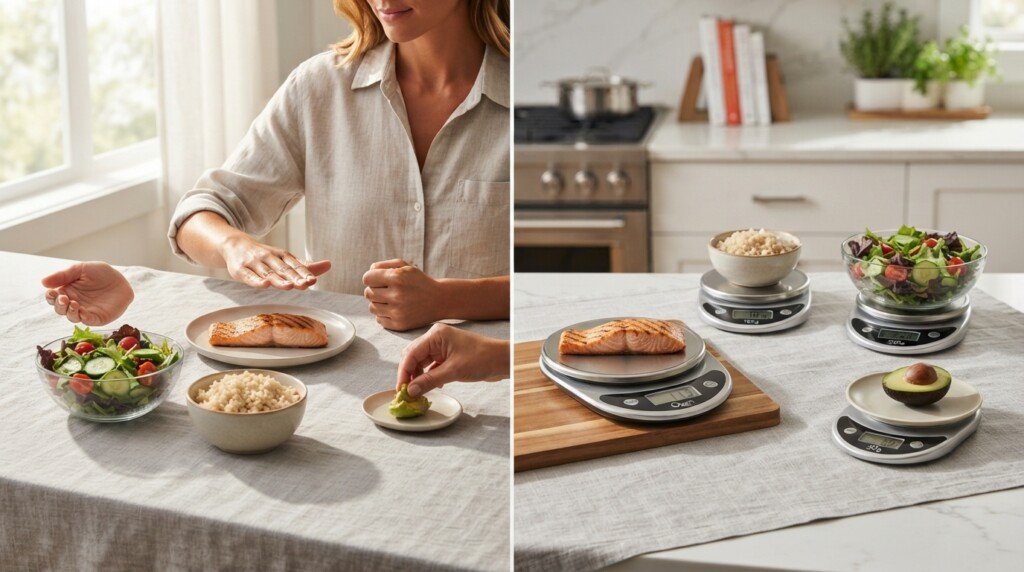
Instead of dramatically overestimating restaurant portions or underestimating calorie-dense foods, people using the hand method generally remain much closer to recommended serving sizes than individuals relying entirely on guesswork.
Another advantage is sustainability.
Most people eventually stop weighing every meal because doing so becomes inconvenient during travel, social events, restaurants, or work.
The hand method continues working regardless of location.
Many nutrition professionals therefore recommend combining both approaches.
Use a food scale occasionally while learning standard serving sizes.
Then rely on hand-based estimation when measuring tools are unavailable.
This combination provides both education and flexibility.
If you prefer greater precision while cooking at home, the comparison of digital food scales, measuring cups, and other equipment is covered separately in Best Portion Control Tools. Likewise, if you’d like detailed serving references across every major food group, you’ll find practical charts in Recommended Portion Sizes by Food Group.
Quick Reference Table
| Food Group | Hand Method | Household Object |
|---|---|---|
| Lean protein | Palm | Deck of playing cards |
| Cooked rice or pasta | Cupped hand | Tennis ball |
| Vegetables | Fist | Baseball |
| Fruit | Fist | Tennis ball or medium apple |
| Cheese | Two thumbs or small portion | Pair of dice |
| Nut butter | Thumb | Ping-pong ball |
| Cooking oil | Thumb tip | About one teaspoon |
Key Takeaways
Learning to visually estimate portion sizes gives you the flexibility to make balanced food choices almost anywhere, even when measuring tools are unavailable. Using your hand, familiar household objects, and practical visual comparisons creates reliable reference points that are much more accurate than random guessing. While these techniques cannot match the precision of a kitchen scale, they are often accurate enough for everyday meals, restaurant dining, travel, and social occasions.
The most important goal is consistency rather than perfection. As you repeatedly compare foods with your palm, fist, cupped hand, or familiar objects, your brain gradually develops a stronger sense of realistic serving sizes. Over time, this awareness makes balanced eating feel far more natural without requiring constant measuring or calorie counting.
Frequently Asked Questions
1. How can I estimate portion sizes without a scale?
You can estimate portions using your hand or familiar household objects. Your palm is useful for protein, a cupped hand estimates cooked carbohydrates, a fist represents vegetables or fruit, and your thumb helps estimate healthy fats.
2. What is the “fist method” for portion control?
The fist method uses your own hand as a practical measuring guide. A closed fist commonly represents a serving of vegetables or fruit, while other parts of the hand estimate protein, carbohydrates, and fats.
3. How accurate is visual portion estimation?
Visual estimation is less precise than weighing food but is generally accurate enough for everyday eating. It works particularly well when you consistently use the same visual references rather than guessing randomly.
4. Which foods are hardest to estimate visually?
Mixed dishes such as casseroles, pasta meals, curries, and stir-fries are usually the most difficult because multiple food groups are combined into one serving. Calorie-dense foods such as oils, nuts, and nut butters can also be easy to underestimate.
5. Should I stop using a food scale once I learn visual estimation?
Not necessarily. Many people use a food scale occasionally to reinforce portion awareness while relying on visual estimation during restaurants, travel, work, or other situations where measuring equipment is unavailable.
Conclusion
Being able to visually estimate portion sizes is one of the most practical nutrition skills you can develop because it works wherever life takes you. Whether you’re eating at home, dining out, traveling, or attending social events, simple references like your hand or familiar household objects provide realistic guidance without adding unnecessary complexity to meals.
Although these methods are not designed to replace precise measurements forever, they offer an effective balance between accuracy and convenience. As your experience grows, estimating portions becomes increasingly intuitive, allowing you to enjoy food with greater confidence while maintaining balanced eating habits even when a kitchen scale is nowhere in sight.
Disclaimer:
This post may contain affiliate links. If you purchase through them, we may earn a small commission at no extra cost to you. Also, this content is for informational purposes only and does not substitute professional medical advice.
Fuel Your Body Right
Use our free Nutrition Toolkit to find your protein target, fasting window, and net carbs in minutes.
Open Free Tools →