
When Is It Okay to Give In to a Craving?
You have probably heard two completely opposite pieces of advice about cravings.
One says, “Never give in.”
The other says, “Always honor your cravings.”
Neither approach tells the whole story.
The truth is far more balanced.
If you are wondering when to give in to a craving, the answer usually depends on why the craving appeared, how often it happens, and how you respond afterward.
Occasionally enjoying a food you genuinely want is very different from automatically eating every time a craving appears. Likewise, constantly denying yourself foods you enjoy can sometimes make those foods feel even more powerful over time.
A healthier relationship with food is not built by eliminating cravings or by acting on every one of them. Instead, it comes from learning when a craving deserves your attention and when it may simply pass if given a little time.
This article explores how to recognize the difference, why cravings can feel so satisfying, and why moderate, mindful indulgence may sometimes support healthier eating patterns than strict restriction.
Quick Answer
If you’re wondering when to give in to a craving, it may be appropriate when you’ve paused to consider why the craving appeared, you’re making a conscious choice rather than reacting automatically, and enjoying the food fits comfortably within your overall eating pattern. Mindful indulgence is often more sustainable than constant restriction, especially when cravings are occasional rather than overwhelming.
How Can I Tell if a Craving Is Worth Giving In To?
One of the biggest myths about cravings is that they require an immediate yes or no answer.
In reality, there is often another option.
Pause.
A short pause creates enough space to ask an important question:
“What is this craving actually telling me?”
Sometimes the answer is simple.
You skipped lunch.
You’ve been awake since early morning.
Dinner was unusually small.
In these situations, eating may simply be responding to genuine hunger.
Other times, the craving appears after a stressful meeting, while watching television, or out of pure habit.
Neither situation makes you a failure.
They simply have different causes.
Understanding that difference helps you respond thoughtfully rather than automatically.

What Are the Signs That a Craving Is a Genuine Need vs. a Fleeting Desire?
Not every craving deserves the same response.
Some reflect genuine physical needs.
Others disappear surprisingly quickly once your attention shifts elsewhere.
Learning to recognize the difference is one of the most valuable skills you can develop.
Signs It May Reflect Physical Hunger
A craving is more likely to represent genuine hunger when:
- It develops gradually.
- Several hours have passed since your last meal.
- Many different foods sound appealing.
- You notice stomach hunger.
- Eating a balanced meal sounds satisfying.
These signs suggest your body may simply need nourishment.
Signs It May Be a Fleeting Desire
A craving may be more habit-driven when it:
- Appears suddenly.
- Focuses on one specific food.
- Happens shortly after eating.
- Occurs during familiar routines.
- Weakens after a few minutes.
For example, someone may finish dinner feeling comfortably full but immediately begin wanting ice cream simply because dessert is part of their nightly routine.
The craving is real.
But it may not reflect physical hunger.
Ask Yourself Three Simple Questions
Before deciding, try asking:
- Am I physically hungry?
- Would another satisfying meal sound good?
- Will I still want this in fifteen minutes?
These questions are not intended to prevent eating.
They simply encourage awareness before making a decision.
There Is No Perfect Answer Every Time
Some days you may decide to enjoy the food.
Other days you may realize the craving passes naturally.
Neither response is automatically right or wrong.
The important part is making a conscious choice instead of reacting on autopilot.
What Are the Potential Consequences of Regularly Giving In to Unhealthy Cravings?
Occasionally enjoying favorite foods is part of a healthy relationship with eating.
Problems usually arise only when cravings become the primary guide for food choices.
If every craving is automatically satisfied without reflection, several patterns may gradually develop.
Habits Become Stronger
The brain learns through repetition.
If cookies always follow stressful afternoons, that connection becomes increasingly automatic.
Eventually, stress alone may trigger cookie cravings before conscious thought even begins.
Cravings May Become More Frequent
Repeated routines strengthen expectations.
For example:
Coffee becomes associated with pastries.
Movies become associated with popcorn.
Late evenings become associated with chips.
Over time, these situations themselves begin triggering cravings.
Hunger Signals Become Harder to Recognize
If eating is consistently driven by cravings instead of hunger, distinguishing between emotional appetite and physical hunger may become more difficult.
This does not happen overnight.
It develops gradually through repeated patterns.
Feelings of Frustration May Increase
Some people begin feeling disappointed after automatically responding to every craving.
Others feel guilty even after eating foods they genuinely enjoyed.
Neither extreme is helpful.
Building awareness generally creates a healthier relationship with food than relying on either constant restriction or constant indulgence.
When Is It Advisable to Seek Professional Help for Overwhelming Cravings?
Most cravings are a completely normal part of eating.
They come and go throughout life.
However, some situations deserve additional support.
Professional guidance may be helpful if cravings:
- Feel impossible to control.
- Cause significant distress.
- Lead to repeated binge eating.
- Interfere with everyday life.
- Occur alongside rapid or unexplained changes in eating habits.
- Cause ongoing anxiety around food.
Seeking help does not mean something is “wrong.”
It simply provides an opportunity to better understand what may be contributing to persistent eating difficulties.
Healthcare professionals can evaluate nutritional, medical, and psychological factors that may influence recurring cravings.
If you’re unsure whether your cravings follow a consistent pattern, reviewing How to Identify the Root Cause of Your Cravings may help you recognize recurring triggers before deciding whether additional support is needed.
Why Does Giving In to a Craving Feel Satisfying?
Most people have experienced this moment.
You’ve been thinking about a particular food for hours.
Finally, you take the first bite.
Almost immediately, the craving begins to fade.
That feeling is one reason cravings can seem so powerful.
However, the satisfaction does not happen because the food is “magical.”
Instead, eating a desired food temporarily fulfills both a physical expectation and a mental one.
Understanding this process can help remove guilt and replace it with awareness.
The goal is not to analyze every bite.
It is simply recognizing why certain foods feel especially rewarding in specific situations.

What Is the General Role of Dopamine in Craving Satisfaction?
Dopamine is often misunderstood.
People sometimes describe it as the “pleasure chemical,” but its role is much broader.
It helps the brain pay attention to experiences that seem important or rewarding.
Food is one of those experiences.
When you repeatedly enjoy a particular food in certain situations, your brain begins remembering that connection.
Eventually, simply thinking about the food can increase anticipation.
That anticipation is part of what makes cravings feel so compelling.
Anticipation Matters as Much as Eating
Interestingly, satisfaction often begins before the first bite.
Imagine someone walking toward their favorite bakery.
The smell.
The memories.
The expectation.
All of these contribute to the overall experience.
The craving is influenced not only by eating but also by anticipating the reward.
Familiar Foods Feel More Rewarding
People rarely crave random foods.
Instead, cravings usually involve foods connected to positive experiences.
Examples include:
- Homemade desserts.
- Family recipes.
- Favorite restaurant meals.
- Holiday treats.
- Childhood snacks.
These emotional associations make certain foods feel especially satisfying.
Satisfaction Is Temporary
The pleasant feeling that follows eating usually fades naturally.
This is completely normal.
Because satisfaction is temporary, it should not be expected to solve ongoing emotional challenges.
Food can be enjoyable without becoming the only source of comfort.
Can Understanding This Reward Response Help You Indulge More Mindfully?
Yes.
Understanding why cravings feel rewarding often reduces the pressure to either completely avoid them or immediately satisfy them.
Instead of asking,
“Should I eat this or not?”
you can ask,
“If I choose to eat this, how can I enjoy it intentionally?”
That small change often transforms the experience.
Slow Down the Experience
Many cravings disappear before the food is fully appreciated because eating happens automatically.
Eating more slowly allows you to notice:
- Flavor.
- Texture.
- Aroma.
- Satisfaction.
This helps separate enjoyment from mindless habit.
Remove Distractions
Mindful indulgence becomes much more difficult when eating while:
- Scrolling social media.
- Watching television.
- Working.
- Driving.
Giving food your attention often increases satisfaction even with smaller portions.
Enjoy Without Guilt
One of the biggest misconceptions about healthy eating is that enjoying favorite foods is somehow a failure.
In reality, occasional treats can comfortably fit within an overall balanced eating pattern.
Removing unnecessary guilt often reduces the emotional power those foods hold.
Mindful eating is not about making food “perfect.”
It is about making eating intentional.
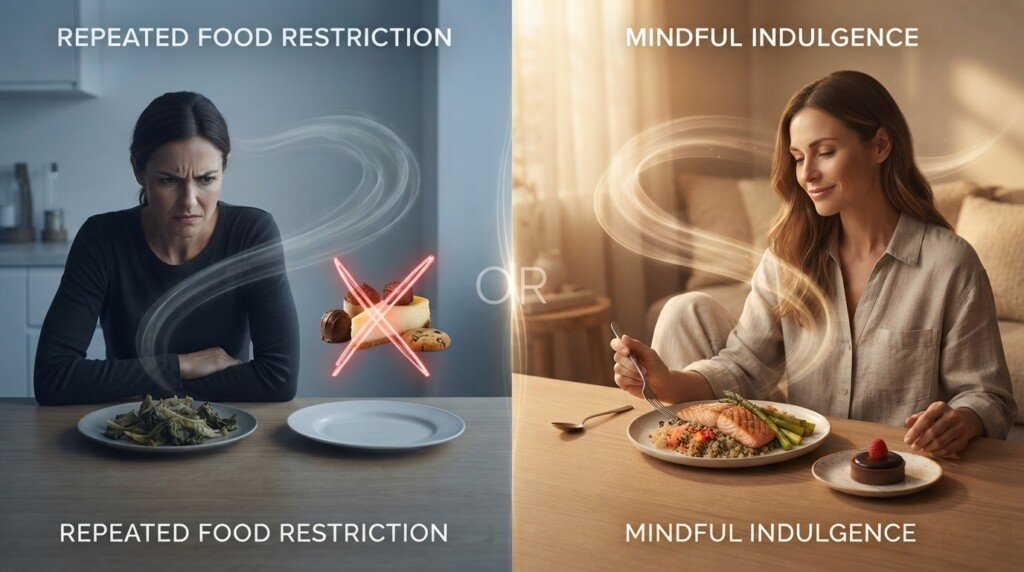
Why Can Giving In Occasionally Prevent Bingeing?
Many people believe the only way to stay healthy is to avoid tempting foods completely.
For some individuals, that approach works well.
For many others, however, constant restriction creates a different problem.
The more forbidden a food becomes, the more attention it receives.
Eventually, the craving may become so intense that moderation feels impossible.
This is one reason many nutrition professionals emphasize flexibility rather than perfection.
Why Might Satisfying a Craving in Moderation Reduce the Risk of a Binge Later?
Imagine someone craving chocolate every day for two weeks.
Each day they refuse it completely.
Eventually, they become exhausted from resisting.
When they finally eat chocolate, they may continue far beyond the amount they originally wanted.
Not because chocolate changed.
Because prolonged restriction made it feel unusually valuable.
This pattern does not happen to everyone.
But it is common enough that researchers continue studying the relationship between restriction and overeating.
Moderation Reduces the “Now or Never” Mindset
When people believe they can never eat a favorite food again, every opportunity feels urgent.
Thoughts such as:
- “I already ruined today.”
- “I’ll start again tomorrow.”
- “This is my last chance.”
often encourage eating beyond satisfaction.
Allowing flexibility reduces that urgency.
Satisfaction Often Arrives Earlier Than Expected
Many people assume they need a large quantity of a favorite food.
When eating slowly and intentionally, they often discover that a moderate portion provides the enjoyment they were seeking.
The goal is satisfaction.
Not restriction.
Not excess.
Flexibility Supports Long-Term Success
Healthy eating patterns last much longer when they feel realistic.
If an eating plan excludes every enjoyable food forever, maintaining it becomes increasingly difficult.
Allowing room for occasional indulgence often makes consistency easier over months and years.
Why Is Mindful Indulgence Better Than Total Restriction?
Mindful indulgence and unrestricted eating are not the same thing.
Likewise, moderation is not permission to ignore hunger or eat without awareness.
Instead, mindful indulgence means making a deliberate choice.
You decide to enjoy the food because you genuinely want it.
Not because you feel guilty.
Not because you have lost control.
And not because you believe tomorrow will require another strict diet.
Restriction Often Gives Foods More Power
Completely forbidding favorite foods may unintentionally increase how often you think about them.
Many people discover that once foods are no longer considered “off limits,” they become less emotionally intense.
Every Eating Choice Doesn’t Need to Be Perfect
Healthy eating is built from patterns.
Not isolated moments.
One dessert does not determine long-term health.
Neither does one craving.
Focusing on overall consistency usually creates a healthier mindset than evaluating every individual food choice.
Balance Creates Sustainability
Perhaps the healthiest question is no longer:
“Can I have this?”
Instead ask:
“Does this choice fit comfortably into my overall way of eating?”
That perspective encourages flexibility without abandoning healthy habits.
For readers looking for practical techniques to manage cravings when they decide not to eat immediately, How to Stop Food Cravings explores those strategies separately.
Key Takeaways
| Topic | Main Insight |
|---|---|
| Giving in to cravings | Occasional mindful indulgence can fit within a balanced eating pattern. |
| Dopamine | It helps reinforce rewarding experiences and contributes to the anticipation of desired foods. |
| Moderation | Conscious choices often support healthier long-term eating than constant restriction. |
| Restriction | Strict rules may increase the emotional importance of certain foods for some people. |
| Long-term mindset | Sustainable eating focuses on patterns rather than perfection. |
Frequently Asked Questions
1. When is it okay to give in to a craving?
It can be appropriate when you’ve paused to understand why the craving appeared, you’re making a deliberate decision, and enjoying the food fits comfortably within your overall eating pattern.
2. Does giving in to cravings prevent bingeing?
For some people, allowing occasional mindful indulgence may reduce feelings of deprivation that can contribute to overeating later. Individual experiences vary.
3. Why do cravings feel satisfying?
Cravings often feel satisfying because the brain anticipates rewarding experiences associated with familiar foods, and eating fulfills that expectation temporarily.
4. Is it unhealthy to enjoy comfort foods occasionally?
No. Occasional comfort foods can be part of a balanced eating pattern when enjoyed mindfully and without guilt.
5. Should I ignore every craving?
Not necessarily. Some cravings reflect genuine hunger, while others are linked to habits or emotions. Learning to distinguish between them is more helpful than automatically saying yes or no.
Conclusion
Knowing when to give in to a craving is less about following strict rules and more about making thoughtful decisions. Cravings are a normal part of eating, and occasionally enjoying a favorite food does not mean you’ve failed or abandoned healthy habits. In many cases, a mindful choice made without guilt is more sustainable than constant restriction or relying entirely on willpower.
The goal is not to satisfy every craving or suppress every urge. Instead, it is to build a balanced relationship with food where enjoyment, awareness, and flexibility can exist together. Over time, this approach helps reduce the emotional power cravings often hold and supports healthier eating patterns that are realistic enough to maintain for the long term.
Disclaimer:
This post may contain affiliate links. If you purchase through them, we may earn a small commission at no extra cost to you. Also, this content is for informational purposes only and does not substitute professional medical advice.
Ready to Start Your Journey?
Use our free 7-in-1 Weight Loss Toolkit to calculate your numbers and build your plan in minutes.
Open Free Tools →