
Why Is It So Hard to Stop Emotional Eating?
Most people who struggle with emotional eating already know what they “should” do. They know vegetables are healthier than chips. They know stress is not solved by cookies. They understand that eating because of sadness will not remove the sadness itself. Yet despite this knowledge, many find themselves repeating the same behavior again and again.
That experience often leads to an unfair conclusion.
People begin believing they simply do not have enough willpower.
In reality, emotional eating is rarely maintained because someone lacks motivation. It continues because the brain has learned a highly efficient habit that temporarily reduces emotional discomfort. Every time food provides even a few minutes of relief, the brain quietly records that experience as something worth repeating. After enough repetition, the behavior becomes increasingly automatic, making emotional eating feel less like a conscious decision and more like an instinctive response.
Understanding why is it hard to stop emotional eating requires looking beyond the food itself. The challenge is not simply resisting cravings. It is interrupting a learned habit loop that has often been reinforced hundreds or even thousands of times over many years.
This article explains why emotional eating feels so difficult to change, how the brain’s reward system strengthens the behavior, and why relying on willpower alone usually leaves people feeling frustrated.
Quick Answer
Why is it hard to stop emotional eating? Emotional eating becomes difficult to stop because the brain gradually learns that food provides temporary emotional relief. Over time, emotions become automatic cues, comfort foods become familiar rewards, and repeated experiences strengthen a habit loop that operates with very little conscious effort. This is why understanding the pattern is often more effective than relying on willpower alone.
What Makes Emotional Eating Such a Difficult Habit to Break?
Changing emotional eating is not as simple as making better food choices. If it were, most people would overcome the habit after reading one nutrition article or making one New Year’s resolution.


Instead, emotional eating behaves much like any deeply practiced habit. It follows a familiar sequence that repeats itself until the brain begins expecting the same outcome every time a particular emotion appears. Eventually, the emotional response becomes almost automatic.
One reason this habit feels so powerful is that it usually works, at least temporarily. Food often provides comfort, distraction, familiarity, or relief for a short period. Even though those effects do not solve the original emotional problem, they are enough to convince the brain that eating was a successful response.
Over time, this repeated learning creates a cycle that becomes increasingly efficient. The emotion appears, the craving follows, eating provides temporary relief, and the brain stores that experience for future use. Every repetition strengthens the pathway slightly more.
Understanding this process helps explain why emotional eating persists even when someone genuinely wants to stop.
What Psychological Triggers Keep the Emotional Eating Cycle Going?
The emotional eating cycle often begins long before food appears.
It starts with an emotional experience that the brain has learned to associate with eating.
That emotion might be stress after work.
Loneliness during the evening.
Disappointment after receiving bad news.
Frustration following an argument.
Even boredom during a quiet afternoon.
The specific emotion matters less than what happens next.

Once the brain recognizes a familiar emotional state, it begins searching for responses that have previously provided relief. If emotional eating has been successful in the past, food quickly becomes one of the first solutions the brain considers.
Importantly, this process is rarely deliberate.
Most people are not consciously thinking,
“I’m sad, therefore I’ll emotionally eat.”
Instead, they simply notice a strong craving appearing during emotionally difficult moments.
That automatic feeling exists because the brain has gradually connected certain emotions with certain behaviors.
Psychologists often describe this process as a conditioned response.
A neutral experience gradually becomes linked with another experience through repetition.
Just as hearing a notification sound may automatically make someone check their phone, certain emotions may automatically activate cravings because they have repeatedly been paired with comfort foods.
This explains why emotional eating often continues even when someone understands it logically.
Knowledge alone does not erase conditioned responses.
Repeated emotional experiences have already taught the brain what to expect.
Another important factor involves predictability.
Emotions are often uncertain and uncomfortable.
Food is familiar.
People know exactly how favorite comfort foods taste, smell, and usually make them feel.
The brain naturally prefers predictable experiences during emotionally uncertain moments because predictability creates a temporary sense of safety.
As this cycle repeats, emotional eating gradually shifts from being an occasional coping strategy to becoming the brain’s preferred emotional shortcut.
This is also why many people describe emotional eating as happening almost automatically.
The brain is not trying to sabotage healthy habits.
It is simply repeating the response it has learned works fastest.
Readers interested in understanding how these emotional patterns first develop can explore Emotional Eating, where the overall behavior pattern is explained in greater detail.
How Does the Brain’s Reward System Reinforce Emotional Eating?
One of the strongest reasons why is it hard to stop emotional eating lies in the brain’s remarkable ability to learn from rewarding experiences.
The human brain is constantly asking one question:
“What helped me feel better?”
Whenever an experience reduces discomfort or creates pleasure, the brain pays attention.
Food is particularly effective because eating activates reward pathways that encourage learning and repetition.
Among the most important of these pathways involves dopamine.
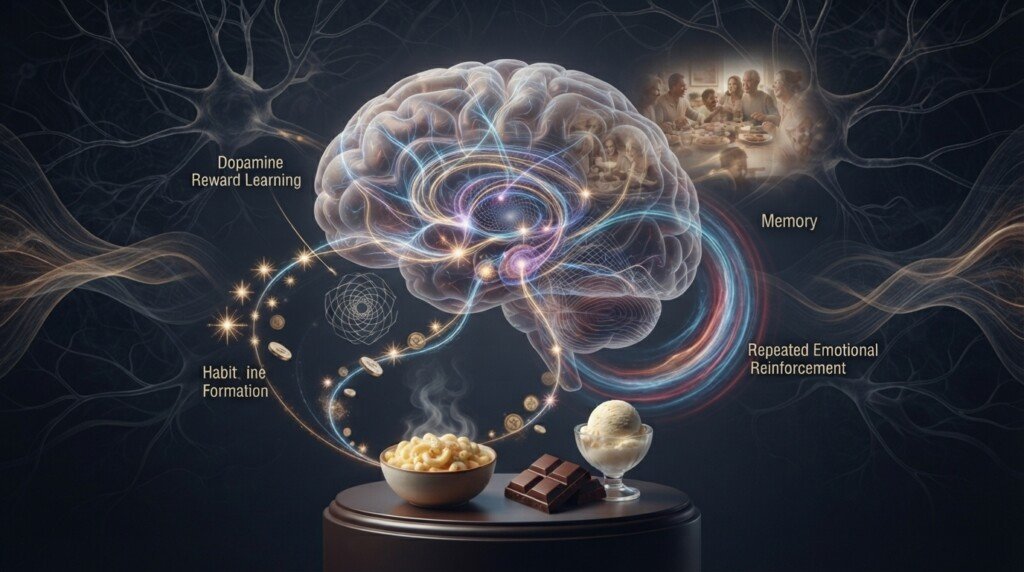
Dopamine is often misunderstood as the brain’s “pleasure chemical,” but its role is actually much broader. Rather than simply creating enjoyment, dopamine helps identify experiences worth remembering. It strengthens learning by telling the brain that something important happened and may be worth repeating in the future.
Imagine someone who finishes a difficult workday feeling mentally exhausted.
They order their favorite pizza.
During the meal, stress temporarily fades into the background.
The brain quietly records that sequence.
Stress.
Pizza.
Relief.
The next time a stressful day occurs, the brain remembers the previous experience long before conscious reasoning fully begins.
This does not mean dopamine forces someone to eat.
Instead, it increases the likelihood that familiar comfort foods will come to mind because previous experiences suggested they were emotionally rewarding.
The process becomes even stronger through repetition.
One stressful evening rarely creates a lifelong habit.
Hundreds of similar evenings often do.
Eventually, the emotional cue alone may activate cravings before the person has consciously considered whether they are physically hungry.
Another fascinating aspect of the reward system is anticipation.
People often begin feeling better before taking the first bite.
Simply thinking about ordering favorite food can create feelings of comfort because the brain already expects relief based on previous experiences.
This anticipation explains why cravings sometimes feel strongest before eating rather than afterward.
The expected emotional reward becomes part of the reward itself.
Importantly, the relief provided by emotional eating is usually temporary.
The stressful situation often remains unchanged.
Sadness eventually returns.
Loneliness is still present.
Because the original emotion was never fully addressed, the brain may once again suggest food during the next emotionally difficult moment.
Little by little, this reward system transforms emotional eating into a highly practiced behavioral shortcut.
The more often it succeeds in providing temporary comfort, the more automatically the brain begins recommending it whenever similar emotions appear.
What Role Do Specific Food Types Play in Temporarily Easing Negative Emotions?
Not all foods create the same emotional response. One of the reasons why is it hard to stop emotional eating is that the foods most commonly chosen during emotional distress are often those that provide immediate sensory satisfaction. They are rich in flavor, familiar in texture, and strongly connected with pleasant memories. The brain gradually learns that these foods offer quick emotional relief, making them far more appealing during difficult moments than foods chosen primarily for nutrition.
Comfort foods are not comforting because they possess some unique emotional property. They become comforting because they have repeatedly appeared during positive or emotionally significant experiences throughout life. A bowl of macaroni and cheese may remind someone of childhood dinners after school. Freshly baked cookies may evoke memories of weekends with grandparents. Pizza may symbolize relaxing Friday nights after a demanding week. These emotional associations become deeply rooted, and over time the foods themselves begin acting as emotional cues.

When someone experiences sadness, disappointment, or loneliness, the brain naturally searches for experiences that previously created feelings of safety or reassurance. Comfort foods fit that role remarkably well because they combine sensory pleasure with emotional familiarity. Even before taking the first bite, the expectation of comfort has already begun influencing the emotional experience.
Highly palatable foods also stimulate multiple senses simultaneously. Their aroma, texture, taste, and appearance all contribute to making the experience feel emotionally rewarding. This multisensory response explains why people often crave very specific foods instead of simply wanting to eat anything available. Emotional eating is rarely satisfied by random choices. The brain usually seeks foods that already carry a strong emotional history.
Another reason these foods become difficult to resist is because they consistently deliver predictable outcomes. Life’s emotional problems are often uncertain, but favorite comfort foods are dependable. People know exactly how they taste and roughly how they will make them feel. During emotionally overwhelming moments, that predictability becomes reassuring. The brain naturally favors familiar experiences over uncertain ones when emotional discomfort is high.
Importantly, the relief created by comfort food is usually temporary. The difficult conversation still happened. The stressful deadline still exists. The loneliness has not disappeared. However, because the emotional discomfort briefly softened while eating, the brain remembers the food as being helpful. It focuses far less on the fact that the relief faded shortly afterward.
This repeated learning explains why comfort foods remain so powerful even when people fully understand that they are not solving the original emotional problem. The brain is responding to previous emotional experiences, not logical reasoning. Every successful episode of temporary relief slightly strengthens the expectation that the same food will help again the next time similar emotions appear.
Understanding this process also explains why emotional eating often feels stronger during periods of prolonged stress or emotional exhaustion. The more frequently the brain experiences emotional discomfort, the more opportunities it has to repeat the same familiar coping behavior. Over time, comfort foods become less of an occasional treat and more of an automatic emotional response.
What Are the Long-Term Health Consequences of Staying Stuck in This Cycle?
One of the reasons emotional eating can be difficult to recognize is because the immediate outcome often feels positive. Someone experiences emotional discomfort, eats a familiar comfort food, and notices temporary relief. Because the emotional benefit appears almost instantly, it is easy to overlook what is happening over weeks, months, and years.
The long-term concern is not the occasional emotional eating episode. Nearly everyone has moments when food accompanies difficult emotions or happy celebrations. Problems arise when the emotional eating cycle becomes the brain’s preferred response to nearly every uncomfortable feeling. At that point, the habit begins influencing multiple areas of daily life.

The most significant consequence is that emotional growth may become interrupted. Whenever food consistently replaces other forms of emotional processing, opportunities to develop healthier coping skills become less frequent. Instead of learning different ways to manage disappointment, loneliness, frustration, or anxiety, the brain repeatedly returns to the same familiar solution. As a result, emotional eating becomes increasingly automatic while alternative coping strategies remain underdeveloped.
Another long-term effect involves the relationship with food itself. Meals that once brought simple enjoyment gradually become emotionally complicated. Food begins carrying expectations far beyond nourishment. It becomes a reward after difficult days, a distraction from uncomfortable emotions, and a source of reassurance during uncertainty. Eventually, eating may feel emotionally exhausting because every meal carries psychological significance rather than simply satisfying hunger.
Repeated emotional eating may also contribute to changes in body weight for some individuals, particularly when comfort foods are consumed in addition to regular meals over extended periods. However, body weight is only one possible outcome and should never be viewed as the only measure of emotional eating. Many people maintain stable body weight while still experiencing a deeply unhealthy relationship with food.
The emotional effects can be even more significant. As emotional eating continues, many individuals begin experiencing increasing frustration with themselves. They understand the pattern intellectually yet continue repeating it during emotionally difficult moments. This disconnect often creates self-doubt and harsh self-criticism. Instead of recognizing emotional eating as a learned habit, people frequently interpret it as evidence that they simply lack discipline.
Over time, these repeated experiences may reduce confidence and create a persistent feeling of being stuck. Each unsuccessful attempt to stop emotional eating reinforces the belief that lasting change is impossible. Ironically, those discouraging emotions often become new triggers for emotional eating, strengthening the cycle even further.
The broader consequences of emotional eating, including its effects on physical health, emotional well-being, and self-esteem, are explored in greater detail in Why Is Emotional Eating a Problem. Understanding those outcomes provides important context, but recognizing why the habit feels so difficult to change is equally important. Lasting change rarely begins with greater willpower. It begins with understanding the mechanism that has been quietly reinforcing the behavior all along.
Key Takeaways
Understanding why is it hard to stop emotional eating begins with recognizing that emotional eating is not simply a matter of self-control. It is a learned habit reinforced by repeated emotional experiences, familiar comfort foods, and the brain’s natural reward system. Every time food temporarily eases emotional discomfort, the brain strengthens the connection between that emotion and eating, making the response feel increasingly automatic.
The emotional eating cycle continues because it provides short-term relief, even though it rarely resolves the underlying emotional challenge. Over time, emotions become cues, comfort foods become expected rewards, and the brain begins anticipating relief before eating has even started. This combination of conditioned learning and reward-based reinforcement explains why emotional eating often persists despite strong intentions to change.
Recognizing this mechanism does not remove the habit overnight, but it replaces self-blame with understanding. When people realize that emotional eating reflects a deeply practiced behavioral pattern rather than a simple lack of willpower, they are better prepared to approach lasting change with realistic expectations.
| Topic | Main Insight |
|---|---|
| Habit loop | Emotional eating becomes automatic because repeated emotional experiences consistently lead to the same eating behavior. |
| Psychological learning | The brain forms conditioned associations between difficult emotions and familiar comfort foods. |
| Reward system | Dopamine-based reward learning reinforces behaviors that temporarily reduce emotional discomfort. |
| Comfort foods | Familiar foods provide emotional predictability and reassurance, making them especially appealing during distress. |
| Long-term cycle | Temporary emotional relief encourages repeated emotional eating, strengthening the habit over time. |
Frequently Asked Questions
1. Why can’t I just stop emotional eating?
Because emotional eating is often a learned habit rather than a simple choice. Repeated emotional experiences teach the brain that food provides temporary relief, making the behavior increasingly automatic over time.
2. Is emotional eating a habit or an addiction?
For most people, emotional eating is best understood as a learned behavioral habit rather than an addiction. Although the brain’s reward system plays an important role, emotional eating and addiction are not the same thing.
3. Why does willpower usually fail?
Willpower addresses individual decisions, but emotional eating often operates through deeply practiced habit loops. Without understanding those learned patterns, relying on willpower alone can become frustrating.
4. Why do comfort foods feel so satisfying during emotional moments?
Comfort foods are often linked with positive memories, familiarity, and emotional reassurance. Combined with the brain’s reward pathways, these associations make them feel especially appealing during emotionally difficult situations.
5. Can understanding the habit loop really make a difference?
Yes. Understanding how emotional eating develops helps replace self-blame with awareness. Recognizing the pattern is often the first step before exploring practical strategies for changing it.
Conclusion
Asking why is it hard to stop emotional eating leads to an important realization. Emotional eating is rarely maintained because people lack determination. It continues because the brain has spent years learning that certain foods provide quick emotional relief, reinforcing the same response every time similar emotions appear. Eventually, the habit becomes so familiar that cravings often arise before conscious decision-making has even begun.
Understanding this process changes the conversation completely. Instead of viewing emotional eating as a personal failure, it becomes easier to recognize it as a learned behavioral pattern shaped by emotion, memory, reward, and repetition. That understanding creates the bridge between recognizing the problem and eventually developing healthier ways of responding to emotions that no longer depend on food as the primary source of comfort.
Disclaimer:
This post may contain affiliate links. If you purchase through them, we may earn a small commission at no extra cost to you. Also, this content is for informational purposes only and does not substitute professional medical advice.
Ready to Start Your Journey?
Use our free 7-in-1 Weight Loss Toolkit to calculate your numbers and build your plan in minutes.
Open Free Tools →