What Is Emotional Eating? Signs, Causes & How to Stop It
Have you ever opened the refrigerator after a difficult day, even though you had dinner an hour earlier?
Or found yourself reaching for chips, chocolate, or ice cream after an argument, during a stressful deadline, or simply because you felt bored?
If so, you’re far from alone.
Many people eat for reasons that have little to do with physical hunger. Food can become a source of comfort, distraction, celebration, or relief during emotionally challenging moments. While enjoying comfort food occasionally is perfectly normal, repeatedly relying on food as the primary response to emotions may gradually develop into a pattern known as emotional eating.
Unlike ordinary hunger, it is not driven primarily by the body’s need for energy. Instead, it often becomes a learned behavior where certain emotions automatically trigger eating, even when the body is already physically satisfied.
This distinction is important because emotional eating is not about lacking willpower or failing to make healthy choices. It is a behavioral pattern that develops over time through repeated experiences, routines, and emotional associations with food.
Understanding that pattern is the first step toward changing it.
In this guide, you’ll learn what emotional eating really means, how to recognize its common signs, why it develops, and when it may be appropriate to seek professional support. This article serves as the foundation for understanding emotional eating before exploring the individual causes, triggers, and management strategies in greater depth.
Quick Answer
Emotional eating is a pattern of eating in response to emotions rather than physical hunger. It often develops when food becomes associated with comfort, stress relief, boredom, celebration, or other emotional experiences. While occasional emotional eating is common, relying on food as the primary way to cope with emotions can become a recurring behavior that affects eating habits over time.
What Is Emotional Eating?
Everyone eats for emotional reasons occasionally.
Sharing birthday cake with family.
Enjoying popcorn during a movie.
Celebrating a promotion with dinner.
These experiences are a normal part of life.
Emotional eating becomes different when food consistently serves as the primary response to uncomfortable emotions rather than physical hunger.
Instead of asking,
“Am I hungry?”
the brain gradually begins asking,
“What will make me feel better right now?”
For many people, food becomes the answer.
That doesn’t happen overnight.
It usually develops slowly through repeated experiences where eating temporarily reduces stress, boredom, sadness, loneliness, anxiety, or frustration.
Over time, those repeated experiences strengthen the connection between emotions and eating until the behavior starts feeling automatic.
This is why emotional eating is better understood as a behavior pattern rather than a single event.
One stressful snack does not make someone an emotional eater.
A recurring cycle where emotions consistently trigger eating is what defines the pattern.
Recognizing that difference removes unnecessary guilt and encourages curiosity instead.
Instead of asking,
“Why can’t I control myself?”
a more helpful question becomes,
“What keeps leading me toward food when certain emotions appear?”
That shift in perspective is often where meaningful change begins.

What Triggers Emotional Eating?
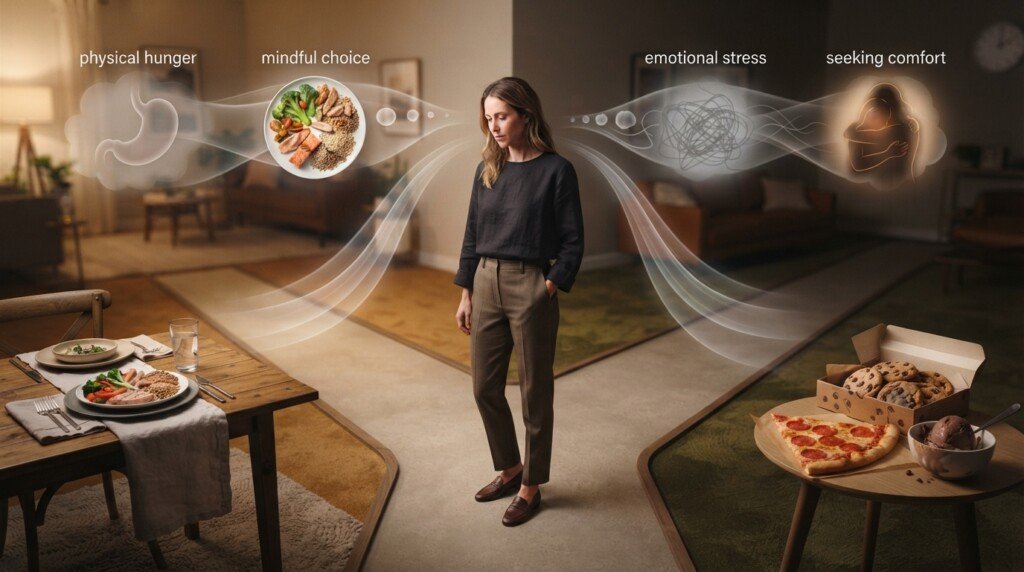
People often assume emotional eating is caused only by stress.
Stress is certainly one trigger.
But it is far from the only one.
Almost any emotion capable of creating discomfort can become associated with eating over time.
For one person, food becomes a reward after completing difficult work.
For another, eating helps fill quiet moments of boredom.
Someone else may eat because loneliness feels less noticeable while enjoying familiar comfort foods.
The important point is that the emotion itself is rarely the whole story.
Instead, emotional eating develops through repeated experiences where food becomes linked to emotional relief.
Imagine someone who always eats ice cream after difficult workdays.
Eventually, simply finishing a stressful shift may trigger the desire for ice cream before they even realize they’re thinking about food.
The emotion and the eating behavior become connected.
Understanding these connections is the foundation for recognizing emotional eating patterns.
The specific emotional triggers that strengthen these habits vary widely between individuals, which is why they deserve a separate discussion in Emotional Eating Triggers, where different emotional patterns are explored in much greater detail.
Here, it is enough to understand that emotional eating usually develops because food repeatedly becomes associated with managing feelings rather than satisfying hunger.

How Can I Identify if I’m an Emotional Eater?
One of the biggest challenges with emotional eating is that it often feels completely normal.
The behavior becomes so familiar that many people stop questioning it.
Recognizing emotional eating begins with noticing patterns instead of isolated moments.
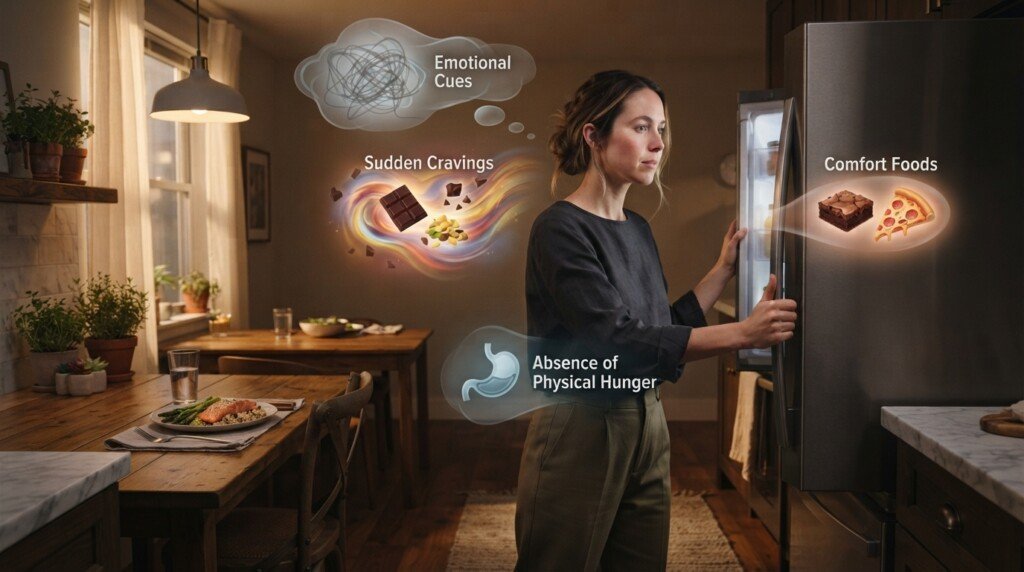
Eating Happens Suddenly
Physical hunger usually develops gradually.
Emotional eating often feels much more immediate.
A difficult conversation.
A stressful email.
A disappointing day.
Within minutes, thoughts about food appear.
The emotional event and eating become closely connected.
Cravings Focus on Specific Foods
True hunger generally makes many different foods sound satisfying.
Emotional eating frequently focuses on particular comfort foods.
Examples include:
- Chocolate
- Ice cream
- Pizza
- Chips
- Cookies
- Fast food
- Pastries
These foods often carry positive emotional associations from previous experiences.
Hunger May Be Absent
Many people notice they were not physically hungry before eating.
If they pause and honestly assess their hunger, they may realize they simply wanted relief from an emotion rather than nourishment.
Eating Happens Automatically
Some emotional eating episodes happen with very little awareness.
People may suddenly realize:
- The snack bag is empty.
- The television show ended.
- They finished dessert without fully tasting it.
This automatic quality often reflects established habits rather than conscious choices.
Emotions Change More Than Hunger
Perhaps the biggest clue is that eating seems to influence emotional discomfort more than physical hunger.
Food temporarily distracts from:
- Stress.
- Frustration.
- Loneliness.
- Anxiety.
- Boredom.
Although this relief may feel genuine, it is often temporary.
The original emotion frequently returns once eating is over.
Readers interested in recognizing these signs in greater detail can explore Signs of Emotional Eating, where each behavioral clue is examined more thoroughly.
What Are the Common Foods Associated With Emotional Eating?
It rarely involves random foods.
People seldom report craving plain vegetables or simple whole grains during stressful moments.
Instead, emotional eating usually centers around foods that are highly familiar, comforting, and emotionally rewarding.
These preferences are shaped by personal experience just as much as nutrition.
Sweet Foods
Many people associate sweets with positive memories.
Examples include:
- Chocolate
- Ice cream
- Cake
- Cookies
- Brownies
- Candy
These foods are commonly connected with celebrations, rewards, and family traditions.
Salty Snack Foods
Others gravitate toward crunchy snack foods.
Examples include:
- Potato chips
- Pretzels
- Popcorn
- Crackers
The texture itself may become part of the comforting experience.

Fast Food
Convenience also matters.
During emotionally difficult moments, foods requiring little effort often become especially attractive.
Examples include:
- Pizza
- Burgers
- French fries
- Fried chicken
These meals are familiar, easily available, and often associated with relaxation.
Childhood Comfort Foods
Many patterns involve foods connected to earlier life experiences.
Examples vary widely:
- Soup.
- Macaroni and cheese.
- Rice dishes.
- Family desserts.
- Homemade baked goods.
These foods carry emotional meaning beyond their nutritional content.
The important point is not that these foods are “bad.”
Rather, they have become closely linked with emotional comfort through repeated experiences.
Understanding that relationship provides valuable insight into why emotional eating often follows similar patterns over time.
When Should I Seek Professional Help for Emotional Eating?
Occasional emotional eating is a normal part of being human.
Almost everyone has eaten because of stress, celebration, boredom, or sadness at some point.
However, emotional eating may benefit from professional support when it becomes frequent, distressing, or difficult to control.
Examples include situations where:
- Eating feels completely automatic.
- Food becomes the primary coping strategy for emotional distress.
- Episodes happen several times each week.
- Eating regularly causes guilt or shame.
- Relationships with food become increasingly stressful.
- Emotional eating interferes with physical health or daily life.
Professional support does not mean someone has failed.
Instead, healthcare professionals can help identify the factors maintaining these eating patterns and develop healthier coping strategies tailored to the individual’s needs.
It is also important to recognize that emotional eating and binge eating are not identical.
Although the two behaviors may overlap for some people, they involve important differences.
Those differences are explored separately in Binge Eating vs Emotional Eating, which helps distinguish between these related but distinct eating patterns.

Key Takeaways
Emotional eating is not defined by a single meal or an occasional craving. Instead, it is a recurring behavior pattern where emotions consistently become the cue for eating rather than physical hunger. Recognizing this distinction allows you to approach the behavior with curiosity instead of self-criticism.
Unlike physical hunger, emotional eating often appears suddenly, focuses on specific comfort foods, and temporarily changes how you feel more than it satisfies genuine hunger. Over time, these repeated experiences can strengthen the connection between emotions and eating, making the pattern feel automatic.
Understanding emotional eating does not mean every episode needs to be analyzed or eliminated. The goal is to recognize when food has become a coping mechanism so you can better understand the pattern before deciding how to change it.
This guide provides the foundation for emotional eating. The individual topics, including emotional eating triggers, common signs, why people turn to food during difficult emotions, and practical ways to reduce emotional eating, are explored separately throughout this content cluster.
| Topic | Main Insight |
|---|---|
| Emotional eating | A repeated behavior pattern where emotions trigger eating instead of physical hunger. |
| Emotional triggers | Stress, boredom, loneliness, anxiety, celebration, and other emotions may gradually become linked with eating. |
| Common foods | Comfort foods such as chocolate, ice cream, chips, pizza, cookies, and other familiar favorites are commonly involved. |
| Self-awareness | Recognizing recurring patterns is more helpful than judging individual eating episodes. |
| Professional support | Help may be beneficial when emotional eating becomes frequent, distressing, or difficult to control. |
Frequently Asked Questions
1. What is emotional eating?
It is the habit of eating in response to emotions rather than physical hunger. It often develops gradually when food becomes associated with comfort, stress relief, boredom, or other emotional experiences.
2. What are the signs I’m an emotional eater?
Common signs include eating suddenly without feeling physically hungry, craving specific comfort foods, eating automatically during emotional situations, and using food primarily to change how you feel rather than to satisfy hunger.
3. How do I stop emotional eating?
The first step is understanding why emotional eating happens and recognizing your personal patterns. Practical strategies for changing these habits are covered separately in How to Stop Emotional Eating, since this guide focuses on understanding the behavior rather than treatment.
4. Is emotional eating always unhealthy?
No. Occasionally eating because of emotions is a normal part of life. Emotional eating becomes more concerning when it develops into a repeated pattern that replaces other ways of coping with emotions or causes significant distress.
5. Is emotional eating the same as binge eating?
No. Although the two can overlap, they are different behaviors. Emotional eating refers to eating in response to emotions, while binge eating has specific characteristics that distinguish it as a separate pattern. These differences are discussed in Binge Eating vs Emotional Eating.
Conclusion
Emotional eating is far more than an occasional craving for comfort food after a stressful day. It is a learned behavior pattern that develops when eating becomes closely connected to managing emotions instead of responding to physical hunger. Because this pattern usually forms gradually through repeated experiences, many people do not recognize it until it has become part of their everyday routine.
The encouraging news is that awareness changes everything. Once you begin noticing the situations, emotions, and habits that repeatedly lead to emotional eating, the behavior becomes much easier to understand. Rather than viewing yourself as someone who simply lacks willpower, you can recognize emotional eating as a pattern with identifiable causes and triggers.
This guide serves as the starting point for understanding emotional eating, but it is only one part of the bigger picture. Exploring your personal triggers, recognizing the warning signs, understanding why food becomes an emotional coping tool, and learning practical ways to change these habits can all help you build a healthier and more balanced relationship with food over time.
Disclaimer:
This post may contain affiliate links. If you purchase through them, we may earn a small commission at no extra cost to you. Also, this content is for informational purposes only and does not substitute professional medical advice.
Ready to Start Your Journey?
Use our free 7-in-1 Weight Loss Toolkit to calculate your numbers and build your plan in minutes.
Open Free Tools →