


What Are the Signs of Emotional Eating?
Most people do not wake up one morning and suddenly realize they have developed emotional eating habits.
Instead, the pattern usually forms so gradually that it feels completely normal.
A stressful day ends with takeout.
A lonely evening becomes an excuse for ice cream.
Boredom during the weekend leads to endless snacking while watching television.
After months or even years, these behaviors stop feeling like choices and start feeling like routines.
That is why recognizing the signs of emotional eating can be surprisingly difficult. Many people assume they simply have poor self-control or love comfort food. In reality, emotional eating often follows clear physical, behavioral, and mental patterns that become easier to recognize once you know what to look for.
The goal of this article is not to diagnose or label your eating habits.
Instead, it is to help you step back and honestly observe whether emotions may be influencing your relationship with food more often than you realize.
By learning these common warning signs, you can begin separating emotional eating from normal hunger and understand why the behavior tends to repeat itself.
Quick Answer
The signs of emotional eating often include eating when you are not physically hungry, craving specific comfort foods during emotional situations, eating quickly or automatically, feeling guilty afterward, and repeatedly using food to cope with stress, boredom, loneliness, or other emotions. While occasional emotional eating is normal, recognizing recurring patterns is the first step toward understanding your relationship with food.
What Are the Physical and Behavioral Signs of Emotional Eating?
One emotional eating episode rarely tells the whole story.
Almost everyone eats emotionally from time to time.
The real difference lies in repetition.
When the same emotions repeatedly lead to the same eating behaviors, a recognizable pattern begins to emerge.
These patterns generally appear in three different ways.
Some involve physical experiences.
Others become visible through daily habits and behaviors.
Some exist almost entirely inside your thoughts.
Looking at all three together provides a much clearer picture than focusing on only one.


What Are the Physical Signs of Emotional Eating?
Although emotional eating is driven by emotions rather than physical hunger, the body often provides subtle clues that the eating experience is different from normal hunger.
Learning to notice these differences can make emotional eating much easier to recognize.
Hunger Appears Suddenly Instead of Gradually
Physical hunger usually builds over time.
Perhaps breakfast was several hours ago.
Your stomach begins feeling emptier.
Energy gradually declines.
A wide variety of foods sound appealing.
Emotional eating often feels very different.
The urge appears almost instantly.
One difficult email.
One stressful conversation.
One boring afternoon.
Suddenly, eating becomes the first thing on your mind.
The speed of the craving often provides the first clue.
Specific Foods Feel Impossible to Ignore
True hunger rarely insists on one particular food.
If you are genuinely hungry, many meals sound satisfying.
With emotional eating, the mind usually becomes attached to something very specific.
Examples include:
- Chocolate.
- Ice cream.
- Pizza.
- Chips.
- Cookies.
- Fast food.
- Pastries.
It is not simply food you want.
It is one particular food that seems capable of making the moment feel better.
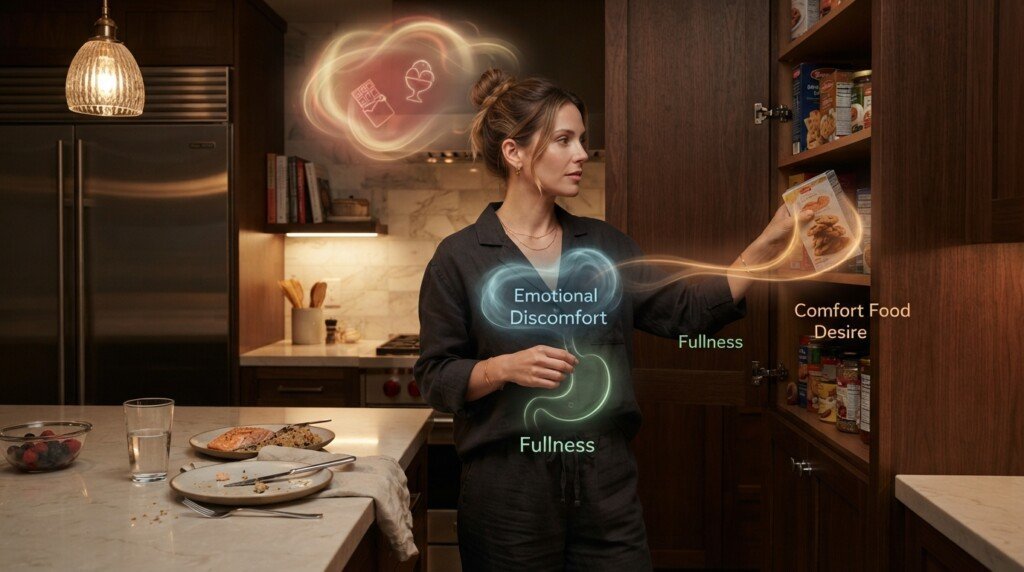
Physical Fullness Does Not Always End the Desire to Eat
One of the clearest signs of emotional eating is continuing to think about food despite already feeling physically full.
Someone may finish dinner, leave the table satisfied, and then immediately begin searching the kitchen for dessert.
The body has enough food.
The emotion has not changed.
Because the emotion remains, the urge to eat often continues.
Temporary Emotional Relief Becomes the Main Goal
After eating, physical hunger naturally decreases.
With emotional eating, many people notice something else.
The emotional discomfort also seems to soften, at least briefly.
Stress feels less intense.
Loneliness fades for a few minutes.
Boredom becomes less noticeable.
Unfortunately, this relief often disappears quickly, allowing the original emotion to return.
What Are the Behavioral Signs of Emotional Eating?
Behavior often reveals emotional eating even more clearly than physical sensations.
These habits usually develop gradually through repetition.
Many people are unaware they have formed them until they intentionally begin paying attention.

Eating Becomes Automatic
One common behavior is eating with very little conscious awareness.
Someone may sit down to watch television with a snack.
Before realizing it, the entire bag has disappeared.
The eating happened almost automatically.
The focus remained on the television rather than the food.
Food Becomes Part of Emotional Routines
Certain situations begin feeling incomplete without food.
Examples include:
- Watching movies.
- Finishing work.
- Studying late.
- Feeling stressed.
- Driving home.
- Relaxing after dinner.
Over time, these situations become closely connected with eating regardless of hunger.
Eating Alone More Frequently
Some people begin preferring to eat comfort foods privately.
This does not necessarily mean they are hiding food intentionally.
Instead, eating alone may feel easier because there is no need to explain the behavior.
For others, privacy removes feelings of embarrassment or self-consciousness.
Eating Very Quickly
Emotional eating often happens at a much faster pace than ordinary meals.
The goal becomes emotional relief rather than enjoying the eating experience.
Food is finished before fullness has much opportunity to register.
Many people later struggle to remember tasting the meal at all.
Planning Life Around Comfort Foods
As emotional eating patterns strengthen, some individuals begin thinking ahead about opportunities to eat favorite foods.
For example:
“I’ll order pizza after this stressful meeting.”
“I deserve ice cream after today.”
“I can’t wait to get home so I can eat.”
These thoughts gradually become part of emotional routines.
Repeated Attempts to “Start Over Tomorrow”
Many emotional eaters experience a familiar cycle.
They promise themselves today is the last time.
Tomorrow everything will change.
Then another stressful day arrives.
The cycle repeats.
The issue is rarely motivation.
It is that the underlying emotional pattern remains unchanged.
Readers who want to better understand how these patterns first develop can continue with Emotional Eating, which explains how emotional eating evolves into a long-term behavior rather than an occasional event.
What Thought Patterns Are Associated With Emotional Eating?
Not every sign of emotional eating can be observed from the outside.
Some of the strongest clues happen internally through recurring thoughts.
These mental habits often appear long before eating begins.

Food Feels Like the Fastest Solution
People experiencing emotional eating frequently think:
“I just need something comforting.”
“I’ll feel better after I eat.”
“I deserve this.”
The food becomes associated with solving emotional discomfort.
All-or-Nothing Thinking
Many emotional eaters also develop perfectionistic thoughts.
Examples include:
“I already ruined today.”
“I might as well keep eating.”
“I’ll start over Monday.”
Rather than viewing one eating decision as neutral, the entire day becomes labeled as either successful or failed.
This mindset often encourages further overeating.
Guilt Appears Before Eating Has Even Finished
Sometimes guilt begins surprisingly early.
People may already regret their decision while they are still eating.
Instead of enjoying the food, they begin criticizing themselves.
Ironically, this guilt may create even more emotional discomfort, making additional eating seem appealing.
Food Becomes the Reward for Difficult Emotions
Many thought patterns frame food as something earned.
Examples include:
“I survived today.”
“I worked hard.”
“I deserve a treat.”
Although occasional rewards are perfectly normal, consistently linking emotional experiences with food may gradually strengthen emotional eating habits.
How Can I Tell if I’m Eating Due to Emotions Rather Than Hunger?
If you’re unsure, ask yourself one simple question:
“Would I still want a balanced meal right now, or am I only craving one specific comfort food?”
For a more detailed comparison, see Emotional Hunger vs Physical Hunger, where the differences are explored in depth.
Why Does Emotional Eating Lead to Guilt?
For many people, the hardest part of emotional eating is not the eating itself.
It is what happens afterward.
The comfort that food briefly provided begins to fade, and another emotion quietly takes its place.
Guilt.
People often replay everything they ate, criticize themselves for lacking willpower, and promise to “be better tomorrow.” Unfortunately, those feelings rarely solve the problem. In many cases, they become part of the emotional eating pattern itself.
Understanding why guilt develops is important because guilt is not simply an unpleasant emotion that follows emotional eating. It can actually become one of the reasons the cycle continues.
The more someone blames themselves, the more emotional distress they experience.
The more emotional distress they experience, the stronger the urge to seek comfort again.
Recognizing this cycle is one of the first steps toward breaking it.

How Does the Cycle of Emotional Eating and Guilt Develop?
Emotional eating usually follows a predictable pattern rather than occurring randomly.
Although everyone’s experience is different, many people move through the same sequence of thoughts and emotions repeatedly without realizing it.
It often begins with an uncomfortable emotion.
Stress after work.
Loneliness during the evening.
Disappointment after receiving bad news.
Frustration over a difficult situation.
Instead of addressing the emotion directly, food becomes the quickest source of comfort.
At first, eating often feels helpful.
The emotional discomfort softens.
Attention shifts away from the problem.
For a short period, everything feels more manageable.
Then the eating ends.
The original emotion often returns.
Alongside it comes something new.
Self-criticism.
People may begin thinking:
“Why did I eat that?”
“I had already promised myself I wouldn’t.”
“I ruined my progress.”
These thoughts create fresh emotional distress.
Ironically, the very emotion created by guilt may later trigger another episode of emotional eating.
The cycle begins again.
Over weeks, months, or years, this pattern can become deeply familiar.
Not because someone lacks discipline.
But because the brain repeatedly learns that food offers temporary emotional relief, even if that relief never lasts very long.
The Guilt Often Becomes Stronger Than the Eating
Interestingly, many people remember the guilt far more vividly than the food itself.
They stop enjoying the eating experience altogether.
Instead, every bite becomes accompanied by thoughts like:
- “I shouldn’t be eating this.”
- “I’ll regret this later.”
- “I’ve already failed.”
Rather than providing comfort, food becomes associated with shame.
This emotional burden often weighs far more heavily than the meal itself.
Restriction Can Make the Cycle Worse
Another common pattern begins the next morning.
Someone decides to make up for yesterday.
They skip breakfast.
Eat very little all day.
Avoid favorite foods completely.
By evening, hunger and emotional fatigue have both increased.
Comfort foods become even more appealing.
Another emotional eating episode occurs.
The person feels guilty again.
This cycle has very little to do with motivation.
It is often the predictable result of alternating between emotional eating and overly restrictive eating.
For readers who want practical strategies for changing this pattern, How to Stop Emotional Eating explores those approaches in much greater depth.
What Is the Physiological Impact of Repeated Emotional Eating on the Body?
Occasional emotional eating is unlikely to have meaningful effects on long-term health.
Nearly everyone has comfort foods during stressful periods.
Problems become more likely when emotional eating turns into a frequent coping strategy that continues for months or years.
Hunger Signals Can Become Harder to Recognize
When emotions repeatedly determine eating decisions, it may become increasingly difficult to recognize normal hunger and fullness.
Instead of responding to physical cues, eating becomes linked primarily to emotional situations.
Over time, this can make meals feel disconnected from the body’s natural appetite signals.
Weight Changes May Occur
Repeated emotional eating can contribute to gradual weight gain for some individuals, particularly if comfort foods are consumed in addition to regular meals rather than replacing them.
However, weight change is not inevitable.
Not everyone who emotionally eats gains weight, and emotional eating should never be judged solely by body size.
People of every body type can experience emotional eating.
Energy Levels May Become Less Consistent
Meals driven by emotional urgency sometimes replace more balanced eating patterns.
This may leave some individuals feeling:
- Less energized.
- More sluggish.
- Less satisfied after meals.
Again, these experiences vary widely between individuals.
Emotional Health Is Often Affected More Than Physical Health
Perhaps the greatest impact of repeated emotional eating is psychological rather than physical.
Constant guilt around food may contribute to:
- Increased stress.
- Lower confidence.
- Greater anxiety around eating.
- Reduced enjoyment of meals.
- Feeling trapped in a repeating cycle.
For many people, improving their relationship with food becomes just as important as improving nutrition itself.
What Strategies Help Break Free From the Guilt Cycle?
Breaking the guilt cycle begins with changing the conversation you have with yourself.
Many people believe guilt motivates healthier choices.
Research and clinical experience often suggest the opposite.
Persistent self-criticism usually increases emotional distress instead of reducing it.
Replace Judgment With Observation
Instead of immediately asking,
“Why did I fail?”
try asking,
“What happened before I started eating?”
This small shift changes the focus from blame to understanding.
Curiosity often reveals patterns that guilt hides.
Accept That Emotional Eating Happens Occasionally
The goal is not perfection.
Even people with very healthy relationships with food occasionally eat because of emotions.
One emotional eating episode does not erase healthy habits built over months or years.
Viewing each experience as information rather than failure makes lasting change much more realistic.
Focus on the Pattern, Not One Meal
A single dessert is rarely the problem.
The repeated emotional pattern deserves attention.
Looking at weekly or monthly habits provides a much clearer picture than judging one afternoon or one evening.
Build Self-Compassion Alongside Awareness
Many people speak to themselves after emotional eating in ways they would never speak to a close friend.
Replacing harsh self-criticism with kindness does not excuse unhealthy habits.
Instead, it creates the emotional space needed to understand why those habits developed in the first place.
The practical methods for reducing emotional eating over time are covered in How to Stop Emotional Eating, where coping strategies, behavior change, and long-term habit development are discussed in detail.
Key Takeaways
Recognizing the signs of emotional eating is less about judging individual eating episodes and more about identifying recurring patterns. Emotional eating often reveals itself through a combination of physical sensations, everyday behaviors, and thought patterns that repeatedly appear during emotionally challenging moments.
Many people first notice emotional eating because of what happens after eating rather than before it. Feelings of guilt, disappointment, or frustration can become just as much a part of the cycle as the food itself. Understanding that this guilt often reinforces emotional eating rather than preventing it helps explain why the pattern can be difficult to break.
Most importantly, recognizing these signs should not lead to self-criticism. Awareness is the foundation for change. Once you understand how emotional eating appears in your own life, you are better prepared to explore its underlying causes and develop healthier ways of responding to difficult emotions.
| Topic | Main Insight |
|---|---|
| Physical signs | Sudden hunger, specific comfort food cravings, eating despite fullness, and seeking emotional relief instead of nourishment are common clues. |
| Behavioral signs | Automatic eating, rapid eating, private eating, and repeated food-related routines often develop gradually over time. |
| Thought patterns | Self-criticism, all-or-nothing thinking, and using food as a reward commonly reinforce emotional eating. |
| Guilt cycle | Emotional relief is often followed by guilt, which creates additional emotional distress and can trigger future emotional eating. |
| Next steps | Recognizing patterns is the first step before exploring emotional triggers and practical behavior-change strategies. |
Frequently Asked Questions
1. What are the signs of emotional eating?
Common signs include eating when you are not physically hungry, craving specific comfort foods, eating automatically or very quickly, feeling guilty afterward, and repeatedly turning to food during stressful or emotional situations.
2. Why does emotional eating cause guilt?
Many people judge themselves after eating for emotional reasons, especially if they believe they should have relied on willpower instead. This self-criticism creates guilt, which may increase emotional distress and reinforce the emotional eating cycle.
3. How do I know if I’m an emotional eater?
If you consistently notice that emotions such as stress, boredom, loneliness, or frustration lead you to eat even when you are physically satisfied, emotional eating may be influencing your eating habits. Looking for recurring patterns rather than isolated episodes is often the most reliable approach.
4. Is emotional eating the same as overeating?
No. Emotional eating refers to eating in response to emotions instead of physical hunger. Although it may involve overeating, the two are not always the same, and emotional eating can occur even during relatively small eating episodes.
5. Can emotional eating become a long-term habit?
Yes. Because emotional eating is a learned behavior pattern, repeating it over time can strengthen the connection between emotions and food. The encouraging news is that learned patterns can also be changed with greater awareness and appropriate support.
Conclusion
The signs of emotional eating are often much easier to recognize when you stop focusing on individual meals and begin looking for recurring patterns. Sudden cravings, eating without physical hunger, relying on comfort foods during emotional situations, and experiencing guilt afterward are all signals that emotions may be influencing your relationship with food more than you realize.
Recognizing these patterns is not about labeling yourself or assigning blame. It is about building awareness. Once you understand how emotional eating appears in your own life, you are in a much stronger position to explore its underlying causes, recognize your personal triggers, and gradually develop healthier ways of responding to difficult emotions without relying on food alone.
Disclaimer:
This post may contain affiliate links. If you purchase through them, we may earn a small commission at no extra cost to you. Also, this content is for informational purposes only and does not substitute professional medical advice.
Ready to Start Your Journey?
Use our free 7-in-1 Weight Loss Toolkit to calculate your numbers and build your plan in minutes.
Open Free Tools →