
How Long Does It Take to See VO2 Max Improvements?
A good VO2 max improvement timeline is rarely as dramatic as fitness watches make it look. You might see a higher number within a few weeks, but that does not mean everyone will improve at the same speed, and a single reading is not enough to prove that your aerobic fitness has changed.
The encouraging part is that measurable improvement can begin relatively early, especially when someone is starting from a low fitness level. The frustrating part is that progress usually becomes slower as fitness improves.
That difference matters.
A beginner who has never trained consistently may see noticeable changes from a relatively small amount of structured exercise. An experienced endurance athlete may train for weeks or months for a much smaller percentage improvement.
There is no single deadline at which your VO2 max is supposed to increase. Your starting fitness, training consistency, age, genetics, recovery, health, and even the accuracy of the test all influence what you see.
So instead of asking, “How quickly can I increase my VO2 max?” a more useful question is, “What should a realistic progression look like for someone at my current fitness level?”
What’s a realistic timeline for seeing VO2 Max improvements?
For many people, the first meaningful changes can appear within several weeks of consistent aerobic training, but the exact timing varies considerably.
Research illustrates why giving everyone the same deadline is misleading. In one nine-week study, measurable VO2 max changes that exceeded normal day-to-day variability appeared after roughly 21 training sessions at the group level. Other physiological changes appeared earlier. (PubMed)
That does not mean you need exactly 21 workouts before your VO2 max can change.
It means the signal from actual adaptation can be difficult to separate from ordinary biological and measurement variation when you look at only a handful of sessions.
For a previously inactive person, the early weeks of training can produce relatively noticeable improvements. The body has plenty of room to adapt because the cardiovascular and muscular systems are being challenged in ways they were not accustomed to.
Someone who already has a high aerobic capacity has less room for rapid improvement.
That is why two people can follow the same training plan and see very different results.
A practical way to think about the timeline is in stages.
During the first few weeks, you may notice that exercise feels easier before your VO2 max number changes dramatically. Your breathing may settle more quickly, familiar workouts may feel less exhausting, and you may recover more comfortably.
Around the first month or two, a consistent beginner may start seeing clearer measurable changes. The improvement may show up in a laboratory test, a wearable estimate, or in repeatable exercise performance.
Over several months, progress generally becomes more dependent on training quality, recovery, and how close you are to your personal aerobic ceiling.
The important point is that fitness does not improve in a perfectly straight line.
You may see a rise, a period of little change, another rise, and then another plateau.
That is normal.
How does training intensity affect the speed of gains?
Training intensity can influence how strongly your cardiovascular system is challenged, but harder does not automatically mean faster.
This distinction is important because people often assume that if moderate exercise produces an improvement, extremely hard exercise must produce a much larger one.
The reality is more complicated.
Your body needs a sufficient training stimulus. But it also needs recovery. If the intensity is so high that you cannot train consistently, the theoretical benefit of the workout becomes less important.
A well-designed training program usually combines different intensities rather than treating every workout as a VO2 max test.
Harder aerobic sessions can provide a strong stimulus for improving aerobic capacity. Easier sessions can allow you to accumulate training volume without creating excessive fatigue.
The combination can be more sustainable than repeatedly pushing yourself to the limit.
Recent research also suggests that the relationship between training intensity and VO2 max improvement is influenced by starting fitness and training status. A 2024 systematic review found that lower initial fitness levels were generally associated with larger percentage improvements in VO2 max, while adaptations continued to occur across different fitness levels. (PubMed)
This gives us an important lesson.
If you are a beginner, you do not necessarily need an extreme program to make progress.
In fact, simply becoming consistent may produce a substantial change.
If you are already highly trained, you may need more carefully structured training because your body has already adapted to many of the basic demands of endurance exercise.
That is one reason advanced athletes often spend so much time fine-tuning relatively small details.
Their problem is no longer getting their body to respond.
Their problem is finding the right stimulus for further improvement.
There is another issue that gets overlooked: intensity is only useful when it is appropriate for the individual.
A workout that feels challenging but manageable for one person might be excessive for another.
Your current fitness level determines how much stress a particular pace, resistance, incline, or heart rate represents.
That is why copying an advanced athlete’s program is rarely a shortcut.
It may simply give you too much fatigue for the amount of fitness you currently have.
Can I expect measurable changes within the first month?
Yes, it is possible to see measurable changes within the first month, particularly if you are beginning from a relatively low fitness level.
But “measurable” does not necessarily mean that your fitness watch will suddenly show a dramatically higher VO2 max.
This is where expectations need to be realistic.
Your cardiovascular system can begin adapting before a consumer device detects a clear change. You may become more comfortable at a particular pace, maintain the same speed with less effort, or recover more quickly after exercise.
Those changes matter.
Consider someone who starts with a 30-minute walk and gradually progresses to brisker, longer aerobic sessions.
At first, the activity may leave them noticeably breathless. Several weeks later, the same session may feel routine.
Their watch might report a modest change, no change, or even fluctuate from one day to another.
That does not automatically mean the training failed.
Wearable estimates are influenced by the data available to the algorithm, including heart rate, pace, exercise type, and environmental conditions.
Even laboratory measurements have normal variation.
One study examining repeated VO2 max testing found meaningful day-to-day variability, which is why researchers recommend considering measurement reliability when interpreting changes. (PubMed)
This creates an important distinction between physiological change and measurement change.
If your VO2 max estimate moves from 42 to 43, that might represent genuine improvement.
It might also partly reflect normal variation.
If it moves from 42 to 43 while your running pace improves, your recovery improves, and the same workout feels easier, the overall picture becomes much more convincing.
That is why you should never judge your entire fitness journey from one reading.
Look for a trend.
Do beginners improve faster than advanced athletes?
Generally, beginners have more room to improve.
That does not mean advanced athletes cannot improve. It means their percentage gains are often smaller because they have already developed a large portion of their aerobic capacity.
Imagine two people.
The first person has spent the last five years mostly sedentary. Their cardiovascular system has had relatively little reason to adapt to sustained aerobic demand.
The second person has spent five years running, cycling, swimming, or participating in endurance sports.
Give both people the same training stimulus and you should not expect identical results.
The beginner may experience a noticeable improvement because the body is responding to a new challenge.
The experienced athlete is already adapted.
This is one of the most important concepts to understand when evaluating your own VO2 max improvement.
A 5 percent increase might be relatively easy for someone starting from a low baseline but extremely difficult for someone who is already highly trained.
That does not make the advanced athlete’s smaller improvement less valuable.
A small increase at a high level can represent a substantial amount of work.
It can also translate into meaningful improvements in endurance performance.
The 2024 systematic review mentioned earlier found that lower initial fitness was generally associated with greater percentage improvements in VO2 max, supporting the idea that starting fitness strongly influences the size of the response. (PubMed)
So if your progress slows after your first few months, do not automatically assume that something is wrong.
You may simply be moving from the easy gains of early adaptation toward the harder gains of advanced training.
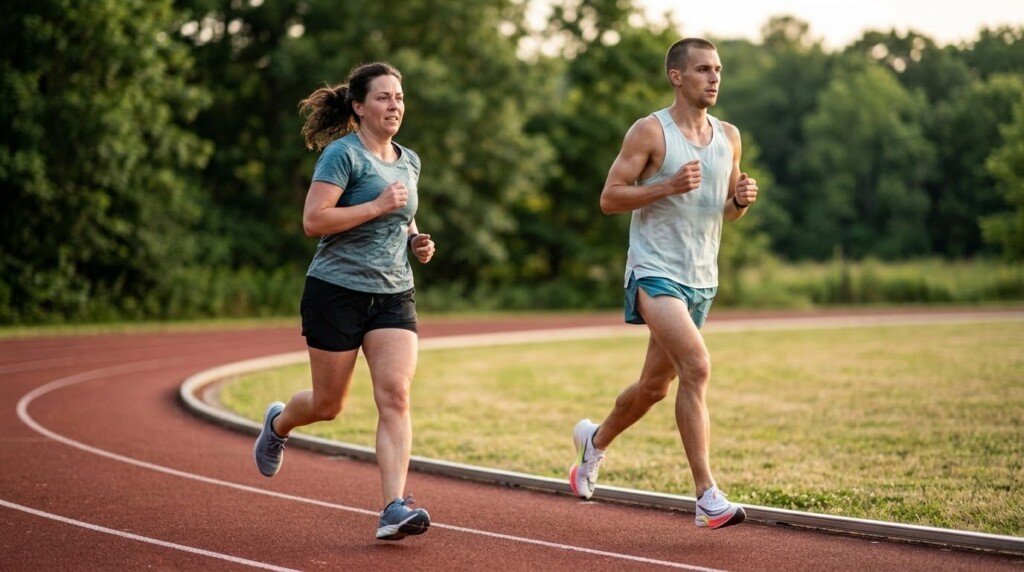
Why might progress plateau, and how do you break through it?
A VO2 max plateau can be frustrating because it creates the impression that your body has stopped responding.
Sometimes that is exactly what happened.
Often, however, the situation is more complicated.
The first possibility is that your training has become too predictable.
Your body adapts to repeated demands. A workout that was challenging three months ago may no longer provide enough stimulus to create the same level of adaptation.
The second possibility is that you are doing too much.
This sounds contradictory, but it is common.
Someone sees their progress slow down and responds by adding more hard workouts. Instead of improving, they accumulate fatigue.
Their performance drops, recovery worsens, and the VO2 max estimate may stagnate.
The solution is not always more training.
Sometimes it is better training.
Another possibility is that your training is not specific enough to your goal.
You may be exercising regularly but spending almost all your time at one intensity. That can improve general fitness while providing a less varied stimulus for further aerobic development.
Recovery is another major factor.
Poor sleep, inadequate nutrition, excessive stress, and insufficient rest can all interfere with your ability to perform quality training.
You can have a theoretically excellent training plan and still make poor progress if your body is never adequately recovering from it.
Then there is the possibility that the plateau is not actually a plateau.
This is especially relevant if you rely heavily on a smartwatch.
A wearable estimate can move up and down because the underlying inputs change. Heat, hills, fatigue, heart rate variation, pacing, and the type of workout can influence the estimate.
That means you should look at several measures before deciding that progress has stopped.
Ask yourself:
Are you running or cycling faster at the same effort?
Does the same workout feel easier?
Can you maintain a higher workload before becoming breathless?
Does your heart rate recover more quickly after demanding exercise?
Are you completing workouts that previously felt difficult with less fatigue?
If several of these are improving, your fitness may still be progressing even if the VO2 max number has temporarily stalled.
There is also a more uncomfortable possibility.
You may be close to your current physiological ceiling.
That does not mean you have reached your permanent maximum. It means the easy improvements are over.
At that point, progress becomes slower and requires more precise training, recovery, and patience.
This is where the difference between beginner and advanced training becomes especially obvious.
A beginner may improve simply by becoming active consistently.
An advanced athlete may need months of careful progression to achieve a relatively small improvement.
How often should I retest to track real progress?
Retesting too frequently can create more confusion than useful information.
VO2 max does not need to be checked every few days.
If you test too often, you may mistake normal biological variation for meaningful progress or regression.
A better approach is to give your training enough time to produce a meaningful adaptation before comparing results.
For many recreational exercisers, testing every several weeks or every few months is more useful than checking constantly.
The exact interval depends on how you are measuring it.
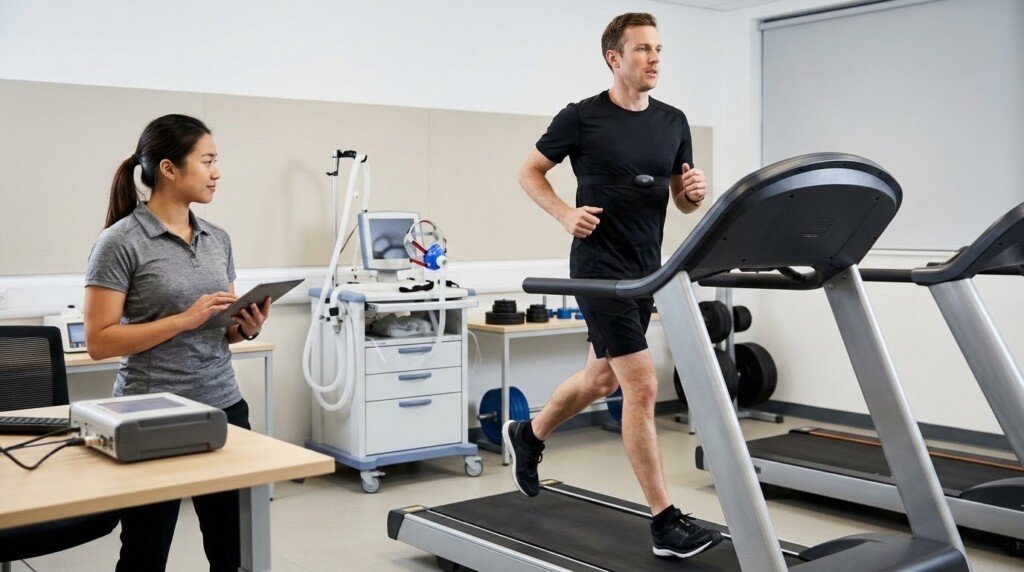
If you are using a fitness watch, you can observe the ongoing estimate without treating every daily fluctuation as meaningful. Look at the broader trend over several weeks.
If you are performing a standardized field test, repeat the same test under similar conditions.
If you are using a laboratory assessment, follow the testing schedule recommended by the professional conducting the assessment.
Consistency matters enormously.
Suppose your first test is performed on a cool morning after a good night’s sleep, while your second is performed after poor sleep on a hot afternoon.
Even if your underlying fitness has improved, the conditions can make the comparison less clean.
Try to keep important variables reasonably similar.
Use the same exercise modality when possible. Follow a similar warm-up. Avoid comparing a fresh test with one performed while severely fatigued. Keep the testing environment as consistent as practical.
This is not about creating laboratory perfection.
It is about reducing unnecessary noise.
A useful approach is to pair VO2 max testing with performance markers.
For runners, this could include pace at a familiar effort or performance over a repeatable route.
For cyclists, it might include power at a defined heart rate or performance over a familiar course.
For general exercisers, it could be how quickly you recover from a standardized aerobic session.
This gives you more context than a single VO2 max number.
One older but important analysis of VO2 max testing found that test-retest measurement error could explain part of the apparent differences between people’s training responses.
In plain language, a small change is not automatically proof of a real physiological change.
That is why repeated trends are more convincing than isolated readings.
Frequently Asked Questions
1. How long does it take to improve VO2 Max?
There is no universal timeline, but noticeable changes can begin within several weeks of consistent training. Beginners and people with lower starting fitness often see larger percentage gains, while experienced athletes generally progress more slowly.
2. Why has my VO2 Max plateaued?
A plateau can occur because your body has adapted to your current training, your workload is no longer appropriate, recovery is inadequate, or you are already highly trained. It can also be a measurement issue, especially when relying on wearable estimates.
3. How often should I retest my VO2 Max?
For most people, retesting every several weeks to a few months is more useful than testing constantly. If you use a wearable, focus on the longer-term trend rather than daily fluctuations. Standardized conditions make comparisons more meaningful.
4. Can beginners improve VO2 Max faster than experienced athletes?
Often, yes. Beginners usually have more room for improvement because their initial aerobic fitness is lower. Advanced athletes can still improve, but the gains tend to become smaller and require more precise training and recovery.
5. Does a higher VO2 Max always mean I am getting fitter?
Not necessarily from one measurement. VO2 max is an important indicator of aerobic capacity, but test variability and wearable estimation errors can affect the number. Looking at VO2 max alongside repeatable performance and recovery gives you a stronger picture.
The Bottom Line
Your VO2 max improvement timeline should be viewed as a progression, not a deadline.
If you are starting from a low fitness level, the first few weeks can bring surprisingly noticeable changes. Exercise may become easier, recovery may improve, and measurable aerobic gains may begin to appear.
As your fitness rises, the pace changes.
The first few improvements may come relatively quickly. Later improvements demand more patience.
That is not your body failing.
It is what happens when you move closer to your current potential.
Do not panic over one flat reading. Do not add endless hard workouts because your watch has not moved. And do not compare your progress with someone who has spent years developing their aerobic system.
Instead, give your training enough time to work, measure under reasonably consistent conditions, and pay attention to performance as well as the number on the screen.
If you are still building your foundation, the next step is understanding how to improve your VO2 max through appropriate training rather than chasing a faster number at any cost.
And if you want to understand why your rate of progress may differ from someone else’s, the factors behind your individual VO2 max potential matter just as much as the training itself.
Disclaimer:
This post may contain affiliate links. If you purchase through them, we may earn a small commission at no extra cost to you. Also, this content is for informational purposes only and does not substitute professional medical advice.
Train Smarter, Not Harder
Use our free Fitness Toolkit to find your heart rate zones and calories burned in minutes.
Open Free Tools →