
How Much Protein Do You Need to Prevent Muscle Loss While Losing Weight?
When you are losing weight, eating less is only half of the equation. The other question is what your body does with the tissue you already have.
A calorie deficit encourages your body to use stored energy, but weight loss is not made entirely of body fat. Some lean tissue can also be lost, particularly when dieting is aggressive or nutritional intake is poorly planned. That is why protein to prevent muscle loss deserves more attention than simply asking how many calories you should eat.
Protein provides amino acids your body uses to maintain and repair tissue. During weight loss, getting enough protein can help create a better environment for retaining lean mass, especially when combined with appropriate resistance exercise. A 2024 systematic review and meta-analysis of 47 studies found that higher protein intake helped reduce muscle-mass decline during weight loss in adults with overweight or obesity. (PubMed)
But there is an important catch.
There is no single protein number that is perfect for everyone.
A 120-pound sedentary woman, a 200-pound man doing resistance training, a 65-year-old dieting adult, and a competitive athlete preparing for an event do not necessarily need the same amount of protein.
So instead of chasing an arbitrary “maximum,” it makes more sense to build your protein intake around your body weight, activity level, age, and the size of your calorie deficit.
The practical framework below gives you a starting point in both grams per kilogram and grams per pound, so you can turn a general recommendation into an actual daily target.
How much protein do I actually need to prevent muscle loss?
For many adults trying to lose weight while preserving muscle, a practical starting range is around 1.2 to 1.6 grams of protein per kilogram of body weight per day, which is approximately 0.55 to 0.73 grams per pound.
That does not mean everyone needs exactly 1.6 g/kg.
It means that protein requirements during dieting are often higher than the basic adult recommended intake of 0.8 g/kg/day, particularly when preserving lean tissue is an important goal.
For example, someone weighing 70 kg, or about 154 pounds, could use the following framework:
1.2 g/kg: about 84 grams per day
1.4 g/kg: about 98 grams per day
1.6 g/kg: about 112 grams per day
That is a much more useful way to think about protein than simply being told to “eat more protein.”
There is also evidence that protein intake above approximately 1.3 g/kg/day may be particularly helpful for preserving muscle mass during weight loss, while intakes below 1.0 g/kg/day were associated with greater risk of muscle-mass decline in a 2024 meta-analysis. These figures are not a guarantee for an individual, but they provide a useful practical range. (PubMed)
The right target within that range depends on your circumstances.
If you are lightly active and have a modest calorie deficit, you may not need to push toward the upper end.
If you are older, resistance training regularly, already fairly lean, or dieting aggressively, a higher intake may make more sense.
The objective is not to turn every meal into a protein challenge.
The objective is to make adequate protein a consistent part of your diet while leaving enough room for carbohydrates, fats, fiber, fruits, vegetables, and other foods your body needs.

How does age affect daily protein requirements for muscle preservation?
Age changes the protein conversation because maintaining muscle can become more challenging as you get older.
This does not mean that every older adult needs an enormous amount of protein. It means that simply meeting the minimum recommended intake may not always be the most useful target when someone is actively trying to lose weight while preserving lean mass.
Older adults can experience changes in how muscle responds to dietary protein and exercise. At the same time, appetite may decrease, meals may become smaller, and physical activity may decline. If calorie intake falls substantially during dieting, there is also less opportunity to obtain protein unless meals are planned deliberately.
This creates a situation where an older person can accidentally eat much less protein than they realize.
Imagine someone who normally eats three meals but begins dieting by cutting breakfast, replacing lunch with a small salad, and eating a modest dinner. Their calories may be lower, but their protein intake can also fall dramatically.
That is not necessarily a better weight-loss strategy.
For older adults who are intentionally losing weight, higher protein intake has been associated with better retention of lean mass compared with lower protein intake. A systematic review and meta-analysis involving adults over 50 found that higher protein intake during weight loss was associated with greater lean-mass retention and greater fat loss.
This is one reason protein should be considered alongside the total calorie deficit rather than treated as an afterthought.
Age alone should not determine your protein target, though.
Your current body weight, activity level, health status, appetite, training routine, and dietary pattern all matter.
Someone in their 60s who strength trains three times a week and is deliberately losing weight may have a very different protein requirement from someone of the same age who is mostly sedentary.
There is also a medical consideration.
People with chronic kidney disease or certain other medical conditions should not simply increase protein intake based on a general internet recommendation. Individual medical circumstances can change what is appropriate.
If you are older and losing weight intentionally, the more useful goal is not “eat as much protein as possible.”
It is to ensure that your diet provides enough high-quality protein consistently while avoiding an unnecessarily aggressive calorie restriction.
How do I calculate my own personalized protein target based on body weight and activity level?
The simplest way to calculate your target is to start with your body weight in kilograms.
If you know your weight in pounds, divide it by 2.205.
For example:
154 pounds ÷ 2.205 = about 70 kg
You can then multiply your weight in kilograms by an appropriate protein factor.
A useful starting framework looks like this:
1.2 g/kg: lighter activity or a less aggressive approach to weight loss
1.4 g/kg: regular activity and a stronger focus on preserving lean mass
1.6 g/kg: regular resistance training, greater muscle-preservation priority, or more demanding dieting circumstances
For the 70 kg example:
70 × 1.2 = 84 grams
70 × 1.4 = 98 grams
70 × 1.6 = 112 grams
If you prefer pounds, the approximate equivalent range is:
0.55 g/lb: lower end
0.64 g/lb: middle
0.73 g/lb: upper end
You do not need to calculate this every morning.
Choose a reasonable target and make it practical.
For someone weighing 180 pounds, for example, a target around 100 to 130 grams per day may be a reasonable starting framework depending on activity and dieting circumstances.
That does not mean 130 grams is automatically better than 100 grams.
More protein does not compensate for an excessively restrictive diet, poor recovery, or inadequate overall nutrition.
Another useful distinction is whether your current body weight is appropriate for the calculation.
For people with obesity, using actual body weight can sometimes produce an unnecessarily high protein target. In that situation, a dietitian or other qualified professional may use an adjusted or goal-based weight rather than simply multiplying total body weight by a protein factor.
This is one reason online protein calculators can give very different answers.
The number is only as good as the assumptions behind it.
Your activity level also matters.
A person who walks regularly but does not perform resistance training may not need the same protein target as someone lifting weights several times a week.
An athlete in a calorie deficit has a different challenge again.
And if you are already quite lean and trying to lose the last few pounds while maintaining substantial muscle mass, the margin for error becomes smaller.
The practical rule is this:
Start with your body weight, choose a reasonable protein range, then adjust according to training, age, dieting intensity, and how well you can actually maintain the intake.
Consistency matters more than finding a magical number.
What are the best protein sources for muscle preservation?
The best protein source is one you can eat consistently while fitting it into the rest of your diet.
Chicken breast is useful.
Greek yogurt is useful.
Eggs are useful.
Fish is useful.
Lean beef can be useful.
Cottage cheese can be useful.
Tofu, tempeh, beans, lentils, soy foods, and other plant-based options can also contribute substantially.
Protein powder can be convenient when food alone makes your daily target difficult to reach, especially on busy days. It does not have to replace normal meals. It can simply fill a gap between what you are eating and what you are trying to achieve. Different products also vary considerably in protein content and ingredients, so understanding the basics of protein powder can help you decide whether it actually makes sense for your routine.
The phrase “best protein” can be misleading because the answer depends on the person.
Someone who eats dairy may find Greek yogurt and cottage cheese extremely convenient.
Someone who does not eat animal products may rely more heavily on soy, legumes, seitan, and plant-based protein products.
Someone who struggles with appetite may find a protein shake easier to consume than another large meal.
Someone who enjoys cooking may have no reason to use a supplement at all.
Protein quality is worth considering, particularly when muscle preservation is the goal.
Foods that provide all or most of the essential amino acids in useful amounts can make it easier to meet your needs. Animal proteins and soy are examples of relatively complete protein sources, while plant-based diets can also provide adequate protein when a variety of foods are included across the day.
The bigger mistake is often not choosing the “wrong” protein.
It is simply eating too little.
A person can build an extremely healthy diet from vegetables, fruit, whole grains, legumes, and healthy fats while still falling short of protein if portions are small and protein-rich foods are rarely included.
During weight loss, that gap becomes more important.
You have fewer calories to work with, so every meal needs to do more nutritional work.
A 400-calorie meal containing 10 grams of protein is very different from a 400-calorie meal containing 30 or 40 grams of protein when muscle preservation is a priority.
This does not mean every meal needs to be high in protein.
It means protein should have a deliberate place in your meals instead of being whatever happens to remain after you choose everything else.
Does protein timing, spread throughout the day versus one big meal, actually matter?
Total daily protein is the first priority.
If you consistently eat 110 grams of protein per day, that matters more than obsessing over whether you consumed it at exactly the “perfect” time.
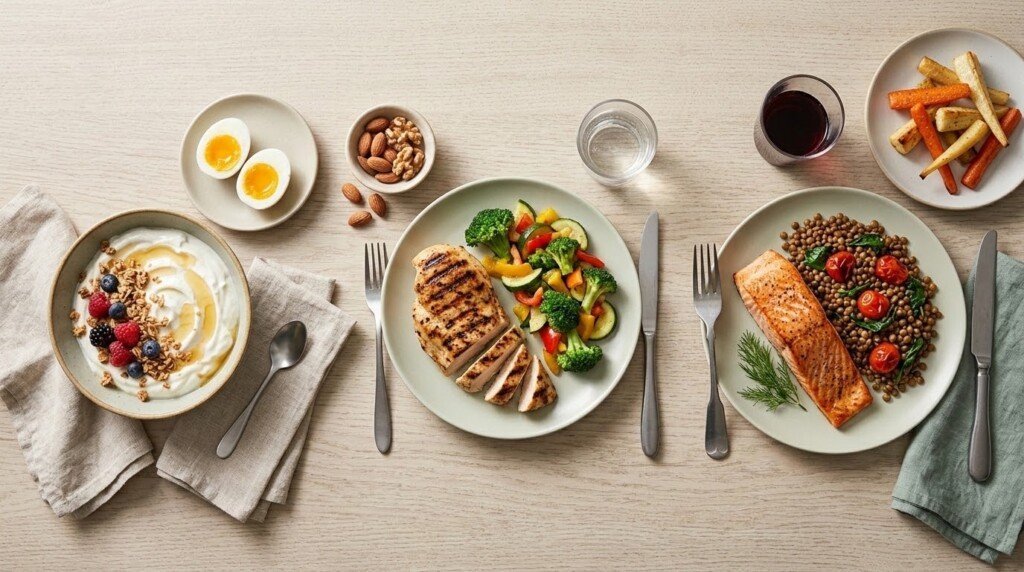
However, distributing protein across several meals can be a practical way to support muscle maintenance rather than eating almost all of it at dinner.
Consider two approaches.
Person A eats a small breakfast with 5 grams of protein, a light lunch with 10 grams, then consumes 95 grams at dinner.
Person B consumes approximately 30 to 35 grams at breakfast, lunch, and dinner, with a small protein-rich snack if needed.
Both may reach a similar daily total, but the second pattern gives the person more opportunities to include meaningful protein servings throughout the day.
Research on higher-protein diets during weight loss has supported daily intakes in the general range of 1.2 to 1.6 g/kg/day, with meal-level amounts often around 25 to 30 grams discussed as a practical target in adults.
That does not mean 30 grams is a magic threshold.
Your needs vary with body size.
A smaller adult may need less per meal, while a larger or highly active person may need more.
A simple strategy is to divide your daily target across three or four eating occasions.
If your goal is 120 grams per day, you could aim roughly for:
Breakfast: 30 grams
Lunch: 30 grams
Dinner: 40 grams
Snack: 20 grams
You do not have to hit those numbers exactly.
The point is to stop thinking of protein as something you “catch up on” at the end of the day.
Protein timing also becomes more practical around exercise.
A protein-containing meal or snack around training can fit comfortably into a muscle-preservation strategy, but you do not need to panic if you cannot consume protein immediately after your final repetition.
The entire day’s intake remains important.
This is particularly useful for people who have been influenced by the idea that missing a narrow post-workout window means their workout was wasted.
It does not.
If your daily protein intake is adequate and your overall diet supports your goals, there is no need to build your entire schedule around a stopwatch.
Do athletes need even more protein to prevent muscle loss?
Athletes have a different problem from the average dieter.
They are often trying to lose body fat while maintaining muscle, strength, training quality, recovery, and performance at the same time.
That makes aggressive dieting more complicated.
An athlete who reduces calories while continuing high-volume training is placing a substantial demand on the body. Protein becomes particularly important because the athlete is not simply trying to become lighter. They are trying to change body composition without sacrificing the physical qualities that matter for their sport.
For this reason, protein recommendations for athletes dieting to reduce body fat can be higher than those used for general adults.
A review focused specifically on athletes during weight loss proposed approximately 1.6 to 2.4 g/kg/day, with the appropriate point within that range depending partly on the size of the calorie deficit and the type and intensity of training.
That translates roughly to:
0.73 to 1.09 grams per pound per day.
For a 180-pound athlete, that would represent approximately:
131 to 196 grams per day.
That is a substantial amount of protein.
It also shows why copying an athlete’s diet simply because you want to lose weight is not necessarily sensible.
A recreational dieter who lifts weights three times per week does not automatically need nearly 200 grams of protein every day.
The more demanding your training and the more aggressive your deficit, the more useful the higher end of the range may become. But individual circumstances still matter.

What’s the recommended intake for people training intensely while in a deficit?
For people training intensely while deliberately reducing calories, a practical range of around 1.6 to 2.4 g/kg/day is often used in sports nutrition discussions, with the lower end more appropriate for some situations and the higher end potentially more useful when the calorie deficit is substantial or when preserving lean mass is especially important.
The number should not be viewed in isolation.
Suppose two athletes both weigh 80 kg.
Athlete A has a modest calorie deficit, performs moderate resistance training, and has plenty of time to recover.
Athlete B is preparing for a competition, has a larger energy deficit, trains intensely most days, and is already relatively lean.
Giving both athletes the exact same protein target because they weigh the same ignores the most important part of the situation.
The second athlete may have a stronger reason to move toward the upper end of the range.
Training volume also matters.
An endurance athlete may have high overall energy expenditure but different nutritional priorities from a strength athlete. A physique athlete cutting body fat may have a particularly strong focus on maintaining lean mass. A team-sport athlete may need to balance protein with sufficient carbohydrate to support repeated high-intensity efforts.
This is why athletes should not look at protein in isolation.
A high protein intake cannot rescue an athlete who is chronically under-fueled.
If carbohydrate intake is too low to support training, recovery may suffer even if protein is excellent.
Likewise, dietary fat cannot simply disappear because protein is important.
A successful calorie deficit is still a complete diet.
For recreational lifters, the practical answer is often much simpler.
Start around the general weight-loss range, assess your training demands, and move toward the higher end if your circumstances justify it.
There is no advantage in making your diet unnecessarily complicated.
Are there risks to consuming excessive protein?
More protein is not automatically better.
Once you are consuming enough protein to support your needs, adding substantially more may provide little additional benefit while taking calories away from other foods your body also needs.
This matters because a diet built around enormous protein servings can crowd out carbohydrates, fats, fruits, vegetables, whole grains, and other sources of important nutrients.
There is also a practical issue.
Protein contains calories.
Four calories per gram may sound insignificant, but adding 100 grams of protein beyond what you actually need adds roughly 400 calories. If you are trying to maintain a calorie deficit, that can make weight loss considerably harder.
So a person who believes “more protein means more fat loss” can accidentally undermine their own goal.
Protein is not a free food.
There are also medical situations where high protein intake should be approached cautiously. People with chronic kidney disease or other relevant medical conditions should discuss protein targets with their healthcare professional rather than adopting an aggressive high-protein diet independently.
For otherwise healthy adults, research has generally supported higher-protein diets within commonly studied ranges, but that is very different from claiming that unlimited protein is beneficial. The practical goal remains adequate protein, not maximum protein.
Another mistake is assuming that protein supplements are automatically healthier than whole foods.
They are not.
A protein powder is simply a convenient source of protein. It can be useful when your schedule, appetite, food preferences, or calorie budget make it difficult to reach your target through meals. But if you already meet your protein needs comfortably through normal foods, adding several shakes every day may accomplish very little.
The same applies to expensive protein products.
A higher price does not necessarily mean better muscle preservation.
Look at the actual protein content, serving size, ingredients, calories, and whether you can comfortably use the product as part of your normal diet.
For someone trying to lose weight, the best protein strategy is usually the one that can survive real life.
If you can consistently hit your target with chicken, fish, eggs, yogurt, tofu, beans, lentils, or other foods, there is no nutritional requirement to buy a supplement.
If a protein shake makes the difference between consistently reaching your target and repeatedly falling short, then the supplement has a practical purpose.
The broader goal is simple.
Lose body fat without treating muscle as disposable tissue.
Protein helps, but it is one part of that equation. The size of your calorie deficit, resistance training, overall diet quality, recovery, age, and starting body composition also influence what happens to lean mass during weight loss.
Think of protein as insurance rather than a guarantee.
It improves the conditions for muscle retention, but it cannot completely eliminate muscle loss if the overall weight-loss approach is poorly designed.
FAQ
1. How much protein do I need to prevent muscle loss?
A practical starting range for many adults losing weight is around 1.2 to 1.6 grams of protein per kilogram of body weight per day, or approximately 0.55 to 0.73 grams per pound. People who are older, leaner, resistance training regularly, or following a more demanding calorie deficit may have reason to use the higher end. Individual medical circumstances can change the appropriate target.
2. What are the best protein sources while dieting?
There is no single best source for everyone. Lean meat, poultry, fish, eggs, Greek yogurt, cottage cheese, milk, tofu, tempeh, beans, lentils, and other protein-rich foods can all contribute. Protein powder can also be useful when convenience makes it easier to reach your daily target, but it is not required if whole foods already provide enough protein.
3. Do athletes need more protein than average dieters?
Often, yes. Athletes trying to lose weight while maintaining performance and lean mass may benefit from higher protein intake than the average dieter. Sports nutrition research has proposed roughly 1.6 to 2.4 g/kg/day during weight loss for athletes, with the appropriate amount depending on factors such as training demands and calorie-deficit severity.
4. Is 1 gram of protein per pound necessary when losing weight?
Not for everyone. One gram per pound is about 2.2 g/kg, which falls toward or above the higher end of many weight-loss protein recommendations. Some lean, highly trained athletes may use intakes around this level, but most people do not need to automatically reach 1 gram per pound to preserve muscle.
5. Can eating too much protein stop weight loss?
It can make weight loss harder if the additional protein pushes your total calorie intake too high. Protein still contains calories, so increasing it without accounting for the rest of your diet can reduce or eliminate your calorie deficit. The goal is to consume enough protein to support muscle preservation while leaving room for a nutritionally balanced diet.
Disclaimer:
This post may contain affiliate links. If you purchase through them, we may earn a small commission at no extra cost to you. Also, this content is for informational purposes only and does not substitute professional medical advice.
Fuel Your Body Right
Use our free Nutrition Toolkit to find your protein target, fasting window, and net carbs in minutes.
Open Free Tools →