
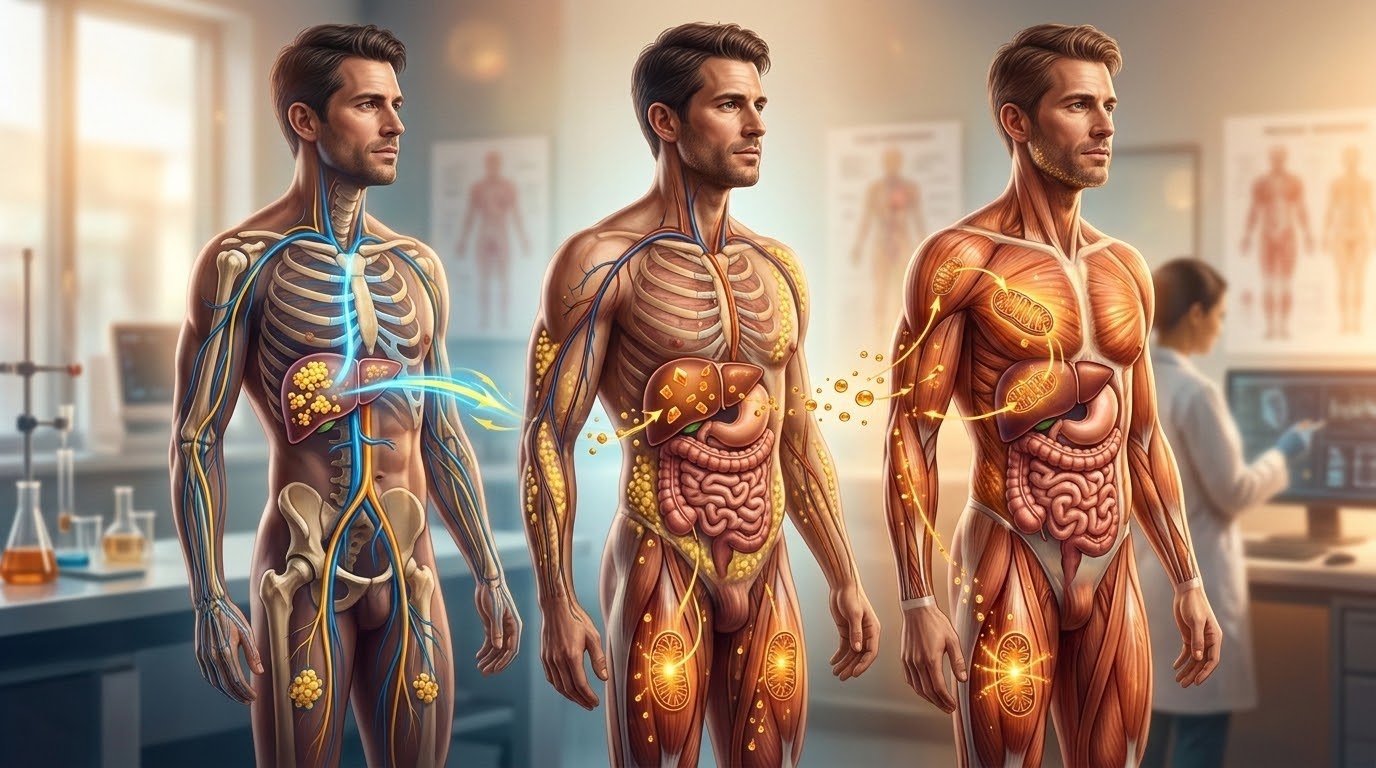
What Is Fat Adaptation? The Science of Becoming “Fat-Adapted”
If you have ever heard someone say they are “fat-adapted,” it can sound as if the body has permanently switched from burning carbohydrates to burning fat. That is not quite what happens.
Fat adaptation is a metabolic adjustment in which the body becomes better at using fat as a fuel source, particularly when carbohydrate availability is low. The change can involve greater fat oxidation, increased use of fatty acids by tissues, and greater production and use of ketone bodies. It is more specific than simply burning fat at a given moment. Your body burns some fat every day, even when carbohydrates are readily available. Fat adaptation describes a longer-term shift in how efficiently and readily the body can rely on fat.
This distinction matters because “burning fat” and being “fat-adapted” are not interchangeable ideas. A person can oxidize fat during an overnight fast or a long walk without being chronically adapted to a low-carbohydrate, high-fat eating pattern. In contrast, prolonged carbohydrate restriction can produce measurable changes in fuel utilization and fat oxidation. (PubMed Central (PMC))
That does not automatically make fat adaptation better, healthier, or necessary for everyone. The body is designed to use multiple fuels. Carbohydrates remain particularly useful when energy demands are high because carbohydrate metabolism can provide ATP at a faster rate than fat oxidation. Fat adaptation changes the balance. It does not eliminate the body’s ability or need to use carbohydrates.
The most useful way to understand fat adaptation is therefore not as a magical metabolic upgrade, but as a specific form of fuel-use adaptation.
What is fat adaptation?
Fat adaptation refers to a physiological state in which the body has adjusted to rely more heavily on fat as an energy source, especially during periods of low carbohydrate availability.
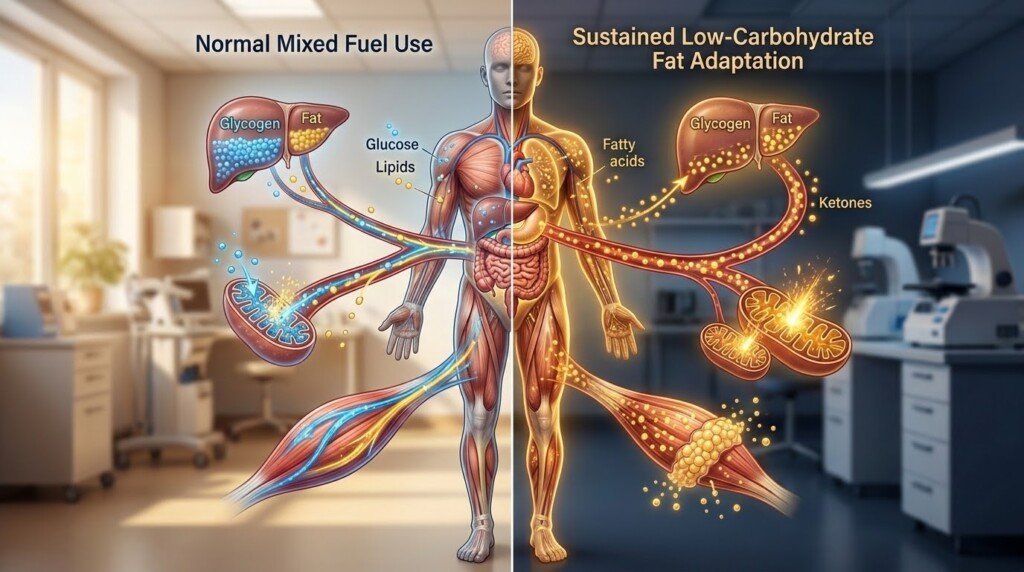
Under ordinary conditions, the body continually mixes fuels. Glucose, fatty acids, glycogen, and, depending on the circumstances, ketone bodies can all contribute to energy production. The proportion changes according to what you have eaten, how long it has been since your last meal, your activity level, hormone levels, training status, and other factors.
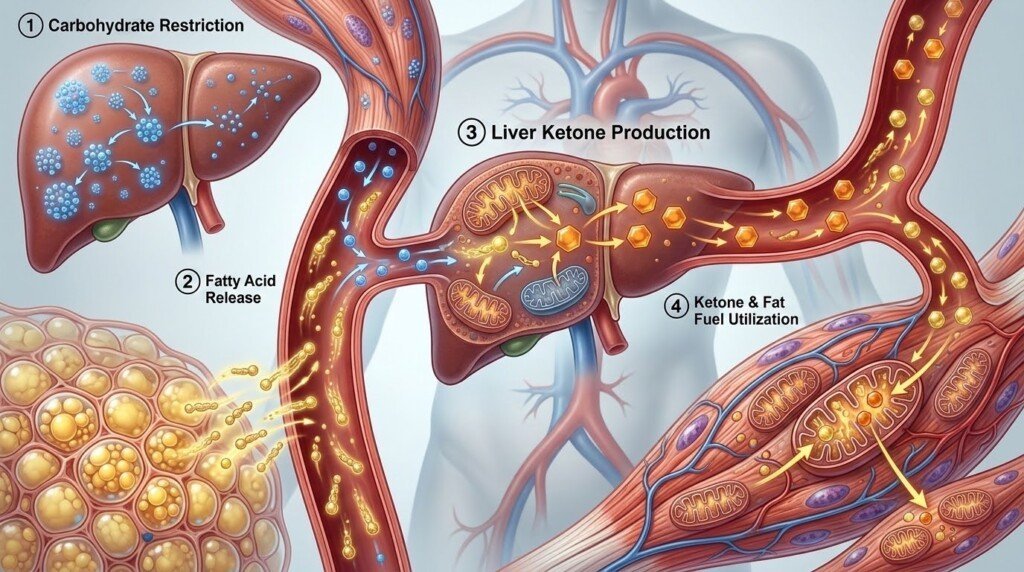
When carbohydrate availability falls substantially for long enough, the body has to respond. Liver and muscle glycogen availability changes, insulin levels generally fall, fatty acids become more available from stored triglycerides, and the liver increases ketone production. Tissues then become more accustomed to using fatty acids and ketones.
This is where the phrase “fat-adapted” comes from.
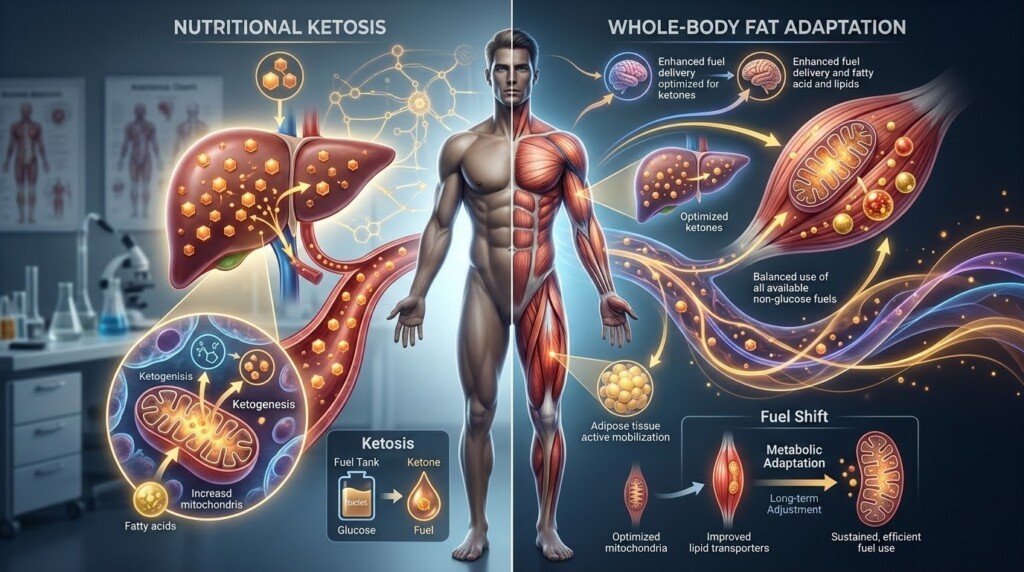
It is important, however, not to confuse fat adaptation with ketosis. Ketosis is a metabolic state characterized by increased ketone production and use. Fat adaptation is the broader process of physiological adjustment to greater reliance on fat-derived fuels. A person can enter ketosis relatively quickly after substantial carbohydrate restriction, while the wider adaptation process can continue beyond the initial appearance of ketones.
The difference becomes especially interesting during exercise. Research on ketogenic diets has consistently found that carbohydrate restriction can increase the body’s capacity to oxidize fat during steady-state exercise. In some studies, substantial changes in fat oxidation occurred within days, while longer adaptation periods produced additional metabolic changes.
So, in plain English, being fat-adapted means your metabolic machinery has become better prepared to use fat when carbohydrate availability is limited.
What are the key benefits of achieving fat adaptation?
The potential benefit of fat adaptation is greater access to a large energy reserve.
The human body stores relatively small amounts of carbohydrate compared with the amount of energy stored as body fat. Glycogen stored in the liver and muscles is limited, while adipose tissue can hold a much larger energy reserve. This difference is one reason fat is such an important long-term fuel source. (PubMed Central (PMC))
When someone becomes more efficient at mobilizing and oxidizing fat, the body can draw more heavily on that energy source during appropriate conditions. This can be particularly relevant during prolonged, lower-intensity exercise, when fat oxidation can contribute substantially to energy production.
Some people also report steadier energy while following a very low-carbohydrate eating pattern. That experience is plausible, but it should not be presented as a guaranteed effect of fat adaptation. Individual responses vary, and research does not establish that fat adaptation universally produces better day-to-day energy.
There is also an important distinction between increased fat oxidation and greater fat loss. Burning more fat during a particular workout does not automatically mean losing more body fat over time. Total energy intake, energy expenditure, body composition, activity, and dietary adherence still matter.
For athletes, the situation is even more complicated. Fat adaptation can substantially increase the capacity for fat oxidation, but that does not mean it automatically improves performance. High-intensity exercise relies heavily on carbohydrate because carbohydrate oxidation can generate energy more rapidly than fat oxidation. Research on ketogenic diets has therefore produced mixed results depending on the type and intensity of exercise being performed.
The practical takeaway is simple: fat adaptation can change fuel use, but changing fuel use is not the same thing as guaranteeing better health, greater weight loss, or superior athletic performance.
What physiological changes occur during the process?
The body does not flip a metabolic switch overnight.
Instead, several systems gradually adjust to reduced carbohydrate availability.
One of the earliest changes involves glycogen. When dietary carbohydrate is substantially restricted, the body’s readily available carbohydrate stores become less prominent as a fuel source. Insulin levels generally decrease, allowing greater mobilization of fatty acids from adipose tissue. The liver can then convert fatty acids into ketone bodies, which can be used by several tissues and become increasingly important as carbohydrate availability remains low.
Muscle metabolism also changes.
With continued carbohydrate restriction, skeletal muscle increases its capacity to oxidize fat. Enzymatic activity and other aspects of substrate utilization can shift toward greater fat use. Research in endurance athletes has demonstrated striking increases in fat oxidation after ketogenic dietary interventions.
The brain also has an important role. Long-chain fatty acids themselves cannot simply replace glucose as the brain’s primary circulating fuel. Instead, during substantial carbohydrate restriction, the liver produces ketone bodies that can cross the blood-brain barrier and provide an alternative fuel source. This is one reason ketosis becomes metabolically important during prolonged carbohydrate restriction.
These adaptations are useful because they allow the body to continue meeting energy demands when carbohydrate availability is reduced.
But adaptation has tradeoffs.
A body that becomes highly efficient at using fat may simultaneously reduce its reliance on carbohydrate oxidation during certain conditions. That can matter during intense exercise because carbohydrate can provide energy at a faster rate. One controlled study in elite endurance athletes found that ketogenic adaptation increased fat oxidation but also reduced exercise economy at intensities relevant to competition.
That is why the phrase “fat-adapted” should never be treated as synonymous with “metabolically superior.”
It means adapted for a particular fuel environment.
What foods best promote fat adaptation?
Fat adaptation is primarily driven by the body’s overall metabolic environment, especially carbohydrate availability, rather than by one special “fat-adapting” food.
A very low-carbohydrate, high-fat dietary pattern can create the conditions that promote ketosis and greater fat oxidation. Foods commonly used in ketogenic patterns include eggs, fish, meat, nuts, seeds, oils, avocados, and other foods naturally high in fat and relatively low in carbohydrate.
However, simply eating more fat does not automatically make someone fat-adapted.
A person could eat a high-fat diet while still consuming enough carbohydrate to prevent substantial ketosis. Conversely, someone can increase fat oxidation during fasting or prolonged exercise without following a ketogenic diet.
Food quality also matters. A diet designed around fat adaptation should not be reduced to “eat as much fat as possible.” Nutrient density, protein adequacy, fiber, micronutrients, total calorie intake, and individual health needs still matter.
This is one reason it is useful to separate the concept of fat adaptation from the specific ketogenic diet. The ketogenic diet is one method that can produce the metabolic conditions associated with fat adaptation, but the broader physiological concept is larger than a single diet.
How do I actually achieve fat adaptation?
If the goal is to become fat-adapted, the central requirement is creating enough sustained carbohydrate restriction for the body to increase its reliance on fat-derived fuels.
That does not mean the process should be approached as a race.
The body needs time to adjust. During the early period of carbohydrate restriction, some people experience fatigue, changes in exercise performance, headaches, gastrointestinal symptoms, or other effects. A recent review of ketogenic diet initiation found that early reductions in exercise capacity can occur during the transition period, while performance may normalize with continued adaptation in some settings.
The timeline is also not identical for everyone.
Some metabolic changes can occur surprisingly quickly. Research in elite athletes has found substantial increases in fat oxidation within approximately five to six days of a ketogenic low-carbohydrate, high-fat diet. Other changes may continue over weeks or longer.
This is why there is no single day when every person suddenly becomes “fat-adapted.”
The more useful question is whether the body has meaningfully shifted toward greater fat utilization under the conditions being tested.
What is the optimal macronutrient ratio for fat adaptation?
There is no universal macronutrient ratio that guarantees fat adaptation for every person.
Ketogenic diets commonly use very low carbohydrate intake, relatively high fat intake, and moderate protein intake. One commonly described ketogenic pattern contains roughly 70% to 80% of calories from fat, 10% to 20% from protein, and 5% to 10% from carbohydrate. (Cleveland Clinic)
Those numbers are useful for understanding what a conventional ketogenic diet looks like, but they should not be interpreted as a prescription for everyone.
Protein deserves particular attention because it serves structural and functional roles beyond energy production. Exercise level, body size, age, health status, and dietary goals can all affect appropriate protein intake.
Carbohydrate requirements also vary enormously. Someone training for repeated high-intensity efforts may have very different carbohydrate needs from someone who is sedentary and primarily interested in nutritional ketosis.
For readers interested specifically in how ketogenic eating patterns create the conditions for fat adaptation, the dedicated ketogenic diet and fat adaptation article can go deeper into the dietary approach without confusing the broader concept of fat adaptation with the diet itself.
The key point is that carbohydrate restriction is the primary nutritional lever. Adding large amounts of dietary fat without sufficiently reducing carbohydrate availability does not create the same metabolic environment.
How can I measure or confirm that I’ve become fat-adapted?
There is no single home test that can definitively stamp someone as “fat-adapted.”
Blood ketone measurements can confirm nutritional ketosis, but ketosis and complete fat adaptation are not identical. Someone may produce ketones while still undergoing broader metabolic adjustments. (Cleveland Clinic)
Researchers can assess substrate utilization more directly through methods such as indirect calorimetry, which estimates whether someone is relying more heavily on carbohydrate or fat during a particular condition.
For everyday readers, the more useful question is often whether the expected metabolic changes are occurring consistently rather than whether a single ketone reading has crossed a particular number.
A person may also notice changes in hunger, exercise tolerance, energy patterns, or ability to maintain activity without frequent carbohydrate intake. These observations can provide context, but they are not proof of fat adaptation by themselves.
The cluster’s article on signs of fat adaptation is the better place to explore those practical indicators in detail.
Why does fat adaptation feel different from simply burning fat?
This is one of the most important distinctions in the entire topic.
Your body burns fat right now.
Even after eating a carbohydrate-containing meal, your body does not suddenly stop oxidizing fat. Fuel use is constantly mixed and adjusted according to energy availability, insulin, activity, hormones, and tissue demands.
Imagine two people walking at the same comfortable pace.
Both may be burning some fat.
That does not mean both are fat-adapted.
The difference is that fat adaptation describes a broader capacity to rely on fat as a major fuel source when carbohydrate availability is low. It involves changes in substrate oxidation and metabolic machinery that occur over time.
Think of ordinary fat burning as using a particular fuel.
Think of fat adaptation as becoming better equipped to run on that fuel when the circumstances require it.
That distinction prevents one of the most common misunderstandings in nutrition content: assuming that any increase in fat oxidation means someone has become “fat-adapted.”
It does not.
Does fat adaptation mean the body stops using carbohydrates?
No.
This is another popular oversimplification.
Even someone who has followed a ketogenic diet for a long time retains the ability to use carbohydrate. The body can make glucose through gluconeogenesis, and carbohydrate metabolism remains important for certain tissues and exercise demands.
In fact, high-intensity exercise presents a particularly important limitation to the idea that fat is always the superior fuel.
Fat oxidation is slower in terms of maximum ATP production than carbohydrate oxidation. As exercise intensity rises, the body’s reliance on carbohydrate generally increases because it needs energy at a faster rate. (PubMed Central (PMC))
This means a fat-adapted athlete may have an impressive ability to oxidize fat during prolonged, steady-state exercise while still relying heavily on carbohydrate during short, intense efforts.
The body is not choosing a permanent winner.
It is choosing the fuel that best matches the demand.
That is also why fat adaptation fits naturally into the broader concept of metabolic flexibility. A healthy metabolism needs to respond to changing circumstances rather than stubbornly rely on one fuel at all times.
Can fat adaptation help with weight loss?
Potentially, but this needs a much more careful answer than “fat-adapted means fat loss.”
Increasing fat oxidation does not automatically produce greater long-term body-fat loss.
Suppose your body burns more fat during a workout. If your overall energy intake also increases enough to compensate, the net change in stored body fat may be small or nonexistent.
Ketogenic diets can produce weight loss in some populations, but the mechanism is not simply “your body burns fat, therefore your body fat disappears.” Appetite changes, spontaneous energy intake, water loss, dietary adherence, food choices, and total energy balance can all contribute.
Early weight loss during carbohydrate restriction can also include substantial changes in body water because glycogen is stored with water. This can make the scale move quickly at first without representing an equivalent amount of body-fat loss.
Fat adaptation may therefore be relevant to weight management, but it should not be sold as a shortcut.
The more important question is whether a person’s overall dietary pattern is sustainable, nutritionally adequate, and appropriate for their goals.

What happens when carbohydrates are added back after fat adaptation?
The metabolic system responds.
A person who has been following a ketogenic diet may continue to show elevated fat oxidation for a period after carbohydrate intake increases, but the balance of fuel use shifts. Research has shown that reintroducing carbohydrates can lower fat oxidation, while some adaptations may persist temporarily.
This is another reason to avoid thinking of fat adaptation as a permanent state.
Metabolism remains responsive.
If carbohydrate availability rises consistently, carbohydrate oxidation becomes more prominent again. If carbohydrate availability falls substantially, fat oxidation and ketone production can rise again.
The body is constantly adjusting.
That responsiveness is not a failure of fat adaptation. It is normal physiology.
Is fat adaptation useful for everyone?
No.
There is no physiological requirement for every healthy person to become fat-adapted.
Some people may find a low-carbohydrate approach useful for appetite control, dietary preference, endurance training, or specific medical purposes under professional supervision. Others may feel better, train better, or find greater dietary flexibility with a higher carbohydrate intake.
Athletes deserve particular caution because the type of exercise matters.
A ketogenic diet can increase fat oxidation substantially, yet evidence does not show a universal performance advantage. A recent International Society of Sports Nutrition position stand notes that ketogenic diets increase fat oxidation, but performance responses vary and carbohydrate metabolism remains important for high-intensity work.
For someone whose training involves repeated sprints, explosive lifting, high-intensity intervals, or competition requiring rapid energy production, aggressively restricting carbohydrate may create problems rather than solve them.
For someone primarily interested in metabolic health, the answer is equally individual.
Fat adaptation is a metabolic adaptation, not a health score.
What is the difference between fat adaptation and ketosis?
The two concepts overlap, but they are not identical.
Ketosis refers to a metabolic state in which ketone production rises enough for ketone bodies to become an important circulating fuel. This commonly happens when carbohydrate availability is substantially reduced, during fasting, or with prolonged carbohydrate restriction.
Fat adaptation refers to the broader physiological adjustment toward greater reliance on fat-derived fuels.
Ketosis can occur relatively quickly. Broader adaptations to sustained carbohydrate restriction can continue beyond the initial rise in ketones.
This distinction is particularly important because someone can measure a ketone level and assume that the number proves complete metabolic adaptation. It does not.
A ketone meter tells you about ketones.
It does not directly measure every adaptation taking place in muscle, liver, adipose tissue, and other organs.
What are the potential downsides of trying to become fat-adapted?
Fat adaptation itself is not necessarily harmful, but the dietary strategy used to achieve it can create challenges.
A very restrictive ketogenic diet may make it harder to consume certain carbohydrate-rich foods that also provide fiber, vitamins, minerals, and beneficial plant compounds. It can also be difficult to sustain socially and practically.
Some people experience digestive changes, fatigue, headaches, or reduced exercise performance during the transition. These effects vary, and they should not simply be dismissed as proof that the diet is “working.”
There are also situations where ketogenic diets require medical supervision or may not be appropriate.
People with diabetes, especially those using medications that can cause hypoglycemia, should not make major carbohydrate changes casually. People with certain medical conditions or those taking specific medications should discuss significant dietary changes with a healthcare professional.
And there is an important safety distinction between nutritional ketosis and diabetic ketoacidosis. Nutritional ketosis is a normal metabolic state. Diabetic ketoacidosis is a dangerous medical emergency involving severe metabolic disturbance and requires urgent treatment. (Cleveland Clinic)
That distinction should never be blurred in weight-loss content.
How long does it take to become fat-adapted?
There is no universal timeline.
Some components of the adaptation can occur rapidly. Studies in trained athletes have found large changes in fat oxidation within several days of adopting a ketogenic low-carbohydrate, high-fat diet. Other physiological adaptations can continue over several weeks. (PubMed Central (PMC))
This creates an important distinction between entering ketosis and becoming fully adapted.
A person may enter nutritional ketosis within a few days of substantial carbohydrate restriction, while changes in exercise performance, fuel utilization, appetite, and other physiological responses may take longer and vary considerably between individuals. Cleveland Clinic notes that ketosis itself can commonly occur within roughly two to four days when carbohydrate intake is very low, although individual responses differ. (Cleveland Clinic)
If you are interested specifically in the timing question, the article on how long it takes to become fat-adapted should be treated separately from this foundational explanation.
The important lesson is that adaptation is a process, not a switch that flips at midnight on a particular day.
What does being fat-adapted actually mean in everyday life?
Strip away the nutrition jargon and the concept becomes fairly straightforward.
A fat-adapted body has become better prepared to use fat as a major fuel source when carbohydrate availability is low.
That can involve:
- greater fat oxidation
- greater fatty-acid availability
- increased ketone production during carbohydrate restriction
- increased ability of tissues to use fat-derived fuels
- changes in how carbohydrate and fat are prioritized during exercise
It does not mean:
- you burn only fat
- carbohydrates become useless
- you automatically lose body fat
- you can eat unlimited calories without gaining weight
- ketosis proves perfect metabolic health
- everyone should follow a ketogenic diet
Those distinctions are more important than the label itself.
The bigger picture: fat adaptation is about fuel availability, not metabolic superiority
The most useful way to think about fat adaptation is as a response to a particular nutritional environment.
When carbohydrate availability is consistently low, the body adjusts. Fat becomes more prominent as a fuel, the liver increases ketone production, and tissues become better equipped to use those fuels.
That is an impressive example of human metabolic adaptability.
But the same physiology also explains why the adaptation should not be romanticized.
The body evolved to handle changing fuel availability. It can use carbohydrates when they are plentiful, increase fat use when carbohydrate availability falls, produce ketones when necessary, and change fuel selection according to energy demand.
The goal is not to force the body into one fuel state forever.
The goal is to understand what is actually happening.
For some people, fat adaptation may be a useful physiological adaptation within a carefully chosen dietary approach. For others, pursuing it may offer little practical advantage and may make eating or training unnecessarily restrictive.
The difference comes down to context.
And that is the part often missing from simplistic “fat-burning” claims.
Frequently Asked Questions
1. What is fat adaptation?
Fat adaptation is a physiological adjustment in which the body becomes better at using fat as an energy source, particularly when carbohydrate availability is consistently low. It involves changes in fat oxidation, fatty-acid use, and ketone production. It is broader than simply burning fat during a workout or overnight fast.
2. What does it mean to be “fat-adapted”?
Being “fat-adapted” means the body has undergone metabolic changes that increase its capacity to rely on fat-derived fuels. It does not mean the body stops using carbohydrates or that a person will automatically lose more body fat.
3. What are the benefits of fat adaptation?
Potential benefits include greater capacity for fat oxidation and increased ability to rely on stored or dietary fat during periods of low carbohydrate availability. This may be relevant to some endurance athletes and people following ketogenic diets, but it does not guarantee better health, weight loss, or exercise performance.
4. Is fat adaptation the same as ketosis?
No. Ketosis is a metabolic state involving elevated ketone production and use. Fat adaptation describes a broader physiological adjustment toward greater reliance on fat-derived fuels. A person can enter ketosis before the full range of metabolic adaptations has occurred.
5. Does everyone need to become fat-adapted?
No. Fat adaptation is not a requirement for good health or successful weight management. Whether it is useful depends on a person’s goals, dietary preferences, exercise demands, health status, and ability to sustain the approach safely.
Disclaimer:
This post may contain affiliate links. If you purchase through them, we may earn a small commission at no extra cost to you. Also, this content is for informational purposes only and does not substitute professional medical advice.
Fuel Your Body Right
Use our free Nutrition Toolkit to find your protein target, fasting window, and net carbs in minutes.
Open Free Tools →