Cialis vs. Viagra: Which Is Right for You?
If you are comparing Cialis vs. Viagra, the biggest mistake is treating them like two versions of the same pill. They belong to the same medication family and work through a similar biological pathway, but the experience can be quite different.
Cialis contains tadalafil. Viagra contains sildenafil. Both are prescription phosphodiesterase type 5, or PDE5, inhibitors used to treat erectile dysfunction. Both help improve blood flow to the penis when sexual stimulation is present. Neither medication creates an erection simply because you swallowed a tablet. (DailyMed)
The practical difference comes down to timing, duration, flexibility, side effects, other medications, and what you want from treatment.
Cialis is often attractive to men who do not want to plan sexual activity around a relatively short medication window. Viagra may appeal to someone who prefers an established on-demand option and does not need that longer window.
Neither is automatically “better.” The right choice depends on the individual.
It is also important to clear up something before getting into the comparison: neither drug permanently increases penis size. A medication that produces a fuller erection can sometimes make the penis look or feel larger than it does during an incomplete erection, but that is a change in erect fullness, not new tissue growth.
Both medications are prescription treatments, and both have important cardiovascular and drug-interaction considerations. That makes choosing between them something to discuss with a healthcare professional rather than a simple matter of picking the stronger-sounding dose.
What’s the core difference between Cialis and Viagra?
The simplest comparison is this:
Cialis uses tadalafil and is known for a much longer window of erectile-function support. Viagra uses sildenafil and generally has a shorter on-demand window.
Both medications inhibit PDE5. This allows more cGMP to remain active in penile erectile tissue, helping smooth muscle relax and allowing increased blood flow when sexual stimulation occurs.
The important point is that their basic mechanism is similar. Their practical profiles are not identical.
That difference is why one man may strongly prefer Cialis while another is perfectly satisfied with Viagra.

Onset time compared
Neither Cialis nor Viagra should be thought of as an instant erection switch.
For Viagra, the usual recommended dose is taken approximately one hour before sexual activity, although the prescribing information allows administration from 30 minutes to four hours before sexual activity. The usual starting dose is 50 mg, with adjustment according to effectiveness and tolerability. (DailyMed)
Cialis has a slightly different approach. For as-needed treatment, the current prescribing information recommends a 10 mg starting dose, which may be increased to 20 mg or reduced to 5 mg based on effectiveness and tolerability. Patients are instructed to take it at least 30 minutes before anticipated sexual activity.
This does not mean Cialis necessarily produces an erection faster for every man.
It means tadalafil’s pharmacological profile gives it a much longer period during which erectile function can be improved.
Food can also matter differently. Viagra can be affected by a high-fat meal, which can delay absorption. Cialis can be taken without regard to food.
For someone who regularly eats a large meal before going out, that difference can be surprisingly practical.
Duration compared
This is where the two medications become much easier to distinguish.
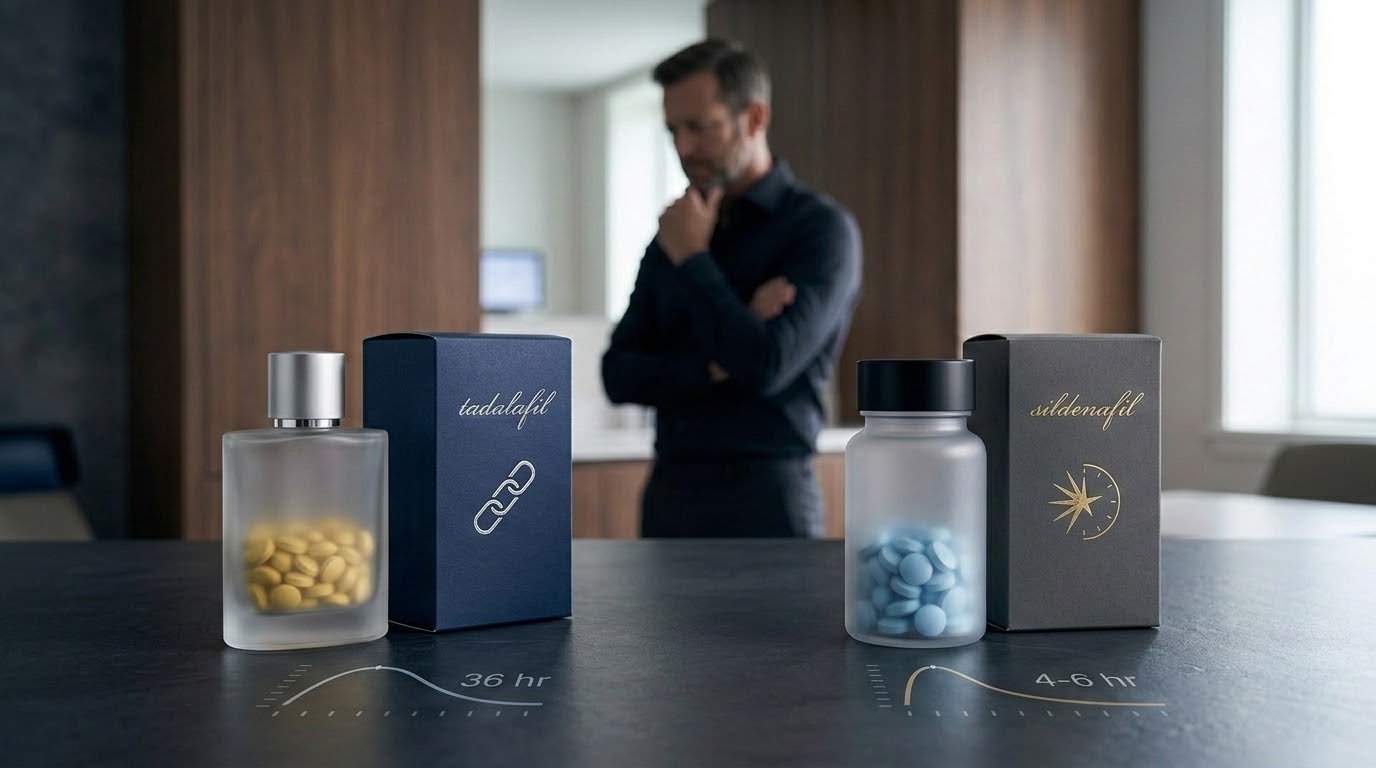
Cialis has an approved as-needed effect that can improve erectile function for up to 36 hours after dosing. That does not mean you have an erection for 36 hours. It means the medication can continue helping erectile function during that period when sexual stimulation occurs.
Viagra has a substantially shorter functional window. The AUA guideline describes sildenafil’s duration of action as up to approximately 12 hours, compared with up to 36 hours for tadalafil. (American Urological Association)
That difference changes the experience.
Imagine two men planning a weekend with their partners.
One knows approximately when sex is likely to happen and is comfortable taking a medication beforehand. Viagra may fit that pattern well.
Another dislikes having to think, “I need to take my pill around this time.” For him, Cialis may feel more natural because the longer window provides more flexibility.
This is one reason the nickname “the weekend pill” became associated with tadalafil. The important distinction is that the longer window is not the same thing as a continuous erection.
The medication still requires sexual stimulation.
Why do some men prefer Cialis over Viagra?
The answer usually has less to do with one medication being universally stronger and more to do with freedom from timing.
Some men prefer Cialis because the longer duration gives them a larger window in which sexual activity can occur. Instead of feeling that the medication has to be coordinated closely with a specific moment, tadalafil can provide a broader opportunity for erectile support.
That can matter psychologically as well as practically.
Sex does not always happen according to schedule. Dinner can run late. Plans can change. A couple may decide to have sex spontaneously rather than at the exact time originally expected.
For some men with ED, having to plan around medication can become another source of pressure. A longer medication window can reduce that sense of a countdown.
There is another reason tadalafil may be attractive: it has an FDA-approved once-daily option for erectile dysfunction. The current Cialis label lists 2.5 mg once daily as the starting dose, with the possibility of increasing to 5 mg depending on effectiveness and tolerability. (DailyMed)
That is different from Viagra’s standard on-demand approach.
However, daily tadalafil should not be confused with simply taking a large dose every day. The dosing strategy is different, and the appropriate dose depends on the individual.
The AUA guideline also notes that the commonly used PDE5 inhibitors have broadly similar efficacy in the general ED population. In other words, the available evidence does not support the simplistic idea that Cialis is always more powerful than Viagra or that Viagra is automatically weaker.
What often differs is the experience of using them.
A man who values spontaneity may prefer tadalafil.
A man who prefers a shorter, more clearly defined treatment window may prefer sildenafil.
Someone who finds one medication’s side effects troublesome may do better with the other.
And some men simply respond better to one PDE5 inhibitor than another.
That last point matters because ED treatment is not a bodybuilding competition where the highest dose wins.
If your problem is not simply erection quality but also uncertainty about why erections have changed, the broader picture matters. For example, Why Isn’t My Erection as Hard as Before? looks at physical and psychological factors that can contribute to declining firmness.
The medication can help the erection. It does not automatically explain why the erection became difficult in the first place.
Which is safer for the heart?
This is one of the most important questions to answer carefully because “Cialis is safer for your heart” is too broad to be medically responsible.
Neither Cialis nor Viagra should be considered universally safer for the heart.
Both tadalafil and sildenafil are PDE5 inhibitors, and both can lower blood pressure to some degree because of their vasodilating effects. More importantly, both are contraindicated with nitrate medications because the combination can cause a dangerous drop in blood pressure.
Nitrates include medications used to treat angina and other heart-related conditions. This is not an interaction to experiment with.
If someone takes nitroglycerin or another nitrate, they should not simply choose Viagra because they heard it is “shorter acting” or choose Cialis because they heard it is “gentler.” The issue requires medical assessment.
The cardiovascular question also goes beyond drug interactions.
Sexual activity itself places a cardiovascular demand on the body. The current Cialis prescribing information says physicians should consider a patient’s cardiovascular status before prescribing because there is cardiac risk associated with sexual activity in some men.
That means the right question is not:
“Which pill is safer for the heart?”
A better question is:
“Is sexual activity medically appropriate for me, and which ED medication fits my health and other medications?”
That distinction is much more useful.
Both medications can also interact with drugs that lower blood pressure, including alpha-blockers, and both have additional medication-specific considerations. The current Cialis label specifically warns about interactions involving nitrates, alpha-blockers, antihypertensive medications, CYP3A4 inhibitors, and certain other drugs. (DailyMed)
Viagra also carries warnings regarding blood-pressure-lowering medications and alpha-blockers.
Alcohol can complicate the picture too, particularly because substantial alcohol consumption can contribute to dizziness or blood-pressure effects and can independently make erections more difficult.
This is why “which is safer?” cannot be answered properly by comparing two brand names in isolation.
Your medical history matters.
Your other medications matter.
Your blood-pressure status matters.
Your cardiovascular health matters.
And the reason you are experiencing ED matters.
There is also a difference in how long tadalafil remains relevant to drug interactions because of its longer pharmacological activity. The Cialis prescribing information specifically highlights its prolonged presence and the importance of considering interactions, particularly with nitrate use.
For anyone with significant cardiovascular disease, recent cardiovascular events, unexplained chest pain, or medications that may interact with PDE5 inhibitors, this is a doctor conversation, not a trial-and-error purchase.
If you have been told that sexual activity itself is unsafe because of your cardiovascular condition, neither Cialis nor Viagra is a workaround.

Does Cialis make you “bigger,” or just firmer?
Cialis does not permanently make the penis bigger.
The same applies to Viagra.
Both medications work primarily by improving the blood-flow response involved in achieving and maintaining an erection. They do not stimulate permanent growth of penile tissue.
So why do some men say they look bigger on Cialis?
The answer is usually fullness.
An erection is not simply an on-or-off event. There can be a substantial difference between a partial erection and a fully engorged erection. If someone has previously been experiencing erections that were only partly firm, a successful response to tadalafil may make the penis appear fuller, harder, or closer to its individual’s maximum erect size.
That can create the impression that the medication increased size.
It did not create new tissue.
It helped the existing erectile tissue reach a more complete state of engorgement.
The same explanation applies to Viagra.
This is why a man who compares a partially erect penis before treatment with a fully erect penis after treatment may conclude that the drug “made him bigger.” The comparison is not really measuring permanent anatomical size.
The medication’s purpose is erection quality.
This distinction is important because chasing a supposed size-enhancement effect can lead men toward unsafe or unproven products that have nothing to do with established ED treatment.
If your concern is that your erections have become less firm than they used to be, the more useful question is not whether you can make the penis larger. It is why you are not reaching your previous level of erectile firmness.
That can involve vascular health, medications, psychological factors, hormonal issues, lifestyle factors, or a combination of several things.
A PDE5 inhibitor can improve the erection response, but it does not necessarily remove the underlying cause of ED.

Why firmness can look like size
Think about filling a balloon.
A partially filled balloon and a fully inflated balloon do not contain different material. The difference is how completely they are expanded.
Erectile tissue behaves differently from a balloon, but the analogy illustrates the basic perception problem.
When blood flow and smooth-muscle relaxation produce a more complete erection, the penis may reach a larger-looking erect state than it does during a weak or incomplete erection.
That is a perceived size increase caused by fuller erection, not anatomical enlargement.
This is also why taking more medication than prescribed is not a sensible way to chase a bigger-looking erection.
More is not automatically better.
Higher PDE5 inhibitor doses can increase the likelihood of adverse effects without producing a proportional improvement in erectile function.
The same principle applies to the question of whether a particular Cialis dose is “stronger” than a particular Viagra dose.
Is 20mg Cialis as strong as 100mg Viagra?
No, you cannot compare them by simply looking at the numbers.
20 mg of tadalafil is not equivalent to 100 mg of sildenafil.
They are different active ingredients with different pharmacokinetic profiles, dosing ranges, and clinical characteristics. Milligrams describe the amount of that specific drug. They do not provide a universal measure of how “strong” an ED medication is.
This is one of the most common mistakes in online comparisons.
Someone sees:
Cialis: 20 mg
Viagra: 100 mg
and assumes the 100 mg tablet must be five times stronger.
That calculation has no clinical meaning.
The current Cialis label lists 5 mg, 10 mg, and 20 mg tablet strengths, with 10 mg generally used as the starting as-needed dose for ED and adjustment based on response and tolerability. (DailyMed)
The Viagra label lists 25 mg, 50 mg, and 100 mg strengths, with 50 mg as the usual recommended dose for most patients and adjustment based on effectiveness and toleration.
These dose ranges reflect the pharmacology of each medication, not a shared strength scale.
The better comparison is what each medication does at an appropriately prescribed dose for a particular patient.
That also explains why a doctor might prescribe 5 or 10 mg tadalafil to one man and 50 mg sildenafil to another. The decision can involve age, kidney or liver function, other medications, side effects, frequency of sexual activity, response to previous treatment, and other health factors.
The goal is not to find the biggest number.
The goal is to find an effective dose that provides acceptable erectile function without unnecessary adverse effects.
For men who are interested in duration specifically, How Long Does Cialis Last? goes deeper into tadalafil’s longer action without confusing duration with the strength of an erection.
There is another important point: neither medication works without sexual stimulation.
A PDE5 inhibitor improves the body’s physiological response to sexual stimulation. It does not manufacture sexual desire and does not force an erection regardless of circumstances.
That matters because a man may take a pill, become frustrated when nothing happens immediately, and assume the medication is too weak.
The issue may instead be timing, insufficient stimulation, incorrect use, expectations, or an underlying condition affecting response.
So which one makes more sense?
There is no universal winner in the Cialis vs. Viagra debate.
Cialis may make more sense for someone who values:
- A longer window for sexual activity
- Less pressure around exact timing
- The option of once-daily tadalafil under medical supervision
- A medication that can be taken without regard to food
Viagra may make more sense for someone who values:
- A familiar on-demand treatment approach
- A shorter medication window
- Planning sexual activity around a specific occasion
- Sildenafil specifically because of previous response or tolerability
Those are practical differences, not a declaration that one drug is medically superior for everyone.
Both have similar core mechanisms. Both are established ED treatments. Both have important contraindications. Both can cause side effects. And both require a prescription in the United States.
The best choice is therefore usually the medication that matches your health profile and the way you actually live.
If you are taking nitrates, have significant cardiovascular disease, use alpha-blockers, take multiple medications, or have unexplained ED, talk with a healthcare professional before using either medication.
And if you are considering buying ED medication online, verify that it comes from a legitimate prescription pathway. The question of access is separate from the physiological comparison, which is why Is Cialis Available Over the Counter? addresses that issue separately.
FAQ: Cialis vs. Viagra
1. Why do men prefer Cialis over Viagra?
Many men prefer Cialis because tadalafil can improve erectile function for up to 36 hours after an as-needed dose, giving more flexibility around when sex happens. Cialis also has an approved once-daily option. That does not mean it works better for everyone. Individual response, side effects, health conditions, and medication interactions all matter.
2. Is Cialis better for your heart than Viagra?
Neither should be considered universally better or safer for the heart. Both are PDE5 inhibitors and both are contraindicated with nitrate medications because the combination can cause a dangerous drop in blood pressure. Cardiovascular health and the safety of sexual activity should be considered before either medication is prescribed.
3. Does Cialis make you bigger?
No. Cialis does not permanently increase penis size. By improving blood flow and erection firmness, it may allow a man to reach a fuller erection than he could achieve without treatment. That can make the penis appear larger compared with a partial erection, but it is not permanent tissue enlargement.
4. Is 20mg Cialis as strong as 100mg Viagra?
There is no valid milligram-for-milligram comparison between the two. Tadalafil and sildenafil are different medications with different pharmacological properties and dosing ranges. A 20 mg tadalafil dose is not equivalent to 100 mg sildenafil simply because the numbers are different. The appropriate dose should be determined by effectiveness, tolerability, health status, and other medications.
5. Which is better, Cialis or Viagra?
Neither is automatically better. Cialis generally offers the longer window and more flexibility, while Viagra is a well-established on-demand option with a shorter duration. For many men, the practical question is which medication provides reliable erections with acceptable side effects and fits their health profile. A clinician can help determine which option is appropriate.
Disclaimer:
This post may contain affiliate links. If you purchase through them, we may earn a small commission at no extra cost to you. Also, this content is for informational purposes only and does not substitute professional medical advice.
Know Your Body Better
Use our free tools to track your cycle, find your fertile window, estimate your due date, and more.
Open Free Tools →