
What Factors Influence VO2 Max?
The factors that influence VO2 max are more complicated than simply asking whether someone is fit or unfit. Your VO2 max reflects the combined ability of your lungs, heart, blood, blood vessels, and working muscles to move oxygen from the air into your tissues and use it to produce energy.
That is why two people who exercise for a similar amount of time can have noticeably different VO2 max values. One person may have a larger cardiac output, another may have better-developed skeletal muscle adaptations, and another may simply have a different genetic starting point.
The important thing is that VO2 max is not controlled by one body part.
It is better understood as a chain.
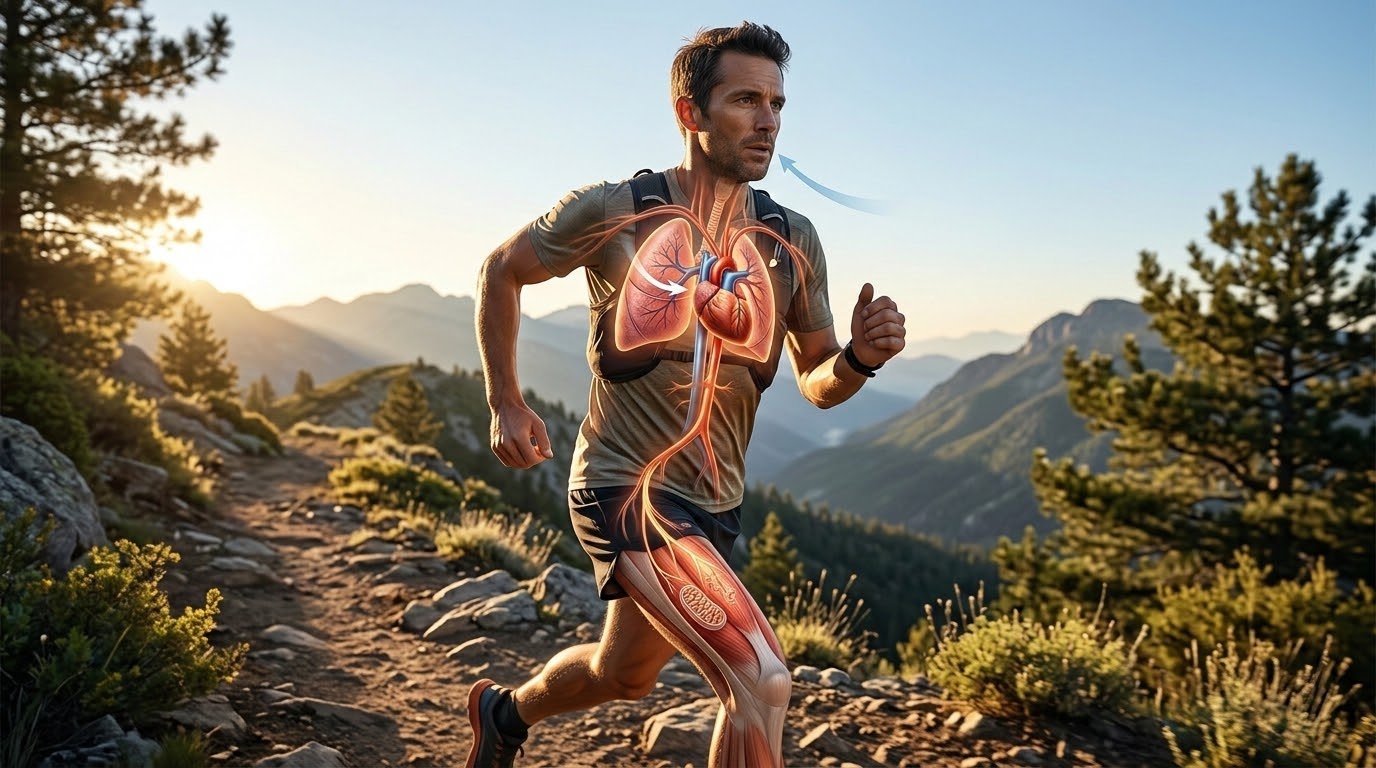
Oxygen has to enter the lungs, move into the bloodstream, travel through the cardiovascular system, reach the working muscles, and ultimately be used by mitochondria inside those muscles. If one part of that chain becomes a limiting factor, the maximum amount of oxygen the body can use can be affected.
This also explains why genetics matter without determining your entire fitness future. Research has found substantial genetic influence on VO2 max and on how much individuals respond to exercise, but studies have not identified a simple set of genes that can accurately predict someone’s final aerobic potential. (PubMed)
What physiological factors determine VO2 Max?
VO2 max is the result of several physiological systems working together at their upper limits. Your cardiovascular system, respiratory system, blood, skeletal muscles, and cellular energy machinery all contribute.
It is tempting to ask which one is most important, but that question oversimplifies what is happening.
During intense exercise, oxygen delivery behaves more like a connected system than a collection of independent parts. The lungs need to bring oxygen into the body, the heart needs to circulate oxygen-rich blood, the blood needs to transport it, and the muscles need to extract and use it.
A weakness or limitation anywhere along that pathway can influence the final result.
This is one reason someone can have healthy lungs but a relatively modest VO2 max, or strong muscles but limited aerobic capacity.
Your maximum oxygen consumption is ultimately a whole-body performance.

How does the cardiovascular system contribute to VO2 Max?
The cardiovascular system plays a central role because oxygen cannot reach working muscles unless oxygenated blood is transported there efficiently.
When you exercise, your heart rate rises and your heart pumps more blood with each minute. This increases cardiac output, which is the amount of blood your heart moves through the circulation each minute.
That increased blood flow is essential because your muscles suddenly need much more oxygen than they do at rest.
Think about what happens when you begin running.
Your leg muscles start contracting repeatedly. Their energy requirements rise. They need more oxygen and nutrients, and they produce more metabolic byproducts that need to be managed. Your cardiovascular system responds by increasing blood flow.
Your heart beats faster.
The amount of blood pumped with each beat can increase.
Blood vessels supplying active muscles widen.
More oxygenated blood reaches the tissues that need it most.
At high exercise intensities, these processes are pushed toward their limits. The cardiovascular system therefore becomes a major part of determining how much oxygen can ultimately reach the muscles.
Cardiac output is particularly important because even if your blood contains plenty of oxygen, that oxygen cannot be delivered at a high rate without sufficient circulation.
This is one reason aerobic training can change VO2 max. Repeated endurance exercise can produce adaptations throughout the cardiovascular system, including changes that allow the body to deliver and utilize oxygen more effectively.
However, cardiovascular fitness is not simply about having a low resting heart rate.
A person can have a relatively low resting heart rate without necessarily having an exceptional VO2 max. Resting measurements and maximal exercise capacity are related to cardiovascular function, but they are not interchangeable.
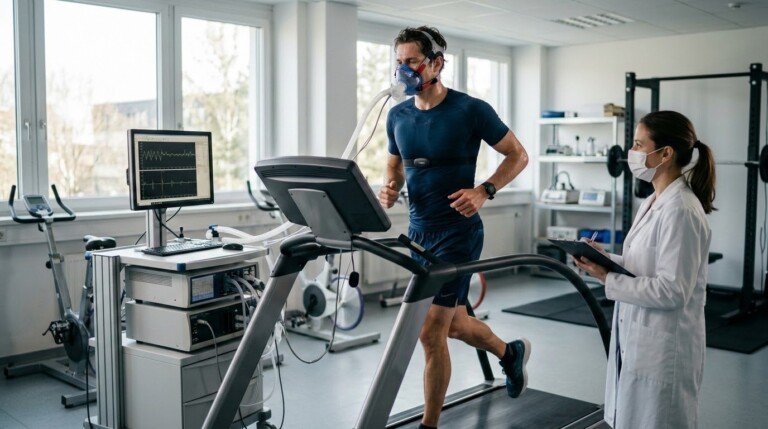
What matters during a VO2 max test is what your cardiovascular system can accomplish when oxygen demand becomes extremely high.
Blood also matters.
Red blood cells carry oxygen using hemoglobin. The amount of oxygen the blood can carry influences how much oxygen can ultimately be delivered to working muscles. This is one reason factors affecting oxygen-carrying capacity can influence aerobic performance.
The entire process is interconnected. The heart pumps the blood, the blood carries oxygen, and the muscles extract that oxygen.
A review of VO2 max physiology describes this as an integrated oxygen transport system involving the lungs, heart, blood, circulation, and skeletal muscle rather than a single isolated limiting organ. (PubMed)
That distinction is important because it prevents an overly simple explanation such as “VO2 max is determined by your heart.”
Your heart is extremely important, but it is only one part of the system.
What role do the respiratory system and lung capacity play?
Your respiratory system is responsible for bringing oxygen into the body and removing carbon dioxide.
At rest, breathing is relatively easy. During intense exercise, the situation changes dramatically.
Your breathing becomes faster and deeper because your muscles are consuming more oxygen and producing more carbon dioxide.
The respiratory system therefore has to increase ventilation substantially to meet the changing demands of exercise.
The first step is getting oxygen into the lungs.
From there, oxygen has to move across the respiratory membrane into the bloodstream. Once it enters the blood, it can bind to hemoglobin and be transported throughout the body.
This means that lung function can influence the oxygen supply available for exercise.
However, there is an important misconception here.
People sometimes assume that simply having larger lungs automatically means having a higher VO2 max.
It does not work that way.
Lung size alone is not the same thing as effective oxygen transport.
What matters is the entire process of ventilation, gas exchange, blood oxygenation, and subsequent oxygen delivery to tissues.
A person could have substantial lung capacity but still have other limitations elsewhere in the oxygen transport chain.
Likewise, a highly trained endurance athlete may have a remarkably high VO2 max because the entire system is capable of moving and using oxygen at a very high rate.
During intense exercise, the respiratory system has to keep up with enormous increases in oxygen demand. In highly trained athletes, particularly at very high workloads, pulmonary function and gas exchange can become more relevant to performance than they are in less-trained individuals.
This is one reason it is inaccurate to say that VO2 max is purely a measure of cardiovascular fitness.
It is a measure of how effectively the whole body can consume oxygen during demanding exercise.
Your lungs are the entry point.
Your heart and circulation are the transport network.
Your muscles are the destination and the place where much of that oxygen is ultimately used.
If the oxygen cannot move efficiently from one stage to the next, the maximum rate of oxygen consumption can be affected.
This is also why serious respiratory conditions can substantially reduce exercise capacity. Someone may have adequate muscular strength but struggle to sustain aerobic work because the respiratory system cannot meet the body’s oxygen and ventilation demands.
At the same time, a healthy person should not assume that trying to increase lung size is the key to dramatically increasing VO2 max.
The body does not operate through a single upgrade button.
It adapts as a system.
How do muscle mass, fiber type, and mitochondrial density affect it?
Getting oxygen to the muscles is only half the story.
The muscles also need to use it.
Skeletal muscle contains mitochondria, which are structures involved in producing energy through aerobic metabolism. During sustained exercise, mitochondria play a central role in converting available fuel and oxygen into usable energy.
This means the muscles themselves can influence aerobic capacity.
Two people might receive similar amounts of oxygenated blood, yet their muscles may not use that oxygen with exactly the same efficiency.
Training can change the muscle environment.
Regular endurance exercise can stimulate adaptations associated with mitochondrial function, capillary networks, and the muscle’s ability to extract oxygen from the blood.
Muscle fiber type also matters.
Human skeletal muscle contains different fiber characteristics, broadly ranging from more fatigue-resistant fibers to fibers that are better suited to producing rapid, powerful contractions.
Endurance-oriented muscle characteristics are generally associated with greater capacity for sustained aerobic activity.
This does not mean that someone can simply choose their muscle fiber type.
Genetics influence the distribution and characteristics of muscle fibers, while training can influence how those fibers function and adapt.
Muscle mass is another piece of the puzzle, although bigger muscles do not automatically mean a higher VO2 max.
A larger amount of muscle can potentially provide more tissue capable of using oxygen, but the relationship is more complicated than simply adding muscle and expecting aerobic capacity to rise.
A bodybuilder with substantial muscle mass does not automatically have the same aerobic capacity as an endurance athlete.
The type of training matters.
The muscles of an endurance-trained athlete become highly adapted to repeated oxygen-dependent work. Their ability to extract and use oxygen can become an important part of their overall aerobic performance.
Mitochondrial density is particularly interesting because it helps explain why aerobic fitness is not simply about the heart.
Imagine that the cardiovascular system delivers a large supply of oxygen to the muscle.
If the muscle has a well-developed aerobic machinery capable of using that oxygen effectively, the delivery system can be put to good use.
If the muscle’s capacity for oxygen utilization is lower, increasing delivery alone does not tell the entire story.
This is why VO2 max should be viewed as an integrated physiological trait.
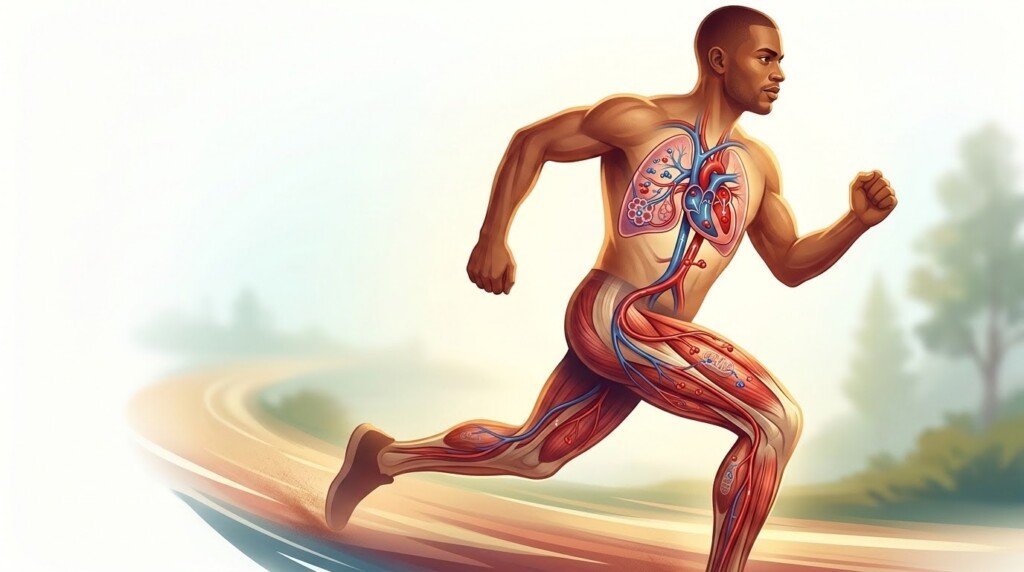
The lungs bring oxygen in.
The heart circulates blood.
Hemoglobin carries oxygen.
Blood vessels deliver it.
Muscle tissue extracts it.
Mitochondria use it.
Each stage contributes to the final result.
How much does genetics determine your VO2 Max potential?
Genetics clearly influence VO2 max, but saying “your VO2 max is genetic” can create the wrong impression.
Genes can influence your starting point, your physiology, your body structure, your response to exercise, and potentially your upper range of adaptation.
They do not provide a simple prediction of exactly what your VO2 max will become.
This distinction matters because people often use genetics as either an explanation or an excuse.
Someone with naturally high aerobic capacity may have an advantage in endurance sports.
Someone who starts with a lower VO2 max can still improve substantially through appropriate training.
The amount of improvement can vary from person to person.
That variation is real.
The mistake is assuming that variation means training does not matter.
Research into VO2 max trainability has identified substantial differences in how people respond to standardized exercise programs. At the same time, researchers have found that genetics alone cannot fully explain the response, and the specific genetic predictors identified so far have not been robust enough to give individuals a simple genetic forecast. (PubMed)
So there are two separate questions:
How much does genetics influence where you start?
And:
How much can you improve from where you start?
Those are not the same question.

Are there specific genes associated with VO2 Max variation?
Researchers have identified numerous genetic variants that appear to be associated with VO2 max, endurance traits, or the response to exercise.
The challenge is that VO2 max is not controlled by one gene.
It is a complex trait.
Genes can influence many of the biological systems involved in aerobic performance, including cardiovascular structure and function, blood-related characteristics, muscle properties, energy metabolism, and cellular responses to exercise.
That means a person’s genetic contribution is more like a collection of small influences than a single “VO2 max gene.”
Some research has examined genes involved in pathways related to mitochondrial function, blood vessel development, muscle characteristics, and cardiovascular responses. However, identifying an association does not mean that a particular gene can accurately predict an individual’s athletic potential.
This is where online discussions often become misleading.
You may see claims suggesting that one gene determines whether someone is naturally built for endurance exercise.
Human physiology is not that simple.
A systematic review examining genetic predictors of VO2 max trainability identified many possible genetic variants, but it also emphasized the limitations of the existing evidence, including small samples, limited replication, differences between studies, and the influence of environmental factors. (PubMed)
That is an important scientific reality.
Genetics matter.
But genes operate within an environment.
Training, physical activity history, nutrition, sleep, health status, age, body composition, and many other factors interact with genetic background.
Even two people with similar genetic backgrounds can end up with different aerobic capacities because their life experiences and training histories differ.
The phrase “genetic potential” therefore needs to be handled carefully.
You cannot look at someone’s VO2 max and determine exactly how much of it came from genes and how much came from training.
Genes and environment interact throughout a person’s life.
Can training actually overcome genetic limitations, or is there a hard ceiling?
Training can improve VO2 max, sometimes substantially.
But individuals do not all reach the same final value after following the same training program.
That is the honest answer.
Some people respond strongly to endurance training. Others respond more modestly. A person’s baseline fitness also matters because someone starting from a low level may have considerable room for improvement.
This is why the idea of a hard genetic ceiling can be misleading.
You probably do have biological limits.
Everyone does.
But you usually do not know exactly where your personal ceiling is simply by looking at your current VO2 max.
A person who currently has a VO2 max of 32 cannot logically conclude that 32 is their genetic maximum.
They may have years of untapped adaptation available.
Conversely, an experienced endurance athlete with years of structured training cannot assume that continued training will produce unlimited increases.
Adaptation eventually becomes harder.
The closer you get to your personal physiological potential, the more difficult it generally becomes to produce large improvements.
This is one reason beginners often experience noticeable changes relatively quickly while experienced athletes may spend months or years chasing comparatively small improvements.
The difference is not necessarily motivation.
It is biology.
Training provides a stimulus.
The body responds by adapting.
But the size of that adaptation depends on where you start, how your body responds, how consistently you train, your recovery, and numerous individual characteristics.
Research from the HERITAGE Family Study found substantial familial influence on changes in VO2 max following standardized training, with considerable variation between individuals. Other reviews have likewise found meaningful genetic contributions to aerobic fitness and training response, while emphasizing that these traits are complex and influenced by multiple factors. (PubMed)
The practical takeaway is much more useful than the genetic debate.
Do not ask, “Do I have good genetics?”
Ask, “How much of my current aerobic capacity have I actually developed?”
Those questions lead to very different mindsets.
Someone who starts with a naturally high VO2 max may have an advantage, but that advantage does not guarantee exceptional athletic performance.
Someone who starts lower may have enormous potential for improvement.
And someone who has already trained for years may have less room for dramatic gains but can still improve other aspects of endurance performance.
Genetics influence the playing field.
They do not tell you the final score before you start playing.
FAQ
1. What determines VO2 Max?
VO2 max is determined by the combined function of the respiratory system, cardiovascular system, blood and oxygen transport, skeletal muscles, and cellular oxygen utilization. Genetics, age, body composition, training history, health, and other environmental factors also influence the result.
2. Is VO2 Max genetic?
Yes, genetics contribute meaningfully to VO2 max and to differences in how people respond to exercise training. However, VO2 max is a complex trait influenced by many genes and environmental factors. Genetics do not determine the exact VO2 max you will achieve.
3. Can I improve my VO2 Max despite bad genetics?
Yes. A genetic predisposition toward a lower starting point or smaller training response does not mean improvement is impossible. People vary in how strongly they respond to training, but exercise can improve aerobic capacity even when genetic potential differs.
4. Is lung capacity the most important factor for VO2 Max?
No. Lung function is part of the oxygen transport system, but VO2 max depends on the entire pathway from oxygen entering the lungs to oxygen being delivered and used by the muscles. The heart, circulation, blood, muscles, and mitochondria all contribute.
5. Does having more muscle automatically increase VO2 Max?
No. Muscle mass alone does not guarantee greater aerobic capacity. The muscles also need the ability to extract and use oxygen efficiently. Muscle characteristics, mitochondrial function, blood supply, and cardiovascular fitness all matter.
Conclusion
Understanding the factors that influence VO2 max changes how you should interpret your own number. There is no single organ responsible for it and no single gene that determines your fate.
Your VO2 max is the result of a remarkably connected system.
Your genetics help shape the starting conditions. Your cardiovascular system determines how effectively oxygenated blood can circulate. Your respiratory system handles oxygen exchange. Your muscles determine how effectively that oxygen can be extracted and used. Your mitochondria provide the cellular machinery needed to turn that oxygen into usable energy.
And training can influence many parts of that system.
That is the useful perspective to take forward. Your genetics may influence your potential, but your current VO2 max is not a genetic report card. It is a snapshot of how your body is functioning now.
Disclaimer:
This post may contain affiliate links. If you purchase through them, we may earn a small commission at no extra cost to you. Also, this content is for informational purposes only and does not substitute professional medical advice.
Train Smarter, Not Harder
Use our free Fitness Toolkit to find your heart rate zones and calories burned in minutes.
Open Free Tools →