Recommended Portion Sizes for Every Food Group (Chart + Guide)
If you’ve ever searched online for the right portion size, you’ve probably found conflicting advice. One article recommends eating a cup of rice, another suggests half a cup, while a nutrition label on the package lists an entirely different serving size. Before long, a simple question like “How much should I actually eat?” becomes surprisingly difficult to answer.
This confusion explains why so many people struggle with portion control even when they choose nutritious foods. Most people aren’t intentionally overeating. Instead, they’re working with inconsistent information, oversized restaurant meals, and serving sizes that often don’t reflect what ends up on the plate.
Understanding recommended portion sizes isn’t about measuring every bite or carrying a food scale wherever you go. It’s about developing a practical reference that helps you build balanced meals with confidence. Once you know what a standard serving actually looks like, it becomes much easier to recognize when portions have gradually become larger than intended and when your meals are already providing enough nourishment.
Another important point is that recommended portion sizes are starting points rather than strict rules. A physically active athlete, a growing teenager, an older adult, and someone recovering from illness may all require different amounts of food. Age, activity level, health conditions, medications, and personal goals all influence how much an individual needs. The recommendations in this guide are designed to provide reliable everyday reference points that most healthy adults can use when planning balanced meals.
This guide brings together the most commonly recommended serving sizes across every major food group. Instead of jumping between multiple resources, you’ll have one practical reference that explains standard portions, how cooking changes serving sizes, and what those measurements actually look like in everyday life.
Quick Answer
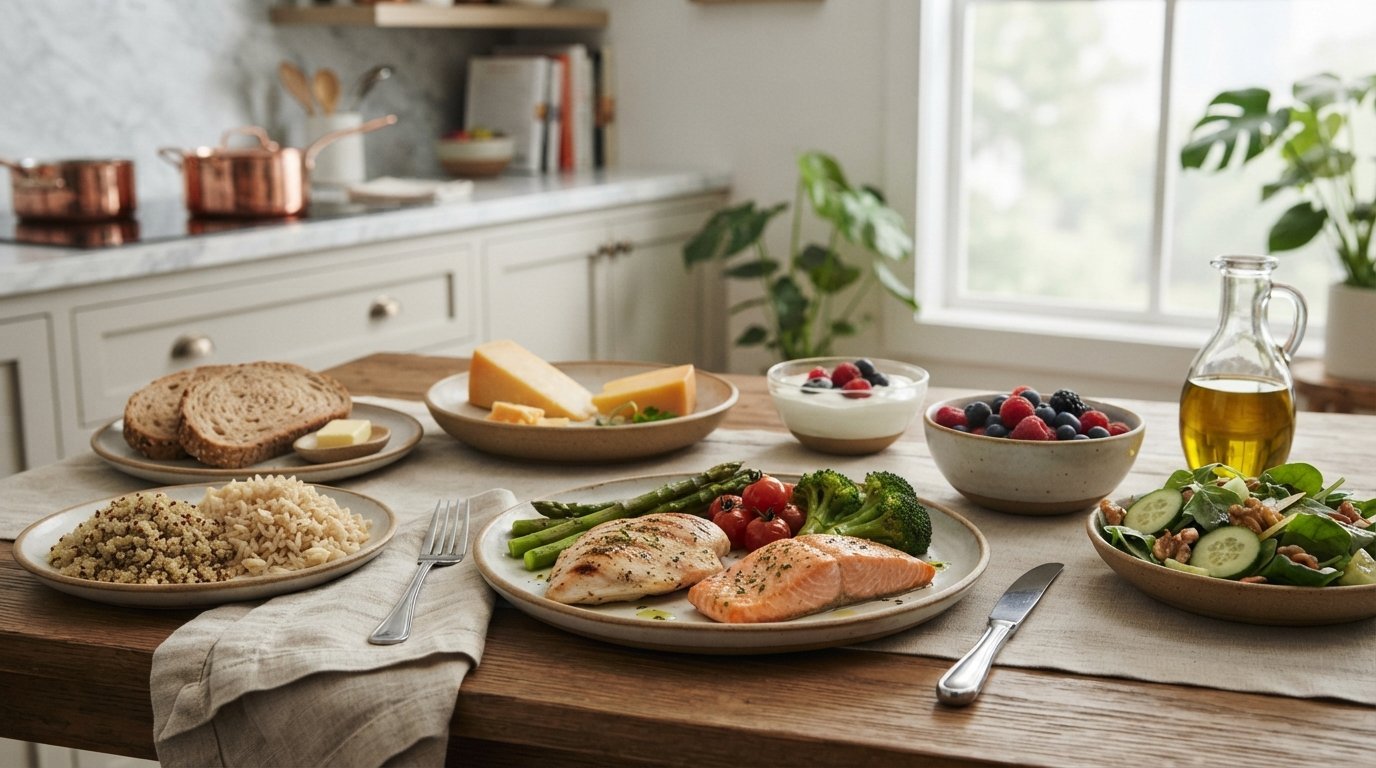
The easiest way to understand recommended portion sizes is to think in terms of food groups rather than calories alone. Most balanced meals include vegetables, fruit, whole grains or other starches, lean protein, and healthy fats. While individual needs vary, standard serving sizes provide a practical starting point that makes meal planning much easier and helps prevent portions from gradually becoming larger over time.
Recommended Portion Sizes by Food Group
| Food Group | Standard Serving Size |
|---|---|
| Fresh fruit | 1 medium fruit or 1 cup chopped fruit |
| Vegetables | 1 cup raw vegetables or ½ cup cooked vegetables |
| Leafy greens | 2 cups raw |
| Cooked rice | ½ cup cooked |
| Cooked pasta | ½ cup cooked |
| Bread | 1 slice |
| Oatmeal | ½ cup dry oats |
| Chicken or fish | 3 to 4 ounces cooked |
| Lean beef | 3 ounces cooked |
| Eggs | 2 large eggs |
| Beans or lentils | ½ cup cooked |
| Milk | 1 cup |
| Yogurt | ¾ to 1 cup |
| Cheese | 1½ ounces natural cheese |
| Nuts | 1 ounce |
| Nut butter | 2 tablespoons |
| Olive oil | 1 tablespoon |
These measurements are reference portions, not meal plans. A complete meal often contains several servings from different food groups depending on your nutritional needs.
What’s a Standard Serving Size for Fruits and Vegetables?
Among all food groups, fruits and vegetables probably create the least anxiety. Most people understand they are nutritious and should appear regularly in meals. The confusion usually comes from knowing how much counts as one serving and whether there is such a thing as eating too much.
Unlike calorie-dense foods, fruits and vegetables generally provide substantial fiber, vitamins, minerals, antioxidants, and water while supplying relatively fewer calories for their volume. This makes them one of the easiest food groups to include generously within balanced meals.
Even so, serving sizes remain useful because they help people understand whether they are meeting daily recommendations rather than simply guessing.
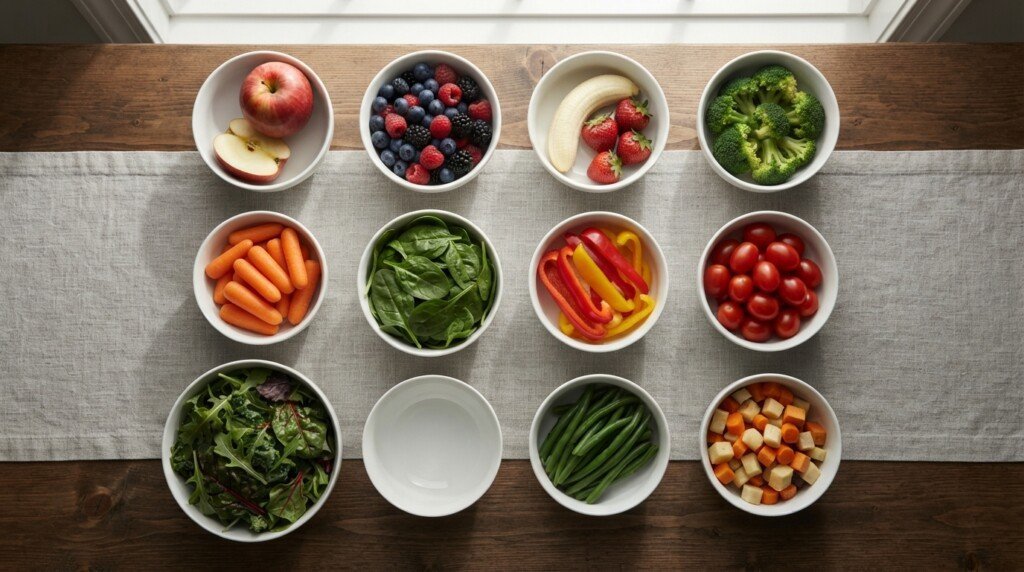
Fresh fruit, frozen fruit without added sugar, canned fruit packed in juice, and dried fruit all contribute toward daily fruit intake, although their serving sizes differ because water content changes their volume.
Vegetables are even more flexible. Raw vegetables, cooked vegetables, frozen vegetables, and salads all count toward daily intake, but cooking changes the volume considerably. A large bowl of spinach may shrink dramatically after cooking while still providing the same nutritional value.
Instead of focusing only on filling your plate, understanding standard servings helps ensure that different food groups remain balanced throughout the day.
How Many Servings of Fruit Are Recommended Per Day?
Most healthy adults are encouraged to consume roughly 1½ to 2 cups of fruit daily, although exact recommendations vary according to age, sex, activity level, and overall dietary needs.
A single serving generally includes one medium apple, banana, orange, pear, or similar-sized fruit. Smaller fruits such as berries, grapes, cherries, or melon are usually measured by volume, with one cup representing one serving.
Fruit juice deserves separate consideration.
Although 100 percent fruit juice contains vitamins and minerals, it lacks much of the fiber found in whole fruit. Because of this, whole fruit is generally preferred whenever possible.
Dried fruit also counts toward fruit intake, but because water has been removed, the serving size becomes much smaller. Approximately one-quarter cup of raisins, dried cranberries, or dried apricots usually represents one serving.
Rather than concentrating all fruit intake into one meal, many people find it easier to spread fruit across breakfast, snacks, and dessert. This approach often provides greater satisfaction while naturally increasing overall dietary variety.
What Counts as One Standard Serving of Vegetables?
Vegetables include an enormous variety of foods, making serving sizes slightly more complicated than fruit.
Generally speaking, one cup of raw vegetables or one-half cup of cooked vegetables equals one serving.
Leafy greens require special consideration because they contain much more air between leaves. Two cups of raw spinach, lettuce, kale, or mixed greens typically equal one serving after accounting for their lower density.
Starchy vegetables such as potatoes, peas, and corn also count as vegetables, although they contribute more carbohydrates than leafy greens or broccoli. They can still fit comfortably within balanced meals while simply being recognized for their slightly different nutritional profile.
Color variety also matters.
Dark green vegetables provide nutrients different from orange vegetables.
Red vegetables contribute different antioxidants than cruciferous vegetables such as broccoli or cauliflower.
Rather than eating exactly the same vegetables every day, rotating colors throughout the week naturally broadens nutrient intake while making meals more interesting.
Many people discover they fall short of vegetable recommendations simply because vegetables appear only during dinner. Including vegetables in omelets, soups, sandwiches, wraps, salads, and snacks makes reaching daily recommendations much easier without dramatically changing eating habits.
What’s a Standard Serving Size for Grains and Starches?
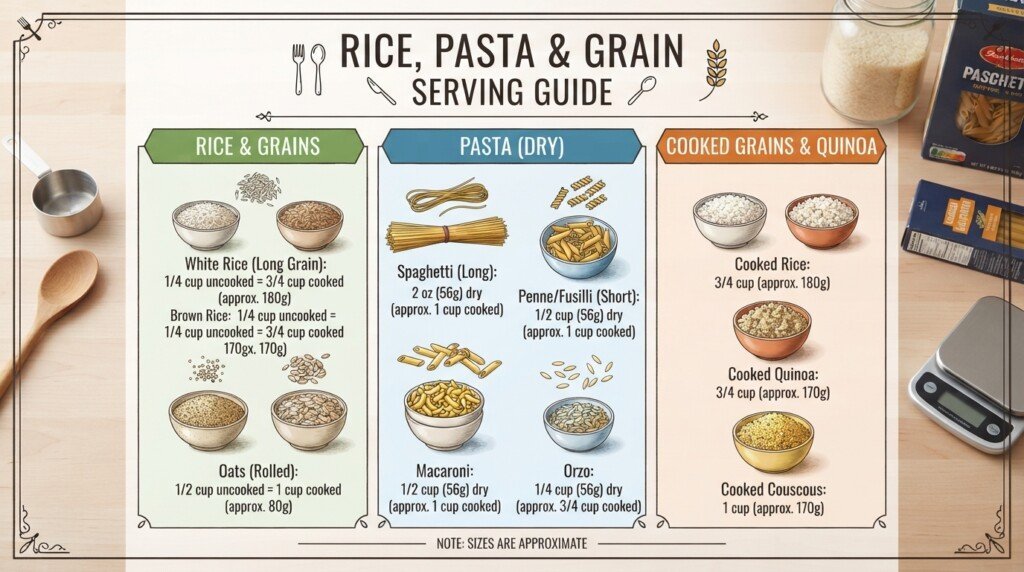
Grains often create more confusion than any other food group because serving sizes change after cooking.
Dry rice looks completely different once water is absorbed.
Pasta expands dramatically.
Oats increase several times in volume.
Bread, cereals, tortillas, crackers, potatoes, quinoa, barley, couscous, and many other foods all belong to this category while using different measurements.
Another reason grains become confusing is that restaurant portions rarely resemble standard servings.
A restaurant bowl of pasta frequently contains three or four servings.
Large rice portions served alongside entrées often equal two servings before any additional side dishes are considered.
Understanding recommended portions does not mean eliminating grains.
Whole grains remain valuable sources of complex carbohydrates, dietary fiber, B vitamins, and minerals that support overall health and sustained energy.
Instead, recognizing standard serving sizes simply helps create meals that remain balanced alongside vegetables and protein rather than allowing grains to dominate the plate.
What Is a Standard Serving Size for Rice or Pasta?
One standard serving of cooked rice is generally one-half cup.
The same guideline applies to cooked pasta.
Many people are surprised by this because restaurant servings commonly provide two to four times this amount.
Brown rice, white rice, jasmine rice, basmati rice, wild rice, and most other cooked rice varieties follow similar serving measurements.
Likewise, spaghetti, penne, fusilli, macaroni, linguine, and most cooked pasta types use the same reference serving.
Of course, eating one-half cup does not mean every meal should contain only that amount.
Highly active individuals or those requiring greater energy intake may reasonably consume additional servings depending on the rest of their meal.
The important distinction is recognizing that a large restaurant bowl containing two cups of pasta represents approximately four standard servings rather than one.
Understanding this difference often explains why portion sizes gradually increase over time without people realizing it.
How Does Cooking Method Affect the Serving Size of Rice and Pasta?
Cooking changes food volume far more than many people expect.
Dry rice absorbs water while cooking, causing its volume to increase significantly.
Pasta behaves similarly as it hydrates.
This means measuring cooked portions and dry portions produces very different results.
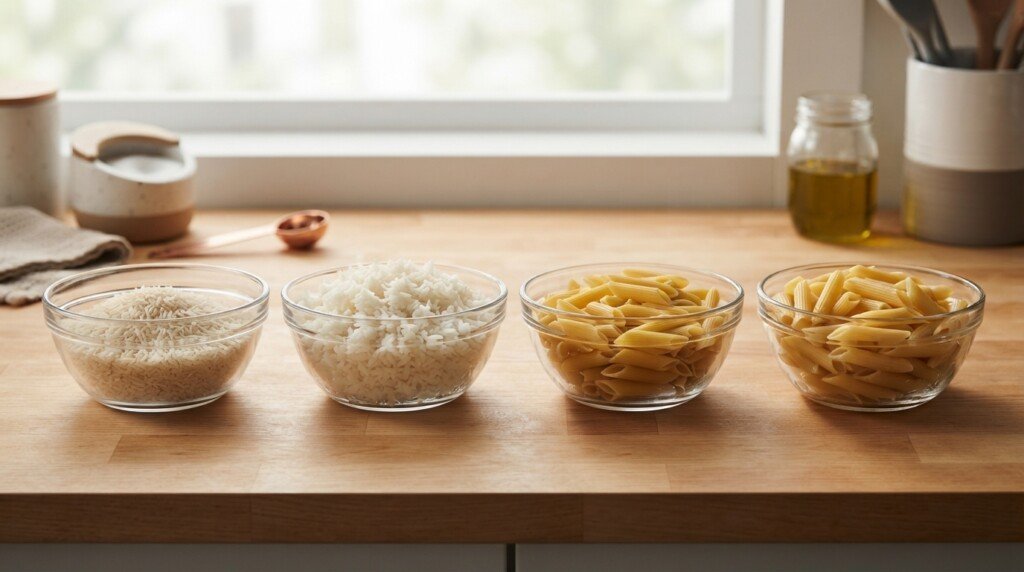
For example, approximately one-quarter cup of dry rice generally becomes about one-half cup cooked, depending on the variety.
Dry pasta also expands substantially after boiling, meaning a relatively small handful of uncooked pasta may produce a much larger cooked serving than expected.
Different cooking methods also influence texture, water retention, and perceived fullness.
Rice cooked with more water may appear larger while containing essentially the same nutritional content.
Pasta cooked al dente retains slightly less water than softer pasta, subtly affecting volume without dramatically changing nutrition.
Because these differences become confusing quickly, most people find it easiest to think in terms of cooked serving sizes, since that is how food ultimately appears on the plate.
What’s a Standard Serving Size for Protein?
Protein is one of the most discussed nutrients in nutrition, yet it is also one of the easiest food groups to overestimate or underestimate. Ask five people what a serving of chicken looks like, and you’ll probably receive five different answers. Some picture an entire chicken breast, others think of a palm-sized piece, while many simply fill whatever space remains on the plate.
This confusion is understandable because protein foods vary enormously in shape, density, cooking methods, and moisture content. A chicken breast from one grocery store may weigh nearly twice as much as another. A thick salmon fillet and a lean pork chop may look similar but provide different amounts of protein and calories. Plant proteins such as beans, lentils, tofu, and tempeh are measured differently again.
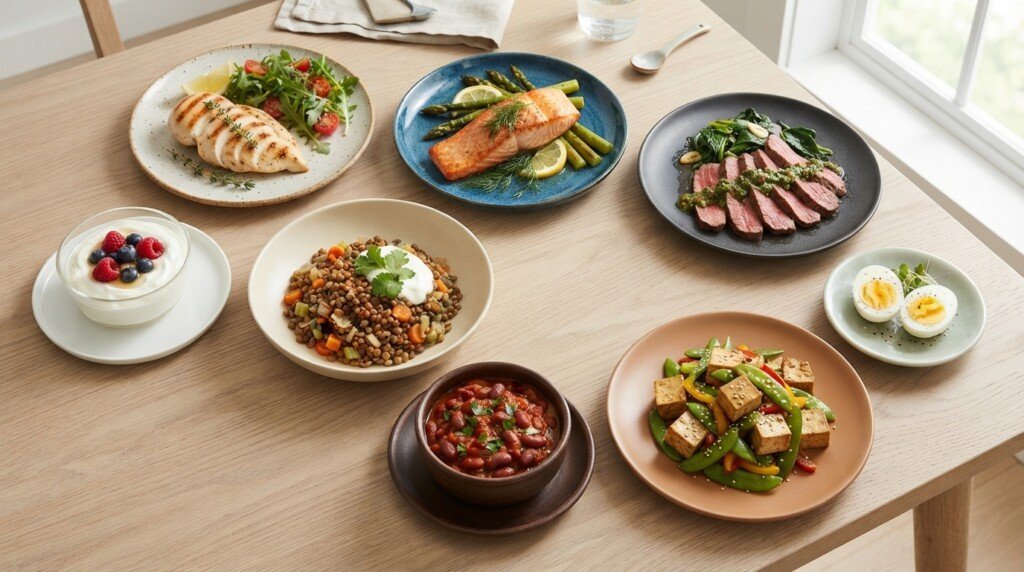
Rather than aiming for exact perfection, recommended portion sizes provide a practical reference that helps create balanced meals. Protein plays an important role in maintaining muscle mass, supporting tissue repair, promoting satiety, and contributing to many essential body functions. Including appropriate portions at meals often helps people stay satisfied for longer without relying on oversized servings.
The goal is not to maximize protein at every opportunity. Instead, it is to include enough protein to complement vegetables, grains, and healthy fats while keeping meals balanced.
What Is the Recommended Serving Size for Chicken Breast or Fish?
For most adults, a standard serving of cooked chicken, turkey, lean beef, pork, or fish is approximately 3 to 4 ounces, or roughly 85 to 115 grams after cooking.
This amount typically provides a substantial source of high-quality protein without overwhelming the rest of the plate.
Many restaurant entrées contain significantly larger portions. A grilled chicken breast served at a restaurant may weigh six, eight, or even ten ounces, which equals two or sometimes three standard servings. The same applies to steaks, grilled salmon fillets, burgers, and pork chops that often exceed everyday reference portions.
Seafood follows similar recommendations. Salmon, cod, tuna, tilapia, shrimp, trout, and many other fish varieties generally fit within the same 3 to 4 ounce serving guideline. Fatty fish such as salmon also contribute beneficial omega-3 fatty acids, making them valuable additions to a balanced eating pattern.
Eggs use a different measurement because of their natural size. Two large eggs are generally considered one protein serving for meal planning purposes.
Plant proteins are measured differently because they contain more water and fiber. Approximately one-half cup of cooked beans, lentils, chickpeas, or split peas typically represents one serving. Tofu and tempeh also provide excellent protein sources, with serving sizes commonly ranging from three to four ounces depending on the product.
Dairy foods contribute protein as well. A cup of milk, three-quarters to one cup of yogurt, or about one and a half ounces of natural cheese all provide meaningful amounts of protein while also supplying calcium and other important nutrients.
The important point is that protein does not need to dominate every meal. A balanced plate usually includes vegetables, whole grains or other carbohydrate sources, healthy fats, and protein working together rather than one category crowding out the others.
What Are Visual Cues to Estimate a Correct Protein Serving Without a Scale?
Although kitchen scales can be useful learning tools, most people do not carry one to restaurants, family gatherings, or work lunches. Fortunately, simple visual references can help estimate protein portions once you become familiar with standard serving sizes.
A cooked serving of chicken, fish, or lean meat measuring about three to four ounces is often similar in size to the palm of an average adult hand, excluding the fingers. This reference provides a convenient estimate without requiring precise measurements.
However, visual estimation should be viewed as an approximation rather than an exact science. Chicken breasts vary considerably in thickness, fish fillets differ in density, and cuts of meat rarely come in identical shapes. Using your hand simply offers a practical way to stay reasonably close to recommended portions when measuring is not practical.
If you would like a more detailed explanation of hand-based methods, everyday object comparisons, and visual estimation strategies, those techniques are explored separately in How to Visually Estimate Portion Sizes, where the topic is covered much more comprehensively.
The most useful habit is not memorizing exact measurements but becoming familiar with what balanced portions naturally look like over time. After repeated exposure to standard servings, estimating protein becomes much easier without constant measuring.
Quick Reference Table
The following chart brings together commonly recommended serving sizes across the major food groups. While individual nutritional needs differ, these reference amounts provide a practical starting point for building balanced meals and understanding how much one serving generally looks like.
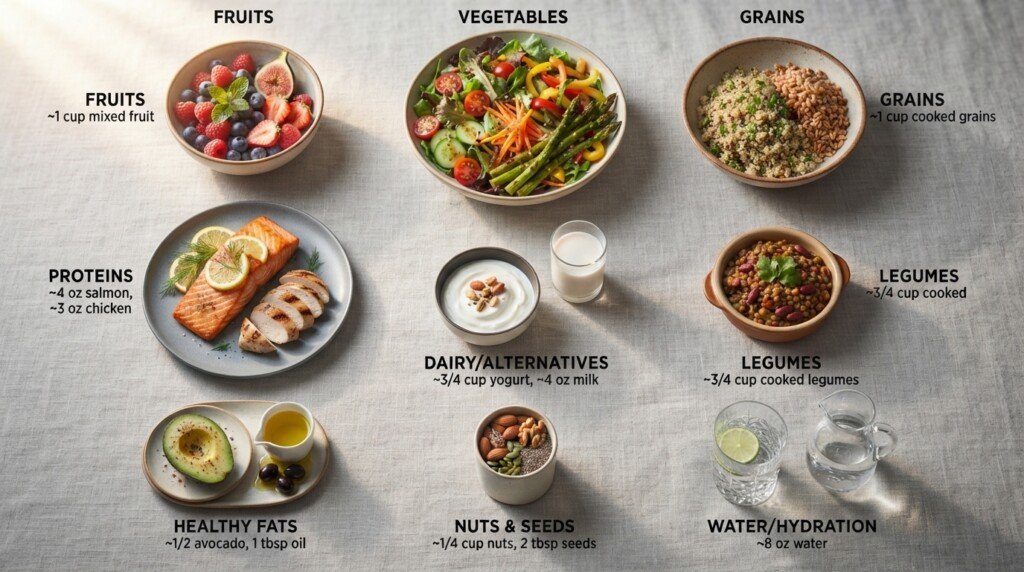
| Food | Standard Serving |
|---|---|
| Apple, orange, pear | 1 medium fruit |
| Berries, melon | 1 cup |
| Leafy greens | 2 cups raw |
| Cooked vegetables | ½ cup |
| Raw vegetables | 1 cup |
| Cooked rice | ½ cup |
| Cooked pasta | ½ cup |
| Bread | 1 slice |
| Dry oats | ½ cup |
| Chicken, turkey | 3 to 4 ounces cooked |
| Fish | 3 to 4 ounces cooked |
| Lean beef | 3 ounces cooked |
| Eggs | 2 large eggs |
| Beans or lentils | ½ cup cooked |
| Yogurt | ¾ to 1 cup |
| Milk | 1 cup |
| Natural cheese | 1½ ounces |
| Nuts | 1 ounce |
| Peanut or almond butter | 2 tablespoons |
| Olive oil | 1 tablespoon |
These serving sizes are intended to help you understand food portions rather than dictate exactly how much you should eat. Daily intake should always reflect your age, activity level, health status, and personal nutritional needs.
Key Takeaways
Understanding recommended portion sizes makes everyday eating far less confusing. Rather than relying on oversized restaurant meals or inconsistent package servings, standard portions provide reliable reference points that help build balanced meals across every food group. They are not rigid rules but practical guides that support healthier decision-making.
Remember that fruits, vegetables, grains, proteins, dairy, and healthy fats all contribute differently to nutrition. Learning what one serving actually looks like allows you to recognize when portions gradually become larger than intended while still enjoying a wide variety of foods. Over time, these reference points become second nature, making balanced eating feel much more natural without requiring constant measuring.
Frequently Asked Questions
1. How many servings of fruit should I eat per day?
Most healthy adults benefit from about 1½ to 2 cups of fruit daily, although individual recommendations vary depending on age, activity level, and overall dietary needs.
2. What is one serving of rice?
One standard serving of cooked rice is ½ cup cooked, regardless of whether it is white, brown, jasmine, or basmati rice.
3. How big should a chicken breast serving be?
A typical serving of cooked chicken breast is 3 to 4 ounces (85 to 115 grams). Many restaurant chicken breasts are considerably larger than this and may contain two or more servings.
4. Are recommended portion sizes the same for everyone?
No. Recommended portion sizes are useful reference points, but individual needs vary according to age, body size, physical activity, health conditions, and personal goals.
5. Do I need to weigh every meal to follow recommended portion sizes?
No. Measuring can be helpful while learning, but most people eventually become comfortable estimating portions using familiar reference amounts and everyday experience.
Conclusion
Learning recommended portion sizes is one of the simplest ways to improve meal balance without following restrictive diets or constantly counting calories. Once you understand what a standard serving looks like across fruits, vegetables, grains, proteins, dairy, and healthy fats, everyday food choices become much easier to manage.
Instead of relying on oversized restaurant meals or confusing package labels, you gain practical reference points that support consistent eating habits. These serving sizes are not meant to limit enjoyment or create rigid food rules. They provide a flexible foundation that can be adjusted to your individual needs while helping you build balanced meals with greater confidence. Over time, these small improvements in portion awareness often become lasting habits that support both long-term health and a more relaxed relationship with food.
Disclaimer:
This post may contain affiliate links. If you purchase through them, we may earn a small commission at no extra cost to you. Also, this content is for informational purposes only and does not substitute professional medical advice.
Fuel Your Body Right
Use our free Nutrition Toolkit to find your protein target, fasting window, and net carbs in minutes.
Open Free Tools →