
Smoking and Erectile Dysfunction
Smoking and erectile dysfunction are more closely connected than many men realize. A cigarette may feel like a short-term habit with a long-term health cost, but the effect is not limited to the lungs or heart. The same blood vessels that need to relax and deliver enough blood for an erection can also be affected by cigarette smoke and nicotine.
That matters because an erection is fundamentally a blood-flow event. Sexual stimulation starts the process, but the body still needs healthy blood vessels, adequate nitric oxide signaling, and the ability to trap blood inside erectile tissue. When smoking interferes with those systems, getting or maintaining a firm erection can become more difficult.
The encouraging part is that smoking-related erectile problems are not necessarily permanent. Research has found that stopping smoking can improve erectile function, although the degree and speed of recovery vary from one person to another.
Can smoking cause erectile dysfunction?
Yes. Smoking can contribute to erectile dysfunction by damaging the vascular system that erections depend on.
Research consistently links cigarette smoking with a higher risk of ED. A meta-analysis of prospective studies found that current smokers had a higher risk of erectile dysfunction than nonsmokers, with an estimated odds ratio of 1.51 in the prospective studies included. The same research found an association between former smoking and ED risk as well, although the risk was lower than for current smokers. (PubMed)
That does not mean every man who smokes will develop ED. Erectile function is influenced by several factors, and smoking may be one contributor among many. However, smoking is a particularly important factor because it directly affects blood vessels and the mechanisms involved in erection.
There is also evidence of a dose relationship. In other words, greater smoking exposure tends to be associated with greater erectile risk. A major review of the evidence found that smoking is associated with ED and identified endothelial dysfunction, reduced nitric oxide availability, and oxidative stress as important mechanisms. (PubMed)
This is why the question should not simply be, “Can smoking stop a man from getting hard?”
A better question is, “What is smoking doing to the system that produces an erection?”
The answer becomes clearer when you look at nicotine and blood vessel function.
How nicotine damages blood vessels
An erection requires blood vessels to respond appropriately to sexual stimulation.
When a man becomes aroused, chemical signals encourage smooth muscle in penile blood vessels to relax. This allows more blood to enter the erectile tissue. As the tissue fills, pressure inside it helps restrict the blood from flowing back out too quickly. The result is a firm erection.
Smoking can interfere with several parts of that process.
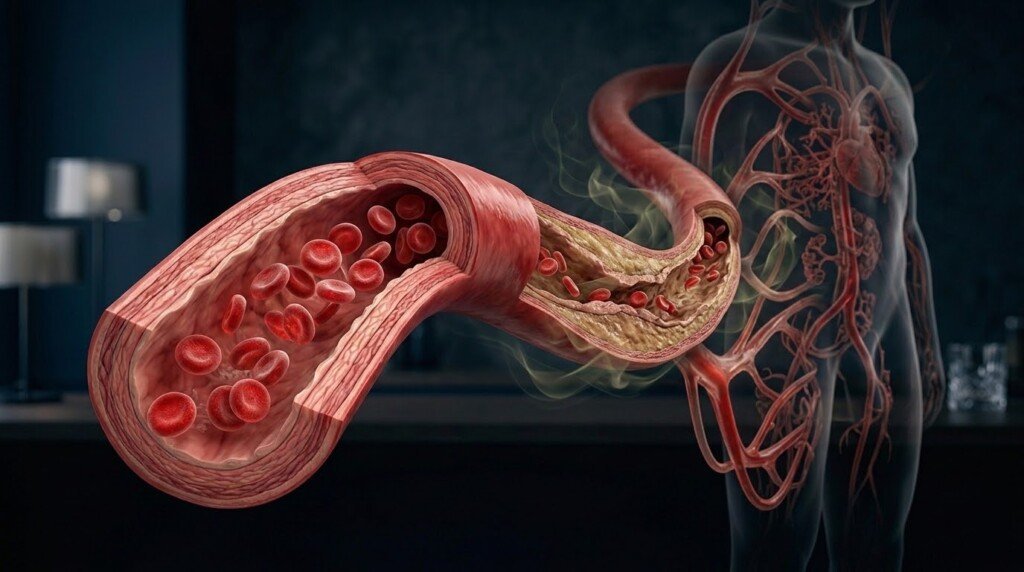
Nicotine can cause blood vessels to constrict, while chemicals in cigarette smoke contribute to oxidative stress and damage to the vascular lining, known as the endothelium. The endothelium plays an important role in regulating blood vessel relaxation and blood flow.
Smoking also affects nitric oxide signaling. Nitric oxide is one of the key chemical messengers involved in the relaxation of smooth muscle during an erection. When nitric oxide availability or signaling is impaired, the vascular response may become less effective.
Think of the difference between a flexible garden hose and one that has become stiff and restricted. The water supply may still exist, but the system cannot respond as efficiently when more flow is needed.
That is roughly the problem smoking can create for erectile function.
There is another important point: the problem is not simply nicotine acting for a few minutes.
Cigarette smoke contains thousands of chemicals, and long-term exposure can contribute to vascular damage and oxidative stress. That means smoking-related ED can involve both immediate changes in vascular function and cumulative changes over time.
This also helps explain why a man might notice inconsistent erections rather than complete erectile failure.
He may still get erections sometimes. He may still experience sexual desire. He may still have morning erections occasionally. But the erection may not reach the same firmness, may take longer to develop, or may disappear more easily during sex.
That pattern can be frustrating, but it does not automatically mean the situation is irreversible.
It also explains why quitting smoking can be meaningful even if ED is not the only reason to quit.

Will quitting smoking actually improve ED?
For many men, quitting smoking can improve erectile function, but nobody can honestly promise that stopping cigarettes will completely reverse ED.
The evidence is encouraging.
A prospective study of men with ED who smoked found that after one year, erectile status improved in at least 25% of men who stopped smoking, while none of the men who continued smoking showed improvement during the same follow-up period. The researchers also found that heavier smoking exposure was associated with more severe ED. (PubMed)
Other research has also found improvements after cessation.
A study involving men aged 30 to 60 found that erectile-function scores were significantly higher six months after smoking cessation across the age groups studied. (PubMed Central (PMC))
A separate analysis of more than 6,700 men found that current smokers had a higher prevalence of ED than nonsmokers, while former smokers had lower odds of ED than current smokers. Interestingly, the study did not show that smoking was associated with lower testosterone. Current smokers actually had higher mean total testosterone than nonsmokers in that population, while still having worse erectile outcomes.
That finding is useful because it challenges a common oversimplification.
Smoking-related ED is not simply a “low testosterone problem.”
Blood vessel function matters enormously.
So if you are asking whether quitting smoking can improve an erection, the more accurate answer is yes, it can, particularly when smoking is a meaningful contributor to the problem. But improvement depends on how much vascular damage has occurred and what other factors are affecting erectile function.
Age matters.
How long you have smoked matters.
How heavily you have smoked matters.
Existing cardiovascular or metabolic conditions matter.
And whether another cause of ED is present matters too.
For example, a man may quit smoking but continue to have ED because he also has diabetes, uncontrolled blood pressure, medication-related sexual side effects, significant anxiety, or another vascular condition.
That does not mean quitting failed.
It means smoking was only one piece of the picture.
This is also why it is better to think of quitting as removing a major obstacle rather than treating it like a guaranteed cure.
If your erection has gradually become less firm, smoking may be part of the explanation. If you are also noticing other changes, you may want to read Why Isn’t My Erection as Hard as Before? to understand why changes in firmness can have several possible causes.

How long after quitting does improvement start?
There is no single smoking cessation timeline that applies to every man’s erectile function.
Some vascular changes can occur surprisingly quickly, while meaningful improvements in sexual function may take weeks or months.
That distinction is important.
You might stop smoking and experience improvements in circulation before you notice a clear difference in your erections. Or you might notice better erections relatively quickly. Someone else may need several months before seeing a meaningful change.
Research has even documented short-term changes.
In one small study, researchers measured nocturnal erections in smokers before and after a period of smoking cessation. After only 24 hours without smoking, several measures of nocturnal penile tumescence and rigidity improved. Continued improvement was observed during the following month in the men who were monitored. (PubMed)
Another study examined penile blood-flow measurements in 20 men who smoked heavily and had ED. After 24 to 36 hours of smoking cessation, measures of penile hemodynamics improved. The researchers noted significant improvement in one of the key Doppler measurements and normalization of other measures in most participants.
Those findings are interesting, but they should not be interpreted as “quit for one day and ED disappears.”
The studies were small, and physiological improvement is not the same thing as a complete recovery of sexual function.
A useful way to think about the timeline is in stages.
Early stage: Blood vessel function can begin responding to the absence of cigarette exposure relatively quickly.
Intermediate stage: Over the following weeks and months, continued abstinence may support better vascular function and sexual response.
Longer-term stage: The potential for noticeable improvement depends increasingly on the amount of previous smoking exposure, age, overall cardiovascular health, and whether permanent vascular disease or another cause of ED is present.
One study following smokers with ED found measurable improvement after a year among men who quit, while a six-month study also reported significantly better erectile-function scores after cessation.
So there is no medically honest answer such as “ED improves exactly 30 days after quitting.”
Your body does not work on a fixed countdown.
What you can say with confidence is that stopping smoking removes an ongoing source of vascular stress, and research supports improvement in erectile function after cessation for at least some men.
What about testosterone after quitting smoking?
This question comes up frequently, but it deserves a careful answer.
There is no reliable universal timeline showing that testosterone rises by a specific amount after quitting cigarettes.
More importantly, testosterone is not the main explanation for smoking-related ED.
The 2022 analysis mentioned earlier found that current smokers had higher mean testosterone than nonsmokers in that study, despite having a higher prevalence of ED. Former smokers had better sexual health outcomes than current smokers. (PubMed)
That tells you something important.
A man can have testosterone that is not low and still have erection problems if his vascular function is impaired.
So if your goal is to improve erectile function after quitting smoking, do not judge your progress solely by whether testosterone changes.
The more relevant question is whether your overall sexual function is improving.
You might notice stronger spontaneous erections, better morning erections, improved erection maintenance, or a more reliable response to sexual stimulation. Those changes are more directly related to the problem you are trying to solve.
Is smoking-related ED permanent?
Not necessarily.
Smoking-related ED can improve after quitting, and the research supports the idea that at least part of the erectile impairment associated with smoking is reversible.
But “reversible” does not mean “guaranteed to disappear.”
This distinction matters.
If smoking has contributed to functional changes in blood vessels, stopping can remove the continuing exposure and give the vascular system an opportunity to recover. But long-term smoking can also contribute to atherosclerosis and other cardiovascular problems. Once significant structural disease is present, quitting may improve risk and function without completely restoring the previous state.
The earlier you address the problem, the better the opportunity to protect erectile function.
That does not mean a 50-year-old or 60-year-old man has missed his chance.
It means the goal should be realistic.
Smoking cessation can improve health at any age, and sexual function can improve as part of that broader change.
There is also a psychological benefit that should not be ignored.
A man who has experienced several unsuccessful sexual encounters may begin expecting another failure. That expectation can create additional pressure during sex. The original vascular problem may have started the problem, but anxiety can eventually become part of the cycle.
That is one reason persistent ED deserves proper attention rather than simply assuming cigarettes are the only explanation.
If erections remain consistently weak after you stop smoking, particularly if the problem is new or progressively worsening, speaking with a healthcare professional is sensible. When to See a Doctor for ED can help explain when erectile changes should be evaluated rather than watched indefinitely.
The same principle applies if you smoke and have other cardiovascular risk factors.
Erectile dysfunction can sometimes appear before more obvious cardiovascular symptoms because penile arteries are relatively small. Persistent ED can therefore be a reason to take overall vascular health seriously, rather than treating the erection problem as an isolated inconvenience.
What if quitting does not fix the problem?
Do not assume that quitting was pointless.
Smoking may have been contributing to ED without being the only cause.
For example, if vascular disease has already developed, quitting may stop further damage while another treatment is still needed. If medications, diabetes, blood-pressure problems, hormonal abnormalities, neurological conditions, or psychological factors are involved, those issues may need separate attention.
This is why a persistent erection problem should not turn into an endless experiment with internet remedies.
The goal is not to find the one trick that forces an erection.
The goal is to understand why erectile function changed in the first place.
Quitting smoking is one of the strongest modifiable steps available to a smoker, but it should be viewed as part of protecting the entire vascular system rather than as a guaranteed ED treatment.
And if smoking is accompanied by heavy alcohol use, it is worth remembering that these factors can overlap. Alcohol and Erectile Dysfunction covers the separate relationship between alcohol exposure and sexual function.
FAQ
1. Will quitting smoking improve erectile dysfunction?
It can. Research has found that some men experience meaningful improvement in erectile function after quitting smoking, with studies reporting improvements over periods ranging from very short-term physiological changes to several months or a year. The amount of recovery varies according to smoking exposure, age, vascular health, and other causes of ED.
2. Is smoking ED permanent?
No, smoking-related ED is not automatically permanent. Smoking cessation can improve erectile function, particularly when the problem is strongly related to reversible vascular dysfunction. However, long-term vascular disease or other medical conditions can limit recovery.
3. Can smoking stop a man from getting hard?
Yes. Smoking can interfere with blood-vessel relaxation, nitric oxide signaling, and penile blood flow, all of which are important for achieving and maintaining an erection. The effect varies considerably between individuals.
4. How long after quitting smoking does testosterone increase?
There is no reliable universal timeline for a testosterone increase after quitting smoking. Testosterone is also not the primary mechanism linking smoking with ED. Research has found that current smokers can have normal or even higher testosterone while still experiencing worse erectile function, highlighting the importance of vascular health.
The Bottom Line
Smoking and erectile dysfunction are connected largely through the health of the blood vessels rather than a simple testosterone deficiency.
Nicotine and cigarette smoke can interfere with vascular function, reduce the effectiveness of nitric oxide signaling, increase oxidative stress, and make the erection process less reliable. The longer and more heavily a person smokes, the greater the concern becomes.
The good news is that quitting can make a difference. Some physiological improvements can appear quickly, while noticeable changes in erectile function may take weeks or months.
So if smoking has become part of your explanation for weaker erections, there is a practical takeaway:
You do not have to wait for erectile dysfunction to become severe before taking smoking seriously.
Stopping removes an ongoing source of vascular stress and gives your cardiovascular and sexual health a better environment in which to recover.
If erectile problems continue despite quitting, do not automatically assume the damage is permanent. That is the point where looking for other contributing factors and getting appropriate medical evaluation becomes more useful than guessing.
Disclaimer:
This post may contain affiliate links. If you purchase through them, we may earn a small commission at no extra cost to you. Also, this content is for informational purposes only and does not substitute professional medical advice.
Know Your Body Better
Use our free tools to track your cycle, find your fertile window, estimate your due date, and more.
Open Free Tools →