What Is VO2 Max? What It Measures and Why It Matters
If you have ever wondered why two people can run at the same pace but one seems comfortable while the other is fighting for breath, VO2 max is part of the explanation. It gives us a way to quantify how effectively the body can take in oxygen, transport it, and use it during intense exercise.
That makes VO2 max much more than a number shown on a smartwatch. It is a measure of cardiorespiratory fitness that brings together the lungs, heart, blood vessels, blood, and working muscles. A laboratory cardiopulmonary exercise test can measure oxygen consumption directly, while watches and field tests usually estimate it from exercise data. (American Heart Association)
Understanding what the number actually means matters because it is easy to treat VO2 max like a simple fitness score. It is not. Your age, sex, body size, genetics, training history, exercise mode, altitude, and testing method can all influence the result.
This guide focuses on the foundation: what VO2 max measures, how the test works, what the number can tell you about fitness, and why the same score should not be interpreted identically for every person.
What does VO2 Max actually measure?
VO2 max stands for maximal oxygen uptake. In practical terms, it describes the greatest rate at which your body can take in, transport, and use oxygen during very demanding exercise.
The measurement is usually expressed as milliliters of oxygen per kilogram of body weight per minute, written as mL/kg/min.
That unit sounds technical, but the idea is straightforward.
Imagine your body as a delivery system. Your lungs bring oxygen into the body. Your heart pumps oxygenated blood around the body. Your blood carries oxygen to the muscles. Your muscles then use that oxygen to help produce energy.
VO2 max gives you a picture of how much oxygen that entire system can use when you are pushed close to your maximum.
A higher value generally indicates greater aerobic capacity. However, it does not mean that a person with a higher number is automatically healthier, stronger, faster, or better at every physical activity. VO2 max is specifically related to the body’s ability to sustain demanding aerobic work.
There is also an important distinction between VO2 max and VO2 peak. A true VO2 max requires evidence that oxygen consumption has reached its physiological maximum. Many people, particularly those who are not highly trained, stop exercising because of fatigue or discomfort before that true maximum is demonstrated. In those cases, the highest oxygen consumption achieved may be reported as VO2 peak instead.
That distinction explains why two apparently similar tests can sometimes use slightly different terminology.
What does VO2 Max represent in terms of overall fitness?
VO2 max is one of the clearest measures of cardiorespiratory fitness because it reflects the combined performance of several systems rather than just one organ.
Your lungs need to move air effectively. Your cardiovascular system needs to circulate blood. Your blood needs to transport oxygen. Your muscles need to extract and use that oxygen. If one part of the chain limits performance, your ability to sustain intense aerobic exercise can be reduced.
This is why VO2 max is often described as a measure of aerobic capacity.
Consider a simple example.
You start jogging. At an easy pace, your oxygen requirements are relatively modest. Your breathing increases, your heart beats faster, and your muscles use more oxygen. As you gradually increase the speed or resistance, the demand continues to rise.
At some point, your body reaches a ceiling. You cannot continue increasing oxygen use indefinitely simply because the exercise becomes harder. VO2 max represents the upper end of that oxygen-use capacity.
This does not mean your body suddenly stops using oxygen after reaching VO2 max. It means your oxygen consumption has reached its maximum or near-maximum rate despite increasing exercise demands.
VO2 max is therefore useful because it captures something that resting measurements cannot.
Someone can have a normal resting heart rate and still have relatively low aerobic capacity. Another person may have an unusually high capacity to sustain demanding exercise. The difference becomes obvious when the cardiovascular system is challenged.
Research and clinical exercise testing also use peak oxygen consumption as an important measure of exercise capacity in various populations. The American Heart Association notes that cardiopulmonary exercise testing can provide valuable information about exercise capacity and, in selected clinical situations, prognosis and functional limitations.
Still, VO2 max should not be treated as a complete health report. It tells you something important about aerobic fitness, but it does not measure muscle strength, flexibility, mobility, body composition, mental health, or every aspect of cardiovascular health.
Think of it as one powerful measurement inside a much larger fitness picture.
What are normal VO2 Max ranges for different demographics?
There is no single VO2 max number that should be considered normal for every adult.
Age and sex are major reasons. VO2 max generally decreases with age, and average values tend to differ between men and women. Exercise mode matters too. A treadmill test and a cycling test can produce different values because different amounts and types of muscle are involved.
For that reason, VO2 max is usually interpreted against reference values appropriate for a person’s age and sex rather than against one universal target.
As a broad illustration, published reference tables place typical middle-of-the-distribution values for adults in their 20s in roughly the high 30s to mid-40s mL/kg/min, depending on sex and testing method. Values generally trend downward across later decades. Reference data also show substantial variation within every age group, which is why a single cutoff can be misleading. (PubMed Central (PMC))
The important point is not to memorize a number.
A 45-year-old with a VO2 max of 40 mL/kg/min and a 25-year-old with the same score are not necessarily in the same relative fitness position. Their age-adjusted percentiles may differ considerably.
The same issue applies to comparing men and women. Population reference values are different, so comparing raw numbers without context can create a false impression.
Exercise mode matters as well. A person may record a different VO2 max on a treadmill than on a bicycle because the movement pattern, muscle recruitment, and ability to reach maximal effort are different.
This is why a useful VO2 max interpretation should answer three questions:
- How was it measured?
- Who is the result being compared with?
- Is the number changing over time under reasonably similar testing conditions?
That third question is particularly useful for people tracking fitness.
A consistent upward trend from the same device or testing method may be more meaningful than obsessing over whether one isolated reading is “good.”
What is the relationship between VO2 Max and athletic performance?
VO2 max matters greatly in endurance performance, but it is not the entire story.
A high VO2 max gives an athlete a larger aerobic engine. But having a large engine does not automatically make someone an exceptional driver.
Two athletes can have similar VO2 max values and perform very differently.
Why?
Because endurance performance also depends on factors such as running economy, cycling efficiency, lactate or ventilatory thresholds, training status, pacing ability, muscular strength, technique, fatigue resistance, and the ability to sustain a high percentage of maximal capacity.
Imagine two runners with the same VO2 max. Runner A uses oxygen very efficiently at race pace. Runner B requires more oxygen to maintain the same speed. Runner A may perform better despite identical maximum oxygen uptake.
This is one reason elite athletes are not judged by VO2 max alone.
VO2 max can tell you about the size of the aerobic ceiling. It does not tell you exactly how efficiently you operate below that ceiling.
For recreational exercisers, the measurement can still be useful. A person who improves aerobic fitness may find everyday activities such as climbing stairs, brisk walking, cycling, or running easier because their cardiovascular system has become better equipped to meet the demand.
The number is therefore most useful when viewed as a measurement of capacity rather than a trophy.
How is VO2 Max measured or tested?
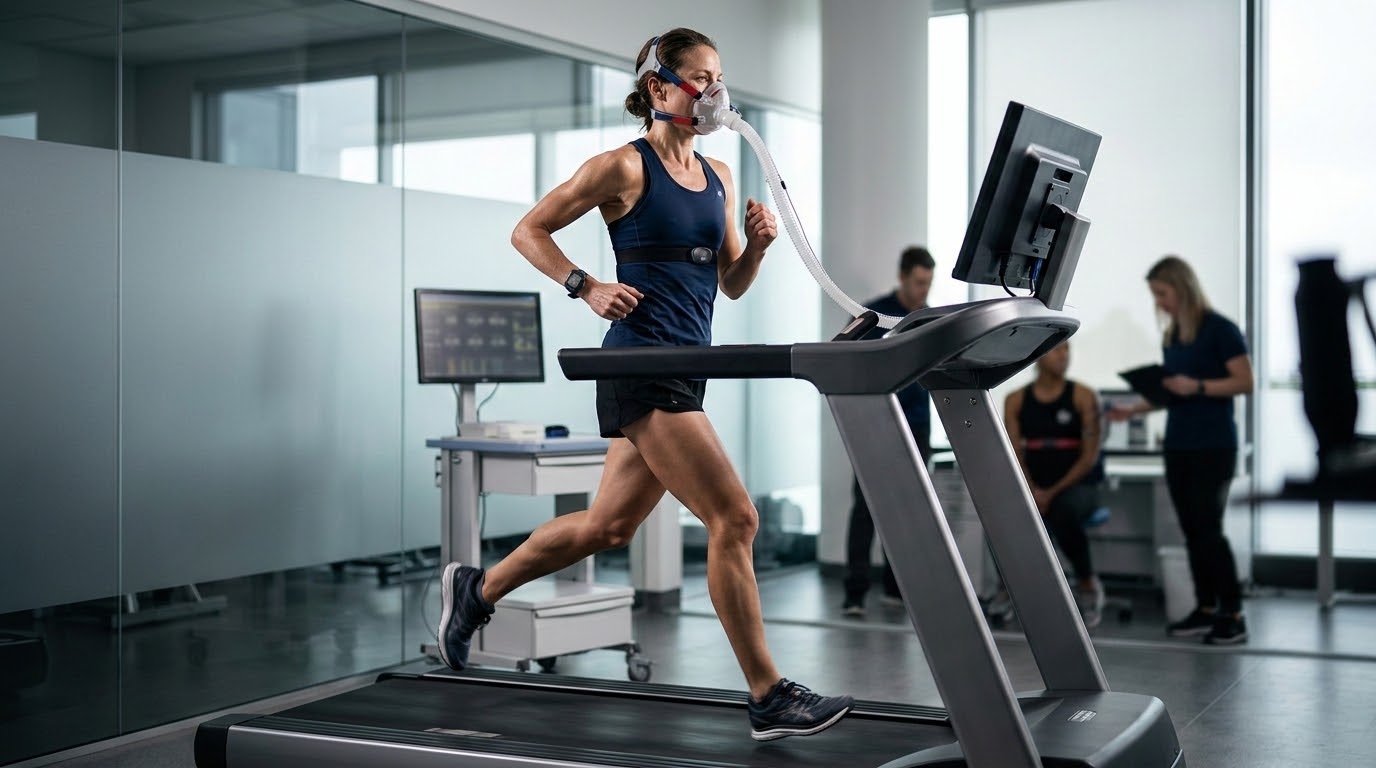
The most direct way to measure VO2 max is through a cardiopulmonary exercise test, commonly called CPET or CPX.
The basic idea is simple. You exercise while the testing system continuously analyzes the air you breathe.
Instead of estimating oxygen use from your heart rate and pace, the equipment measures gas exchange directly.
You may perform the test on a treadmill or stationary bicycle. The workload gradually increases according to a standardized protocol until you reach your maximum or stop because of fatigue, symptoms, or another appropriate reason.
During the test, the system can measure oxygen consumption, carbon dioxide production, ventilation, breathing patterns, heart rate, and other physiological responses.
This is considerably more sophisticated than asking a smartwatch to estimate your VO2 max from a workout.
That does not make wearable estimates useless. It simply means they answer a slightly different question.
A laboratory test asks, “How much oxygen did this person actually consume under controlled testing conditions?”
A wearable generally asks, “Based on the exercise and physiological data available to me, what is the most likely VO2 max?”
Those are not identical measurements.
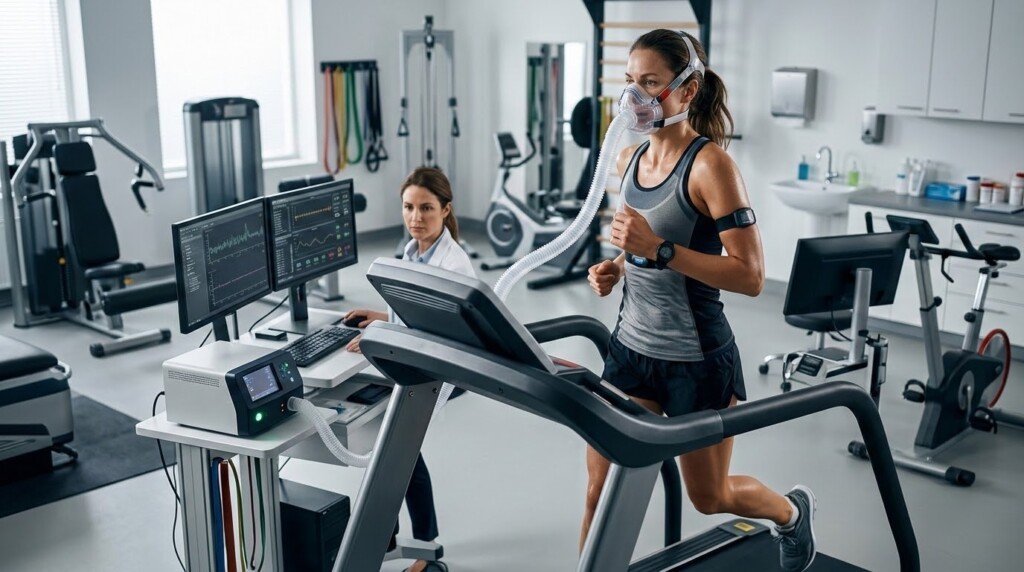
What are the different methods used to measure VO2 Max (lab vs. estimated)?
There are two broad approaches: direct measurement and estimation.
Direct laboratory testing uses respiratory gas analysis. You exercise while wearing equipment that collects and analyzes your inhaled and exhaled air. The system calculates oxygen consumption and other variables throughout the test.
This is the most direct approach and is particularly useful when precise physiological information is needed.
A laboratory test can also reveal more than a single VO2 max number. A CPET can provide information about ventilatory thresholds, breathing efficiency, oxygen pulse, heart rate response, and other variables that help professionals understand why someone may be limited during exercise.
Estimated testing takes a different route.
Field tests may use performance during a timed run, walking test, step test, or other standardized exercise task. Mathematical equations then estimate VO2 max based on variables such as time, distance, heart rate, age, sex, or body weight.
Wearables can also estimate VO2 max using combinations of heart-rate and movement data collected during qualifying workouts.
These estimates can be useful for tracking trends, but they should not be mistaken for laboratory measurements.
A watch may estimate that your VO2 max increased from 38 to 41. That can be encouraging and potentially useful for monitoring progress. But it does not mean the device directly measured 41 mL/kg/min of oxygen consumption in your lungs.
The difference becomes particularly important when comparing results from different devices.
A treadmill estimate from one system may not be directly comparable with a cycling estimate from another. A change in temperature, terrain, heart-rate accuracy, GPS accuracy, fatigue, or workout structure can also influence an estimate.
In other words, estimated VO2 max is best treated as a tracking tool, not an absolute laboratory truth.
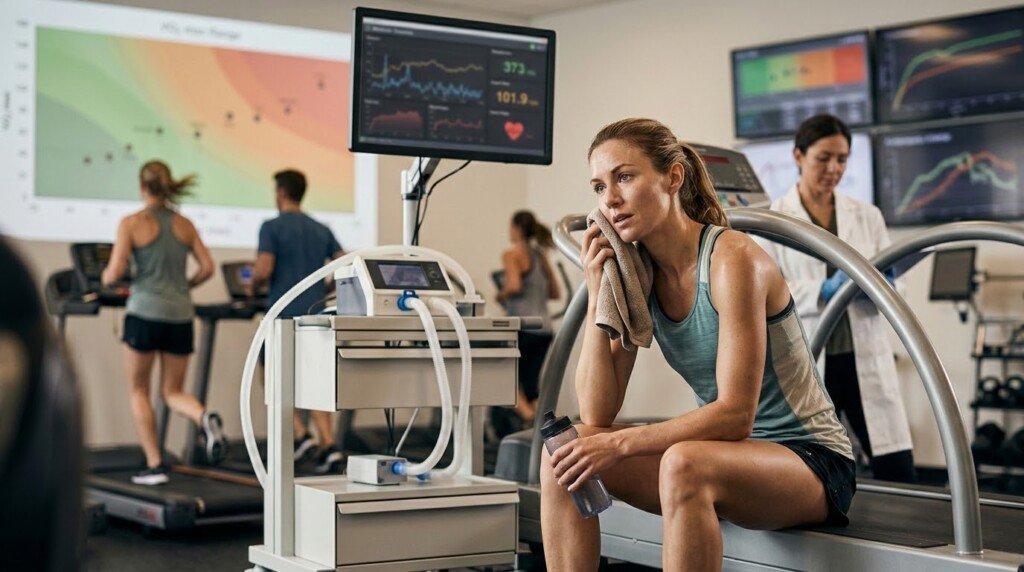
What equipment is needed for an accurate VO2 Max test?
A properly conducted laboratory VO2 max test requires specialized equipment and trained personnel.
The core setup usually includes an exercise device such as a treadmill or cycle ergometer, a system that measures respiratory gases, and monitoring equipment for variables such as heart rate. Depending on the setting and purpose of the test, additional monitoring may be used.
A breathing mask or mouthpiece is commonly used so the system can analyze the air moving into and out of the respiratory system.
The testing software then combines the respiratory data with the exercise workload and physiological responses.
A professional laboratory may also monitor electrocardiographic activity and blood pressure, particularly when the test is being performed for clinical reasons.
This is why a genuine laboratory test is not something that can be perfectly replicated with a smartwatch and a treadmill at home.
The equipment is only part of the equation, though. Testing quality also depends on protocol selection, calibration, data collection, participant effort, and interpretation.
The American Heart Association describes CPET as a conventional exercise test enhanced with simultaneous gas exchange measurements, allowing clinicians to examine oxygen consumption alongside other cardiopulmonary responses.
For a healthy recreational athlete who simply wants to follow fitness trends, a wearable estimate may be perfectly adequate for personal tracking.
For someone being evaluated for unexplained exercise intolerance, significant shortness of breath, cardiovascular disease, pulmonary disease, or another medical concern, a clinically supervised exercise test can provide much richer information.
The right test depends on the question you are trying to answer.
How should I prepare for a VO2 Max test?
Preparation can affect the quality of the result, so the goal is to arrive ready to exercise hard without introducing unnecessary variables.
If you are having a formal laboratory test, follow the instructions provided by the testing facility. Their protocol should take precedence because preparation requirements can vary depending on the purpose of the test and your health status.
In general, you do not want to arrive after an unusually exhausting workout. Heavy exercise shortly before testing can leave you fatigued and potentially affect your ability to reach your highest exercise capacity.
It is also sensible to avoid turning test day into an experiment.
If you normally consume caffeine, drastically changing your caffeine intake immediately before the test may create an unnecessary variable. Likewise, unusual meals, poor hydration, inadequate sleep, or significant stress can make the testing experience different from your normal training conditions.
Wear comfortable exercise clothing and appropriate footwear for the equipment being used.
Most importantly, tell the testing professional about medications, medical conditions, recent illness, unusual symptoms, or anything else that could affect exercise performance or safety.
If the test is being performed for a medical reason, do not independently change medications or attempt to manipulate your heart rate before the appointment.
A VO2 max test is intentionally demanding. The purpose is to challenge the cardiovascular and respiratory systems enough to measure their response.
That means safety matters more than squeezing out an artificially impressive number.
For repeated testing, consistency becomes especially valuable. If you want to compare your results over time, try to use the same exercise mode and similar testing conditions whenever practical. A treadmill test followed months later by a cycling test may produce a different number even if your underlying fitness has not changed dramatically.
FAQ
1. What is VO2 Max?
VO2 max is the maximum rate at which your body can take in, transport, and use oxygen during intense exercise. It is usually expressed in mL/kg/min and is widely used as a measure of cardiorespiratory or aerobic fitness.
2. How is VO2 Max measured?
The most direct method is a laboratory cardiopulmonary exercise test. You exercise on a treadmill or stationary bike while specialized equipment analyzes the oxygen you consume and carbon dioxide you produce. Watches, field tests, and other methods can estimate VO2 max but do not directly measure oxygen consumption.
3. What does VO2 Max tell you about your fitness?
It tells you about your body’s capacity to use oxygen during demanding aerobic exercise. A higher VO2 max generally reflects greater aerobic capacity, but it does not measure every part of fitness. Strength, mobility, body composition, exercise economy, and other factors also matter.
4. Does age affect VO2 Max?
Yes. VO2 max generally declines with age, although the rate varies substantially between individuals. Regular physical activity can help preserve aerobic capacity, and physically active older adults can have much higher aerobic fitness than sedentary younger adults. (ACSM)
5. Is a smartwatch VO2 Max reading accurate?
A smartwatch provides an estimate rather than a direct measurement. It can be useful for tracking trends, especially when you use the same device and similar workout conditions consistently. A laboratory CPET is more appropriate when a precise physiological measurement or clinical assessment is needed.
Disclaimer:
This post may contain affiliate links. If you purchase through them, we may earn a small commission at no extra cost to you. Also, this content is for informational purposes only and does not substitute professional medical advice.
Train Smarter, Not Harder
Use our free Fitness Toolkit to find your heart rate zones and calories burned in minutes.
Open Free Tools →