Myth: You Need to Cut Out All Fats to Lose Weight
For decades, dietary fat was treated as the obvious enemy of weight loss.
Low-fat labels appeared everywhere. People switched from whole milk to skim milk, replaced traditional spreads with low-fat alternatives, avoided nuts because they were “too fatty,” and treated oils, avocados, and other naturally fat-rich foods as foods that belonged outside a weight-loss diet.
That history still influences how many people eat today.
If you have ever wondered, do you need to cut fat to lose weight, the short answer is no. Cutting dietary fat can reduce overall calorie intake for some people, and lower-fat diets can certainly produce weight loss. But that is very different from saying that all dietary fat must be eliminated for fat loss to occur. Research comparing different dietary approaches has repeatedly found that both lower-fat and higher-fat approaches can support weight loss, with long-term success depending heavily on the overall dietary pattern and how well a person can maintain it. (PubMed)
Fat also has legitimate physiological jobs.
It contributes to cell structure, helps the body absorb fat-soluble vitamins, provides essential fatty acids, and can contribute to the enjoyment and satisfaction of meals. The type of fat matters too. Unsaturated fats, including monounsaturated and omega-3 fats, are nutritionally different from the idea of simply treating every gram of fat as an enemy.
The important distinction is this:
Fat is calorie-dense, but calorie-dense does not mean inherently fattening.
A diet containing too much total energy can promote weight gain regardless of whether those calories come primarily from fat, carbohydrate, or a mixture of both.
So where did the fear of fat come from? And if you are trying to lose weight, which fats actually deserve a place on your plate?
Quick Answer: Do You Need to Cut Fat to Lose Weight?
No. Do you need to cut fat to lose weight? You can lose weight without eliminating dietary fat. Reducing fat may lower calorie intake because fat contains more energy per gram than protein or carbohydrate, but completely removing it is unnecessary and can make a diet less satisfying and harder to maintain. The better approach is to control overall intake while choosing appropriate portions and prioritizing nutritious fat sources.
The goal is not a fat-free diet.
It is a sensible diet that includes the right foods in amounts that fit your individual needs.
Why Did Fat Get Blamed for Weight Gain in the First Place?
The fear of dietary fat did not come from nowhere.
There was a logical argument behind it.
Fat contains more energy per gram than protein or carbohydrate. That makes high-fat foods relatively energy-dense. If someone adds large amounts of oil, butter, creamy sauces, fried foods, or other fat-rich foods without accounting for the additional energy, total intake can rise quickly.
That observation was gradually transformed into a much broader message:
Fat contains more calories, therefore fat makes you fat.
That conclusion was too simplistic.
Still, it was easy to understand.
Nutrition advice often works its way into public culture through simple rules. “Reduce fat” is easier to communicate than explaining energy density, food quality, appetite, dietary adherence, and individual differences.
The result was an era in which “low fat” became almost synonymous with “healthy.”
The problem was that removing fat from foods did not automatically make the resulting products nutritionally superior.
In many processed foods, fat was reduced while sugar, refined starches, or other ingredients were used to maintain taste and texture.
That created an important lesson that is still relevant today:
Removing one nutrient from a food does not automatically make the food healthier.
What Historical Dietary Trends Contributed to “Fat-Phobia”?
The low-fat movement became especially influential during the second half of the twentieth century as concerns about dietary fat and cardiovascular disease became increasingly prominent.
Public health messaging increasingly emphasized reducing total fat and, in particular, limiting certain saturated fats.
The message was gradually simplified for consumers.
Choose low-fat foods.
Avoid high-fat foods.
Trim visible fat.
Use less oil.
Choose reduced-fat products.
Some of those recommendations had legitimate nutritional reasoning behind them. The problem was that the public interpretation became much broader than the original scientific discussion.
Instead of distinguishing between different types of dietary fat and considering the overall dietary pattern, many people began treating fat as one single category.
A handful of almonds and a deep-fried pastry both became “high-fat foods.”
An avocado and a processed snack became nutritionally grouped together because both contained fat.
That classification ignored the rest of the food.
Modern nutrition is more nuanced.
Dietary fat is not one substance with one biological effect. Different fatty acids have different properties, and foods containing fat also provide varying amounts of protein, fiber, vitamins, minerals, and other compounds.
Research has also challenged the idea that simply making a diet low in fat guarantees superior long-term weight loss. A large systematic review of long-term randomized trials found that low-fat diets did not consistently outperform higher-fat approaches for weight loss. (PubMed)
That does not mean low-fat diets are ineffective.
It means “low fat” is not a magic requirement for losing weight.

Which Fats Are Actually Beneficial for Weight Loss?
This is where the conversation becomes much more useful.
Instead of asking whether fat is good or bad, consider what kind of fat you are eating and what food it comes from.
Dietary fats can be broadly grouped into saturated, monounsaturated, and polyunsaturated fats, with trans fats representing a separate category of concern.
For weight management, however, the goal should not be to memorize a list of “good fats” and “bad fats.”
The bigger picture matters.
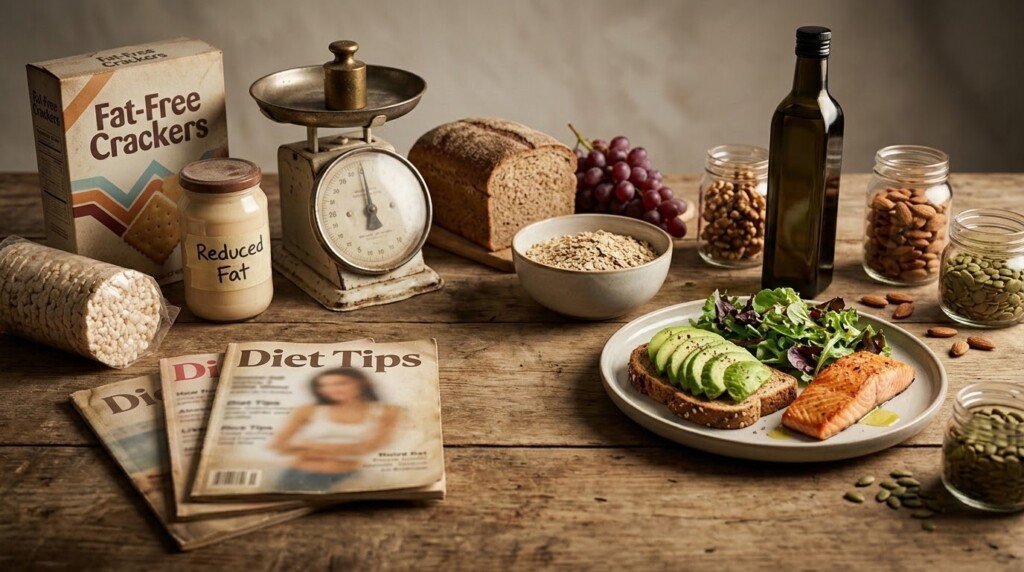
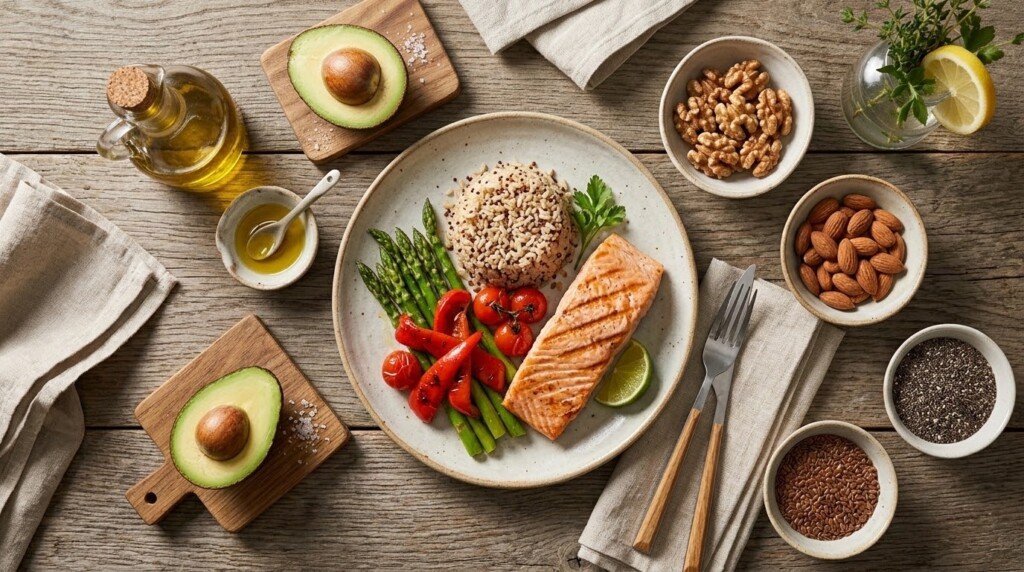
A food containing unsaturated fat may also provide fiber, vitamins, minerals, and plant compounds. Nuts, seeds, avocados, olives, and many plant oils are examples.
Fatty fish can provide omega-3 fatty acids alongside high-quality protein and other nutrients.
These foods can fit into a weight-loss diet because the presence of fat does not automatically cancel their nutritional value.
At the same time, healthy fats are still calorie-dense.
That matters.
Adding unlimited amounts of olive oil, nut butter, nuts, seeds, or avocado to an otherwise balanced diet can still push total energy intake upward.
Calling a food “healthy” does not make its calories irrelevant.
This is why the most useful approach is inclusion rather than unlimited consumption.
What Are the Different Types of Dietary Fats and Their Roles in the Body?
Dietary fat performs several important functions.
It forms part of cell membranes and contributes to normal cellular structure. Certain fatty acids are essential because the body cannot produce enough of them on its own.
Fat also helps the body absorb fat-soluble vitamins such as vitamins A, D, E, and K.
This means that dietary fat is not simply an optional source of extra calories.
It is part of normal human nutrition.
Monounsaturated fats are found in foods such as olive oil, avocados, and many nuts.
Polyunsaturated fats include omega-3 and omega-6 fatty acids. Fatty fish, certain seeds, nuts, and plant oils can provide different types of these fats.
Saturated fats occur naturally in many animal foods and some plant foods. Their role in the diet needs to be considered in the context of overall dietary pattern and what foods they replace.
The important point for weight loss is that none of these categories should be interpreted as a license to eat unlimited quantities.
Fat contains substantial energy in a relatively small amount of food.
That makes portion awareness useful even when the food itself is highly nutritious.
The question is not whether the fat is “healthy enough” to ignore quantity.
It is whether the food and portion make sense within the person’s overall eating pattern.
How Does Eating Healthy Fats Impact Satiety and Appetite Control?
Fat can influence the sensory experience of a meal and may contribute to how satisfying food feels.
It is one reason a completely fat-free meal can sometimes feel less satisfying than a meal containing a moderate amount of fat.
However, the relationship between dietary fat and satiety is more complicated than saying “fat keeps you full.”
A systematic review examining dietary fat, fiber, satiation, and satiety found that the evidence was not strong enough to establish a simple universal satiety advantage from dietary fat alone. (PubMed)
That is an important distinction.
Fat can contribute to meal satisfaction, but it should not be marketed as a guaranteed appetite-control tool.
What matters is the whole meal.
Consider a bowl containing vegetables, beans, a protein source, and a modest amount of olive oil.
The satisfaction of that meal comes from multiple factors, including its protein, fiber, volume, texture, flavor, and fat content.
Removing every trace of fat does not necessarily make the meal better.
It may simply make it less enjoyable.
And enjoyment matters because a diet that feels miserable is difficult to maintain.
Recent evidence also suggests that low-fat diets do not necessarily provide a universal appetite advantage. A 2025 systematic review of randomized trials found little or no additional benefit from low-fat diets for several appetite outcomes, although the researchers emphasized that the evidence base remains limited and further research is needed. (PubMed)
That gives us a more realistic conclusion.
Fat can be part of a satisfying meal.
But it is not a magic appetite suppressant.
What Are Practical Ways to Incorporate Beneficial Fats Into a Weight-Loss Diet?
The easiest approach is to stop treating fat as something that must either dominate a meal or disappear completely.
Use it as a supporting ingredient.
A small amount of olive oil can add flavor to vegetables.
Nuts or seeds can complement yogurt or oatmeal.
Avocado can add richness to a meal built around vegetables and protein.
Fatty fish can provide both protein and omega-3 fatty acids.
Nut butter can work well with fruit or whole-grain foods when the portion fits the overall meal.
The key word is portion.
Fat is energy-dense, so a nutritious food can still contribute more energy than intended when portions become very large.
This is particularly relevant for foods such as oils, nuts, seeds, nut butters, and avocado because they can be easy to consume without realizing how much has accumulated.
A practical fat-loss meal does not need to be fat-free.
Instead, think about balance.
Start with a nutritious protein source.
Add vegetables or other fiber-rich foods.
Include a carbohydrate source if it fits your preferences and needs.
Then add an appropriate amount of dietary fat for flavor, nutrition, and satisfaction.
That approach is considerably more flexible than treating fat as forbidden.
What Happens If You Cut Fat Out of Your Diet Completely?
Removing all dietary fat can sound attractive when the goal is weight loss. If fat contains more calories per gram than protein or carbohydrate, it seems logical that eliminating it completely should make losing weight easier.
The problem is that human nutrition does not work quite that neatly.
Fat is not simply an optional source of calories. Your body uses dietary fat for several important physiological functions, including supporting cell membranes, helping absorb fat-soluble vitamins, and providing essential fatty acids. Removing an entire macronutrient also makes your food choices considerably more restrictive.
That does not mean everyone needs a high-fat diet.
It means there is an important difference between reducing excessive intake of calorie-dense foods and eliminating dietary fat altogether.
The first can be a useful weight-management strategy.
The second is generally unnecessary.
What Are the Potential Negative Health Consequences of a Fat-Free Diet?
A truly fat-free diet creates nutritional problems because some dietary fats are essential.
Essential fatty acids cannot simply be manufactured by the body in sufficient amounts, so they need to come from food.
Dietary fat also helps the body absorb vitamins A, D, E, and K. These are fat-soluble vitamins, meaning dietary fat plays a role in their absorption.
This is one reason completely eliminating fat is fundamentally different from simply eating less of it.
Imagine someone removes olive oil, nuts, seeds, avocado, eggs, fatty fish, and other sources of fat from their diet.
They may succeed in reducing calorie intake.
But they have also eliminated many foods that can contribute valuable nutrients and variety.
The solution is not to swing to the opposite extreme and eat unlimited amounts of fat.
It is to include appropriate sources in sensible quantities.
There is another problem with extreme restriction.
Food becomes unnecessarily complicated.
A person may start examining every label for fat content and rejecting nutritious foods simply because their fat percentage seems high.
This can create an unnecessarily narrow diet.
A sustainable eating pattern should leave room for variety.
It should allow someone to enjoy nutritious foods without constantly thinking that one nutrient has to be avoided completely.
This is particularly important because long-term weight management is not a short nutritional experiment.
You are building an eating pattern that may need to work for years.
A diet that only works when you are willing to avoid an entire category of foods can become difficult to maintain when restaurants, family meals, travel, holidays, or ordinary life enter the picture.
Why Do Low-Fat Diets Sometimes Fail to Deliver Sustainable Weight Loss?
There is nothing inherently wrong with a low-fat diet.
Some people prefer it.
Some people find it easier to manage portions when they choose lower-fat foods.
The problem occurs when “low fat” becomes synonymous with “automatic weight loss.”
It is not.
A lower-fat food can still contain substantial calories.
A low-fat diet can still contain excessive portions.
And a product marketed as low-fat can still be highly processed.
This is where the old low-fat era produced some confusing lessons.
People were encouraged to choose reduced-fat versions of familiar foods, but reducing fat does not necessarily make a food filling, nutrient-dense, or appropriate for unlimited consumption.
A lower-fat cookie is still a cookie.
A low-fat sweetened yogurt may still contain substantial added sugar.
A reduced-fat snack can still be easy to overeat.
The label describes one characteristic of the food.
It does not describe the entire nutritional picture.
Research comparing low-fat diets with diets containing more fat has also failed to establish that simply reducing dietary fat guarantees greater long-term weight loss. One major review of randomized trials found no consistent long-term weight-loss advantage for low-fat diets compared with higher-fat approaches.
That finding does not make dietary fat irrelevant.
It simply removes the idea that fat restriction is a universal requirement for successful weight loss.
The bigger issue remains whether the overall eating pattern creates an appropriate energy intake while providing enough nutrition and remaining practical enough to maintain.
How Much Fat Should You Actually Eat While Trying to Lose Weight?
There is no single amount of dietary fat that works perfectly for everyone.
Your calorie needs, dietary preferences, activity level, health circumstances, and overall eating pattern all matter.
The mistake is assuming that successful fat loss requires pushing fat intake as low as possible.
It does not.
Instead, think in terms of proportion and food quality.
A meal does not need to contain a large amount of fat to be satisfying.
But it also does not need to contain zero fat.
A moderate amount can add flavor and texture while contributing essential fatty acids and helping with absorption of fat-soluble vitamins.
For someone trying to lose weight, the practical challenge is controlling energy intake without creating an unnecessarily restrictive diet.
Because fat is energy-dense, portions deserve attention.
One tablespoon of oil can be easy to pour without measuring.
A handful of nuts can quietly become several servings.
Nut butter can turn into multiple spoonfuls very quickly.
None of these foods are “bad.”
They are simply foods where small portions contain meaningful amounts of energy.
That makes awareness more useful than fear.
Is Fat Actually Bad for Weight Loss?
No.
But “healthy fat” should not be interpreted as “eat unlimited amounts.”
This distinction is frequently lost in social media nutrition advice.
One extreme says:
Fat makes you fat, so eliminate it.
The opposite extreme says:
Healthy fats are good, so calories from them do not matter.
Neither is particularly useful.
A better position sits between those extremes.
Dietary fat can absolutely be part of a fat-loss diet.
At the same time, total energy intake still matters.
If someone adds large amounts of olive oil, nuts, avocado, cheese, and nut butter to their existing diet without changing anything else, their overall energy intake may increase substantially.
The foods may be nutritious.
The additional energy can still matter.
Nutrition becomes much easier when you stop assigning moral labels to individual nutrients.
Fat is not “bad.”
Carbohydrates are not “bad.”
Protein is not automatically “good.”
The overall pattern determines far more than a single nutrient category.
If you are also questioning whether carbohydrates need to be eliminated for fat loss, the same principle applies. Carbs Make You Fat explores that separate myth and explains why carbohydrate intake should be considered in the context of total energy intake and food quality.
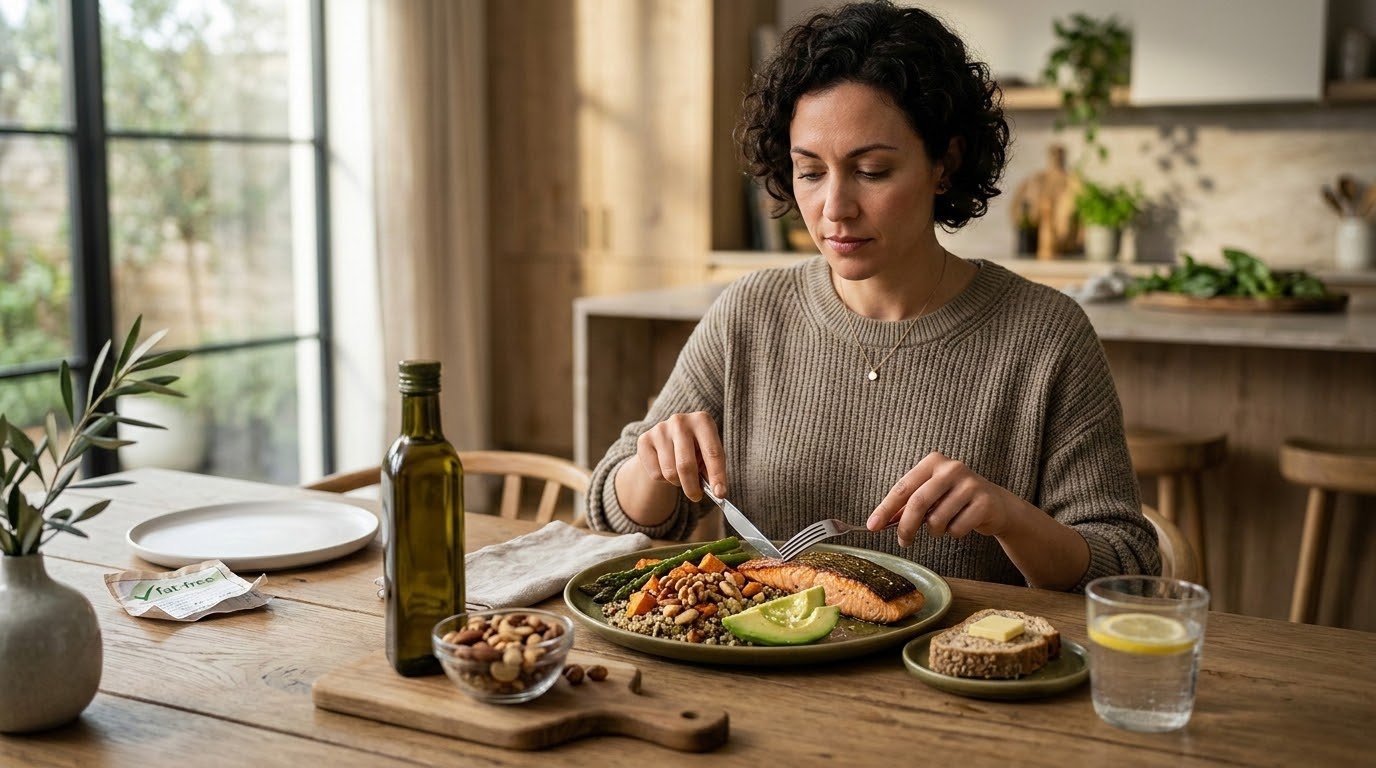
What Does a Balanced Fat-Loss Plate Actually Look Like?
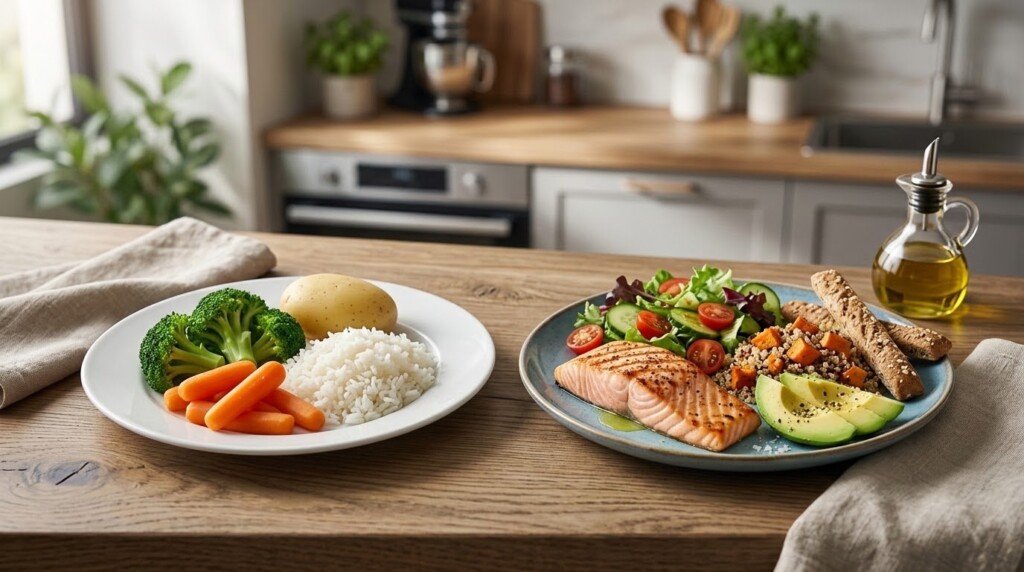
Imagine a normal dinner.
You could have grilled salmon, roasted potatoes, vegetables, and a modest amount of olive oil.
There is fat in the salmon.
There is fat in the olive oil.
There are carbohydrates in the potatoes.
There is protein in the salmon.
There are fiber and micronutrients in the vegetables.
Nothing about that meal requires removing all fat to make it compatible with weight loss.
The same principle could work with a different combination.
Chicken, brown rice, vegetables, avocado, and beans.
Or Greek yogurt, berries, oats, and a small amount of nuts.
The exact foods do not need to be identical for the principle to work.
A balanced meal can contain multiple macronutrients.
The objective is not to make one nutrient disappear.
It is to build a pattern that provides enough nutrition and satisfaction while fitting your overall energy needs.
For readers who want to understand how macronutrients differ from vitamins and minerals, the distinction is covered in Macronutrients vs Micronutrients. That broader nutritional framework is useful because weight-loss decisions should not be based on one nutrient in isolation.
What Should You Remember About Dietary Fat and Weight Loss?
The biggest lesson is surprisingly simple.
You do not need to fear fat.
You also do not need to worship it.
Dietary fat has legitimate biological functions, and completely eliminating it is unnecessary for most people. Some fats, particularly unsaturated fats found in foods such as nuts, seeds, avocados, olive oil, and fish, can fit well within a nutritious eating pattern.
At the same time, fat contains more energy per gram than protein or carbohydrate, so portion size remains relevant.
That combination of facts explains why fat can be both nutritionally valuable and something worth consuming thoughtfully during weight loss.
There is no contradiction.
A nutritious food can still be calorie-dense.
A calorie-dense food can still be part of a healthy diet.
And a healthy diet can still support fat loss.
The Better Question to Ask About Fat
Instead of asking:
“How do I eliminate fat?”
Ask:
“Which fat-containing foods improve the quality of my diet, and what portion fits my needs?”
That question produces much better decisions.
Maybe olive oil helps you enjoy vegetables.
Keep it.
Maybe nuts make your breakfast more satisfying.
Keep them, but be aware of the portion.
Maybe fatty fish provides a convenient source of protein and omega-3 fats.
Keep it.
Maybe you regularly eat large amounts of fried foods because you believe they are fine as long as you avoid other fats.
That deserves a different conversation.
The goal is not to eliminate fat.
The goal is to make fat work within a balanced diet.
Key Takeaways
The belief that all dietary fat must be eliminated for weight loss is outdated and unnecessarily restrictive.
Fat is energy-dense, which means portion size matters. But that does not make fat inherently fattening. Your body requires certain fatty acids, and dietary fat contributes to important functions including cell structure and absorption of fat-soluble vitamins.
Low-fat diets can absolutely produce weight loss.
They simply do not have a special status that makes them necessary for everyone.
The most sustainable approach is usually more flexible.
Choose nutritious sources of fat.
Use sensible portions.
Build meals around adequate protein, vegetables, fiber-rich foods, and other nutrient-dense ingredients.
And judge your diet by its overall pattern rather than one nutrient.
Frequently Asked Questions
1. Do You Need to Avoid Fat to Lose Weight?
No. You can lose weight while eating dietary fat. Fat contributes important nutrients and physiological functions, while long-term weight loss depends primarily on maintaining an appropriate overall energy balance.
2. What Fats Are Good for Weight Loss?
Foods containing unsaturated fats can fit well into a weight-loss diet. Examples include avocados, nuts, seeds, olive oil, and fatty fish. Their portions still matter because dietary fat is energy-dense.
3. Is a Fat-Free Diet Healthy?
A completely fat-free diet is generally unnecessary and can make it difficult to obtain essential fatty acids and properly absorb fat-soluble vitamins. A balanced diet can include moderate amounts of dietary fat.
4. Can Eating Healthy Fats Cause Weight Gain?
Yes, if they contribute to a sustained calorie surplus. “Healthy” describes nutritional qualities, not an exemption from energy balance. Nutritious fat-containing foods can still provide substantial calories.
5. Why Did Low-Fat Diets Become So Popular?
Low-fat eating became popular through decades of dietary and public-health messaging that emphasized reducing dietary fat. The message was often simplified into the idea that fat itself caused weight gain, even though long-term weight management depends on the broader dietary pattern.
Conclusion
The question do you need to cut fat to lose weight has a straightforward answer: no.
You can reduce body fat without eliminating dietary fat from your meals.
In fact, trying to remove every source of fat can make an otherwise healthy diet unnecessarily restrictive. Your body needs essential fatty acids, dietary fat helps with the absorption of vitamins A, D, E, and K, and fat-containing foods can contribute flavor and satisfaction to meals.
The smarter approach is not to swing between “fat is terrible” and “fat is always healthy.”
Both positions miss the point.
Choose quality sources. Pay attention to portions. Consider the entire meal. Keep your overall energy intake appropriate for your goals.
Weight loss does not require a war against fat.
It requires a diet you can actually live with.
Disclaimer:
This post may contain affiliate links. If you purchase through them, we may earn a small commission at no extra cost to you. Also, this content is for informational purposes only and does not substitute professional medical advice.
Fuel Your Body Right
Use our free Nutrition Toolkit to find your protein target, fasting window, and net carbs in minutes.
Open Free Tools →