
Myth: Carbs Make You Fat
For years, carbohydrates have been treated as if they are the obvious culprit behind weight gain. Bread, rice, potatoes, pasta, fruit, and even some vegetables have all been blamed for making people gain fat. That idea has become so common that simply asking do carbs make you fat can produce very different answers depending on which diet trend you happen to encounter.
The reality is more nuanced.
Carbohydrates are a source of energy. Eating them does not automatically cause the body to turn them into body fat. What matters for long-term weight gain is the overall energy balance created by a person’s eating pattern, activity level, appetite, food choices, and other factors.
That does not mean every carbohydrate-rich food is equally useful for weight management. A bowl of beans, fruit, or intact whole grains is nutritionally very different from a large serving of refined pastries or sugar-sweetened drinks. The distinction matters, but it is not the same as saying that carbohydrates themselves are fattening.
The confusion largely comes from mixing together several different ideas: carbohydrates and insulin, carbohydrate-rich foods and calorie intake, temporary water-weight changes, and the effects of highly processed foods. Once these concepts are separated, the “carbs make you fat” argument becomes much easier to understand.
This article looks at where the claim came from, why low-carbohydrate diets became so influential, and what actually happens to carbohydrates after you eat them.
Quick Answer: Do Carbs Make You Fat?
No. Do carbs make you fat is not a question with a simple yes or no based on carbohydrates alone. Carbohydrates do not automatically become body fat simply because they are eaten. Weight gain generally occurs when overall energy intake remains higher than energy expenditure over time. However, highly refined carbohydrate foods can make it easier to consume excess energy because they may be easy to overeat, less filling, or packaged with added fats and sugars.
The better question is not whether carbohydrates are “bad.”
It is which carbohydrate foods you eat, how much you eat, what they replace, and how they fit into your overall diet.
Where Did the “Carbs Make You Fat” Myth Come From?
The belief that carbohydrates are uniquely responsible for body fat did not appear overnight. It developed through decades of changing nutrition advice, competing dietary theories, popular diet books, media coverage, and growing public interest in low-carbohydrate eating.
To understand why the idea became so powerful, it helps to separate the historical popularity of low-carb diets from the much simpler claim that every carbohydrate is inherently fattening.
Those are not the same argument.
Low-carbohydrate diets have existed in different forms for a very long time. What changed was their visibility and the way their results were interpreted.
People who reduced carbohydrates often experienced noticeable changes in body weight, particularly early in the diet. That experience could make the conclusion seem obvious: carbohydrates were removed, weight went down, therefore carbohydrates must have been causing the weight gain.
But body weight is influenced by more than body fat.
Reducing carbohydrate intake can change glycogen stores and associated water storage, which can produce relatively quick changes on the scale. A rapid drop in scale weight can therefore be mistaken for an equally rapid reduction in body fat.
That distinction helped reinforce the idea that carbohydrate restriction had a uniquely powerful effect on fat loss.
There was another factor.
Many carbohydrate-rich foods in modern diets are highly processed and easy to consume in large amounts. Sweetened drinks, desserts, refined snacks, bakery products, and other convenience foods can contribute substantial energy without necessarily creating the same level of fullness as minimally processed foods.
When someone removes these foods during a low-carb diet, their overall food intake may change dramatically.
They may also eat more protein, more vegetables, and fewer highly processed foods.
If body weight then decreases, it becomes tempting to credit the carbohydrate restriction alone.
The actual explanation may be considerably broader.


What Is the Historical Context Behind the Rise of Low-Carb Diets?
Low-carbohydrate dieting became particularly prominent through several waves of popular nutrition culture.
Different approaches emphasized different mechanisms, but many shared a common idea: limiting carbohydrate intake could make weight loss easier.
Some approaches focused heavily on insulin and the body’s hormonal response to carbohydrate consumption. Others emphasized appetite control, reduced processed food intake, or the idea that carbohydrates were particularly problematic for modern sedentary lifestyles.
The popularity of these diets was also helped by their simplicity.
“Eat fewer carbs” is easier to communicate than a complicated explanation involving total energy intake, food quality, appetite, physical activity, sleep, and individual differences.
Simple rules spread quickly.
They are easy to remember, easy to market, and easy to turn into a recognizable diet identity.
This does not mean every low-carb diet is ineffective.
Many people can lose weight successfully while following a lower-carbohydrate eating pattern. The important point is that success with a particular dietary pattern does not automatically prove that one macronutrient is uniquely responsible for body fat.
A diet can work because it changes several behaviors simultaneously.
Someone eating fewer carbohydrates may also be eating fewer ultra-processed foods, consuming more protein, reducing snacking, drinking fewer sugary beverages, and eating more deliberately.
Those changes can all matter.
Which Scientific Studies or Dietary Trends Contributed to This Narrative?
The scientific discussion around carbohydrates and weight has involved several competing hypotheses over the years.
One particularly influential line of thinking focused on insulin. Because carbohydrate consumption can increase insulin secretion, some researchers and diet advocates proposed that insulin’s effects on fat storage might make carbohydrate restriction especially effective for reducing body fat.
This idea became highly visible in popular nutrition writing.
At the same time, controlled dietary studies comparing different macronutrient patterns produced a more complicated picture. Weight loss can occur across a variety of dietary approaches when overall energy intake is appropriately managed.
That does not mean macronutrient composition is irrelevant.
Protein, carbohydrate, and fat influence hunger, food preference, exercise performance, dietary adherence, and the types of foods people tend to consume. These differences can make one dietary pattern easier for one person to maintain than another.
But “this diet works well for me” is not equivalent to “this macronutrient causes fat gain.”
That distinction is crucial.
The rise of low-carb diets also coincided with growing concern about highly processed carbohydrates. As public discussion increasingly focused on sugar, refined grains, sweetened beverages, and processed foods, the category of “carbohydrates” sometimes became unnecessarily broad.
A sugary soft drink and a bowl of lentils are both sources of carbohydrate.
Their nutritional profiles, fiber content, micronutrients, protein content, physical structure, and effects on fullness are dramatically different.
Treating them as identical because both contain carbohydrates creates an oversimplified picture.
What Does the Science Actually Say About Carbs and Weight Gain?
The most useful way to understand carbohydrates and body fat is to stop thinking of food as having a single destination.
When you eat carbohydrates, the body does not simply decide, “This will become fat.”
Instead, carbohydrates enter a dynamic system involving digestion, absorption, blood glucose, glycogen storage, oxidation for energy, and, when overall energy availability exceeds the body’s needs, storage of excess energy.
The body is constantly deciding how to use available fuel.
After a carbohydrate-containing meal, glucose becomes available for energy. Some carbohydrate can be stored as glycogen in the liver and muscles. These stores can later provide fuel when energy demand increases.
If carbohydrate intake changes substantially, glycogen storage also changes.
Because glycogen is stored alongside water, changes in carbohydrate intake can cause noticeable shifts in scale weight without representing equivalent changes in body fat.
This is one reason people sometimes conclude that carbohydrates immediately make them gain fat after seeing the scale rise following a higher-carbohydrate meal.
The increase may largely reflect water and glycogen rather than newly accumulated body fat.
That distinction matters enormously when interpreting short-term weight changes.
How Does the Body Process Carbohydrates for Energy Versus Fat Storage?
Carbohydrates are primarily an energy source.
After digestion, carbohydrates are broken down into smaller molecules, including glucose, which can be used by cells to produce energy.
The body can use this energy immediately.
It can also store some carbohydrate as glycogen for later use.
Muscles store glycogen for their own energy needs, while the liver maintains glycogen that helps support blood glucose between meals.
The body can also convert carbohydrate into fat through a process called de novo lipogenesis.
However, this pathway should not be misunderstood as meaning that every carbohydrate-containing meal automatically becomes body fat.
Under ordinary dietary conditions, carbohydrate is commonly oxidized for energy and stored as glycogen. The body regulates multiple fuel sources simultaneously.
The bigger issue for long-term fat gain is persistent excess energy.
When the body receives more usable energy than it needs over time, that excess energy can ultimately contribute to stored body fat.
This is why the simple statement “carbs turn into fat” misses the important part of the physiology.
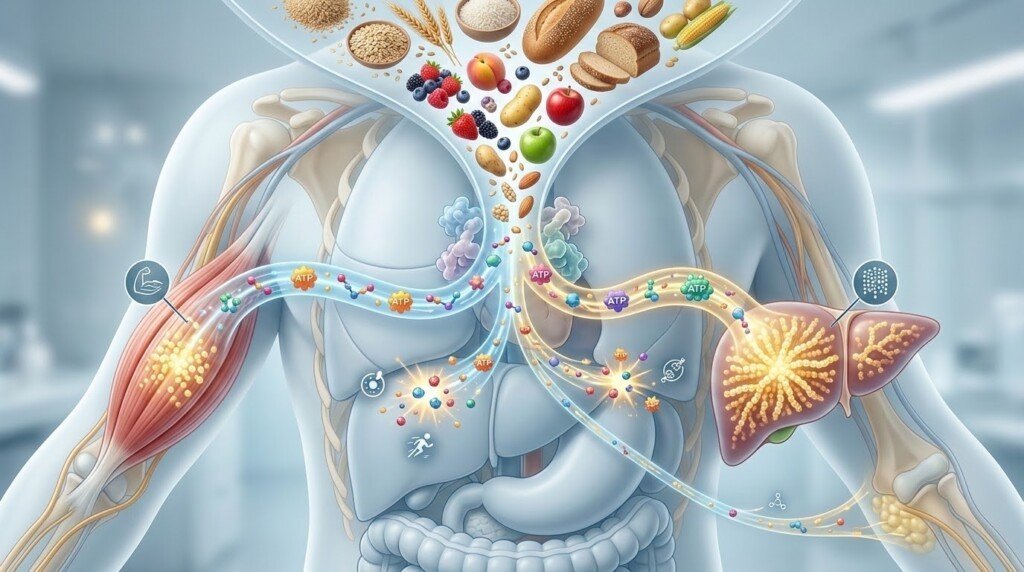
The body can convert nutrients, but what determines long-term changes in body fat is the overall energy environment rather than the mere presence of carbohydrate in a meal.
Consider two diets.
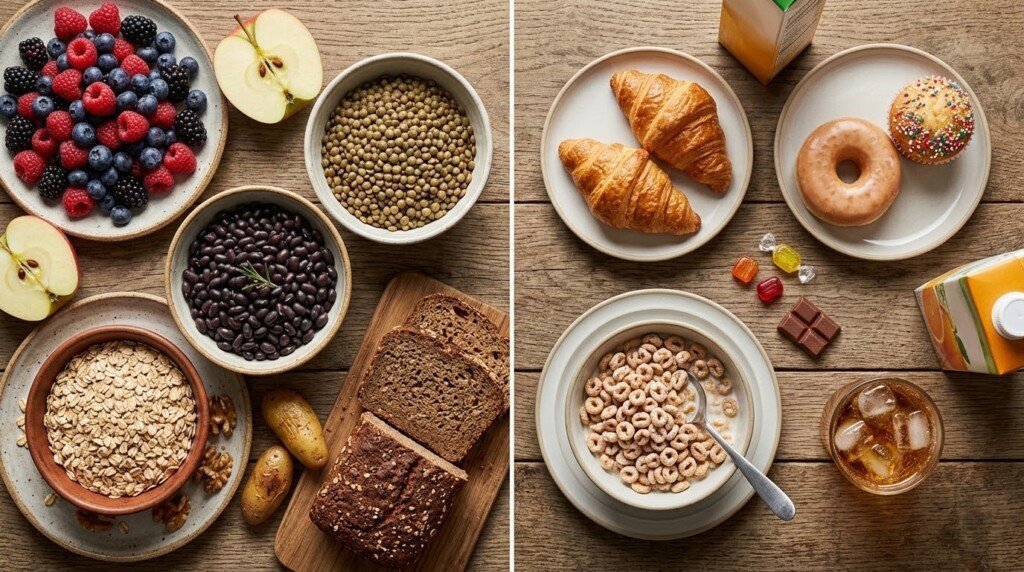
One contains carbohydrates from vegetables, beans, fruit, potatoes, oats, and whole grains. The person eats satisfying portions and maintains an appropriate overall energy intake.
Another contains large amounts of refined snacks, sweetened beverages, pastries, and desserts. The person frequently eats beyond hunger and consumes more total energy than their body needs.
Both diets contain carbohydrates.
Their effects on weight management can be very different.
The carbohydrate label alone cannot explain the outcome.
Does Calorie Intake Matter More Than Macronutrient Source for Weight Gain?
For changes in body weight and body fat over time, overall energy balance is fundamental.
If a person consistently consumes more energy than their body uses, excess energy can be stored and body weight can increase.
If energy intake remains below energy expenditure over time, stored energy is mobilized and body weight generally decreases.
Macronutrient composition still matters because it influences how easy it is to maintain that energy balance.
Protein can increase satiety and supports lean tissue.
Fiber-rich carbohydrates can contribute to fullness.
Dietary fat is energy dense and contributes to food palatability.
Highly processed foods can be easy to consume quickly and in large quantities.
These factors affect eating behavior.
So saying “calories matter” should not be interpreted as “food quality doesn’t matter.”
Both concepts can be true at the same time.
A person’s ability to maintain an appropriate energy intake depends partly on what foods they eat, how satisfying those foods are, how much they enjoy them, and how easily those foods fit into their lifestyle.
This is also why the argument between “carbs versus calories” can become unnecessarily polarized.
It is not necessary to choose one explanation and reject the other.
Carbohydrate intake can influence appetite, food choices, exercise performance, and total energy intake. At the same time, sustained energy surplus is what ultimately permits body fat to accumulate.
The practical question is therefore not whether carbohydrates are dangerous.
It is whether the overall eating pattern supports the person’s health and weight-management goals.
Are All Carbs Treated Equally by the Body?
No. Calling all carbohydrates “bad” ignores one of the most important distinctions in nutrition: the difference between the carbohydrate itself and the food that delivers it.
A whole orange and a sugary soft drink both contain carbohydrate, but they behave very differently as foods. The orange provides water, fiber, vitamins, minerals, and a physical structure that takes time to eat. The soft drink provides rapidly available carbohydrate in a form that is extremely easy to consume without much fullness.
The same distinction applies to oats and sweet pastries, lentils and candy, potatoes and highly processed snack foods.
This is why the question do carbs make you fat cannot be answered simply by labeling every carbohydrate as either healthy or unhealthy. The quality, structure, portion, preparation, and overall dietary context matter.
Why Are Whole-Carbohydrate Foods Often Easier to Fit Into a Fat-Loss Diet?
Many minimally processed carbohydrate foods contain substantial amounts of fiber and water.
Vegetables, fruits, beans, lentils, and intact whole grains can provide considerable volume relative to their energy content. Fiber can also support fullness and normal digestive function.
This does not make these foods magically fat-burning.
Their advantage is more practical.
They can make a satisfying diet easier to maintain.
For example, a meal containing potatoes, vegetables, lean protein, and a modest amount of fat can be filling and nutrient dense. The carbohydrate in the potatoes is not automatically a problem. In fact, removing the potatoes might make the meal less satisfying for someone who enjoys them.
The same principle applies to fruit.
Fruit contains naturally occurring sugars, but it also comes packaged with fiber, water, and micronutrients. Treating fruit as equivalent to candy simply because both contain sugar misses the broader nutritional context.
This is why a sustainable fat-loss diet does not need to eliminate carbohydrate-rich whole foods simply because carbohydrates have developed a bad reputation.
Why Can Refined Carbs Make Weight Management More Difficult?
The more relevant concern is often the food’s overall composition and how easy it is to consume in large amounts.
Many refined carbohydrate foods have been processed to remove or break down parts of the original food structure. They may also contain added sugars, fats, salt, or other ingredients that increase palatability.
Think about how quickly someone can consume a sweetened beverage compared with eating several pieces of whole fruit.
The beverage requires almost no chewing.
It may provide little fullness.
The calories can be consumed in minutes.
The same principle can apply to cookies, pastries, chips, and other highly palatable foods.
Again, the problem is not that the carbohydrate molecule suddenly becomes fattening.
The issue is that certain food combinations make it easier to consume more energy than intended.
This distinction is important because it prevents an unnecessarily restrictive conclusion.
You do not need to fear bread because some breads are highly processed.
You do not need to fear rice because white rice contains rapidly digestible carbohydrate.
You need to understand how those foods fit into your overall eating pattern.
If your diet consistently provides satisfying portions, adequate protein, fiber-rich foods, and an appropriate overall energy intake, carbohydrates can fit comfortably into a weight-management plan.
If you are comparing broader dietary patterns, the differences between lower-carbohydrate and lower-fat approaches are covered separately in Low Carb vs Low Fat Diet, rather than turning this myth-focused article into a full diet comparison.
What About Insulin? Does It Make Carbs Uniquely Fattening?
Insulin is one of the reasons the carbohydrate myth has been so persistent.
Carbohydrate consumption can raise blood glucose, which generally stimulates insulin release. Insulin has important functions in the body, including helping regulate blood glucose and influencing how nutrients are stored and used.
Because insulin can promote storage and reduce the release of stored fat in certain metabolic circumstances, it is sometimes presented as the explanation for why carbohydrates supposedly cause fat gain.
That interpretation is incomplete.
Insulin is not a villain.
It is a normal hormone essential to healthy metabolism.
The body does not need to keep insulin low at all times to prevent fat gain. Nor does eating carbohydrate automatically place the body into a state of continuous fat storage.
Fat storage and fat loss occur within a much larger energy-regulation system.
If someone consumes more energy than they use over time, body fat can increase. If energy availability remains lower than expenditure over time, stored energy can be mobilized.
Insulin participates in this system, but it does not override the fundamental relationship between energy intake and expenditure.
This is why reducing carbohydrates can help some people lose weight without proving that carbohydrates themselves are uniquely fattening.
A lower-carb diet may reduce food choices, decrease appetite for some individuals, eliminate many processed foods, or make it easier to maintain an appropriate energy intake.
Those are meaningful effects.
But they are different from claiming that carbohydrates automatically become body fat.
So Why Do Some People Lose Weight Quickly When They Cut Carbs?
This is where the scale can create a particularly convincing illusion.
When carbohydrate intake drops substantially, the body generally uses some stored glycogen. Glycogen is stored with water, so changes in glycogen storage can produce noticeable changes in body water.
As a result, someone beginning a low-carbohydrate diet may see the scale move relatively quickly.
That early change can feel dramatic.
But a rapid change in scale weight does not mean the same amount of body fat disappeared.
Some of the change can reflect water and glycogen.
This explains why someone might regain several pounds quickly after increasing carbohydrate intake again without having suddenly gained the same amount of body fat.
The scale is measuring total body mass.
It cannot distinguish fat, water, glycogen, food volume, and other components on its own.
That distinction is particularly important when evaluating any diet.
A dramatic first-week change can attract attention, but sustainable body-fat reduction should be judged over a longer period rather than through short-term scale fluctuations.
Does Cutting Carbs Make Sense for Some People?
It can.
The fact that carbohydrates are not inherently fattening does not mean everyone must eat a high-carbohydrate diet.
Some people genuinely prefer lower-carbohydrate eating.
They may feel more satisfied with meals built around protein, vegetables, healthy fats, and smaller amounts of carbohydrate.
Others perform better physically and psychologically with more carbohydrate in their diet.
Athletes, highly active individuals, and people who simply enjoy foods such as rice, oats, potatoes, fruit, and whole grains may find carbohydrate-inclusive eating easier to maintain.
Individual preference matters because adherence matters.
The best dietary pattern is not necessarily the one with the fewest carbohydrates.
It is the one that provides adequate nutrition and can be maintained consistently while supporting the person’s health and goals.
That may look different from one person to another.
What Should You Actually Do With Carbs If You’re Trying to Lose Weight?
Instead of asking whether carbohydrates should be eliminated, start with a better set of questions.
What carbohydrate foods do I actually enjoy?
Which ones keep me satisfied?
Am I eating mostly minimally processed sources or relying heavily on refined snacks and sugary drinks?
Are my portions appropriate for my overall needs?
Do my meals contain enough protein and fiber?
Are carbohydrate-rich foods replacing foods that provide important nutrients, or are they complementing a balanced meal?
These questions produce much more useful answers than simply labeling carbohydrates as good or bad.
For many people, a practical approach is to build meals around nutrient-dense foods and allow carbohydrate sources to remain part of that structure.
Fruit can stay.
Whole grains can stay.
Beans and lentils can stay.
Potatoes can stay.
Rice can stay.
There is no physiological rule stating that these foods must disappear for fat loss to occur.
At the same time, foods such as desserts, pastries, sweetened drinks, and refined snack products can still be enjoyed without pretending they have unlimited nutritional value.
The goal is not perfection.
It is context.
A Better Way to Think About the Carb Question
The “carbs make you fat” myth survives because it takes a complicated biological system and reduces it to one sentence.
Carbohydrates increase insulin.
Insulin promotes storage.
Therefore carbohydrates cause fat gain.
The problem is the missing middle.
Human metabolism does not operate through a single switch.
Your body is constantly balancing energy intake, energy expenditure, glycogen storage, fat oxidation, protein turnover, appetite, physical activity, and numerous hormonal signals.
Carbohydrates are one part of that system.
They are not the entire system.
A more useful statement would be this:
Carbohydrate-rich foods can contribute to weight gain when they are part of an overall eating pattern that consistently provides more energy than the body uses. But carbohydrates themselves do not automatically create body fat.
That distinction is scientifically and practically important.
It allows people to make decisions based on the quality and quantity of their overall diet rather than fear.
If you are working through other common nutrition myths, the broader Weight Loss Myths topic can help put individual claims into context. The same principle applies here: examine the mechanism rather than accepting a memorable slogan.
Key Takeaways
The evidence does not support the simplistic claim that carbohydrates automatically make people fat.
Carbohydrates are an important energy source and can be stored as glycogen or used for immediate energy. The body can also convert carbohydrate into fat under certain conditions, but that does not mean every carbohydrate-containing meal is automatically converted into body fat.
Long-term weight gain is primarily associated with sustained excess energy intake relative to expenditure.
Food quality still matters because different carbohydrate foods can have very different effects on fullness, nutrition, eating behavior, and overall energy intake. Whole and minimally processed carbohydrate sources can fit comfortably into a balanced fat-loss diet, while highly refined and highly palatable foods may make overeating easier for some people.
Low-carbohydrate diets can work for some individuals.
That does not prove carbohydrates are uniquely fattening.
It means that a particular dietary pattern may make it easier for that person to manage food intake and maintain consistency.
Frequently Asked Questions
1. Do carbs actually make you fat?
No. Carbohydrates do not automatically cause body-fat gain. Sustained excess energy intake is the primary driver of long-term weight gain, while the type and quality of carbohydrate foods can influence appetite, nutrition, and how easy it is to maintain an appropriate energy intake.
2. Are all carbs bad for weight loss?
No. Fruits, vegetables, beans, lentils, potatoes, and whole grains can all fit into a weight-loss diet. Highly refined carbohydrate foods can be easier to overeat, but that does not make every carbohydrate food unhealthy or fattening.
3. Why did low-carb diets become so popular?
Low-carb diets became popular through several waves of dietary trends that emphasized insulin, carbohydrate restriction, appetite control, and rapid early changes in scale weight. Early water and glycogen changes also helped make carbohydrate restriction appear especially powerful.
4. Does insulin cause carbs to turn directly into body fat?
Insulin plays an important role in nutrient storage and metabolism, but it does not mean that eating carbohydrates automatically creates body fat. Long-term fat gain depends on the overall energy balance of the diet and lifestyle.
5. Can I eat carbs and still lose weight?
Yes. Many people successfully lose weight while eating carbohydrate-rich foods. The key is choosing a dietary pattern that provides appropriate overall energy intake, adequate nutrition, satisfying foods, and consistency over time.
Conclusion
The question do carbs make you fat sounds simple, but the answer requires more than blaming one macronutrient.
Carbohydrates are not a metabolic shortcut to automatic fat storage. They provide energy, replenish glycogen, and can come from foods ranging from highly nutritious whole foods to highly processed products. Those foods should not be treated as interchangeable simply because they share the same macronutrient category.
The more useful approach is to stop asking whether carbohydrates are inherently fattening and start asking how they fit into your overall diet.
If carbohydrate-rich foods help you build satisfying, nutritious meals that you can maintain consistently, there is no universal reason to eliminate them simply because of their carbohydrate content. If highly refined foods make it easier for you to overeat, reducing those particular foods may be useful.
That is a much more practical conclusion than “carbs are bad.”
Fat loss does not require fearing carbohydrates. It requires understanding them.
Disclaimer:
This post may contain affiliate links. If you purchase through them, we may earn a small commission at no extra cost to you. Also, this content is for informational purposes only and does not substitute professional medical advice.
Fuel Your Body Right
Use our free Nutrition Toolkit to find your protein target, fasting window, and net carbs in minutes.
Open Free Tools →