


Metabolic Flexibility and Energy Levels: Why You Feel Tired or Sluggish
Feeling tired in the afternoon is easy to blame on a bad night’s sleep, a heavy lunch, too much coffee, or simply “getting older.”
Sometimes that is exactly what is happening.
But energy is not controlled by one switch.
Your brain, muscles, liver, hormones, sleep schedule, food intake, activity level, and circadian clock all participate in keeping you energized. Your body also has to continually adjust which fuels it uses as circumstances change.
That is where metabolic flexibility and energy levels become an interesting connection.
Metabolic flexibility describes the body’s ability to adjust fuel use according to what is available and what the body needs. When carbohydrate is readily available, carbohydrate oxidation can increase. When food has not been consumed for a while or energy demands change, fat oxidation can become more important. (PubMed Central (PMC))
This does not mean that every afternoon energy crash is caused by poor metabolic flexibility. Persistent fatigue can have many causes, including insufficient sleep, anemia, medication effects, thyroid problems, depression, sleep disorders, inadequate nutrition, and other medical conditions.
The useful question is narrower:
Could the way your body handles and switches between fuels contribute to why your energy feels inconsistent?
There is another piece that makes this even more interesting. Your metabolism does not operate identically at 8 a.m., 2 p.m., and midnight. Circadian rhythms influence glucose metabolism, insulin sensitivity, lipid metabolism, appetite, and energy expenditure across the day. (PubMed Central (PMC))
So if you regularly feel fine in the morning and sluggish later in the day, the story may involve more than the food sitting in front of you.
How Does Metabolic Flexibility Affect Energy Levels Throughout the Day?
Energy is often described as though your body has a single fuel tank.
It does not.
Your body has access to several energy sources and metabolic pathways. Glucose can be used rapidly, glycogen can provide stored carbohydrate, and body fat provides a large reserve of stored energy. During fasting, the contribution of fat to energy production generally increases.
Your metabolism continually adjusts the mixture.
That adjustment is part of metabolic flexibility.
When the system responds appropriately, energy availability can adapt as your circumstances change. You eat a meal, become active, sit at a desk, walk home, exercise, and eventually sleep. Each situation creates different demands.
That does not mean you should feel equally energetic during every hour.
Normal energy fluctuations happen.
The problem is when people interpret every fluctuation as evidence that their metabolism is “broken.”
How Do Carbohydrates and Fats Influence Energy Depending on Metabolic Flexibility?
Carbohydrates and fats are not interchangeable in exactly the same way.
Carbohydrate is particularly useful when energy needs are high because glucose and stored glycogen can support relatively rapid energy production. Fat provides a large energy reserve and becomes increasingly important during lower-intensity activity and periods of lower food availability.
A metabolically flexible body can adjust the relative contribution of these fuels.
Imagine you eat lunch containing carbohydrates.
Your body now has more incoming glucose available. It can increase carbohydrate use while also storing some energy for later.
Several hours pass.
The immediate supply from lunch has decreased. Your body can increase reliance on stored fuels.
Then you go for a brisk walk.
Energy demand rises again, and your muscles adjust their fuel use according to the intensity and duration of the activity.
This is not a conscious decision.
Your metabolism is continuously making these adjustments.
Metabolic inflexibility refers to a reduced ability to change fuel oxidation when fuel availability or metabolic conditions change. Research has linked this phenomenon with insulin resistance, although the relationship is complex and metabolic inflexibility is not itself a diagnosis. (PubMed Central (PMC))
The important point for energy is that fuel switching is part of normal physiology.

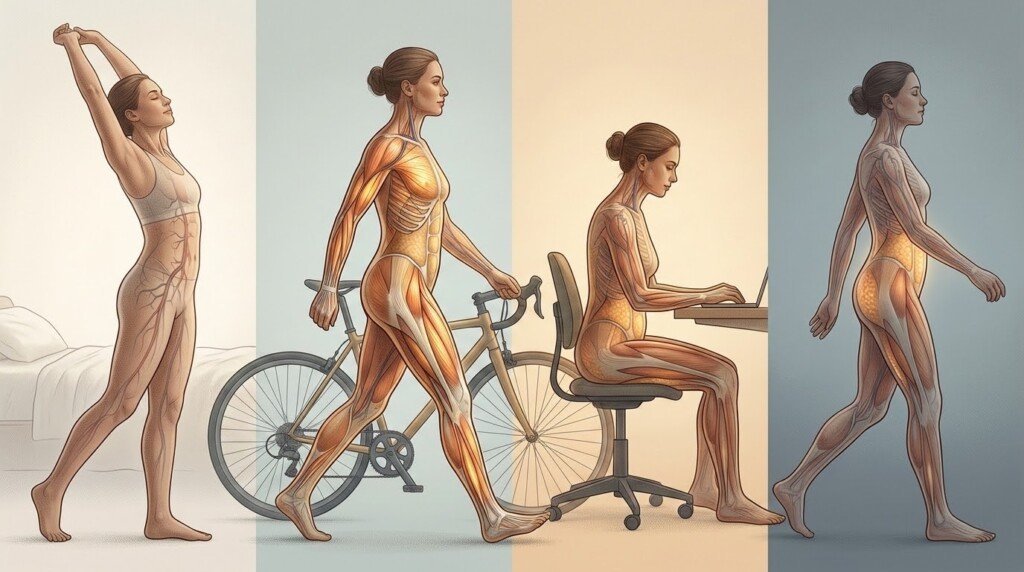
Why Can Energy Feel Fine in the Morning but Crash Later?
There is no single explanation.
A mid-afternoon crash can happen because you slept poorly, ate a very large meal, skipped physical activity, have been sitting for hours, consumed too little food earlier, or simply experience a normal circadian dip in alertness.
The timing of your biological clock matters too.
Circadian rhythms influence metabolic processes throughout the day, including glucose tolerance, insulin sensitivity, lipid metabolism, appetite, and energy expenditure. Human research generally finds better glucose tolerance earlier in the day than later in the evening. (PubMed Central (PMC))
That does not mean your metabolism suddenly “shuts down” at 2 p.m.
It means the metabolic environment changes over a roughly 24-hour cycle.
Your body is not metabolically identical at every hour.
This is one reason a person can experience a predictable afternoon slump without having a serious metabolic problem.
What Are Common Signs of Poor Metabolic Flexibility Related to Fatigue?
There is no reliable symptom checklist that can diagnose poor metabolic flexibility.
That distinction matters.
You might read online that constant hunger, afternoon fatigue, brain fog, difficulty losing weight, or cravings automatically mean your metabolism cannot switch fuels properly.
That is too simplistic.
Those experiences can have many explanations.
However, if energy fluctuations repeatedly occur alongside other metabolic concerns, such as known insulin resistance, obesity, poor exercise tolerance, or significant changes in blood glucose, it may be reasonable to discuss the broader metabolic picture with a healthcare professional.
Research has found associations between metabolic inflexibility and metabolic dysfunction, but researchers do not use afternoon fatigue as a standalone diagnostic test. (PubMed Central (PMC))
So think of symptoms as signals worth understanding, not proof of a specific metabolic problem.
Can Chronic Low Energy Actually Be a Sign of Impaired Metabolic Flexibility?
Possibly, but chronic fatigue alone is not enough to make that conclusion.
Metabolic flexibility concerns fuel switching.
Fatigue is a symptom.
Those are not the same thing.
If you are tired every day, the first priority should be to consider the common and medically important explanations rather than assuming you need to “fix your metabolism.”
Sleep deprivation is an obvious example.
So are anemia, thyroid disorders, certain medications, depression, anxiety, sleep apnea, inadequate calorie or nutrient intake, dehydration, infections, and other health problems.
Persistent fatigue deserves attention precisely because it has such a wide range of possible causes.
Metabolic flexibility may be part of the metabolic picture, but it should not become a convenient explanation for every unexplained symptom.
Why Does the Same Meal Sometimes Give You Energy and Other Times Make You Sluggish?
This is where the idea of context becomes useful.
The response to a meal does not happen in isolation.
Your previous meal, sleep, activity, stress, time of day, body composition, fitness, and overall health can all influence what happens afterward.
The meal itself matters too.
A large meal that combines substantial calories, refined carbohydrates, fat, and alcohol may leave someone feeling very different from a smaller meal containing protein, vegetables, and fiber-rich carbohydrates.
That does not mean one meal is inherently “good” and another is “bad.”
It means digestion and metabolism are dynamic.
Two identical meals eaten by the same person under different circumstances may not produce exactly the same subjective experience.
The circadian system adds another layer.
Research in humans shows daily rhythms in glucose tolerance and several other aspects of metabolism. These rhythms are influenced by the interaction between the central clock and peripheral clocks in tissues such as the liver, muscle, and adipose tissue. (PubMed Central (PMC))
Your metabolism is therefore not simply reacting to food.
It is also operating according to biological timing.
When Are Your Body’s Metabolic Switches Most Active?
The phrase “metabolic switch” sounds like something that turns on at a specific time.
Real physiology is more gradual.
Your body contains multiple systems that regulate fuel use. Insulin helps coordinate nutrient storage and utilization. Glucagon participates in maintaining blood glucose during fasting. Adrenal hormones influence energy availability and stress responses. Cellular energy sensors respond to the energy state of individual cells.
Meanwhile, the circadian system coordinates many of these processes across the day.
The result is not one switch.
It is an interconnected network.
What Are the Primary Metabolic Switches in the Human Body?
Several biological signals help determine which fuels are being used.
Insulin generally rises when nutrients, particularly carbohydrate, enter the bloodstream after eating. It helps tissues take up glucose and influences whether the body is storing or mobilizing energy.
Glucagon helps maintain blood glucose during periods when you are not eating by promoting processes that release or produce glucose.
AMPK, a cellular energy sensor, responds to changes in cellular energy availability and helps coordinate energy-producing and energy-consuming processes.
Catecholamines, such as adrenaline and noradrenaline, influence energy mobilization during exercise and stress.
The circadian clock provides the timing framework around many of these processes.
These systems do not operate independently.
They interact.
That is why saying “insulin is the fat-burning switch” or “fasting turns on the metabolic switch” is too simplistic.
There are many switches, signals, and feedback systems operating at the same time.
Metabolic flexibility is the broader capacity of this system to change fuel use appropriately.
How Does the Circadian Clock Influence Metabolism?
Your circadian system is essentially a biological timing network.
The central clock is located in the brain, while peripheral clocks exist in tissues throughout the body, including the liver, skeletal muscle, and adipose tissue. Together, these clocks help coordinate physiological processes across approximately 24-hour cycles. (PubMed Central (PMC))
That timing system helps organize when your body expects activity, food, rest, and fasting.
Research in humans has identified daily rhythms in glucose tolerance, insulin responses, lipid metabolism, energy expenditure, and appetite. Several metabolic measures tend to be more favorable earlier in the biological day than later. (PubMed Central (PMC))
This does not mean everyone must eat breakfast at exactly 7 a.m.
It does mean timing is biologically relevant.
Your body evolved in an environment where activity and food availability followed daily cycles. Modern life can disrupt those patterns through night-shift work, irregular sleep, late-night light exposure, and eating at unusual times.

How Does Exercise Timing Affect When These Metabolic Switches Activate?
Exercise changes energy demand immediately.
When you start moving, your muscles need more ATP, the cellular energy currency.
The body responds by increasing energy production.
But the metabolic response can vary depending on when you exercise.
Morning exercise occurs in a different hormonal and circadian environment than late-night exercise.
That does not mean one time is universally superior.
It means exercise timing interacts with your biological clock.
Research on circadian metabolism suggests that the body’s handling of glucose and energy changes across the day. Exercise itself can also influence metabolic signaling and circadian physiology. (PubMed Central (PMC))
For most people, consistency is likely to be more practical than obsessing over a perfect exercise hour.
A workout you perform regularly is more useful than an “optimal” workout time you cannot maintain.
Are There Specific Times of Day When Fuel Switching Naturally Happens?
Fuel switching happens throughout the day.
There is not one magical hour when your body suddenly changes from carbohydrate burning to fat burning.
Instead, fuel use shifts continuously according to food intake, fasting duration, activity, exercise intensity, and hormonal signals.
After eating, carbohydrate oxidation generally increases.
As time passes without food, the body progressively draws more heavily on stored fuels.
During exercise, fuel use changes according to intensity and duration.
During sleep, your body continues using energy even though you are not eating.
So the metabolic system is always adjusting.
Circadian rhythms influence the backdrop against which these changes happen, but they do not replace the effects of food and physical activity.
Why Do You Sometimes Feel Hungry and Tired at the Same Time?
Hunger and fatigue can overlap, but they are not necessarily caused by the same process.
You may feel tired because you slept poorly and hungry because you have eaten very little.
You may feel sleepy after a large meal without actually needing more food.
You may also confuse boredom, stress, dehydration, or habit with hunger.
The metabolic explanation can be more complicated still.
If meals are irregular, energy intake is inadequate, or physical activity is high, your subjective energy can change.
Blood glucose also changes after meals, but a normal post-meal glucose response should not automatically be interpreted as a dangerous “blood sugar crash.”
People often use the phrase sugar crash loosely.
A true episode of hypoglycemia is a medical issue and is not the same thing as ordinary post-meal sleepiness.
This distinction is particularly important for people with diabetes or people taking glucose-lowering medication.
What Does a “Blood Sugar Dip” Actually Mean?
The phrase “blood sugar dip” is popular online because it seems to explain almost every afternoon slump.
But it can mean several different things.
Someone might use it to describe feeling sleepy after lunch.
Another person might mean feeling hungry three hours after eating.
Someone with diabetes may use it to describe an objectively measured fall in blood glucose.
Those situations are not equivalent.
A healthy person can experience normal fluctuations in blood glucose without becoming hypoglycemic.
If you repeatedly experience shaking, sweating, confusion, faintness, palpitations, or other concerning symptoms, particularly if you have diabetes or take medication that lowers glucose, that deserves medical attention rather than a social-media diagnosis of “metabolic inflexibility.”
Metabolic health should be evaluated with appropriate clinical information.
It should not be inferred from one afternoon slump.
Why Does the Afternoon Slump Feel So Predictable?
Because several factors can converge.
You may have been awake for six or seven hours.
Your alertness naturally changes throughout the day.
You may have eaten lunch.
Your body is processing nutrients.
You may have been sitting for several hours.
Your workload may have become mentally exhausting.
And your circadian rhythm is influencing alertness and metabolic processes.
That combination can produce a very predictable dip.
The important insight is that predictable does not necessarily mean pathological.
Humans are rhythmic organisms.
The body expects changes in activity and rest.
The challenge of modern life is that work schedules, screens, artificial light, meals, and sleep do not always follow the same rhythm.
Circadian misalignment has been associated with adverse effects on glucose regulation and metabolic health, particularly in settings such as shift work. (PubMed Central (PMC))
That does not mean working late once will damage your metabolism.
Chronic disruption is the more meaningful concern.

Can Poor Sleep Make Metabolic Flexibility and Energy Levels Worse?
Sleep is one of the most important pieces of this conversation.
If you sleep poorly, you may wake up already feeling depleted.
You may rely more heavily on caffeine.
You may move less.
Your appetite may change.
You may choose more convenient, energy-dense foods.
And your circadian system may become misaligned.
The relationship between sleep, circadian rhythms, and metabolism is complex, but human research clearly shows that sleep and circadian disruption can influence glucose regulation and metabolic processes. (PubMed Central (PMC))
This is another reason not to blame every energy dip on metabolic flexibility.
Sometimes the metabolic issue is downstream of a much simpler problem.
You are exhausted because you are not sleeping enough.
Could Poor Metabolic Flexibility Be Connected to Insulin Resistance?
There is a meaningful scientific relationship here, but it should not be overstated.
Metabolic flexibility is often studied by examining how the body changes fuel oxidation in response to insulin or changes in nutrient availability.
Insulin-resistant individuals may show a reduced ability to switch from fat toward carbohydrate oxidation when insulin rises. The classic metabolic-flexibility literature describes this connection, while more recent research continues to examine how much of the difference is explained by obesity, insulin resistance, or other factors. (PubMed Central (PMC))
So there is a connection.
But metabolic inflexibility is not synonymous with insulin resistance.
And fatigue is not proof of either one.
If persistent tiredness is accompanied by symptoms or risk factors that concern you, a healthcare professional can determine whether testing is appropriate.
That is far more useful than trying to diagnose yourself based on how you feel after lunch.
Why Does Metabolic Flexibility Matter for Energy Without Being a Cure for Fatigue?
This distinction is worth making very clearly.
Improving metabolic flexibility may support healthier fuel use.
It does not mean that every person with fatigue will suddenly have unlimited energy.
Fatigue has too many possible causes for that claim to make sense.
Think of metabolic flexibility as one component of the energy system.
Your body needs fuel.
Your cells need to convert that fuel into usable energy.
Your nervous system needs to regulate wakefulness and sleep.
Your muscles need to respond to physical demands.
Your circadian system needs to coordinate timing.
Your cardiovascular system needs to deliver oxygen and nutrients.
Your endocrine system needs to coordinate multiple signals.
When those systems work together, energy regulation is more resilient.
But a problem in any one of several areas can affect how you feel.
What Does Circadian Timing Have to Do With Your Afternoon Energy?
The circadian angle is perhaps the most useful part of this topic because it challenges the idea that metabolism is static.
Your metabolism changes throughout the day.
Human studies have documented daily rhythms in glucose tolerance, insulin sensitivity, lipid metabolism, appetite, and energy expenditure. Several measures tend to be more favorable earlier in the day, although the precise timing and magnitude vary between individuals. (PubMed Central (PMC))
That means the same person can have a different metabolic response at different times.
It also means the phrase “my metabolism is slow” is often too vague to be useful.
A better question is:
Slow compared with what, under what conditions, and at what time of day?
Your metabolism is not a single number.
It is a dynamic system.
What Can Make Circadian Metabolism Less Predictable?
Several modern habits can disrupt normal timing.
Working night shifts is an obvious example.
But chronic sleep restriction, irregular sleep schedules, substantial social jet lag, excessive nighttime light exposure, and eating at unusual times can also interfere with circadian alignment.
Research reviews have linked circadian disruption with altered glucose metabolism and increased metabolic disease risk, although the strength of evidence varies depending on the specific exposure and population. (PubMed)
Again, this is about patterns.
Eating dinner late once does not mean your metabolism is damaged.
Staying awake until 3 a.m. occasionally does not permanently reset your metabolic clock.
The concern is repeated disruption.
What Should You Notice if Your Energy Pattern Is Actually Concerning?
Normal tiredness is different from persistent unexplained fatigue.
A normal afternoon dip may improve after movement, a short break, adequate food, or simply passing through the sleepy period.
Persistent fatigue is different.
If you are exhausted most days despite adequate sleep, regularly fall asleep unintentionally, struggle to function at work, become unusually short of breath, experience unexplained weight changes, or have other concerning symptoms, do not assume the answer is metabolic flexibility.
Speak with a healthcare professional.
The body has many ways of signaling that something needs attention.
A social-media explanation is not a substitute for an evaluation.
Should You Try to “Train” Your Metabolism to Avoid Energy Dips?
This is where many metabolic-flexibility articles become unnecessarily complicated.
You do not need to spend the day testing whether you are burning fat or carbohydrates.
You do not need to deliberately create hunger to prove your body can use stored energy.
You do not need to eliminate carbohydrates because someone told you they cause an afternoon crash.
And you do not need to force fasting if it makes you feel worse.
The practical strategies for improving metabolic flexibility belong in a separate discussion, and how to improve metabolic flexibility covers the diet and exercise side in more detail.
For this article, the important point is understanding the physiology.
Energy is dynamic.
Fuel use is dynamic.
Circadian timing is dynamic.
And your subjective energy is influenced by all three.
Frequently Asked Questions
1. Why Do I Feel Tired Even Though I Eat Regularly?
Eating regularly does not guarantee stable energy. Sleep quality, meal size and composition, physical activity, stress, circadian timing, medical conditions, medications, and many other factors can affect fatigue. If tiredness is persistent or severe, it is better to investigate the underlying cause than assume it is a metabolic-flexibility problem.
2. Does Metabolic Flexibility Affect Energy Levels?
It can influence how the body adjusts fuel use as food availability and energy demands change. Metabolic flexibility refers to the capacity to alter fuel oxidation according to those changing conditions. However, there is no evidence that ordinary afternoon fatigue alone proves someone has impaired metabolic flexibility.
3. When Is My Metabolism Most Active During the Day?
There is no single hour when your entire metabolism becomes “most active.” Different metabolic processes follow different daily rhythms. Human research shows meaningful circadian variation in glucose tolerance, insulin sensitivity, lipid metabolism, appetite, and energy expenditure, with several processes generally showing stronger activity or better glucose handling earlier in the biological day.
4. Is an Afternoon Energy Crash Always a Blood Sugar Problem?
No. An afternoon slump can result from normal circadian changes, poor sleep, meal size, inactivity, stress, or other factors. A clinically significant low blood glucose episode is different from ordinary post-lunch sleepiness and should be evaluated appropriately, particularly in people using glucose-lowering medication.
5. Can Poor Sleep Affect Metabolic Flexibility?
Poor sleep and circadian disruption can affect glucose regulation and other metabolic processes, so sleep is relevant to the broader environment in which metabolic flexibility operates. However, poor sleep should not automatically be interpreted as proof of metabolic inflexibility.
The Bottom Line
Metabolic flexibility and energy levels are connected through one important idea: your body has to continually adapt.
You are not using exactly the same fuel in the same proportions all day.
You are not metabolically identical at breakfast and midnight.
You are not supposed to have perfectly flat energy from morning until bedtime.
Fuel availability changes.
Exercise changes energy demand.
Sleep changes your physiological state.
Circadian rhythms change the metabolic environment.
Your body responds to all of these signals at once.
That is normal physiology.
The more interesting question is whether your metabolism can make those transitions effectively.
Research suggests that metabolic inflexibility is associated with metabolic dysfunction, including insulin resistance, but it is not a diagnosis that can be made from an afternoon slump. (PubMed Central (PMC))
So if you regularly crash around 3 p.m., do not immediately blame your metabolism.
Look at the whole pattern.
How did you sleep?
What did you eat?
How much have you moved?
What time is it biologically?
How stressed are you?
Does the fatigue happen every day?
And if the tiredness is persistent, severe, or unexplained, could there be a medical reason that deserves proper evaluation?
That is a much more useful way to think about energy.
Your metabolism is not a machine with one switch.
It is a constantly adapting system working within a 24-hour biological rhythm.
Understanding that complexity can explain why energy sometimes rises, falls, and changes throughout the day without turning every tired afternoon into a metabolic disorder.
Disclaimer:
This post may contain affiliate links. If you purchase through them, we may earn a small commission at no extra cost to you. Also, this content is for informational purposes only and does not substitute professional medical advice.
Ready to Start Your Journey?
Use our free 7-in-1 Weight Loss Toolkit to calculate your numbers and build your plan in minutes.
Open Free Tools →