


Common Misconceptions About Mindful Eating
Type the words “mindful eating” into any search engine, and you’ll quickly find conflicting opinions. Some people describe it as another weight loss trend. Others believe it’s only for people who eat perfectly healthy meals. Some assume it means ignoring nutrition completely, while others think it’s exactly the same as intuitive eating.
It is no surprise that many people become confused before they even begin.
These misunderstandings often prevent people from experiencing the real benefits of mindful eating. Instead of seeing it as a way to build awareness around eating, they view it through the lens of dieting, restriction, or complicated food rules.
The reality is much simpler.
Mindful eating misconceptions usually develop because people compare mindfulness to traditional dieting. Diets often focus on changing what you eat through external rules. Mindful eating focuses on changing how you experience eating through awareness. Those are two very different approaches.
This article addresses the most common myths surrounding mindful eating, explains why they persist, and clarifies what mindful eating actually means. Rather than introducing another set of food rules, the goal is to remove unnecessary confusion so you can better understand what mindful eating truly involves.
Quick Answer
Mindful eating misconceptions often come from confusing mindfulness with dieting, food restriction, or intuitive eating. Mindful eating is not a diet, does not require avoiding specific foods, and is not limited to healthy eating. Instead, it encourages paying attention to your eating experience, body signals, and relationship with food without unnecessary judgment.
Is Mindful Eating About Restriction?
One of the biggest reasons people avoid mindful eating is because they assume it comes with another long list of food rules.
They expect to hear things like:
Never eat dessert.
Avoid processed foods.
Always eat slowly.
Never snack.
Only eat organic foods.


Many people have spent years moving from one eating plan to another. Each new approach introduces another collection of rules, restrictions, and expectations. When they hear the phrase “mindful eating,” it is understandable that they assume this is simply another version of the same experience.
In reality, mindful eating takes a completely different direction.
Rather than controlling food through strict rules, it encourages becoming more aware of your thoughts, physical sensations, and eating habits. The purpose is not to create perfect eating behavior. The purpose is to improve awareness so that eating decisions become more intentional.
This difference may appear subtle at first, but it changes the entire experience.
Restriction tells you what you should do.
Mindfulness helps you understand what is happening.
Why Is Mindful Eating Often Misunderstood as Another Diet?
Modern nutrition culture has conditioned many people to believe that every eating approach must ultimately be about losing weight.
If someone talks about food, people naturally assume calories, meal plans, restrictions, or weight loss will eventually become part of the conversation.
Because mindful eating involves changing eating habits, it is frequently placed into the same category as traditional diets.

However, the two approaches begin from very different starting points.
Traditional diets generally provide external instructions.
Eat this.
Avoid that.
Count this.
Limit that.
Mindful eating begins with observation instead.
How hungry am I?
How satisfied do I feel?
Am I enjoying this meal?
Am I eating automatically or intentionally?
These questions are designed to increase awareness rather than enforce compliance.
Another reason for the confusion is that many people experience weight-related changes after becoming more mindful during meals. While this sometimes happens, it is not the primary objective of mindful eating. The focus remains on developing a healthier relationship with food rather than chasing a specific number on the scale.
The broader principles behind mindful eating are explored in the Mindful Eating pillar article, where its overall philosophy and purpose are discussed in greater depth.
Why Do People Think Mindful Eating Means Restriction?
Restriction has become so common in nutrition conversations that many people struggle to imagine any eating approach without it.
Food is often divided into categories.
Good foods.
Bad foods.
Cheat meals.
Clean eating.
Guilty pleasures.

When people hear about mindful eating, they sometimes assume it simply introduces another category of approved and forbidden foods.
It does not.
Mindful eating asks different questions.
How does this food make me feel?
Am I satisfied?
Am I enjoying what I’m eating?
Am I eating because I’m hungry or because something else is happening?
Notice that none of these questions automatically label food as acceptable or unacceptable.
This does not mean nutrition suddenly becomes unimportant.
Choosing nutritious foods remains valuable for overall health.
The difference is that mindful eating encourages making those choices with awareness rather than fear.
Fear-based restriction often creates an exhausting cycle.
A person avoids a particular food.
Eventually the restriction becomes difficult to maintain.
The food is eaten anyway.
Guilt follows.
Even stricter rules are created.
The cycle repeats.
Mindful eating attempts to reduce this cycle by replacing automatic judgment with curiosity.
Instead of asking,
“Was I good today?”
The question becomes,
“What was my experience during this meal?”
That shift often reduces unnecessary guilt while encouraging more balanced decision-making over time.
Is Mindful Eating Only for Certain Types of Food?
Another widespread myth is that mindful eating only works with salads, vegetables, smoothies, or other foods traditionally labeled as healthy.
This misunderstanding usually develops because mindful eating is frequently shown in advertising through carefully arranged bowls of colorful produce or perfectly prepared meals.
While those foods certainly can be eaten mindfully, they are not requirements.
Mindful eating is about attention.
Not food categories.

Whether someone is eating oatmeal, pizza, fruit, soup, birthday cake, or homemade pasta, the principles remain the same.
Awareness.
Presence.
Observation.
Satisfaction.
The food itself does not determine whether eating is mindful.
The experience does.
Why Do Some People Believe Mindful Eating Only Applies to “Healthy” Foods?
This misconception is closely connected to the idea that eating must always be perfect.
Many people believe mindful eating exists to encourage flawless nutrition. They imagine every mindful meal consisting of vegetables, lean protein, and carefully measured portions.
Real life rarely works that way.
People celebrate birthdays.
Travel.
Attend weddings.
Share family meals.
Enjoy favorite desserts.
Mindful eating fully acknowledges these experiences.
In fact, these situations often become valuable opportunities to practice awareness because they challenge rigid food rules.
For example, imagine eating a slice of birthday cake.
Someone following strict food rules might spend the entire experience feeling guilty.
Someone practicing mindful eating pays attention to the actual experience.
How does it taste?
Am I enjoying it?
Am I comfortably satisfied?
Do I want another piece because I’m still enjoying it or because I’m eating automatically?
The cake itself is not the issue.
The awareness surrounding the experience is what matters.
This also explains why mindful eating does not classify foods as morally good or bad.
Foods differ in nutritional value, but they do not determine a person’s worth, discipline, or success.
Removing those moral labels often helps create a healthier relationship with eating over time.
Is Mindful Eating the Same as Intuitive Eating?
Because both approaches encourage listening to your body instead of following rigid diet rules, they are often used interchangeably. While they certainly overlap, they are not identical.
Mindful eating is primarily about how you experience eating in the present moment. It encourages paying attention to the taste, texture, smell, satisfaction, hunger, fullness, thoughts, and emotions that arise while eating. The emphasis is on awareness.
Intuitive eating is a broader philosophy that includes honoring hunger, respecting fullness, making peace with food, rejecting diet culture, respecting your body, and rebuilding trust after years of restrictive eating.
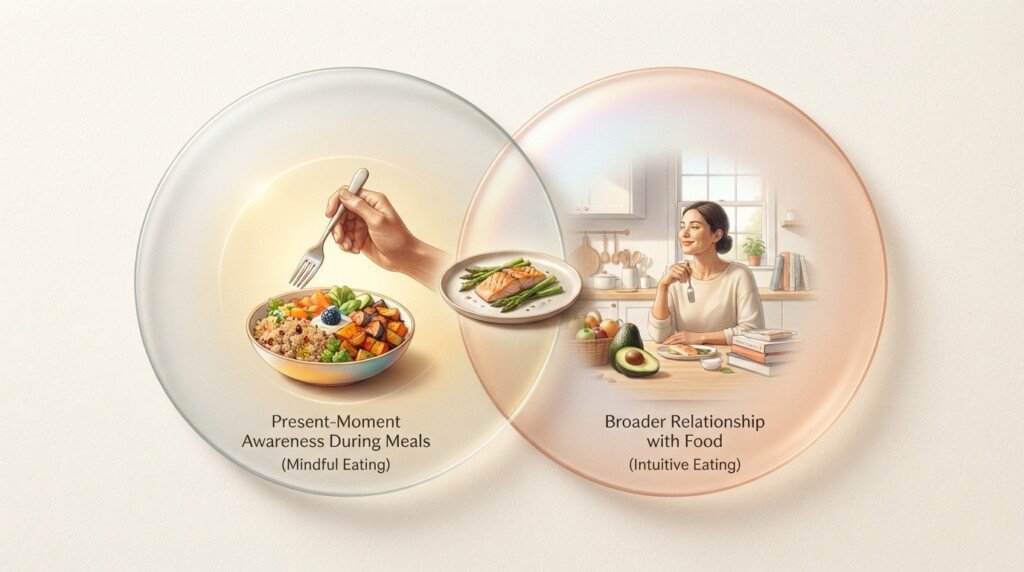
In other words, mindful eating can be viewed as one important skill that supports intuitive eating, but it is not the entire framework.
Understanding this distinction helps prevent unnecessary confusion. Someone can practice mindful eating without fully following every principle of intuitive eating, and someone exploring intuitive eating will almost certainly use mindfulness as one of the tools that supports the process.
Rather than treating them as competing methods, it is more accurate to see them as complementary approaches with different scopes.
If your goal is to understand every difference between these two concepts, the complete comparison is covered separately in Mindful Eating vs Intuitive Eating, where each principle is explained in detail.
Why Is Mindful Eating Often Confused With Intuitive Eating?
The confusion usually starts because both approaches encourage people to move away from traditional dieting.
Instead of calorie counting, rigid food rules, or labeling foods as “good” and “bad,” both approaches encourage listening more closely to the body’s internal signals.
From the outside, they appear almost identical.
However, they ask slightly different questions.
Mindful eating asks,
“What am I noticing right now?”
Intuitive eating asks,
“How can I build a long-term relationship with food based on trust instead of restriction?”
Mindfulness emphasizes awareness during the eating experience itself.
Intuitive eating includes that awareness while also addressing broader issues such as chronic dieting, body respect, food permission, and healing the relationship with eating over time.
Another reason people confuse them is that many online articles simplify both concepts until they sound exactly alike. Complex ideas are often reduced to short social media posts that remove important distinctions.
Fortunately, understanding the difference does not require choosing one approach over the other.
Many people naturally combine both.
They practice mindfulness during meals while gradually rebuilding trust in their body’s natural eating signals through intuitive eating principles.
The important point is recognizing that neither approach is another restrictive diet.
Both encourage greater awareness, flexibility, and respect for the body’s needs rather than adding more food rules.
Key Takeaways
Most mindful eating misconceptions come from viewing mindfulness through the lens of traditional dieting. People often assume mindful eating involves strict food rules, only applies to healthy foods, or is exactly the same as intuitive eating. In reality, mindful eating focuses on awareness rather than restriction. It encourages paying attention to hunger, fullness, satisfaction, and the eating experience without unnecessary judgment or perfectionism.
Understanding these misconceptions helps remove many of the barriers that prevent people from trying mindful eating. Once the myths are replaced with accurate expectations, mindful eating becomes less about controlling food and more about building a healthier, more balanced relationship with eating that can fit into everyday life.
| Misconception | Reality |
|---|---|
| Mindful eating is another diet | It focuses on awareness rather than food rules. |
| Mindful eating requires restriction | No foods are automatically forbidden or required. |
| It only works with healthy foods | Any food can be eaten mindfully. |
| Mindful eating equals intuitive eating | They overlap but are different approaches with different scopes. |
| You must eat perfectly | Mindful eating values curiosity over perfection. |
Frequently Asked Questions
1. Is mindful eating a diet?
No. Mindful eating is not a diet. It does not provide meal plans, calorie targets, or lists of forbidden foods. Instead, it encourages paying attention to your body’s signals and your eating experience.
2. Is mindful eating the same as intuitive eating?
No. They share several principles, but they are not identical. Mindful eating focuses on awareness during eating, while intuitive eating is a broader framework for rebuilding a healthy relationship with food.
3. Can you mindfully eat junk food?
Yes. Mindful eating applies to all foods, not only foods traditionally considered healthy. The emphasis is on awareness, satisfaction, and intentional eating rather than labeling foods as good or bad.
4. Does mindful eating mean ignoring nutrition?
No. Mindful eating encourages awareness while still recognizing the importance of balanced nutrition. It simply avoids relying on fear or rigid food rules as the primary motivation for eating decisions.
5. Why do so many people misunderstand mindful eating?
Many misconceptions come from comparing mindful eating to traditional diets or oversimplified information shared online. This often causes people to assume mindfulness involves restriction when it actually focuses on awareness.
Conclusion
Understanding the truth behind mindful eating misconceptions makes it much easier to appreciate what mindful eating actually offers. It is not another diet, another list of forbidden foods, or another system that demands perfection. Instead, it encourages paying closer attention to your body, your thoughts, and your eating experience so that food decisions become guided by awareness rather than fear or rigid rules.
As these misconceptions begin to disappear, many people discover that mindful eating feels surprisingly practical. It can be used with everyday meals, celebrations, favorite foods, and healthy choices alike because its purpose is not to control eating but to improve your relationship with it. Over time, this shift from judgment to awareness often becomes one of the most valuable changes a person can make for long-term well-being.
Disclaimer:
This post may contain affiliate links. If you purchase through them, we may earn a small commission at no extra cost to you. Also, this content is for informational purposes only and does not substitute professional medical advice.
Fuel Your Body Right
Use our free Nutrition Toolkit to find your protein target, fasting window, and net carbs in minutes.
Open Free Tools →