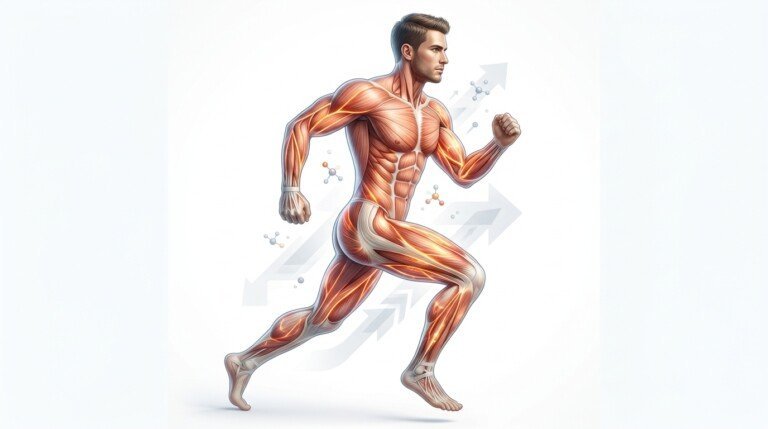
Symptoms and Types of Sarcopenia
Symptoms of sarcopenia can begin quietly. An older adult may notice that carrying groceries feels harder, getting up from a chair takes more effort, or walking at the same pace as before has become surprisingly tiring. These changes are easy to dismiss as normal aging, especially when they happen gradually.
But there is an important difference between getting older and developing clinically meaningful muscle decline.
Sarcopenia is not diagnosed simply because someone has less muscle than they had in their younger years. Healthcare professionals look at muscle strength, muscle quantity or quality, and physical performance to determine whether the decline reaches a clinically significant level. The EWGSOP2 framework, for example, places low muscle strength at the center of identifying probable sarcopenia, with low muscle quantity or quality used to confirm the condition and poor physical performance indicating severe sarcopenia.
That distinction matters because muscle loss affects much more than appearance.
Muscle supports movement, balance, posture, everyday strength, and independence. A gradual reduction in muscle capacity can eventually change how easily someone climbs stairs, gets out of a chair, walks outdoors, or carries ordinary household items.
The challenge is recognizing the pattern early without assuming that every sign of weakness means sarcopenia.
This article breaks down the symptoms, explains what clinicians actually test, and separates the major types and stages used to describe the condition.
What are the early and progressive symptoms of sarcopenia?
The early symptoms of sarcopenia are often functional rather than dramatic.
You may not suddenly look different in the mirror. Instead, everyday tasks begin requiring more effort.
A shopping bag that once felt light may become uncomfortable to carry. Standing from a low chair may require using your hands. Walking uphill may leave you unusually tired. You might notice that your walking speed has slowed or that you avoid activities that previously felt routine.
These changes deserve attention because strength and physical performance are central to how sarcopenia is identified.
The most useful question is not simply, “Do my muscles look smaller?”
It is:
“Has my physical capacity changed in a way that is persistent and meaningful?”
That question provides a much better starting point.
Sarcopenia also tends to develop gradually. Because the change can happen over months or years, people often adapt their behavior before they recognize the underlying problem.
Someone may stop taking the stairs.
Then they start using the elevator.
They may stop carrying heavier groceries.
Then they order delivery more often.
They may stop walking as far because it feels tiring.
Eventually, their activity level decreases because their physical capacity has already declined.
That can create a difficult cycle.
Less activity means less muscle stimulation. Less muscle stimulation can contribute to further weakness. Further weakness makes activity even more difficult.
Not every older adult who becomes less active has sarcopenia. Joint pain, cardiovascular problems, neurological conditions, medication effects, poor sleep, nutritional problems, and many other factors can produce similar changes.
That is why symptoms are clues rather than a diagnosis.

What are the earliest, most subtle signs to watch for?
The earliest signs are often easy to explain away.
You might notice that opening a tightly sealed jar requires more effort than it used to. You may need both hands to lift an object that once felt manageable. Getting up from the sofa may become slower. Walking through a large store may leave you more tired than expected.
None of these signs proves sarcopenia.
The important issue is whether several changes are appearing together and whether they represent a meaningful decline from your previous level of function.
A few practical warning signs deserve attention.
Reduced grip strength can be one clue. Everyday examples include struggling to open containers, carry bags, hold heavier objects, or maintain a firm grip.
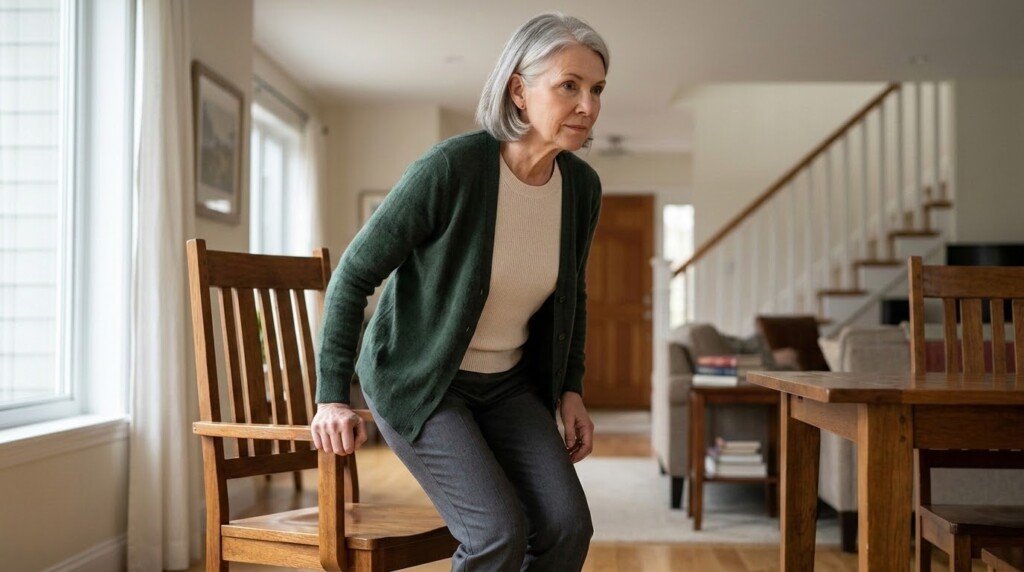
Difficulty rising from a chair is another useful functional signal. If you increasingly need your arms to push yourself upward, that may indicate reduced lower-body strength.
Slower walking can also be meaningful. Walking speed is used as one measure of physical performance in clinical assessment.
Reduced stair-climbing ability is another clue. A person may find themselves taking stairs more slowly, stopping more frequently, or avoiding them altogether.
Declining exercise capacity can also matter, particularly when the change cannot be explained by a new illness, injury, or major change in routine.
There is another subtle sign that is easy to miss: changing confidence.
An older adult may start feeling uncertain about walking on uneven ground, getting up from the floor, or carrying something while moving.
The physical change may be small.
The behavioral change may be larger.
Someone who previously walked everywhere may start looking for a chair whenever possible. Someone who regularly participated in recreational activities may begin declining invitations because they are worried about keeping up.
That behavioral retreat can become important because physical inactivity can further reduce the stimulus that muscles need.
A practical self-check can therefore focus on function rather than appearance.
Ask yourself:
- Is standing from a chair noticeably harder than it used to be?
- Has your walking speed changed?
- Are stairs becoming more difficult?
- Has your grip noticeably weakened?
- Are ordinary objects becoming harder to carry?
- Have you stopped activities because they now feel physically demanding?
- Do you feel less steady or confident when moving?
- Have several of these changes persisted rather than appearing for just a few days?
A “yes” to one question does not mean you have sarcopenia.
Several persistent changes deserve a more serious conversation with a healthcare professional.
The reason is simple: early functional changes can be easier to address than severe physical decline.
How does sarcopenia progressively affect mobility and daily activities?
As muscle weakness becomes more significant, the effects can move from occasional inconvenience to genuine limitations.
Consider the difference between “stairs feel harder” and “I avoid stairs because I cannot comfortably climb them.”
Those statements represent very different levels of functional impact.
Early weakness may simply make certain tasks slower.
More advanced weakness can make those tasks difficult or unsafe.
Walking is a good example.
A healthy older adult may naturally walk more slowly than they did at 30. That alone does not indicate sarcopenia.
The concern increases when walking speed declines noticeably and the person also experiences weakness, reduced physical performance, or difficulty with daily activities.
Chair transfers provide another example.
Standing from a chair requires coordinated force from the hips, thighs, and trunk. If strength declines, the person may lean forward more, use their arms, rock several times, or require assistance.
The task itself has not changed.
The person’s physical reserve has.
This distinction is important because sarcopenia is ultimately about losing useful capacity.
The condition can also affect activities outside the home.
An older adult may stop gardening because kneeling and standing have become difficult. They may avoid carrying laundry upstairs. They may take fewer walks. They may stop participating in hobbies that involve standing for longer periods.
These changes can accumulate.
A person does not necessarily lose independence in one dramatic event.
Instead, their world can gradually become smaller.
Fewer activities.
Less movement.
Less confidence.
More sitting.
Less opportunity to challenge the muscles.
That pattern can reinforce physical decline.
This is why identifying symptoms early is valuable. The goal is not to label every normal age-related change as a disease. The goal is to recognize when a change in physical function deserves professional attention.
The clinical literature supports using muscle strength and physical performance as important parts of early identification. EWGSOP2 recommends measures such as grip strength and chair-stand testing to identify low muscle strength, while physical performance measures help determine severity.
The difference between ordinary aging and clinically meaningful decline is therefore not simply how old someone is.
It is what their body can still do.
How is sarcopenia diagnosed?
Sarcopenia is diagnosed through a combination of clinical findings rather than a single test.
A healthcare professional may evaluate muscle strength, muscle quantity or quality, and physical performance. The exact tests and thresholds depend on the diagnostic framework being used, the patient’s setting, and the population being assessed.
This matters because different organizations have developed criteria that are similar in structure but not identical in their thresholds.
The European Working Group on Sarcopenia in Older People, commonly known as EWGSOP2, emphasizes a sequence beginning with muscle strength, followed by muscle quantity or quality and physical performance.
The Asian Working Group for Sarcopenia, or AWGS, uses its own criteria designed for Asian populations.
These frameworks should not be mixed casually.
A result that meets one set of thresholds may not automatically meet another.
For the reader, the most useful concept is that clinicians are trying to answer three different questions:
How strong are the muscles?
How much muscle is present?
How well does the person physically perform?
Looking at all three provides a much clearer picture than any single measurement.
What specific tests measure muscle mass and strength?
Several tests can be used, depending on the clinical setting.
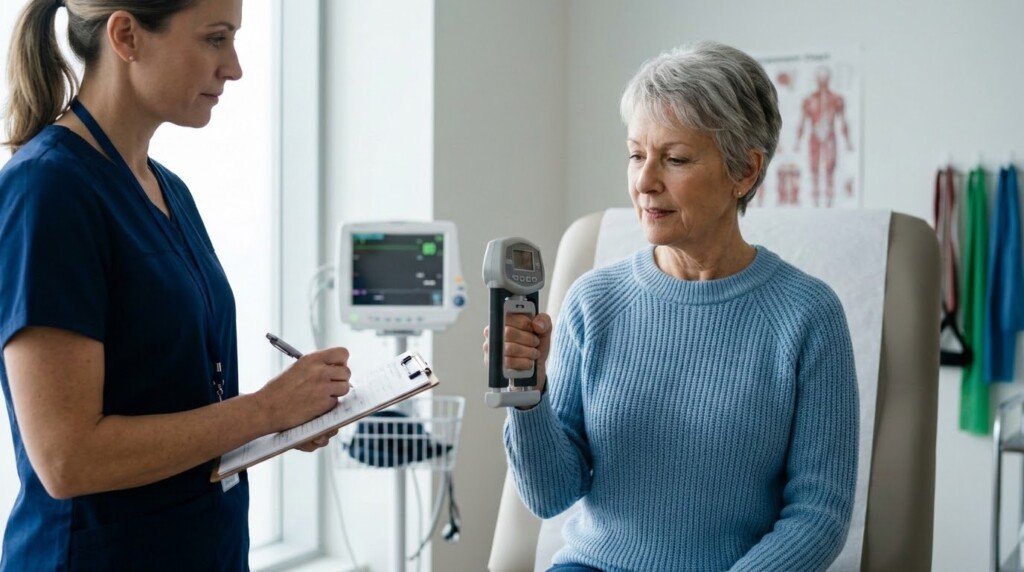
Handgrip strength is one of the most common measures of muscle strength. A handheld dynamometer measures how strongly a person can squeeze. It is quick, relatively inexpensive, and useful for identifying reduced strength.
Under AWGS 2019 criteria, low handgrip strength was defined as less than 28 kg for men and less than 18 kg for women. These thresholds belong specifically to that framework and should not be treated as universal diagnostic values for every population.
Chair-stand testing provides another practical measure.
The person may be asked to rise from a chair repeatedly without using their arms, depending on the protocol. The test gives information about lower-body strength and physical performance.
Walking speed is another commonly used assessment.
A clinician may time the person over a defined walking distance. Slower walking can indicate impaired physical performance.
AWGS 2019 uses a six-meter walking speed threshold of less than 1.0 meter per second as one indicator of low physical performance.
The Short Physical Performance Battery, or SPPB, combines several functional tasks and can provide a broader picture of lower-extremity function.
Then there are methods for measuring muscle quantity.
Dual-energy X-ray absorptiometry, commonly called DXA, can estimate lean tissue and appendicular skeletal muscle mass.
Bioelectrical impedance analysis, or BIA, estimates body composition by passing a small electrical current through the body and using resistance measurements to estimate tissue compartments.
MRI and CT can provide more detailed assessments of skeletal muscle, although they are less practical for routine screening because of cost, availability, and other considerations. AWGS guidance commonly uses DXA or BIA for muscle-mass assessment in clinical settings.
This is where online body-composition measurements can become confusing.
A consumer scale that estimates muscle mass may be useful for tracking broad trends, but it does not independently diagnose sarcopenia.
The number can change because of hydration, food intake, recent exercise, and limitations in the measurement technology.
A healthcare professional interprets measurements in context.
That context includes age, sex, medical history, physical function, medications, nutrition, and other relevant factors.
A diagnosis should therefore never be based solely on a home scale saying “low muscle.”
The strength and functional picture matters.
What are the established diagnostic criteria, like EWGSOP or AWGS?
The two major frameworks you are likely to encounter are EWGSOP2 and AWGS.
EWGSOP2 uses a three-part model.
First comes muscle strength.
If strength is low, the person may have probable sarcopenia.
If low muscle quantity or quality is also demonstrated, sarcopenia is confirmed.
If low physical performance is present alongside low strength and low muscle quantity or quality, the condition is classified as severe sarcopenia.
This structure is useful because it recognizes that strength is not merely an optional extra measurement. It is central to the clinical picture.
AWGS 2019 follows a somewhat different pathway.
It incorporates screening approaches such as calf circumference and SARC-F, then evaluates muscle strength, physical performance, and muscle mass.
Under AWGS 2019, sarcopenia is generally identified when low muscle mass is present together with either low muscle strength or low physical performance. Severe sarcopenia involves low muscle mass, low strength, and low physical performance together.
This distinction is worth remembering because online articles sometimes present one threshold as if it were the universal definition.
It is not.
Diagnostic criteria evolve, and different organizations use different approaches based on the populations they serve.
For example, AWGS 2019 uses different muscle-mass thresholds depending on whether DXA or BIA is used and whether the person is male or female. It also has specific strength and physical-performance thresholds. (PubMed Central (PMC))
The practical takeaway is much simpler than memorizing every number.
A professional is not merely asking:
“How much muscle do you have?”
They are asking:
“How strong are you, how much muscle do you have, and how well can you physically perform?”
That broader approach explains why two people with similar body-composition readings can receive different clinical interpretations.
It also explains why a diagnosis cannot be made reliably from photographs, body weight, BMI, or a single home measurement.
What are the different types of sarcopenia?
Sarcopenia can be classified in several ways, but one of the most useful distinctions is between primary and secondary sarcopenia.
Primary sarcopenia is associated primarily with aging.
Secondary sarcopenia occurs when factors beyond aging contribute to muscle decline.
This distinction matters because it changes the clinical question.
If muscle loss is primarily age-related, the focus may be different from a situation where disease, prolonged inactivity, inadequate nutrition, or another condition is contributing.
The classification does not mean a person necessarily has one single cause.
Real life is rarely that tidy.
An older adult may experience age-related changes while also becoming less active after an illness and eating less because of reduced appetite.
Several factors can overlap.
That is why identifying the type should be part of professional assessment rather than a label someone applies to themselves after reading a symptom checklist.

What’s the difference between primary and secondary sarcopenia?
Primary sarcopenia refers to muscle decline associated mainly with aging when no other specific cause explains the condition.
This does not mean the person has done something wrong.
Aging changes muscle biology, physical activity patterns, hormonal environments, and the body’s response to nutritional and exercise stimuli.
Secondary sarcopenia occurs when other factors contribute to the loss of muscle.
These may include chronic disease, inadequate nutritional intake, prolonged inactivity, or other health-related circumstances.
The WHO recognizes both age-related and secondary forms of sarcopenia, reinforcing the idea that the condition is not simply an inevitable consequence of getting older.
A person can also have more than one contributing factor.
Imagine an older adult who has gradually become less active with age, then experiences several months of illness that further reduce movement and appetite.
It would be too simplistic to blame the entire decline on aging.
The illness and inactivity may have accelerated the loss.
That distinction matters because identifying contributing factors can influence how the person’s condition is evaluated and managed.
It also prevents another common misunderstanding.
Secondary sarcopenia does not mean the muscle loss is somehow less real.
It means there are additional factors involved.
This is one reason a proper medical assessment is more useful than trying to identify a “type” from symptoms alone.
The clinical picture may involve age, activity, nutrition, illness, medications, recovery, and other factors simultaneously.
How is severity staged or classified?
Severity is generally described by looking at how many major components of the condition are present.
The EWGSOP2 framework provides a particularly clear example.
Probable sarcopenia is identified when low muscle strength is present.
Confirmed sarcopenia involves low muscle strength together with low muscle quantity or quality.
Severe sarcopenia involves all three: low muscle strength, low muscle quantity or quality, and low physical performance.
This staging approach is useful because it shows why symptoms can vary dramatically between individuals.
Someone with probable sarcopenia may have measurable weakness but still perform many daily activities independently.
Someone with severe sarcopenia may have weakness, reduced muscle quantity or quality, and significant limitations in physical performance.
AWGS 2019 similarly distinguishes sarcopenia from severe sarcopenia based on the combination of muscle mass, strength, and physical performance. (PubMed Central (PMC))
The severity classification is therefore not based on appearance.
A person does not need visibly small muscles to have a clinically meaningful problem.
Likewise, someone with a naturally lean body does not automatically have sarcopenia.
The measurements need to be interpreted together.
This is also why “symptoms” and “diagnosis” should not be treated as interchangeable terms.
Symptoms tell you something may be wrong.
Clinical testing determines whether the findings fit an established diagnostic framework.
That distinction protects people from both underestimating and overestimating the condition.
If persistent weakness, reduced walking ability, difficulty rising from a chair, declining grip strength, or other functional changes are becoming noticeable, the appropriate next step is not to self-diagnose.
It is to get the changes assessed.
The earlier the underlying pattern is understood, the more useful the information becomes for deciding what should happen next.
FAQ
1. What are the symptoms of sarcopenia?
Common warning signs can include declining grip strength, difficulty rising from a chair, slower walking, trouble climbing stairs, reduced exercise capacity, difficulty carrying everyday objects, and a noticeable decline in physical independence. These signs do not diagnose sarcopenia by themselves, because other health conditions can produce similar symptoms.
2. How is sarcopenia diagnosed?
Healthcare professionals typically assess muscle strength, muscle quantity or quality, and physical performance. Common assessments include handgrip strength, chair-stand testing, walking speed, SPPB testing, and muscle-mass measurements using methods such as DXA or BIA. The exact diagnostic criteria depend on the clinical framework being used.
3. What are the different types of sarcopenia?
The main distinction is between primary and secondary sarcopenia. Primary sarcopenia is primarily associated with aging, while secondary sarcopenia involves additional contributing factors such as disease, inadequate nutrition, or prolonged inactivity. More than one factor can contribute to an individual’s muscle decline.
4. Does low muscle mass automatically mean I have sarcopenia?
No. Low muscle mass alone does not establish a sarcopenia diagnosis under commonly used modern criteria. Muscle strength and physical performance are also important parts of the assessment. Under EWGSOP2, low muscle strength is central to identifying probable sarcopenia, while low muscle quantity or quality confirms the diagnosis.
5. Can I diagnose sarcopenia at home?
You can notice warning signs at home, but you should not use a home scale, grip test, or symptom checklist as a definitive diagnosis. Persistent changes in strength, mobility, or daily function are reasons to discuss the situation with a healthcare professional who can select appropriate clinical assessments.
Disclaimer:
This post may contain affiliate links. If you purchase through them, we may earn a small commission at no extra cost to you. Also, this content is for informational purposes only and does not substitute professional medical advice.
Ready to Start Your Journey?
Use our free 7-in-1 Weight Loss Toolkit to calculate your numbers and build your plan in minutes.
Open Free Tools →