

AI Writing Tools vs SEO Writers: What Ranks Better?
AI writing vs human writing SEO is no longer a theory or a future debate.
In 2026, it’s a real ranking question that determines whether your blog grows or dies.
Bloggers are publishing thousands of AI-written posts every day.
Some rank.
Some fail.
Some get wiped out after Google updates.
So what actually performs better in Google:
AI writing or human writing?
This guide breaks down real SEO outcomes, content quality differences, originality, trust signals, and when each approach wins — without hype or tool promotion.
If you care about rankings, you don’t care about ideology.
You care about what actually works.
Right now, bloggers are split into two camps:
One side says:
“AI content doesn’t rank. Google hates it.”
The other side says:
“AI content ranks just fine. Humans are slow and expensive.”
Both sides are wrong.
The real answer is uncomfortable:
AI content can rank.
Human content can rank.
Most content fails no matter who writes it.
The ranking outcome is not determined by who wrote the content.
It’s determined by how the content was produced, structured, edited, and aligned with search intent.
This article breaks down the real performance differences between:
- AI-written content
- Human-written content
- Hybrid content (AI + human)
No hype.
No ideology.
No marketing lies.
Just what actually ranks.
Why This Comparison Even Matters
Most bloggers are asking the wrong question.
They ask:
“Is AI content better than human content?”
That’s not the real question.
The real question is:
Which production method produces content that ranks more consistently?
That depends on:
- Search intent alignment
- Topical depth
- Content originality
- Trust signals
- Internal linking logic
- Structure
- Editing quality
- Content stability over time
Not on whether a human or an AI typed the words.
What Google Actually Cares About (Not Who Wrote It)
Google does not rank content based on authorship method.
Google ranks content based on:
- Relevance
- Helpfulness
- Depth
- Originality
- Clarity
- User engagement
- Trust signals
- Link profile
- Content stability
- Freshness
- Search intent match
Google’s systems do not detect “AI” and then punish it.
Google punishes:
- Thin content
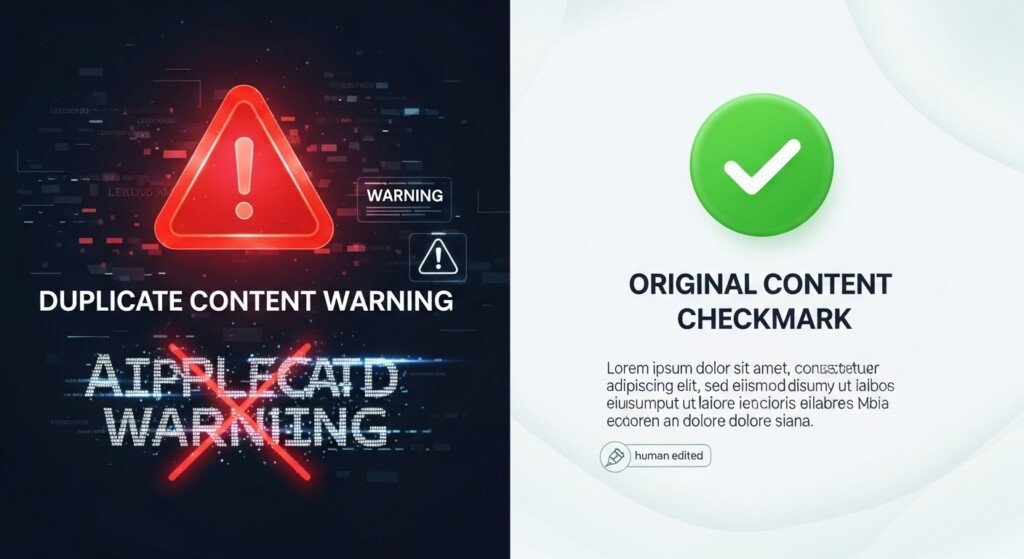
- Duplicate content
- Low-effort content
- Unhelpful content
- Manipulative content
- Auto-generated spam
If your AI content fails, it’s because it falls into one of those categories.
Not because it was written by AI.
If you want the full breakdown of risk factors, see:
AI content SEO risks
The Three Types of Content Being Compared
Before comparing rankings, you need to separate three production models.
1) Raw AI Content
This is what most bloggers publish.
They:
- Generate a draft
- Copy-paste it
- Publish it
- Add no insights
- Do no editing
- Add no structure
- Add no originality
- Add no topical depth
This content:
- Sounds robotic
- Repeats phrases
- Misses subtopics
- Ignores search intent
- Lacks trust signals
This content does not rank.
Not because it’s AI.
Because it’s garbage.
2) Human-Written Content
This is traditional blogging.
A human:
- Researches the topic
- Creates an outline
- Writes from scratch
- Adds insights
- Structures content
- Optimizes headings
- Edits tone
- Adds internal links
This content:
- Has natural flow
- Matches intent better
- Builds trust signals
- Shows topical depth
This content can rank well.
But it is slow, inconsistent, and hard to scale.
3) Hybrid Content (AI + Human)
This is what actually works.
A hybrid workflow:
- Uses AI for drafting and expansion
- Uses humans for structure, editing, insights, and intent alignment
- Adds topical depth manually
- Adds internal linking manually
- Adds trust signals manually
This content:
- Matches search intent
- Covers subtopics
- Is readable
- Is original
- Scales efficiently
This content ranks most consistently.
For bloggers using hybrid workflows, the drafting tool matters as much as the writing strategy.
This is why choosing the best AI writing tools for bloggers directly impacts SEO performance and content quality.

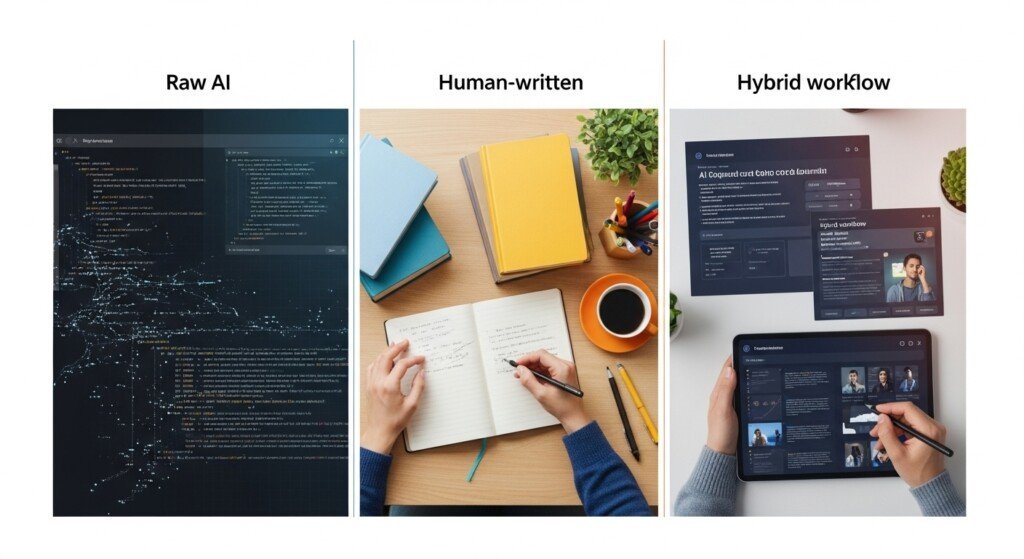
Ranking Outcomes: AI vs Human vs Hybrid
When comparing AI writing vs human writing SEO, the ranking difference isn’t about who typed the content.
It’s about structure, topical depth, originality, and editorial quality.
Here is the blunt truth.
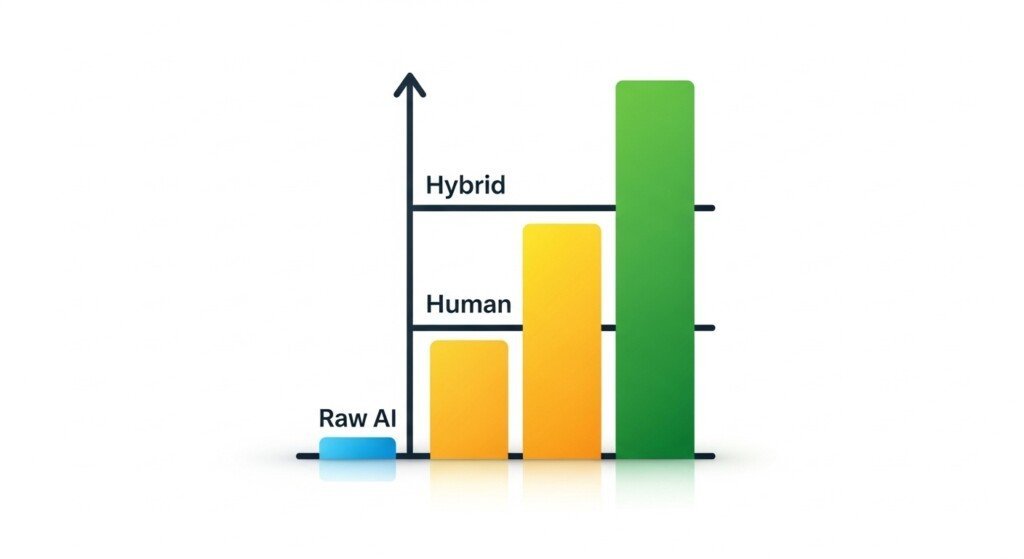
Raw AI Content
- Ranking probability: Low
- Stability: Low
- Trust signals: Weak
- Originality: Low
- Engagement: Poor
- Risk of deindexing: Moderate
This fails long-term.
Human-Written Content
- Ranking probability: High
- Stability: High
- Trust signals: Strong
- Originality: High
- Engagement: High
- Scalability: Low
This works, but it doesn’t scale.
Hybrid Content
- Ranking probability: Highest
- Stability: High
- Trust signals: Strong
- Originality: High
- Engagement: High
- Scalability: High
This dominates both.
Content Quality Differences
This is where most ranking failures happen.
AI Content Quality
Strengths:
- Fast drafting
- Consistent structure
- Logical expansion
- Clean grammar
- High volume production
Weaknesses:
- Repetitive phrasing
- Weak insights
- Generic examples
- Missing subtopics
- Shallow topical coverage
- No lived experience
Without editing, AI content feels:
- Thin
- Robotic
- Over-optimized
- Surface-level
Human Content Quality
Strengths:
- Natural tone
- Original ideas
- Lived experience
- Strong narrative
- Better nuance
- Better emotional flow
Weaknesses:
- Inconsistent quality
- Slow production
- Human bias
- Fatigue
- Burnout
- Structural mistakes
Humans write better content.
They just don’t write enough of it.
Hybrid Content Quality
This removes weaknesses from both sides.
Strengths:
- High volume
- High depth
- Original insights
- Search intent match
- Consistent structure
- Strong trust signals
This is what Google rewards.
Originality: The Real Ranking Separator
Originality is not optional.
Google does not reward reworded junk.
AI Originality
Raw AI output:
- Repeats patterns
- Mirrors training data
- Uses generic phrasing
- Misses nuance
- Produces predictable structure
This triggers:
- Duplicate intent content
- Similarity scoring
- Low differentiation
- Weak topical authority
Human Originality
Humans naturally:
- Add opinions
- Add insights
- Add stories
- Add examples
- Add nuance
This:
- Improves engagement
- Builds trust
- Reduces bounce rate
- Strengthens authority
Hybrid Originality
This is where rankings stabilize.
AI handles:
- Drafting
- Structure
- Expansion
Humans handle:
- Insights
- Examples
- Opinion
- Story
- Tone
- Intent alignment
This produces content Google treats as genuinely helpful.
Trust Signals: Where Humans Still Dominate
Trust signals are not just backlinks.
They include:
- Tone authority
- Writing confidence
- Consistency
- Depth
- Structure
- Experience signals
- Clarity
- Internal linking
AI Trust Signals
AI content:
- Feels generic
- Lacks authority voice
- Avoids strong opinions
- Uses safe language
- Misses nuance
This weakens:
- User trust
- Engagement
- Dwell time
- Conversions
Human Trust Signals
Human content:
- Feels confident
- Shows perspective
- Shows experience
- Uses real examples
- Feels credible
This boosts:
- User engagement
- Trust
- Conversion rates
- Rankings
Hybrid Trust Signals
This is the best case.
Humans inject authority tone.
AI handles volume and structure.
This builds both:
- Scale
- Trust

Stability Over Time
Ranking is not just about getting indexed.
It’s about staying ranked.
Raw AI Content Stability
- Loses rankings after core updates
- Suffers from helpful content updates
- Gets outranked by deeper content
- Fails long-term
Human Content Stability
- Holds rankings longer
- Improves with age
- Gains topical authority
- Attracts backlinks naturally
Hybrid Content Stability
- Matches human stability
- Scales like AI
- Retains rankings longer
- Builds topical authority faster
This wins long-term.
When AI Content Wins
AI content can outperform humans when:
- Speed matters
- Volume matters
- Consistency matters
- Content clusters matter
- Internal linking matters
- Updating content matters
- Expanding content matters
AI wins in:
- Drafting
- Scaling
- Updating
- Repurposing
- Bulk publishing
But only if edited.
When Human Content Wins
Human content wins when:
- Experience matters
- Authority matters
- Nuance matters
- Emotional tone matters
- Opinion matters
- Conversion matters
Humans win in:
- Thought leadership
- Reviews
- Opinion content
- High-trust niches
- Medical / finance content
- Brand building
Why Hybrid Workflows Dominate Rankings
This is the real answer.
Not AI vs human.
AI + human.
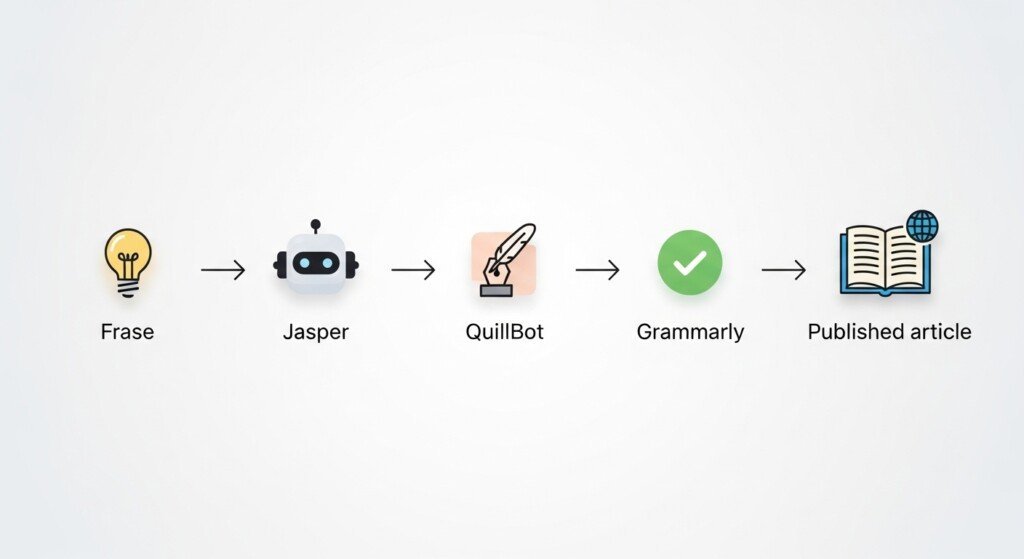
Hybrid workflows:
- Scale faster
- Rank more consistently
- Build topical authority
- Reduce burnout
- Improve quality
- Increase content velocity
This is what serious SEO bloggers use.
The Real SEO Risk Is Not AI
The real SEO risk is:
- Thin content
- Duplicate content
- Low-effort content
- Unhelpful content
- Poor structure
- No internal links
- No topical depth
If you publish bad content, you lose.
AI just makes bad content easier to publish faster.
If you’re worried about penalties, read:
AI content SEO risks
Many bloggers still worry about penalties, but the real issue is quality, not automation.
If you want the full breakdown of AI content SEO risks, see my analysis of Do AI Writing Tools Hurt SEO.
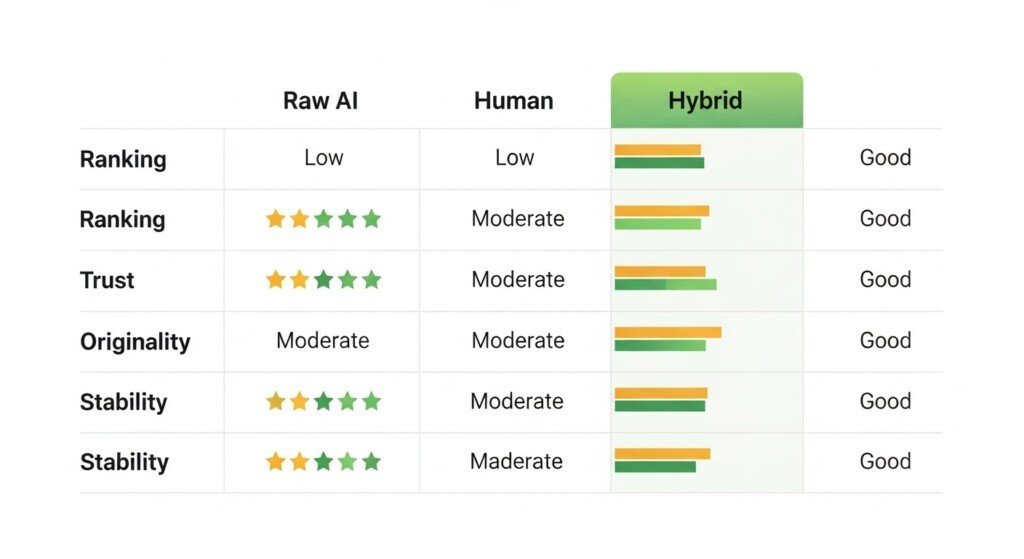
Performance Comparison Summary
| Factor | Raw AI | Human | Hybrid |
|---|---|---|---|
| Ranking Probability | Low | High | Highest |
| Originality | Low | High | High |
| Trust Signals | Weak | Strong | Strong |
| Scalability | High | Low | High |
| Stability | Low | High | High |
| Content Velocity | High | Low | High |
If you’re looking for real performance data and long-term stability, compare AI vs human writing across rankings, engagement, and trust signals.
Final Verdict
There is no war.
There is no replacement.
There is no ideology.
AI content does not rank better.
Human content does not rank better.
Hybrid content ranks better.
If you:
- Use AI for drafting
- Use humans for structure, insights, editing, and intent alignment
- Add topical depth
- Add originality
- Add internal links
You win.
If you:
- Publish raw AI content
- Skip editing
- Ignore intent
- Ignore depth
You lose.
The winning strategy in AI writing vs human writing SEO is not choosing one side.
It’s combining AI drafting speed with human judgment and editorial control.
FAQs
1. Does AI-written content rank better than human-written content?
AI-written content can rank just as well as human-written content when it matches search intent, covers topics deeply, and is edited for quality. Raw AI output does not rank consistently. Edited, structured, and optimized AI content can perform at the same level as human writing.
2. Is Google penalizing AI-generated content in 2026?
No. Google does not penalize AI-generated content. Google penalizes low-quality, thin, duplicate, and unhelpful content. The ranking factor is usefulness and quality, not whether a human or AI created the text.
3. Which is more trustworthy: AI writing or human writing?
Human-written content still performs better for trust-heavy niches and authority topics. AI content performs well for informational, comparison, and SEO-driven content when properly edited. Hybrid workflows outperform both pure AI and pure human writing.
4. Can AI content replace human writers for SEO?
No. AI content replaces manual drafting, not strategy, intent alignment, fact checking, and editorial judgment. The best-performing SEO content in 2026 uses AI for drafting and humans for refinement and optimization.
5. What ranking factors matter more than whether content is AI or human-written?
Search intent match, topical depth, structure, originality, readability, internal linking, and user engagement matter more than whether content was written by AI or a human.
Bottom Line
AI didn’t kill SEO writers.
It exposed bad ones.
The winners are not humans or machines.
The winners are bloggers who use both correctly.
Disclaimer
Some links on this page may be affiliate links.
If you click and purchase, I may earn a small commission at no extra cost to you.
I only recommend tools I genuinely use or believe are useful for bloggers.
This helps support the site and keep content free.