
Do AI Writing Tools Hurt SEO? 5 Truths
Do AI writing tools hurt SEO?
That question is killing blogs in 2026.
Some bloggers think AI content is a shortcut to rankings.
Others think Google is waiting to nuke every site that uses AI.
Both sides are wrong.
The real answer is not ideological.
It’s technical.
AI writing tools do not automatically hurt SEO.
But bad usage absolutely does.
Most ranking losses blamed on AI have nothing to do with AI.
They’re caused by:
• Thin content
• Duplicate content
• Unhelpful content
• Poor structure
• Search intent mismatch
• Zero topical depth
• No internal linking
• Low originality
• Low trust signals
In this guide, I’m going to break down five truths about whether AI writing tools hurt SEO, based on:
• Google’s official stance
• How ranking systems actually work
• What causes ranking loss
• The difference between good and bad AI usage
• Why most bloggers are diagnosing the wrong problem
No hype.
No tool promotion.
No fear marketing.
Just what actually affects rankings.
If you’re still comparing broader blogging tools, start with my main guide on the best AI writing tools for bloggers.
Truth #1 — Google Does NOT Penalize AI Content
Let’s start with the biggest myth.
Google does not penalize content for being written by AI.
Google has said this multiple times.
Google does not care how content is created.
Google cares what content is created.
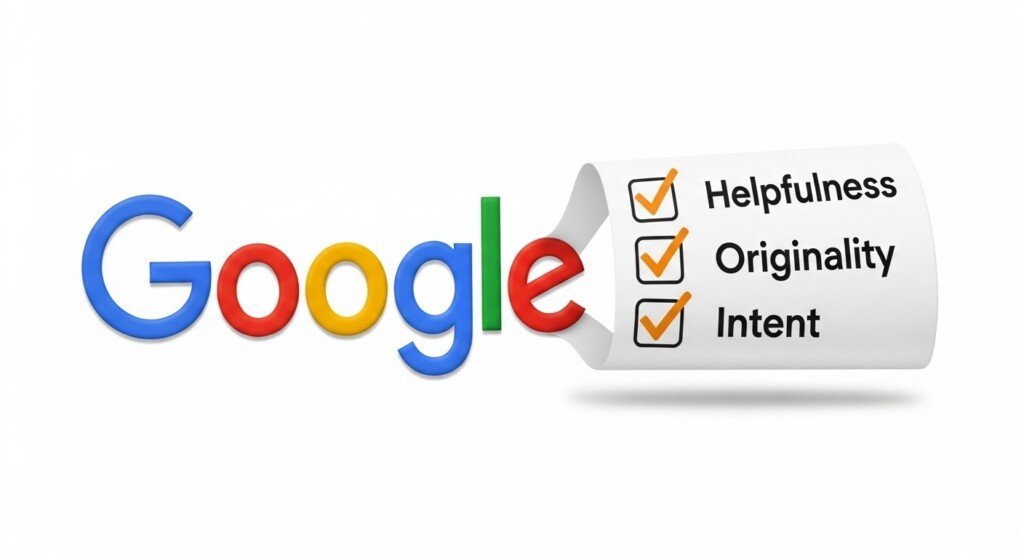
Google ranks content based on:
• Relevance
• Helpfulness
• Depth
• Originality
• Clarity
• Trust signals
• Engagement
• Topical authority
• Search intent match
There is no ranking factor called:
“Was this written by AI?”
Google does not scan your site and apply a penalty for using AI.
Google penalizes:
• Thin content
• Duplicate content
• Auto-generated spam
• Unhelpful content
• Manipulative content
• Low-effort content
If your AI-written pages drop, it’s because they fall into one of those categories.
Not because they were written by AI.
This is why the question do AI writing tools hurt SEO is framed wrong.
The correct question is:
Does bad content hurt SEO?
And the answer is: yes.
AI just makes bad content easier to publish faster.

Truth #2 — The Helpful Content Update Is the Real Threat
Most bloggers think Google updates target AI.
They don’t.
Google’s Helpful Content system targets unhelpful content.
It doesn’t care who or what wrote it.
The Helpful Content Update demotes content that:
• Adds no new value
• Rewords existing articles
• Lacks topical depth
• Ignores search intent
• Exists only to rank
• Feels mass-produced
• Provides no original insight
This is exactly what raw AI output looks like.
So when bloggers say:
“AI content got my site hit.”
What actually happened is:
Their content failed quality signals.
The update didn’t detect AI.
It detected low-value content.
This is why so many blogs publishing raw AI drafts collapsed after updates.
Not because they used AI.
Because they published trash.
Truth #3 — Bad AI Usage Creates All the SEO Risk
This is where most SEO damage comes from.
Not from AI tools.
From how bloggers use them.
Here are the real risk factors that kill rankings:
1) Publishing Raw AI Output
This guarantees failure.
Raw AI content is:
• Repetitive
• Generic
• Thin
• Predictable
• Surface-level
• Low originality
Google doesn’t rank that.
If you generate content and publish it without editing, your SEO will suffer.
Not maybe.
Guaranteed.
2) Search Intent Mismatch
Most AI content fails because it doesn’t answer the actual query.
For example:
Someone searches:
“Best AI writing tools for SEO”
They expect:
• Tool comparisons
• Use cases
• Pros and cons
• Buyer guidance
• Output quality analysis
But AI tools often generate:
• Generic explanations
• Feature dumps
• Marketing fluff
• Irrelevant sections
Google detects this mismatch and demotes the page.
This has nothing to do with AI.
It’s a content alignment failure.
3) Thin Content and Missing Subtopics
AI tools produce shallow drafts.
They do not:
• Cover all subtopics
• Answer follow-up questions
• Add topical depth
• Include supporting explanations
• Build semantic coverage
Google expects topic completeness.
If your content misses:
• Key subtopics
• FAQ questions
• Supporting sections
• Depth signals
Your page will not rank.
Again — not because it’s AI.
Because it’s thin.
4) Duplicate and Similarity Issues
Raw AI output triggers similarity problems.
Why?
Because:
• AI uses predictable phrasing
• AI mirrors training data patterns
• AI repeats sentence structures
• AI recycles topic layouts
This leads to:
• Near-duplicate content
• Internal cannibalization
• Low differentiation
• Similarity scoring penalties
This is one of the biggest hidden SEO risks of AI writing tools.
Not plagiarism.
Similarity.
And Google does not reward “slightly rewritten versions” of the same content.
5) No Internal Linking and Topical Authority
Most AI content has zero internal linking.
That kills SEO.
Internal links:
• Build topical authority
• Create crawl paths
• Pass relevance signals
• Strengthen context
• Support rankings
If your AI content has no internal linking logic, Google treats it as isolated and weak.
This is why many blogs publishing AI clusters fail.
They build pages.
Not ecosystems.
Truth #4 — Good AI Usage Does NOT Hurt SEO
This is the uncomfortable part.
Properly used AI does not hurt SEO.
It often improves it.
When used correctly, AI helps with:
• Draft speed
• Structure
• Section expansion
• Subtopic coverage
• Rewriting
• Editing
• Content velocity
• Consistency
The key difference is this:
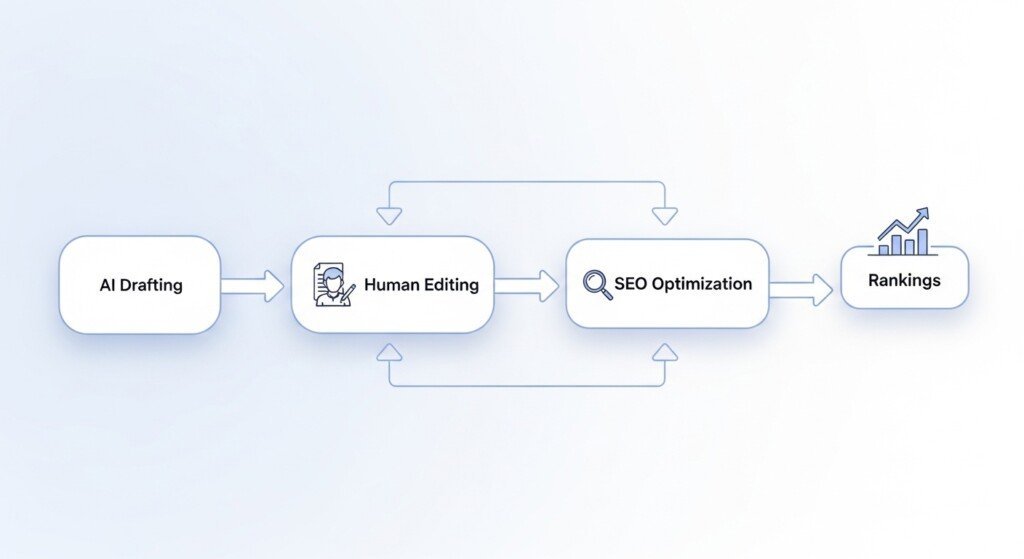
AI should draft. Humans must edit.
Here’s what good AI usage looks like:
• AI generates section drafts
• Human defines outline
• Human adds topical depth
• Human rewrites robotic sections
• Human optimizes headings
• Human adds internal links
• Human adds originality
• Human aligns intent
This produces content that:
• Matches search intent
• Covers subtopics
• Feels natural
• Builds trust signals
• Shows originality
• Scales efficiently
If you want to see how hybrid content actually performs compared to manual writing, compare AI vs human content quality.
That breakdown shows why hybrid workflows dominate long-term rankings.
This is exactly why hybrid content (AI + human) dominates rankings.
Not raw AI.
Not raw human.
Hybrid.
If you want to understand how hybrid content performs compared to manual writing, compare AI vs human content quality.
That comparison shows why hybrid workflows win long-term.
Truth #5 — The Real SEO Risk Is Not AI
The real SEO risk is:
• Thin content
• Duplicate content
• Low-effort content
• Unhelpful content
• Poor structure
• No internal linking
• No topical depth
• No originality
• No editing
AI just makes those mistakes easier to scale.
That’s why some bloggers think:
“AI killed my site.”
No.
Your workflow killed your site.
AI just accelerated it.
If you publish bad content faster, you fail faster.
What Actually Causes Ranking Loss (Not AI)
Here’s the real list.
If your rankings dropped after using AI, it’s almost always one of these:
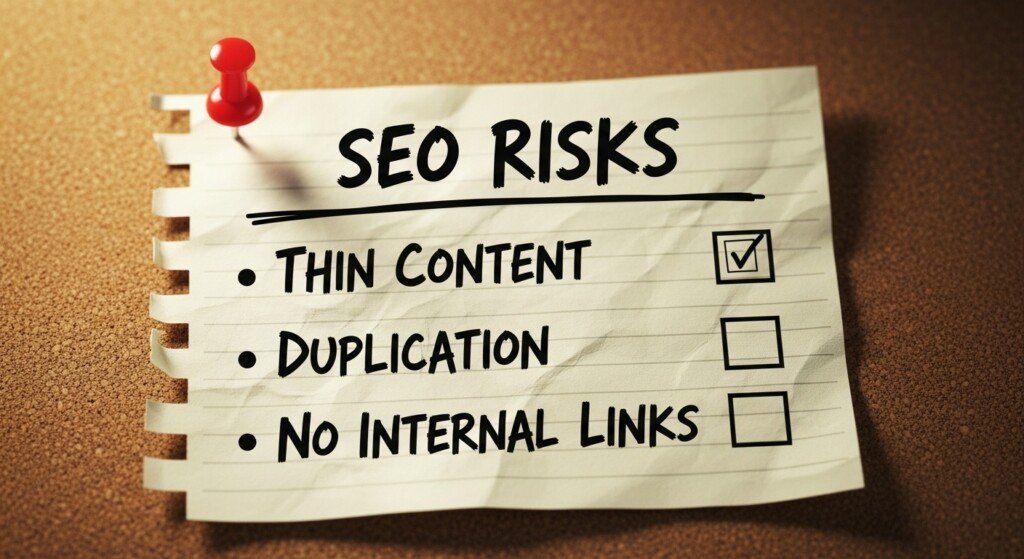
• You published thin content
• You ignored search intent
• You skipped subtopics
• You didn’t rewrite
• You didn’t edit
• You didn’t add internal links
• You didn’t add originality
• You created near-duplicate pages
• You mass-published low-quality drafts
• You chased keywords without depth
None of those are “AI problems.”
They are content quality problems.
Google’s Official Position (Simplified)
Google’s stance is consistent:
Google does not care how content is produced.
Google cares whether content helps users.
Google penalizes:
• Auto-generated spam
• Low-effort content
• Manipulative content
• Thin content
• Unhelpful content
Google rewards:
• Helpful content
• Original content
• Deep content
• Intent-aligned content
• Well-structured content
AI content falls into either bucket.
It’s not special.
It’s just content.
Bad AI Usage vs Good AI Usage
Let’s make this obvious.
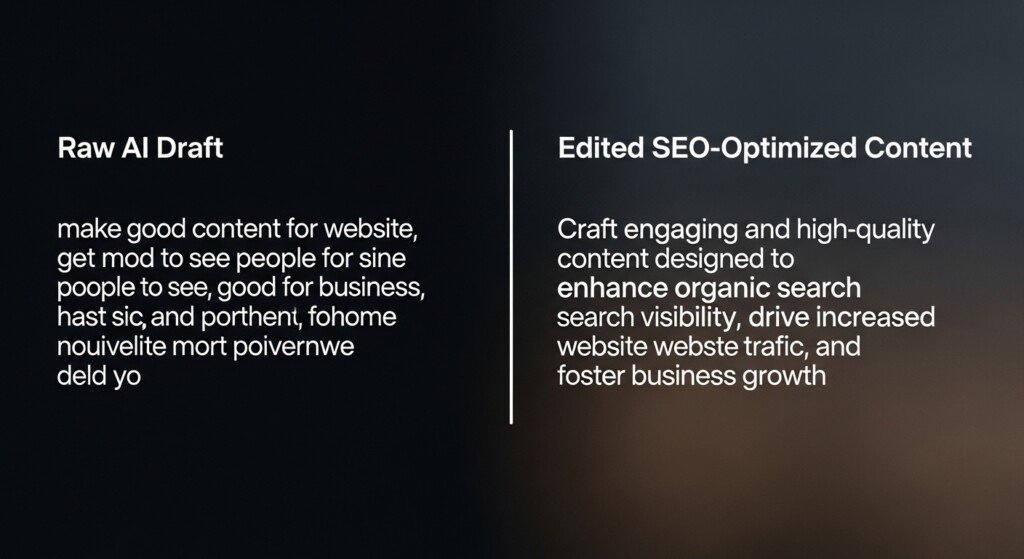
Bad Usage (Kills SEO)
• Generate one big draft
• Publish raw output
• Skip structure
• Ignore intent
• Ignore subtopics
• Skip editing
• Skip internal links
• Mass publish
This guarantees ranking failure.
Good Usage (Does Not Hurt SEO)
• Build SEO outline
• Draft section by section
• Expand subtopics
• Rewrite robotic sections
• Optimize headings
• Add internal links
• Add originality
• Edit for clarity
This produces ranking-ready content.
Why Most Bloggers Get This Wrong
Most bloggers:
• Want shortcuts
• Want automation
• Want zero effort
• Want instant rankings
So they:
• Abuse AI
• Publish garbage
• Blame Google
• Blame AI
• Blame tools
Instead of fixing their workflow.
AI doesn’t break SEO.
Lazy content does.
When AI Content Actually Hurts SEO
To be precise:
AI content hurts SEO when:
• You publish it raw
• You skip editing
• You skip structure
• You skip topical depth
• You skip originality
• You skip internal links
• You mass publish
• You chase keywords blindly
If you do those things, your site will get hit.
Not because of AI.
Because of low-quality content.
When AI Content Does NOT Hurt SEO
AI content does not hurt SEO when:
• It’s edited
• It’s original
• It’s deep
• It matches intent
• It covers subtopics
• It’s structured
• It’s readable
• It includes internal links
In those conditions, AI content performs just like human-written content.
Often better.
Because it scales.
Why Hybrid Content Dominates Rankings
This is the real conclusion.
Not “AI vs human.”
Hybrid.
AI handles:
• Drafting
• Expansion
• Speed
• Volume
Humans handle:
• Structure
• Insights
• Editing
• Intent alignment
• Originality
• Trust signals
This combination produces content that:
• Ranks
• Scales
• Survives updates
• Builds topical authority
• Avoids penalties
If you care about long-term SEO, this is the only sustainable model.
Final Verdict: Do AI Writing Tools Hurt SEO?
No.
Bad content hurts SEO.
AI just makes bad content easier to publish faster.
If you:
• Publish raw AI drafts
• Skip editing
• Skip structure
• Skip intent alignment
• Skip topical depth
Your site will lose rankings.
Not because of AI.
Because of low-quality content.
If you:
• Use AI for drafting
• Use humans for editing
• Add originality
• Add depth
• Add structure
• Add internal links
Your content can rank just fine.
Often better than manual content.
If you’re still deciding whether using AI at all makes sense for your blogging workflow, read are AI writing tools worth it.
That analysis breaks down ROI, time savings, and long-term scalability.
The winning strategy is not choosing sides.
It’s fixing your workflow.
FAQ
1) Do AI writing tools hurt SEO rankings?
No. AI writing tools do not hurt SEO by themselves. Rankings drop when AI-generated content is thin, unhelpful, poorly structured, or published without editing, originality, and search-intent alignment.
2) Is Google penalizing AI-generated content in 2026?
No. Google does not penalize content for being written by AI. Google penalizes low-quality, unhelpful, duplicate, and manipulative content — regardless of whether it was written by a human or an AI tool.
3) What is the biggest SEO risk when using AI writing tools?
The biggest risk is publishing raw AI output without human editing, topical depth, originality, and internal linking. Poor execution — not AI itself — is what causes ranking loss.
4) Can AI-written content rank if it’s properly edited?
Yes. AI-written content can rank well if it is edited for clarity, originality, structure, search intent, and topical depth. Hybrid workflows (AI drafting + human editing) produce the most stable rankings.
5) Why do some AI-written pages lose rankings after Google updates?
They lose rankings because they are thin, repetitive, low-value, or misaligned with search intent. Google’s helpful content updates target low-quality content — not AI usage itself.
Disclaimer
Some links on this page may be affiliate links.
If you click and purchase, I may earn a small commission at no extra cost to you.
I only recommend tools I genuinely use or believe are useful for bloggers.
This helps support the site and keep content free.