


How to Increase Your NEAT Calories Every Day (Without the Gym)
Most people believe burning more calories requires longer workouts, expensive gym memberships, or intense fitness programs.
But here’s something many successful weight loss journeys have in common that often goes unnoticed.
The people who stay active throughout the day usually burn more calories than those who exercise for one hour and remain seated for the rest of the day.
This is exactly why understanding how to increase NEAT calories can make such a meaningful difference.
Rather than relying only on workouts, NEAT focuses on the countless movements that naturally happen between waking up and going to bed. Walking to another room, standing while making a phone call, carrying groceries, tidying your home, taking the stairs, and moving more during everyday tasks all contribute to your daily calorie burn.
Unlike structured exercise, these activities rarely feel like workouts. Yet together, they can have a noticeable impact on your total daily energy expenditure over weeks and months.
If you’re looking for realistic ways to support weight management without spending more hours in the gym, increasing NEAT may be one of the simplest habits to build into your daily routine.
Quick Answer
How to increase NEAT calories starts with adding more natural movement throughout your day rather than scheduling extra workouts. Standing more often, walking during breaks, choosing stairs, completing household chores, carrying groceries, gardening, and moving during leisure time can all increase daily calorie expenditure. While each activity burns a modest number of calories, their combined effect can meaningfully support long-term weight management.
How Can I Increase My NEAT Calories Day to Day?
Many people assume they need dramatic lifestyle changes before they can burn more calories.
In reality, increasing NEAT is often about making dozens of small choices instead of one major decision.
The goal is not to completely change your routine.
The goal is to move a little more whenever everyday opportunities naturally appear.
Unlike a workout that occupies a specific hour of your day, NEAT accumulates from morning until bedtime.
What Are the Most Effective Ways to Incorporate More Standing Into My Routine?
Standing may seem insignificant compared to jogging or lifting weights, but replacing long periods of sitting with more time on your feet increases daily movement without requiring additional exercise.
Many people spend eight or more hours each day sitting at work, driving, eating, and relaxing at home.
Breaking up those long sitting periods encourages more movement throughout the day.
Simple opportunities include:
- Standing while answering phone calls
- Walking while listening to voice messages
- Standing during virtual meetings when possible
- Reading documents while upright
- Waiting for food to cook instead of sitting down
- Standing while folding laundry
- Walking around while thinking through problems
These habits do not feel demanding because they fit naturally into tasks you are already completing.
Over weeks, those extra minutes of standing often lead to more walking, more posture changes, and more overall movement.
If you’re interested in understanding why these everyday movements matter so much, NEAT (Non-Exercise Activity Thermogenesis): What It Is and Why It Matters for Weight Loss explains how they contribute to your daily calorie expenditure.
Can Fidgeting and Small Movements Significantly Contribute to Daily Calorie Expenditure?
Many people underestimate the value of small movements simply because they appear too minor to matter.
The truth is that the body is constantly using energy whenever muscles contract.
Examples include:
- Shifting your sitting position
- Tapping your feet
- Stretching regularly
- Walking across the room
- Carrying shopping bags
- Getting up to refill a water bottle
- Putting items away immediately instead of letting them pile up
None of these activities burns hundreds of calories on its own.
Their strength lies in repetition.
Hundreds of small movements spread throughout an entire day can create a noticeable increase in overall activity compared with remaining seated for hours at a time.
The science behind spontaneous movement and fidgeting is explored in greater detail in Everyday Activities That Increase NEAT, where different forms of daily movement are examined individually.
How Can I Make Household Chores More Active to Increase NEAT Burn?
Many people think of household chores as responsibilities rather than opportunities to stay active.
However, routine cleaning and home maintenance naturally involve walking, lifting, reaching, bending, carrying, and climbing.
Instead of trying to finish chores as quickly as possible, think of them as productive movement.
Activities that naturally contribute to NEAT include:
- Vacuuming multiple rooms
- Sweeping and mopping floors
- Cleaning windows
- Washing the car
- Organizing storage areas
- Carrying laundry baskets upstairs
- Watering plants
- Gardening
- Rearranging furniture during cleaning
Because these activities often last much longer than people realize, they can meaningfully increase daily movement without feeling like exercise.
An added benefit is that your home becomes cleaner while your body remains more active.
Are Specific Non-Exercise Activities Particularly Effective for Maximizing NEAT?
Not every activity contributes equally.
Movements involving the entire body generally require more energy than activities involving only small muscle groups.
Examples of higher-movement NEAT activities include:
- Walking while shopping instead of browsing from one location
- Taking stairs whenever practical
- Walking short distances instead of driving
- Carrying groceries by hand
- Washing your car yourself
- Playing actively with children or pets
- Yard work
- Moving around while talking on the phone
The best activity is usually the one that fits naturally into your existing lifestyle.
A person who enjoys gardening may naturally accumulate substantial movement every weekend.
Someone living in a city may gain more benefit from walking between destinations.
Another individual may stay active simply by completing more household tasks personally instead of outsourcing them.
There is no single “perfect” NEAT activity.
Consistency matters far more than finding one activity that burns the most calories.
Build New Habits Instead of Chasing Motivation
One reason many fitness routines fail is that they depend on motivation.
NEAT works differently.
It becomes more effective when movement is attached to routines you already perform every day.
Examples include:
- Standing whenever you answer the phone
- Walking while waiting for your coffee to brew
- Taking a short walk after meals
- Putting household items away immediately
- Walking during long conversations
- Parking slightly farther from your destination
This approach, often called habit stacking, requires very little willpower because the new behavior becomes connected to an existing habit.
Instead of asking yourself to exercise more, you’re simply asking yourself to move a little more throughout the day.
That subtle difference makes the habit much easier to maintain over the long term.
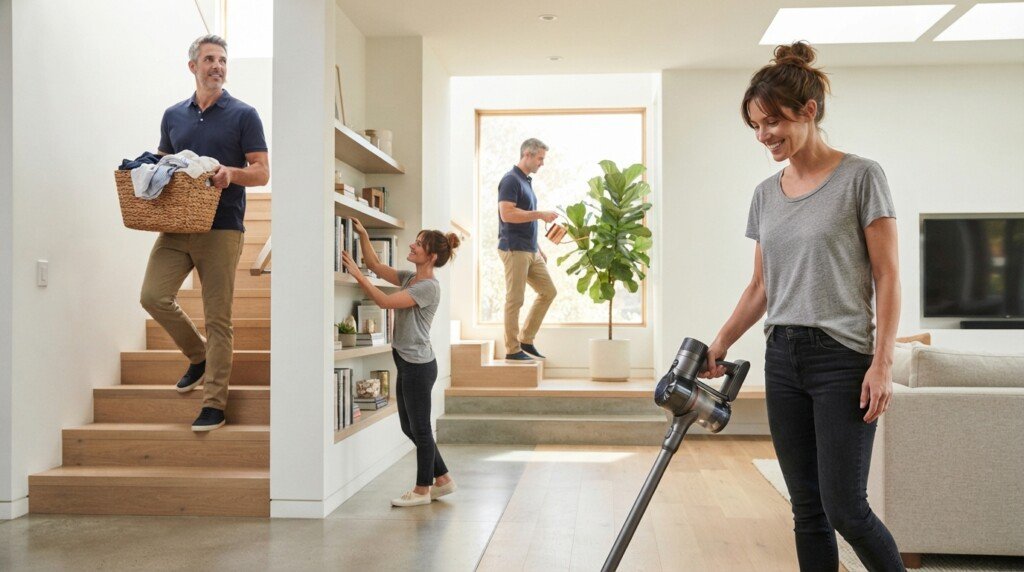
How Can I Increase NEAT Around the House?
You don’t need a gym membership or expensive equipment to move more.
In fact, your home may be the easiest place to increase daily activity because it naturally provides dozens of opportunities to stay on your feet.
Many household tasks involve walking, lifting, bending, reaching, stretching, and carrying. Individually, these movements may seem insignificant, but together they contribute to a more active lifestyle and help support your overall daily calorie expenditure.
The key is not to create extra chores.
It is to approach the tasks you’re already doing with a slightly more active mindset.

What Are the Easiest Ways to Incorporate NEAT Into Daily Household Chores?
Most homes require regular cleaning and maintenance.
Instead of viewing these activities as interruptions to your day, they can become simple opportunities to move more without setting aside additional time for exercise.
Common household activities that naturally increase movement include:
- Vacuuming every room instead of only high-traffic areas
- Sweeping and mopping floors
- Folding and putting away laundry immediately
- Carrying laundry baskets rather than dragging them
- Washing dishes by hand occasionally
- Cleaning windows and mirrors
- Organizing closets and storage spaces
- Watering indoor and outdoor plants
- Making the bed every morning
- Preparing meals from scratch
These activities keep your body in motion through repeated standing, walking, reaching, bending, and carrying.
Over an entire week, those movements can add up far more than most people expect.
Avoid Doing Everything in One Trip
Many people naturally try to make chores as efficient as possible.
Efficiency saves time, but it often reduces movement.
For example, instead of carrying every item upstairs in one large load, making two or three smaller trips increases your daily walking without adding much effort.
Similarly, putting items back where they belong throughout the day creates more movement than allowing everything to pile up until the evening.
The objective is not to waste time.
It is to recognize that everyday movement is valuable rather than something to eliminate whenever possible.
Turn Waiting Time Into Moving Time
One of the biggest opportunities for increasing NEAT happens while you’re waiting.
Think about how many times each day you wait for:
- The microwave to finish
- Coffee to brew
- Laundry cycles to end
- Water to boil
- Food to cook
- Deliveries to arrive
Instead of automatically sitting down or reaching for your phone, use those few minutes to stay moving.
You might:
- Put dishes away
- Wipe kitchen counters
- Organize a shelf
- Water plants
- Walk around the house
- Stretch while standing
These brief periods of activity often feel effortless because they make productive use of time that would otherwise be inactive.
Make Cleaning a Full-Body Activity
Some chores naturally involve more movement than others.
Rather than rushing through them, allow your entire body to participate.
For example:
- Reach high shelves instead of using only waist-level storage.
- Walk around furniture instead of leaning over it.
- Carry supplies with you instead of leaving everything in one location.
- Move from room to room instead of completing everything from a single position.
These small adjustments increase overall movement while completing exactly the same household responsibilities.
What Types of Active Furniture Help Increase NEAT While Working From Home?
Working from home has many advantages, but it also creates more opportunities to remain seated for long periods.
Fortunately, certain furniture choices can naturally encourage movement throughout the day.
Examples include:
- Adjustable standing desks
- Sit-to-stand workstations
- Balance stools
- Active sitting chairs
- Walking pads used during light tasks
- Anti-fatigue standing mats
These products are not designed to replace exercise.
Instead, they help reduce prolonged sitting and encourage more frequent posture changes.
Even alternating between sitting and standing throughout the day increases overall movement compared with remaining in the same position for several hours.
If your workday involves long hours at a desk, you’ll find additional practical strategies in NEAT for Desk Workers, which focuses specifically on staying active in office and remote work environments.
Remember That Furniture Is Only a Tool
Buying new equipment does not automatically increase NEAT.
Movement still depends on your habits.
Someone with a standing desk who never raises it will remain just as sedentary as before.
Likewise, someone using a regular desk but taking frequent walking breaks may accumulate considerably more daily movement.
Furniture supports movement.
It does not replace it.
What Are Creative, Fun Ways to Make Household Tasks More Physically Active?
One reason people struggle with consistency is that they think activity must always feel like exercise.
Household routines offer a different approach.
Instead of scheduling another workout, make ordinary activities a little more engaging.
Ideas include:
- Listening to podcasts while cleaning
- Playing upbeat music while vacuuming
- Gardening with family members
- Organizing one room each weekend
- Washing the car by hand
- Playing active games with children
- Taking pets outside more frequently
- Walking around while brainstorming ideas
- Rearranging furniture occasionally
These activities combine productivity with movement, making it easier to stay active without feeling like you’re exercising.
Involve the Entire Household
Daily movement becomes easier when everyone participates.
Simple examples include:
- Cleaning together before dinner
- Gardening as a family
- Walking after meals
- Playing outside with children
- Tidying shared spaces before bedtime
These activities not only increase movement but also help establish routines that feel enjoyable rather than forced.
Focus on Consistency Rather Than Perfection
Many people look for the single activity that burns the most calories.
A better question is:
“What activity can I realistically continue every day?”
A ten-minute household task repeated daily often contributes more over the course of a year than an ambitious routine that lasts only two weeks.
Long-term success comes from consistency.
Small improvements repeated every day usually outperform dramatic efforts that are difficult to maintain.
By viewing your home as a place where movement naturally happens instead of somewhere to remain seated, you’ll gradually increase your daily activity without making your schedule feel busier.
How Can I Increase NEAT While Watching TV?
Watching television is one of the easiest times to become inactive without realizing it.
Whether you’re catching up on your favorite series, watching sports, or relaxing after work, it’s common to remain seated for several hours at a time. Over weeks and months, those long periods of inactivity can gradually reduce your overall daily movement.
The good news is that you don’t have to give up your favorite shows to stay active.
With a few simple adjustments, television time can become another opportunity to increase your daily calorie expenditure while still enjoying your downtime.

What Are Simple NEAT-Boosting Activities I Can Do While Watching TV?
The easiest approach is to avoid staying completely still for an entire episode.
You don’t need to perform a workout.
Instead, look for opportunities to keep your body gently moving.
Simple ideas include:
- Standing during scene changes
- Walking around the room between episodes
- Folding laundry
- Organizing magazines or books
- Stretching while standing
- Refilling your water bottle
- Tidying the coffee table
- Putting away items that are out of place
- Watering indoor plants
- Walking around while talking during phone calls
These movements require very little effort but help reduce prolonged sitting.
Over time, they become automatic habits rather than conscious decisions.
Create Small Movement Triggers
Instead of relying on motivation, connect movement to something that naturally happens while watching TV.
For example:
- Stand every time a new episode starts.
- Walk around during opening credits.
- Stretch whenever your streaming service asks if you’re still watching.
- Put away one household item every time you refill your drink.
These tiny routines make movement feel effortless because they become linked to existing habits.
What Household Chores Can I Do During Breaks to Boost NEAT?
Even if you’re streaming without commercials, there are natural pauses between episodes.
Those one or two minutes are perfect opportunities to complete quick household tasks.
Consider using those short breaks to:
- Load or unload the dishwasher
- Wipe kitchen counters
- Fold towels
- Empty small trash bins
- Organize shoes near the entrance
- Clean bathroom mirrors
- Put groceries away
- Refill pet food or water bowls
- Sweep a small area
- Collect laundry
Each task may only take a minute or two, but together they increase movement while making your home more organized.
Instead of thinking, “I don’t have time to clean,” you’ll gradually complete many small jobs throughout the evening.
Are There NEAT-Friendly Gadgets That Help Me Stay Active While Watching TV?
Some people enjoy using equipment that encourages gentle movement without turning television time into a workout.
Examples include:
- Under-desk pedal exercisers
- Walking pads used at slow speeds
- Balance boards for standing
- Anti-fatigue standing mats
- Compact steppers
- Light resistance bands for mobility exercises
These tools should be viewed as optional rather than essential.
The biggest contributor to NEAT is still your overall daily movement.
Many people successfully increase their activity without purchasing any equipment simply by standing more often and moving during natural breaks.
How Much Can Increasing NEAT Calories Impact Weight Loss?
One of the most common questions people ask is whether increasing everyday movement actually makes a meaningful difference.
The answer is yes, but with realistic expectations.
NEAT is not a shortcut to weight loss.
It is one piece of the larger picture.
When combined with balanced nutrition, sufficient sleep, and regular physical activity, higher NEAT can support a more sustainable calorie deficit over time.

Can NEAT Alone Lead to Significant Weight Loss, or Does It Need Diet and Exercise Too?
Increasing everyday movement is beneficial, but it should not be viewed as the only strategy for losing weight.
Weight management is influenced by many factors, including:
- Overall calorie intake
- Physical activity
- Sleep quality
- Stress levels
- Medical conditions
- Hormonal health
- Long-term consistency
NEAT works best as part of an overall healthy lifestyle.
Someone who walks more, stands more, and stays active throughout the day while maintaining healthy eating habits is generally in a stronger position than someone relying on workouts alone.
Likewise, regular exercise still provides important cardiovascular, muscular, and mental health benefits that everyday movement cannot fully replace.
Think of NEAT as helping to fill the many hours between workouts.
Instead of asking, “Should I exercise or increase NEAT?”
A better question is:
“How can I combine both?”
What Is the Estimated Calorie Burn Difference Between Sedentary and More Active Lifestyles?
The exact number varies depending on body size, occupation, and daily routine.
However, research has consistently shown that people with highly active lifestyles outside the gym can burn several hundred more calories per day than individuals who remain sedentary.
That difference doesn’t happen because of one activity.
It comes from dozens of small choices such as:
- Walking instead of driving short distances
- Standing more frequently
- Completing household chores
- Taking stairs
- Shopping on foot
- Playing with children
- Gardening
- Carrying groceries
Individually, these activities seem minor.
Together, they can substantially increase total daily energy expenditure over time.
This is one reason weight management often depends as much on what happens outside the gym as what happens inside it.
When Should I Be Mindful of My NEAT Levels?
Many people unknowingly reduce their daily movement during certain periods of life.
Recognizing these situations allows you to stay proactive before long stretches of inactivity become routine.
Are There Specific Times or Situations Where Focusing on NEAT Is Most Beneficial?
Paying closer attention to everyday movement is especially helpful when:
- You recently started working from home.
- You have a desk-based job.
- You’re studying for long hours.
- You’re recovering from a busy travel schedule.
- Winter weather keeps you indoors.
- You’re spending more time watching television.
- Your workout routine has become less consistent.
- You’re trying to maintain weight after reaching your goal.
During these periods, everyday movement often decreases without people noticing.
Making a conscious effort to walk more, stand more, or complete simple household tasks helps prevent prolonged inactivity.
Work-specific ideas are covered separately in NEAT for Desk Workers, where home office routines and office environments are explored in greater detail.
What Common Factors Might Decrease NEAT Unintentionally?
Many everyday habits quietly reduce movement without us realizing it.
Common examples include:
- Spending long hours scrolling on your phone
- Using elevators instead of stairs
- Driving very short distances
- Ordering delivery instead of walking to nearby stores
- Binge-watching television
- Sitting through long meetings without breaks
- Completing all errands by car
- Working for several hours without standing
None of these habits is harmful on its own.
The problem arises when they become the default every day.
Replacing even a few of these sedentary habits with more movement can gradually increase your overall activity level without making life feel more demanding.
Key Takeaways
| Topic | Key Insight |
|---|---|
| Increase NEAT naturally | Focus on small movements throughout the day instead of adding extra workouts. |
| Home activities | Cleaning, gardening, cooking, and organizing all contribute to higher daily movement. |
| TV time | Use episode breaks and waiting periods to stand, walk, or complete quick chores. |
| Weight loss | NEAT supports calorie expenditure but works best alongside healthy eating and regular exercise. |
| Long-term success | Consistency with small habits is more sustainable than relying on motivation alone. |
Frequently Asked Questions
1. What are simple ways to increase NEAT calories daily?
Some of the easiest methods include standing more often, taking walking breaks, using the stairs, completing household chores, walking while talking on the phone, parking farther away, and staying active during leisure time.
2. Can increasing NEAT alone cause weight loss?
Increasing NEAT can help burn more calories, but it works best when combined with a balanced diet and regular physical activity. It should be viewed as one part of a comprehensive weight management strategy.
3. Is walking considered NEAT?
Yes. Walking that occurs as part of your normal daily routine, such as shopping, running errands, or walking your dog, contributes to NEAT. Planned walking workouts are generally classified as exercise instead.
4. Do I need special equipment to increase NEAT?
No. Most people can increase NEAT simply by moving more during everyday activities. Standing more often, doing household chores, and walking regularly are usually enough to make a noticeable difference.
5. How long does it take to notice the benefits of increasing NEAT?
The habit itself can begin immediately, but noticeable changes in overall activity and weight management depend on consistency, nutrition, and your overall lifestyle. Small improvements repeated every day often produce meaningful long-term results.
Conclusion
Learning how to increase NEAT calories isn’t about finding another workout or squeezing more exercise into an already busy schedule. It’s about recognizing that everyday movement matters more than most people realize.
Whether you’re cleaning the house, walking during phone calls, standing while working, taking the stairs, or simply moving more while watching television, these small actions accumulate throughout the day. Individually, they may seem insignificant. Together, they can meaningfully increase your daily calorie expenditure and support healthier weight management.
The biggest advantage of NEAT is that it fits naturally into real life. You don’t need perfect motivation, expensive equipment, or extra hours in the gym. By making movement part of your normal routine instead of treating it as another task on your to-do list, you’ll create habits that are easier to maintain for months and years.
Sustainable weight loss is rarely built on dramatic changes. More often, it comes from consistently making better choices every single day, and increasing your everyday movement is one of the simplest places to start.
Disclaimer:
This post may contain affiliate links. If you purchase through them, we may earn a small commission at no extra cost to you. Also, this content is for informational purposes only and does not substitute professional medical advice.
Ready to Start Your Journey?
Use our free 7-in-1 Weight Loss Toolkit to calculate your numbers and build your plan in minutes.
Open Free Tools →