

Signs You’re Fat-Adapted (And How to Track Your Progress)
Knowing the signs of fat adaptation can be surprisingly difficult because there is no single symptom, blood test, or morning measurement that can tell you, “You are officially fat-adapted.”
Fat adaptation is better understood as a collection of changes. Your body becomes more comfortable relying on fat and ketones as important fuel sources, and that shift can show up in several areas of daily life. Energy may feel steadier. Hunger may become less disruptive. Exercise can begin to feel different. Some people notice changes in mental clarity or fewer dramatic energy swings.
But there is an important catch.
None of these changes proves fat adaptation on its own.
Feeling energetic after breakfast does not automatically mean you are fat-adapted. A high ketone reading does not necessarily mean your muscles have completely adapted to using fat. Likewise, having one difficult workout does not mean the process has failed.
The most useful approach is to look for patterns rather than isolated signals.
This is also why tracking can be valuable. Instead of relying on memory, you can record energy, sleep, exercise performance, hunger, and selected physiological measurements over time. When several measures begin moving in the same direction, you have a much clearer picture of how your body is responding.
What are the physical, mental, and performance signs of being fat-adapted?
The most useful signs of fat adaptation tend to appear across three areas: how you feel physically, how stable your mental energy feels, and how your body performs during activity.
You may notice one change before another. Some people notice appetite and energy changes first. Others notice differences during exercise. Some do not experience dramatic subjective changes at all.
That last point matters.
Fat adaptation does not have to feel spectacular.
The body can become more capable of using fat as fuel without producing a dramatic sensation that tells you the process has happened. In fact, expecting a sudden “fat-adapted feeling” can make progress harder to recognize.
A better self-assessment asks several practical questions.
Are your energy levels becoming more predictable?
Can you go between meals without feeling constantly preoccupied with food?
Do you experience fewer sudden energy crashes?
Does lower-intensity exercise feel easier to sustain?
Are you recovering normally from workouts?
Is your sleep reasonably stable?
Do your ketone measurements, if you use them, show a consistent pattern that matches your dietary approach?
The more of these observations that line up over time, the more useful your assessment becomes.
What physical signs indicate fat adaptation has occurred?
Physical signs can be subtle because fat adaptation is not a disease state with a standardized symptom checklist.
One of the more noticeable changes for some people is more stable energy between meals.
When carbohydrate availability is reduced and the body becomes increasingly capable of using fat-derived fuels, some people report fewer pronounced swings between feeling energized and suddenly feeling depleted. Instead of feeling like they need a snack to get through the next hour, they may find that energy remains relatively steady.
That does not mean hunger disappears.
It means the urgency associated with hunger may change.
Another possible sign is being able to go longer between meals without feeling physically uncomfortable or unusually weak. Appetite is influenced by many factors, including sleep, stress, food composition, total energy intake, and individual physiology, so this should never be interpreted as a definitive test.
Changes in exercise tolerance can also provide useful information.
During the early stages of carbohydrate restriction, some people experience a temporary decline in exercise performance. As adaptation progresses, lower-intensity activity may begin to feel more comfortable again.
You might notice that a long walk, easy cycling session, or steady aerobic workout can be maintained without the same sensation of needing quick carbohydrate energy.
This is particularly relevant because fat oxidation tends to contribute more substantially during prolonged, lower-intensity activity than during short bursts of maximal effort.
Another possible physical change is less dependence on frequent snacks during active periods.
Again, this does not prove fat adaptation.
A person eating a high-protein, high-fiber diet could also experience better satiety. Someone who simply eats more calories could also notice fewer hunger episodes. The context matters.
There can also be changes in body weight or body composition, but these are not reliable markers of fat adaptation itself.
Losing weight does not prove that someone is fat-adapted.
Likewise, maintaining the same weight does not mean fat adaptation has failed.
The purpose of tracking physical signs is therefore not to find one magical symptom. It is to identify whether your body appears increasingly comfortable with the fuel environment you have created.
A simple weekly check can help:
Energy: Is your energy more stable?
Hunger: Are meals keeping you satisfied for longer?
Exercise: Are normal activities becoming easier to sustain?
Recovery: Are you recovering reasonably well after activity?
Daily function: Do you feel capable of completing normal tasks without unusual fatigue?
If several answers gradually move in a positive direction, that is more meaningful than any single morning observation.
What mental signs, like clarity or stable mood, show up?
Mental changes are among the most commonly discussed experiences during fat adaptation, but they are also among the easiest to overinterpret.
Some people report feeling mentally clearer or more focused after adjusting to a ketogenic or very low-carbohydrate eating pattern. Others notice fewer afternoon concentration dips or less of the feeling that their brain suddenly “runs out of fuel.”
Ketones can be used by the brain as an energy source when carbohydrate availability is low, which helps explain why changes in brain fuel availability are often discussed alongside ketogenic diets.
However, subjective mental clarity is not a diagnostic marker.
There are too many other variables involved.
Sleep quality, caffeine intake, stress, hydration, workload, meal composition, and expectations can all change how mentally sharp you feel.
For that reason, it is better to track mental clarity as a repeated observation.
Instead of asking, “Do I feel more focused today?”
Ask:
“How was my concentration during the same part of the day compared with the previous two weeks?”
That question is much more useful.
Mood stability can be tracked in a similar way.
Some people notice fewer dramatic changes in mood associated with hunger or energy dips. Others do not notice any meaningful difference.
There is no requirement that becoming fat-adapted must make you happier, calmer, or more productive.
If you experience persistent irritability, anxiety, depressed mood, or significant changes in mental health, those symptoms should not simply be attributed to dietary adaptation.
The same principle applies to brain fog.
Temporary difficulty concentrating can occur during dietary changes, particularly when carbohydrate intake changes abruptly. But persistent or severe cognitive symptoms deserve attention rather than being dismissed as proof that adaptation is still underway.
The strongest approach is to record a simple daily rating.
For example:
Mental clarity: 1 to 5
Mood stability: 1 to 5
Afternoon concentration: 1 to 5
Mental fatigue: 1 to 5
You do not need a sophisticated app.
A note on your phone is enough.
After two or three weeks, the pattern can be more informative than your memory of any individual day.
How does athletic performance change once you’re fat-adapted?
Exercise performance is where fat adaptation becomes particularly interesting because the body does not use the same fuel mixture at every intensity.
During prolonged, lower-intensity activity, fat can make a substantial contribution to energy production. As exercise intensity increases, carbohydrate becomes increasingly important because it can provide energy at a faster rate.
This means becoming more efficient at using fat does not automatically make someone better at sprinting, repeated high-intensity intervals, or every type of competitive sport.
A person may instead notice changes during endurance-oriented activity.
For example, a previously difficult steady-paced walk or cycling session may feel more manageable. An individual may be able to maintain a moderate effort without experiencing the same urgency for carbohydrate-based fuel.
Some endurance athletes deliberately explore ketogenic diets because of this increased capacity for fat oxidation.
But increased fat oxidation and improved overall athletic performance are not identical outcomes.
An athlete can become highly efficient at burning fat and still experience limitations during high-intensity efforts where carbohydrate availability matters.
This is why performance should be evaluated according to the activity you actually care about.
If you are training for a long-distance event, track endurance, pace, perceived exertion, and recovery.
If you are lifting weights, track strength, repetitions, training quality, and recovery.
If you are simply trying to feel better during everyday activity, track walking tolerance, energy, and general physical function.
Do not use someone else’s performance marker as your own definition of adaptation.
A recreational walker and a competitive cyclist have completely different demands.
One practical rule is especially useful:
Improving fat utilization should not require your overall performance to deteriorate indefinitely.
If exercise capacity remains substantially worse for an extended period, it is worth reassessing the dietary approach rather than assuming that more restriction will eventually solve everything.
How can I track my progress during fat adaptation?
Tracking fat adaptation does not need to become a laboratory project.
In fact, excessive tracking can make the process more confusing.
The goal is to collect enough information to recognize meaningful patterns without becoming obsessed with every fluctuation.
A practical tracking system can use four categories:
Fuel-related measurements
Energy and appetite
Exercise performance
Sleep and recovery
You can record these daily, while looking at the overall trend once or twice a week.
The important part is consistency.
If you change your diet, exercise routine, sleep schedule, caffeine intake, and tracking method every few days, you will have very little useful information to work with.
What key physiological markers should I monitor?
Ketone levels are one of the most obvious measurements people associate with fat adaptation.
Blood ketone meters can measure beta-hydroxybutyrate directly. Breath devices can estimate acetone, while urine strips detect acetoacetate.
Each method has limitations.
Urine ketone strips are inexpensive and convenient, but they can become less useful as the body adapts because urinary ketone levels do not necessarily reflect how efficiently the body is producing and using ketones.
Blood testing is more direct for measuring circulating beta-hydroxybutyrate, but it costs more and requires finger-prick testing.
Breath testing can be convenient for repeated measurements, although readings can vary according to the device and circumstances.

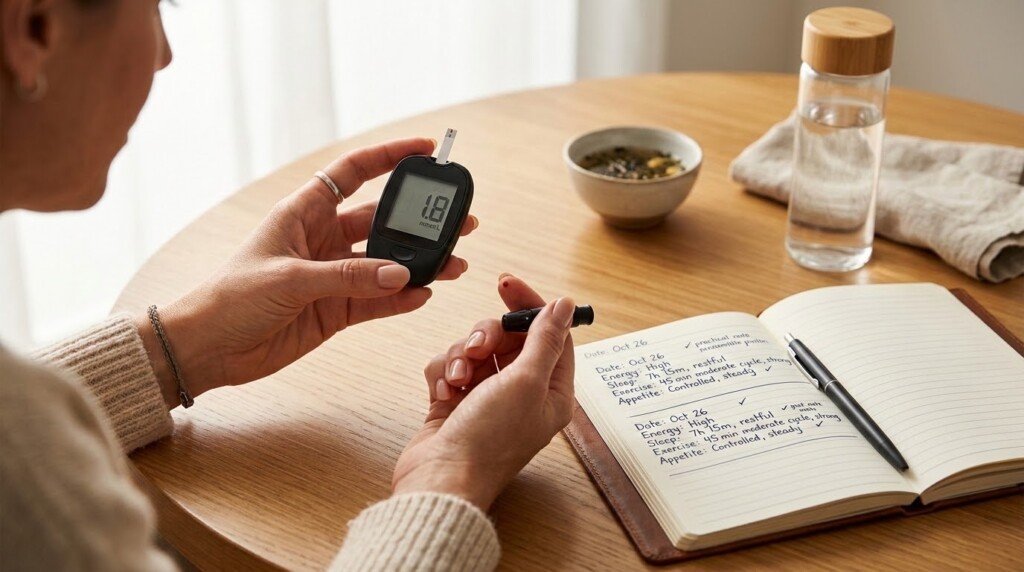
The most important point is that a ketone number is not the same thing as a fat-adaptation score.
A high ketone reading does not automatically mean you are more metabolically adapted than someone with a lower reading.
Ketone production and tissue-level fuel utilization are related but distinct concepts.
This is why ketone testing works best as one part of a larger tracking system.
Energy is another useful marker.
Rate your energy at roughly the same points each day. Morning, midday, afternoon, and evening can provide a useful snapshot.
You can use a simple 1 to 5 scale:
1 means extremely depleted.
3 means normal.
5 means unusually energetic and stable.
After several weeks, look for changes in the pattern rather than chasing a perfect score.
Appetite can be tracked in the same way.
Record how hungry you feel before meals and whether you experience strong cravings between them.
Exercise performance should be recorded according to your activity.
For strength training, track weights and repetitions.
For endurance activity, track duration, distance, pace, and perceived effort.
For everyday movement, simply note whether activity feels easier, unchanged, or more difficult.
Weight can be recorded if it is relevant to your personal goal, but it should not be treated as evidence of fat adaptation.
Body weight fluctuates for many reasons, including water, glycogen, sodium, food volume, and hormonal changes.
That makes it a poor standalone indicator of metabolic adaptation.
What tools or apps can help log and analyze progress?
You do not need expensive technology.
A basic spreadsheet can be more useful than a complicated metabolic tracking system because it allows you to see several variables together.
A simple weekly tracker could contain:
| Marker | Monday | Wednesday | Friday | Sunday |
|---|---|---|---|---|
| Morning energy | 1 to 5 | 1 to 5 | 1 to 5 | 1 to 5 |
| Afternoon energy | 1 to 5 | 1 to 5 | 1 to 5 | 1 to 5 |
| Hunger stability | 1 to 5 | 1 to 5 | 1 to 5 | 1 to 5 |
| Sleep quality | 1 to 5 | 1 to 5 | 1 to 5 | 1 to 5 |
| Exercise performance | 1 to 5 | 1 to 5 | 1 to 5 | 1 to 5 |
| Ketones, if tested | optional | optional | optional | optional |
The exact days do not matter as much as using the same method repeatedly.
Wearable devices can provide useful information about sleep duration, resting heart rate, activity, and exercise. They can help establish trends, but their measurements are estimates rather than perfect clinical readings.
Ketone meters can be useful if you specifically want to monitor nutritional ketosis.
However, buying more devices does not necessarily produce better insight.
If you have five different metrics but never look at the trends, the technology is not helping.
The most effective tracking system is the one you will actually use.
Keep the process simple enough that recording information takes less than a few minutes.
Then review the data weekly.
Ask:
Is my energy becoming more stable?
Is my exercise tolerance improving?
Is hunger becoming easier to manage?
Is my sleep supporting recovery?
Do my ketone measurements, if I use them, fit with the dietary pattern I am following?
That gives you a much clearer picture than checking one number every morning and deciding whether the day was successful.
Why does sleep quality matter to track specifically during this process?
Sleep deserves special attention because it can affect almost every other measurement you are trying to interpret.
A poor night’s sleep can increase fatigue, change appetite, reduce exercise performance, affect concentration, and make mood less stable.
That creates a problem if you are trying to determine whether a dietary change is improving your metabolic flexibility.
Imagine you wake after five hours of sleep and feel exhausted.
You may conclude that your diet is not working.
But what if you slept eight hours the next night and felt significantly better?
The difference may have had little to do with your fuel adaptation.
This is why sleep acts as an important piece of context.
Track sleep duration, how rested you feel when you wake up, and whether you experience repeated nighttime awakenings.
You do not need perfect sleep every night.
The goal is to identify persistent patterns.

If your energy improves while sleep remains stable, that gives you more confidence that the change may be associated with the dietary transition.
If your energy declines while sleep simultaneously worsens, it becomes much harder to attribute the change to fat adaptation alone.
Sleep also matters for exercise recovery.
A person who is training regularly while sleeping poorly may experience reduced performance even if their ability to oxidize fat is increasing.
This is why a complete progress log should not treat metabolism as an isolated system.
Your body is responding to diet, activity, sleep, stress, hydration, and recovery at the same time.
The better your tracking captures that context, the less likely you are to draw the wrong conclusion from one bad day.
If you are still unsure whether your experience fits the broader adaptation process, comparing your observations with the expected fat adaptation timeline can provide useful context without turning the process into a rigid deadline.
Frequently Asked Questions
1. How do I know if I’m fat-adapted?
There is no single definitive symptom that proves fat adaptation. More stable energy, improved tolerance for prolonged lower-intensity exercise, reduced dependence on frequent snacks, and consistent ketone production can provide useful clues when they appear together over time.
2. What are the signs of fat adaptation?
Potential signs include steadier energy, more predictable appetite, fewer pronounced energy dips, improved comfort during prolonged aerobic activity, and changes in how your body handles periods between meals. These are indicators, not diagnostic tests.
3. How can I track fat adaptation progress?
Track several variables rather than relying on one measurement. Useful options include blood, breath, or urine ketone testing, daily energy ratings, hunger, exercise performance, sleep quality, and recovery. Review the trends over several weeks.
4. Do high ketone levels prove that I’m fat-adapted?
No. Ketone levels show that ketone production is occurring, but they do not provide a complete measure of how efficiently your tissues use fat and ketones. Ketone testing is most useful when combined with other progress markers.
5. Can sleep affect how I judge fat adaptation?
Yes. Poor sleep can increase fatigue, hunger, mood changes, and exercise difficulty, which can make it harder to determine whether changes are coming from dietary adaptation or inadequate recovery. Tracking sleep provides important context for interpreting your other measurements.
Disclaimer:
This post may contain affiliate links. If you purchase through them, we may earn a small commission at no extra cost to you. Also, this content is for informational purposes only and does not substitute professional medical advice.
Ready to Start Your Journey?
Use our free 7-in-1 Weight Loss Toolkit to calculate your numbers and build your plan in minutes.
Open Free Tools →