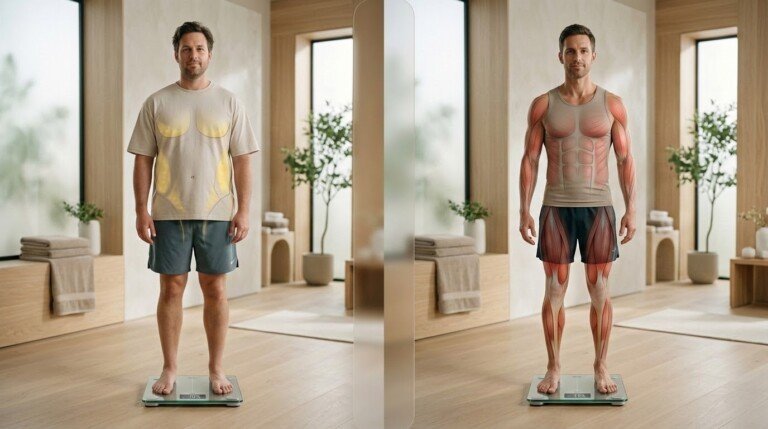
Myth: You Can Spot-Reduce Fat From One Body Part
If you’ve ever done hundreds of crunches because you wanted a flatter stomach, endless leg exercises because you wanted leaner thighs, or repeated arm workouts because you wanted to lose fat from your upper arms, you’ve probably encountered the idea of spot reduction.
It sounds logical.
Train a particular body part, use the muscles underneath it, and eventually the fat sitting on top of those muscles should disappear.
But the body does not work like a collection of independent fat-burning compartments.
So, can you spot reduce fat from one specific body part?
No. You can strengthen and develop particular muscles, but you cannot reliably instruct your body to remove stored fat from only the area you are exercising.
That does not make targeted exercise pointless.
It simply means the benefit is different from what the spot-reduction myth promises.
An abdominal workout can strengthen your abdominal muscles. A leg workout can develop your quadriceps and glutes. Resistance exercises for your arms can improve muscle strength and shape. What those exercises cannot guarantee is that the fat covering those particular muscles will disappear first.
Fat loss is a whole-body process.
When your body needs to draw on stored energy, fat is mobilized from fat tissue through a combination of hormonal signals, blood flow, energy demands, genetics, and individual physiology. The body does not simply look at the muscle you are exercising and decide to empty the nearest fat cells.
That distinction is important because chasing spot reduction can waste enormous amounts of time.
Instead of spending months trying to burn belly fat with abdominal exercises alone, you can use targeted training for what it actually does well while supporting overall fat loss through a broader strategy.
Quick Answer: Can You Spot Reduce Fat?
Can you spot reduce fat from a specific body part through targeted exercise? Not reliably. Exercising a particular muscle primarily trains that muscle, while body-fat reduction occurs through a broader physiological process involving energy balance and systemic fat mobilization.
Targeted exercises can still be valuable because they build and strengthen the underlying muscles.
The practical goal is therefore not to abandon targeted exercise.
It is to stop expecting it to selectively remove the fat covering that muscle.
Why Can’t You Spot-Reduce Fat From a Specific Body Part?
The simplest explanation is that the body does not use stored fat according to the location of the muscle being exercised.
When you perform an abdominal exercise, the abdominal muscles contract.
They need energy.
But that does not mean the body must take that energy directly from the fat cells sitting above your abdomen.
Your muscles have several available energy sources, and the body regulates fuel use across the entire system.
During physical activity, energy can come from circulating fuels and stored substrates, including glycogen and fatty acids. Fatty acids released from adipose tissue can travel through the bloodstream and become available to tissues that need energy.
The process is systemic rather than a direct pipe connecting a particular muscle to the nearest fat deposit.
This explains why a person can have very strong abdominal muscles while still carrying noticeable abdominal fat.
The muscles underneath may be well developed.
They simply remain covered by subcutaneous fat.
The same principle applies elsewhere.
Someone can have strong legs while carrying substantial fat around the thighs.
Someone can have well-developed shoulders while still carrying fat around the upper arms.
Someone can build impressive abdominal strength without immediately developing visible abdominal definition.
Muscle development and fat loss are related, but they are not the same physiological process.
What Is the Scientific Explanation for Why Spot Reduction Isn’t Possible?
The central issue is how stored fat is mobilized.
Body fat is stored primarily inside specialized cells called adipocytes. When the body needs to access stored energy, signals stimulate the breakdown of stored triglycerides into fatty acids and glycerol.
Those fatty acids can then enter circulation and be used by tissues for energy.
The important point is that this process is not controlled simply by which muscle happens to be contracting.
A muscle does not send a direct message saying, “Take the fat directly above me.”
Instead, fat mobilization is influenced by the body’s broader metabolic and hormonal environment.
This is one reason why doing 200 crunches does not mean your abdominal fat receives 200 direct instructions to disappear.
The crunches train your abdominal muscles.
Your overall physiology determines how stored energy is mobilized.
There are also differences in blood flow and receptor activity between different fat depots, which can influence how readily fat is mobilized from particular areas. This is one reason people lose fat differently from one another.
But these biological differences do not translate into a reliable method for choosing a body part and exercising it until the fat there disappears.
That is the key misunderstanding behind spot reduction.
The body has its own priorities.
You can choose which muscles to train.
You cannot precisely choose which fat cells your body will empty first.


How Does the Body Actually Decide Where to Burn Fat From?
The answer is more complicated than simply saying that the body burns fat from wherever it is easiest.
Fat distribution varies considerably between individuals.
Genetics influence where people tend to store body fat and how those fat stores respond to changes in energy balance.
Hormonal factors also matter.
Sex, age, overall body composition, and other physiological characteristics can influence fat distribution and the pattern in which body fat changes.
This is why two people following similar weight-loss plans can notice very different visual changes.
One person may notice changes around the face and waist relatively early.
Another may notice changes in the hips, legs, or upper body first.
Neither person is necessarily doing anything wrong.
Their bodies simply distribute and mobilize stored fat differently.
If you are trying to understand why particular body parts appear to change before others, the detailed fat-loss sequence is a separate question. Which Body Part Loses Fat First? addresses that issue without turning this article into a full explanation of individual fat-loss patterns.
For this article, the important takeaway is simpler:
You can influence overall fat loss, but you cannot reliably select the exact body part where fat will disappear first.
Why Do Some People Think Spot Reduction Works?
The myth survives partly because targeted exercise can produce changes that look like local fat loss.
Imagine someone begins doing regular abdominal exercises.
Over several months, they become more active.
They improve their diet.
Their overall body fat decreases.
Their abdominal muscles become stronger and more developed.
Their waist becomes smaller.
They look noticeably leaner around the stomach.
It is easy to conclude that the ab exercises burned the belly fat.
But several things changed simultaneously.
Overall energy expenditure changed.
Food intake may have changed.
Body fat decreased across the body.
Abdominal muscles became stronger.
The combination created a visible result around the stomach.
That does not demonstrate that the crunches selectively removed abdominal fat.
There is another visual illusion worth understanding.
When a muscle becomes more developed, the shape of the body part can change even if the amount of surrounding fat has not changed dramatically.
A stronger shoulder can look more defined.
A more developed glute can change the shape of the hips.
More muscular legs can appear firmer.
These are legitimate changes.
They simply represent changes in muscle rather than selective removal of nearby fat.
This is why the phrase “toning” can sometimes create confusion.

Can Targeted Exercises Still Be Useful, Even If They Don’t Burn Fat There?
Absolutely.
This is where the spot-reduction myth needs a constructive correction.
The fact that targeted exercises do not selectively remove nearby fat does not make them useless.
Far from it.
Targeted resistance training can strengthen specific muscles, improve physical performance, support joint function, and change muscle size and shape.
If you want stronger abdominal muscles, train your core.
If you want stronger legs, train your legs.
If you want stronger shoulders and arms, train those muscles.
Just separate that objective from fat loss.
You are training the muscle because you want the muscle to adapt.
You are supporting overall fat loss through the broader combination of nutrition, activity, and energy balance.
Those two processes can happen at the same time.
In fact, combining them can produce a much more useful outcome than chasing a particular number on the scale.
Someone might lose body fat while gaining or preserving muscle.
Their total body weight may change slowly, yet their clothing fit and body shape may improve considerably.
That is one reason a successful fat-loss strategy should not be judged entirely by the scale.
What Are Effective Strategies for Overall Body Fat Reduction Instead?
If your goal is to reduce body fat, the answer is not a secret exercise for a particular body part.
The foundation is creating conditions that allow your body to use stored energy over time while preserving as much lean tissue as reasonably possible.
Nutrition plays a major role.
Your overall eating pattern needs to support an appropriate energy intake while still providing enough protein, fiber, vitamins, minerals, and other nutrients.
Exercise complements that process.
Cardiovascular activity can increase energy expenditure and improve cardiovascular fitness.
Resistance training can help maintain or build muscle.
Daily movement also matters.
Walking, climbing stairs, household activity, commuting, and other forms of movement contribute to total activity throughout the day.
Sleep and recovery should not be ignored either.
A plan that depends on exhausting workouts seven days a week may be difficult to maintain.
The objective is not to find the exercise that burns the most calories from the body part you dislike.
The objective is to build a sustainable system that gradually improves body composition.
For the broader balance between cardiovascular exercise, resistance training, and sustainable fat loss, Exercise for Sustainable Fat Loss covers the practical exercise framework separately.
Can Specific Exercises Still Tone the Muscle Underneath, Even Without Local Fat Loss?
Yes.
This is probably the most useful replacement for the spot-reduction idea.
Instead of saying, “I need an exercise that burns belly fat,” think:
“I want to reduce overall body fat while developing my abdominal muscles.”
Those are two different goals.
You can train your abdominal muscles with exercises such as planks, controlled crunch variations, leg raises, and other appropriate movements.
You can train your legs through resistance exercises.
You can strengthen your arms and shoulders through pressing, pulling, and other resistance movements.
As those muscles adapt, they can become stronger and potentially more developed.
If overall body fat also decreases, the muscles may become increasingly visible.
That is how the appearance many people want from “toning” is actually created.
It is not the result of a magical exercise that melts fat from directly above a muscle.
It is the combination of less overall body fat and more developed or preserved muscle.
This distinction can completely change how you approach exercise.

What Happens When You Keep Training One Body Part to Burn Its Fat?
This is where the spot-reduction myth can become frustrating.
A person may spend extra time training their abs because their stomach is the area they most want to change. When the expected result does not appear, they assume they simply need more abdominal exercises.
So they do more.
Twenty minutes becomes thirty.
Three sessions become six.
Crunches are replaced with increasingly difficult variations.
Yet the layer of fat over the abdomen may look remarkably similar.
The problem is not necessarily the quality of the abdominal workout. The problem is the assumption about what that workout is supposed to accomplish.
A stronger muscle does not automatically mean less fat above it.
If overall body fat remains relatively high, developing the muscle underneath may have only a limited effect on visible definition.
This is why endlessly increasing exercises for one body part can become inefficient. You may be investing more time into a process that was never designed to produce the result you want.
A better strategy is to decide what you are actually trying to change.
If the goal is stronger abdominal muscles, train the abs.
If the goal is lower overall body fat, address the factors that influence whole-body fat loss.
If the goal is a more defined appearance, work on both muscle development and overall body composition.
That is a much more precise way to think about exercise.
Why Does Belly Fat Often Become the Center of the Spot-Reduction Myth?
The abdomen is one of the most commonly targeted areas because changes in waist size and abdominal appearance are highly visible.
People also tend to associate a flat stomach with fitness, which has created an enormous market for products and workouts promising “belly fat burning.”
The problem is that many of these promises confuse muscle fatigue with fat loss.
You can perform an intense abdominal workout and feel your stomach muscles burning.
That sensation is real.
It tells you the muscles were challenged.
It does not tell you that abdominal fat was selectively removed.
The same principle applies to sweating.
A person may sweat heavily during a workout and feel as though a large amount of fat has disappeared.
Sweating primarily reflects the body’s attempt to regulate temperature.
It is not a measurement of how much fat was removed from a particular body part.
These distinctions may seem obvious once explained, but marketing often blurs them.
Words such as “burn,” “tone,” “sculpt,” and “target” can make exercise sound as though it has precise control over where body fat disappears.
Human physiology is not that convenient.
What Is the Difference Between Muscle Toning and Fat Loss?
“Toning” is one of those fitness terms that sounds precise but is often misunderstood.
Muscle does not become “toned” through a special type of exercise.
What people usually mean by a toned appearance is some combination of developed muscle and relatively low levels of surrounding body fat.
That requires two different processes.
Resistance training can stimulate muscle adaptation.
Fat loss reduces the layer of fat covering those muscles.
The visual result depends on both.
Imagine two people with similar amounts of abdominal muscle.
One has more body fat covering those muscles.
The other has less.
Their abdominal strength could be similar, but their appearance could be dramatically different.
Now imagine the first person begins resistance training and loses body fat gradually.
Their abdominal muscles become stronger while the layer of fat decreases.
The resulting definition can improve substantially.
The change may look like the abdominal exercises “burned belly fat.”
They did not.
The exercises helped develop the muscle.
The overall fat-loss process reduced the body fat.
Understanding this distinction makes exercise planning much less confusing.
Why Genetics Can Make Spot Reduction Especially Frustrating
There is another factor people often underestimate: genetics.
People do not store body fat in identical patterns.
Some naturally carry more fat around the abdomen.
Others store more around the hips and thighs.
Some notice changes in their face relatively early during weight loss.
Others notice their waist or limbs changing first.
This variation is normal.
It also explains why comparing your body to someone else’s transformation can create unrealistic expectations.
Two people can follow similar nutrition and exercise routines and experience different visual changes because their bodies have different starting points and different patterns of fat distribution.
This does not mean genetics determine everything.
They do not.
Lifestyle influences body weight and body composition significantly.
But genetics can influence where fat is stored and how changes become visible.
That means there may be certain areas that remain stubborn longer than others.
Unfortunately, no number of targeted crunches can override that completely.
The useful response is not frustration.
It is patience and a broader strategy.
Can You Lose Overall Fat Without Losing It From the Area You Want First?
Yes.
This is one of the hardest realities of fat loss.
You can be making genuine progress while the specific body part you care about most appears to change very little.
Your body may be losing fat elsewhere first.
Your face may look slightly leaner.
Your clothing may fit differently.
Your waist measurement may gradually change.
Your overall body composition may be improving.
Yet the area you are watching every morning in the mirror may seem unchanged.
That does not necessarily mean the process is failing.
It may simply mean that your preferred area is not the first place where your body reveals change.
This is why obsessively checking one body part can make normal progress feel invisible.
Instead of asking only, “Does my stomach look flatter?”
consider the bigger picture.
Are measurements changing over time?
Are your clothes fitting differently?
Are you getting stronger?
Is your overall body weight trend moving in the expected direction?
Are you maintaining your routine?
Those signals provide a much more complete picture of progress.
What Should You Do Instead of Chasing Spot Reduction?
The best alternative is not complicated, although it requires more patience than a quick-fix workout.
Start by accepting that overall fat loss is systemic.
Then build a routine that supports that process.
Your nutrition should provide an appropriate overall energy intake without becoming unnecessarily restrictive.
Protein should be sufficient to support muscle retention and recovery.
Resistance training should challenge the major muscle groups.
Cardiovascular activity can support fitness and energy expenditure.
Daily movement should not be ignored simply because it does not look like a formal workout.
Recovery matters because a plan that constantly exhausts you is unlikely to remain sustainable.
Most importantly, give the process enough time to reveal itself.
You cannot choose exactly where your body changes first.
You can choose whether you continue following a strategy that supports your overall goal.
What If You Only Care About Losing Fat From One Area?
It is completely understandable to have a particular area you want to change.
Most people have one.
Maybe it is the abdomen.
Maybe the thighs.
Maybe the arms.
Maybe the lower back.
There is nothing wrong with having a specific aesthetic preference.
The mistake is believing that a specific preference requires a specific fat-burning exercise.
Instead, use a two-part strategy.
First, support overall body-fat reduction.
Second, train the muscles underneath the area you want to develop.
For example, someone wanting a more defined midsection can combine overall fat-loss habits with appropriate core training.
Someone wanting stronger-looking legs can combine overall fat loss with resistance training for the lower body.
Someone wanting more defined arms can combine whole-body fat loss with resistance exercises targeting the arms and surrounding muscles.
This approach respects how the body actually works.
It also gives you something productive to do instead of repeatedly searching for the mythical exercise that burns fat from exactly one location.
A Better Way to Judge Whether Your Exercise Is Working
The success of an exercise should not be judged solely by whether it burns fat from the body part being trained.
Ask what the exercise is actually designed to improve.
Does it increase strength?
Does it improve endurance?
Does it build muscle?
Does it improve movement quality?
Does it help you remain physically active?
Does it make your routine more enjoyable?
Does it support a sustainable lifestyle?
Those are meaningful outcomes.
A plank does not need to burn belly fat to be useful.
A squat does not need to melt thigh fat to be useful.
A biceps curl does not need to remove arm fat to be useful.
Exercise can have value without delivering the specific fat-loss mechanism people sometimes assign to it.
That is an important mindset shift.
The Real Reason Spot Reduction Is Such a Persistent Myth
The idea survives because the promise is attractive.
People want precision.
If the problem is belly fat, they want a belly-fat solution.
If the problem is thigh fat, they want a thigh-fat solution.
A targeted exercise seems like the perfect answer because it connects the problem directly to the solution.
Unfortunately, the body does not operate according to that simple map.
Fat metabolism is systemic.
Muscle training is localized.
That distinction explains almost the entire myth.
You can tell a muscle exactly what to do.
You cannot tell your fat stores exactly which location to empty first.
Once that is understood, many confusing fitness claims become easier to evaluate.
Key Takeaways
The answer to can you spot reduce fat is no, at least not in the way most fitness marketing suggests.
Training a particular muscle does not give you precise control over the fat stored above it. Fat is mobilized through whole-body physiological processes influenced by energy balance, hormones, genetics, blood flow, and individual patterns of fat distribution.
That does not make targeted exercise useless.
It makes its real purpose clearer.
Targeted exercises can strengthen and develop specific muscles. When combined with overall fat loss, that muscle development can contribute to a more defined appearance.
The most effective replacement for spot reduction is therefore not abandoning targeted training.
It is combining targeted muscle development with a sustainable whole-body approach to fat loss.
If your preferred body part changes slowly, that does not automatically mean your plan has failed. The body does not promise to reveal fat loss in the order you would choose.
Focus on the process you can control.
Let the body determine where the changes appear first.
Frequently Asked Questions
1. Can You Spot-Reduce Belly Fat?
No. Abdominal exercises can strengthen the abdominal muscles, but they cannot reliably force the body to remove fat specifically from the stomach. Reducing overall body fat is what eventually decreases abdominal fat.
2. Do Ab Exercises Burn Belly Fat?
Ab exercises use energy and strengthen the abdominal muscles, but they do not selectively burn the fat stored over the abdomen. For a more defined midsection, combine overall fat-loss habits with appropriate abdominal resistance training.
3. How Does the Body Decide Where to Lose Fat First?
Fat-loss patterns are influenced by factors including genetics, hormones, body composition, sex, age, and individual fat distribution. You cannot precisely control which body area loses fat first.
4. Can Targeted Exercises Make a Body Part Look More Defined?
Yes. Targeted resistance training can develop or preserve the underlying muscle. If overall body fat decreases, that muscle may become more visible, creating a more defined appearance.
5. What Should I Do Instead of Spot-Reduction Exercises?
Focus on sustainable overall fat loss while continuing to train the muscles you want to develop. A combination of appropriate nutrition, resistance training, cardiovascular activity, daily movement, and recovery is more useful than trying to burn fat from one specific location.
Conclusion
The appeal of spot reduction is easy to understand.
You see a problem in one place and naturally want a solution that works in that same place.
But body fat does not follow that simple logic.
Can you spot reduce fat? You cannot reliably choose a specific body part and force the fat there to disappear by exercising that area.
What you can do is far more useful.
You can reduce overall body fat through a sustainable approach. You can train specific muscles to become stronger and more developed. You can improve your fitness, movement, and body composition at the same time.
Eventually, those changes can combine to create the appearance you were hoping to achieve.
The key is to stop demanding that one exercise perform two different jobs.
Train the muscle for the muscle.
Support overall fat loss for the fat.
Let your body’s individual fat-loss pattern determine where the visible changes happen first.
Disclaimer:
This post may contain affiliate links. If you purchase through them, we may earn a small commission at no extra cost to you. Also, this content is for informational purposes only and does not substitute professional medical advice.
Train Smarter, Not Harder
Use our free Fitness Toolkit to find your heart rate zones and calories burned in minutes.
Open Free Tools →