


What Is “Skinny Fat”? Definition, Signs & Body Fat Percentage
If you are wondering what is skinny fat, the simplest answer is this: it describes a body composition where someone may appear relatively slim or have a normal body weight, while carrying a higher proportion of body fat and having relatively little muscle mass.
“Skinny fat” is not a medical diagnosis. It is a popular fitness term used to describe a mismatch between what the scale or mirror suggests and what someone’s body composition actually looks like.
That distinction matters because body weight does not tell the whole story.
Two people can weigh exactly the same and have very different amounts of muscle, fat, bone and other lean tissue. BMI has the same limitation. It can help screen for weight categories, but it does not directly measure body fat or distinguish muscle from fat. (NIDDK)
This is why someone can look relatively slim in clothes, have a BMI within the commonly defined healthy range, and still have a relatively high body-fat percentage.
The phrase can also be misleading if it turns into a judgment about appearance. The useful question is not whether someone “looks skinny fat.” The useful question is whether their body composition, waist measurement, muscle mass and overall health tell a different story from their scale weight.
What does “skinny fat” actually mean?
“Skinny fat” generally refers to having a relatively normal body weight or BMI while carrying a comparatively high amount of body fat and relatively little lean muscle.
In clinical research, related concepts are sometimes discussed using terms such as normal-weight obesity or excess adiposity despite a normal BMI. These concepts are more precise than the informal phrase “skinny fat.”
The basic idea is easy to understand.
Imagine two adults who are both 5 feet 9 inches tall and weigh 160 pounds.
One has a relatively high amount of muscle and a lower amount of body fat.
The other has considerably less muscle and more body fat.
Their scales show the same number.
Their bodies do not have the same composition.
This is one reason body composition can sometimes tell a different story from body weight.
BMI has a similar limitation. A BMI between 18.5 and 24.9 is commonly categorized as a healthy weight for adults, but BMI is only a screening measure. It does not directly measure body fat. (NIDDK)
The same problem exists in the opposite direction.
A muscular person may have a relatively high BMI without having excessive body fat.
So the issue is not that BMI is useless. It is that BMI and body weight answer different questions from body-fat percentage and muscle mass.
Someone concerned about their composition should therefore avoid making a conclusion based entirely on the bathroom scale.
The phrase “skinny fat” is best viewed as a description of body composition, not a diagnosis.
What are the health risks associated with being skinny fat?
The health concern is not the label itself.
The concern is the possibility of carrying more body fat, particularly around the abdomen, while having relatively little muscle mass despite a normal-looking body weight.
Fat distribution matters. Abdominal fat is associated with greater metabolic risk, and waist circumference can provide information that BMI misses. NIDDK notes that increased waist size can raise the risk of weight-related health problems even when BMI does not appear high.
Research involving adults with normal BMI has also found associations between increasing waist circumference, higher body-fat percentage and differences in muscle mass. (PubMed Central (PMC))
That does not mean everyone who fits the casual description of “skinny fat” has poor health.
It also does not mean a person can determine their metabolic health simply by looking at their stomach.
Body composition exists on a spectrum.
Someone may have a normal body-fat percentage but relatively little muscle. Another person may have more body fat but excellent cardiovascular fitness, healthy blood pressure and normal metabolic markers.
Health cannot be reduced to one number.
If you are specifically concerned about abdominal fat, the deeper relationship between normal body weight, muscle mass and visceral fat is worth examining separately in the discussion of skinny fat and visceral fat.
The practical takeaway is straightforward: a normal scale weight does not automatically mean optimal body composition.
How can I tell if I’m skinny fat?
You cannot confirm it from appearance alone.
A mirror may give you a clue, but it cannot tell you your body-fat percentage or how much lean tissue you carry.
A better self-assessment combines several pieces of information.
Start with your weight and height.
Then consider your waist measurement.
Then look at your muscle mass or strength.
Finally, if possible, obtain a reasonable estimate of body-fat percentage.
You might notice a pattern such as:
You have a normal-range BMI.
Your waist is relatively large compared with your overall frame.
You have relatively little visible or measurable muscle.
You have low strength compared with what you would expect for your body size.
A body-composition measurement suggests a higher body-fat percentage than your appearance or weight would imply.
That combination is more meaningful than simply having a soft stomach.
There is another important point here.
People often assume that having a flat stomach means they cannot have a high body-fat percentage.
That is not necessarily true.
Fat distribution differs substantially between individuals. Some people store more fat around the abdomen, while others store more around the hips, thighs or other areas.
Genetics, sex, age and hormonal factors all influence body-fat distribution.
So the goal is not to diagnose yourself from one visual feature.
Instead, think of body composition as a puzzle.
Your weight is one piece.
Your waist is another.
Your estimated body-fat percentage is another.
Your muscle mass and physical performance provide additional context.
When those pieces point in the same direction, you have a much clearer picture.
What body fat percentage is considered “skinny fat”?
There is no universally accepted body-fat percentage that officially defines “skinny fat.”
This is important because online articles often present a single number as though it were a medical cutoff.
There is no such universal cutoff for the informal term.
Body-fat classifications themselves can vary according to the organization, measurement method, age, sex and population being considered.
For example, an Obesity Medicine Association clinical practice statement presents adult body-fat categories that differ between men and women, with its cited DXA-based classifications placing the “pre-obesity” range at 25% to 29% for men and 30% to 34% for women, and obesity at 30% or higher for men and 35% or higher for women. (PubMed Central (PMC))
Those numbers should not be turned into a rigid definition of “skinny fat.”
They are classifications used in a particular clinical framework.
A person can also sit near a threshold without suddenly becoming healthier or less healthy because they crossed one percentage point.
This is one reason body-fat percentage should be interpreted as part of a broader picture.

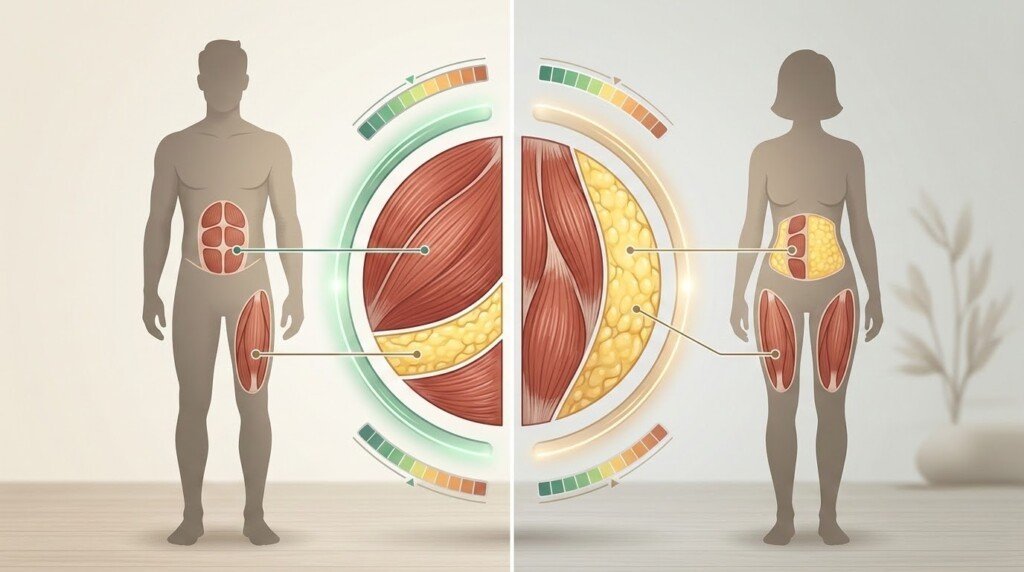
How does this differ between men and women?
Men and women naturally have different body-fat requirements and typical body-fat distributions.
Women generally carry a higher percentage of body fat than men, partly because certain amounts of essential fat are necessary for normal physiological functions.
That means the same body-fat percentage cannot be interpreted identically in both sexes.
For example, a body-fat percentage that might be considered relatively high for a man could be much less unusual for a woman.
Age matters as well.
Body composition changes throughout adulthood. Muscle mass can decline with age while fat mass increases, meaning two people with the same BMI can have different body-fat percentages depending on age and body composition.
Research also shows that body-fat thresholds associated with BMI categories vary by sex and age. (PubMed Central (PMC))
This is why it is risky to use a social-media chart that says something like:
“Men above X% are skinny fat.”
“Women above Y% are skinny fat.”
Those numbers may be useful as rough reference points in some contexts, but they are not a diagnosis.
Measurement method creates another complication.
A DXA scan, skinfold measurements, bioelectrical impedance analysis and visual estimates can produce different results.
Even the same person can receive different readings depending on hydration, food intake, device quality, measurement technique and timing.
That means a body-fat percentage should generally be treated as an estimate, not an absolute biological truth.
The more useful question is whether the measurement is consistent enough to help you understand your trend.
If one device tells you that your body fat is 24% and another says 28%, arguing over which number is “the real one” may be less useful than choosing a reliable method and tracking changes using the same method over time.
A person with a normal BMI but relatively high body fat can therefore be missed by weight-only assessments.
Research on normal-BMI populations has demonstrated that a meaningful proportion of people can have elevated body-fat percentages despite being classified as normal weight by BMI. (PubMed Central (PMC))
That is the core reason body composition deserves attention.
The number on the scale tells you how much you weigh.
It does not tell you exactly what that weight consists of.
What are the signs of being skinny fat?
There is no official checklist for being “skinny fat.”
Still, certain patterns can suggest that your body composition deserves a closer look.
One common pattern is having a relatively normal body weight while carrying more fat around the waist than expected.
Another is having relatively little muscle definition despite being light or normal weight.
Low strength can also provide a useful clue.
For example, someone might weigh relatively little but struggle with basic resistance exercises or have very little muscle development because their overall lean mass is low.
Again, none of these observations proves anything.
A person can have little visible muscle simply because they do not train for muscle development.
Likewise, someone can have a soft appearance while still having a perfectly reasonable body-fat percentage.
This is why the term can become problematic when people use appearance as a diagnosis.
A more objective approach is to combine measurements.
How can I measure my body fat at home without special equipment?
You can estimate body composition at home, but you should understand the limitations before trusting the result.
The simplest method is to use waist circumference alongside body weight and height.
A measuring tape costs very little and can provide useful information about changes in abdominal size.
NIDDK specifically recognizes waist circumference as an additional measure that can help assess health risk beyond BMI. (NIDDK)
To measure your waist consistently, use the same location and conditions each time.
Measure at approximately the same time of day.
Do not deliberately pull your stomach inward.
Keep the tape level around your body.
Record the measurement rather than relying on memory.
You can then track whether your waist changes over several weeks or months.
Another simple method is to take standardized progress photographs.
This is not a body-fat measurement, but it can help you notice changes that the scale misses.
Use the same lighting, distance, clothing and posture.
Do not compare a relaxed morning photograph with a flexed photograph taken under dramatic lighting.
Consistency matters more than aesthetics.
Skinfold measurements are another option.

A caliper can estimate subcutaneous fat thickness at specific sites, and equations can then estimate overall body-fat percentage. However, accuracy depends heavily on the person performing the measurements and the equation being used.
For someone without training, repeated measurements can easily become inconsistent.
Bioelectrical impedance devices are also widely available.
These devices estimate body composition by sending a small electrical current through the body and using the resulting measurements in an algorithm.
They can be useful for tracking trends when conditions are kept consistent, but hydration and other factors can influence readings.
If your device says your body fat changed dramatically overnight, that is almost certainly not a dramatic change in actual body fat.
Body water can change much faster than body tissue.
More sophisticated methods such as DXA can provide a more detailed assessment of body composition, but they require access to specialized equipment.
The key lesson is simple:
You do not need a perfect body-fat measurement to learn whether your body composition is changing.
If your waist is gradually decreasing, strength is increasing and your weight is relatively stable, that may indicate a meaningful body-composition change even if you cannot determine your exact body-fat percentage.
This is one reason body recomposition can be more useful than chasing a particular scale number.
A person can lose fat while gaining or maintaining muscle, producing only a modest change in total body weight.
If you want to understand the measurement side in greater detail, body-fat percentage and body composition can be considered separately from the basic self-assessment here.
When should I see a doctor about my body composition?
Most people do not need a medical appointment simply because they think they might be “skinny fat.”
The phrase itself is not a diagnosis.
A medical conversation becomes more useful when concerns about body composition overlap with health concerns.
For example, it may be worth speaking with a healthcare professional if you have a large or increasing waist circumference, unexplained changes in weight, persistent fatigue, abnormal blood pressure, abnormal blood glucose, cholesterol concerns or a strong family history of metabolic disease.
The reason is not to determine whether you fit a social-media body type.
The reason is to understand your actual health risk.
BMI, waist circumference and other measures can be useful screening tools, but none should be interpreted in isolation. NIDDK notes that healthcare professionals may consider waist size, BMI and additional risk factors when evaluating whether someone should lose weight or address weight-related health concerns. (NIDDK)
A clinician may also be able to look beyond body composition.
Blood pressure, blood glucose, lipid levels, medical history and physical examination can provide information that a home body-fat scale cannot.
This is particularly relevant if your weight appears normal but you have symptoms or laboratory results suggesting a metabolic issue.

When is it worth consulting a physician specifically for weight management concerns?
A conversation is worthwhile when you are concerned about your health rather than simply dissatisfied with your appearance.
It is especially reasonable to seek professional guidance if you have tried repeatedly to change your body composition without success, have significant changes in weight that you cannot explain, or are unsure whether your current weight or waist size represents a health concern.
It can also be useful if you are considering an aggressive calorie restriction or extreme exercise routine because you believe you need to eliminate “skinny fat.”
That approach can backfire.
If your actual issue is relatively low muscle mass combined with excess body fat, simply trying to make the scale smaller may not address the underlying composition.
A lower body weight does not automatically mean a healthier ratio of muscle to fat.
Likewise, gaining muscle can sometimes make the scale stay relatively stable while improving strength, waist measurements and overall body composition.
A physician, registered dietitian or qualified exercise professional can help determine whether the goal should be weight loss, muscle gain, body recomposition, or simply maintaining your current weight while improving fitness.
The goal should be based on your health and circumstances, not on an internet label.
Frequently Asked Questions (what is skinny fat).
1. What does skinny fat mean?
“Skinny fat” is an informal term describing someone who appears relatively slim or has a normal body weight but carries a relatively high proportion of body fat and comparatively little muscle mass. It is not a formal medical diagnosis.
2. What body fat percentage counts as skinny fat?
There is no universally accepted body-fat percentage that defines skinny fat. Body-fat interpretation varies by sex, age, measurement method and clinical framework. A percentage should be considered alongside waist size, muscle mass and overall health rather than used as a standalone diagnosis.
3. How do I know if I’m skinny fat?
You cannot confirm it from appearance alone. A useful assessment combines body weight, BMI, waist circumference, estimated body-fat percentage and muscle mass or strength. Looking at these measurements together provides more information than the scale alone.
4. Can someone have normal BMI and still have high body fat?
Yes. BMI does not directly measure body fat, so a person can fall within the normal BMI range while having a relatively high body-fat percentage. (NIDDK)
5. Should I see a doctor if I think I am skinny fat?
Not necessarily because of the label itself. Consider speaking with a healthcare professional if you have concerns about your waist size, unexplained weight changes, blood pressure, blood glucose, cholesterol, persistent symptoms or other health risks. A clinician can evaluate your overall health rather than relying on body appearance alone.
Disclaimer:
This post may contain affiliate links. If you purchase through them, we may earn a small commission at no extra cost to you. Also, this content is for informational purposes only and does not substitute professional medical advice.
Ready to Start Your Journey?
Use our free 7-in-1 Weight Loss Toolkit to calculate your numbers and build your plan in minutes.
Open Free Tools →