


How Can You Speed Up Fat Burning? 12 Science-Backed Strategies
Many people want to know How to Speed Up Fat Burning, hoping there is one trick that can dramatically accelerate fat loss. Social media often promotes shortcuts, promising rapid results through special workouts, miracle foods, or trendy hacks. While these claims can be appealing, the biology of fat burning is much more practical.
Your body burns fat every day. The real question is not whether fat burning happens, but how you can create the conditions that allow your body to rely on stored fat more efficiently over time.
Fat burning depends on a combination of energy balance, muscle mass, daily movement, recovery, sleep, and overall metabolic health. Each of these factors contributes a small piece to the puzzle. Individually, their effects may seem modest, but together they can significantly influence long-term body composition.
This article explores 12 evidence-supported strategies that can help improve fat oxidation naturally without relying on extreme diets or unrealistic promises. Rather than focusing on quick fixes, you’ll learn how consistent habits create an environment where your body can burn fat more effectively.
Quick Answer
How to Speed Up Fat Burning starts with building habits that support efficient fat oxidation. Maintaining a calorie deficit, preserving muscle, staying physically active, getting enough sleep, managing stress, staying hydrated, and eating adequate protein all work together to help your body use stored fat more efficiently over time.
What Helps Your Body Burn Fat Faster?
There is no biological switch that suddenly puts your body into “fat-burning mode.”
Instead, your body constantly chooses between carbohydrates and fat depending on energy demands, hormone levels, activity, and recent food intake.
Improving fat burning is less about forcing your body to burn more fat and more about creating the right conditions for fat oxidation to occur more often.
The following strategies consistently appear in scientific research as practical ways to support this process.

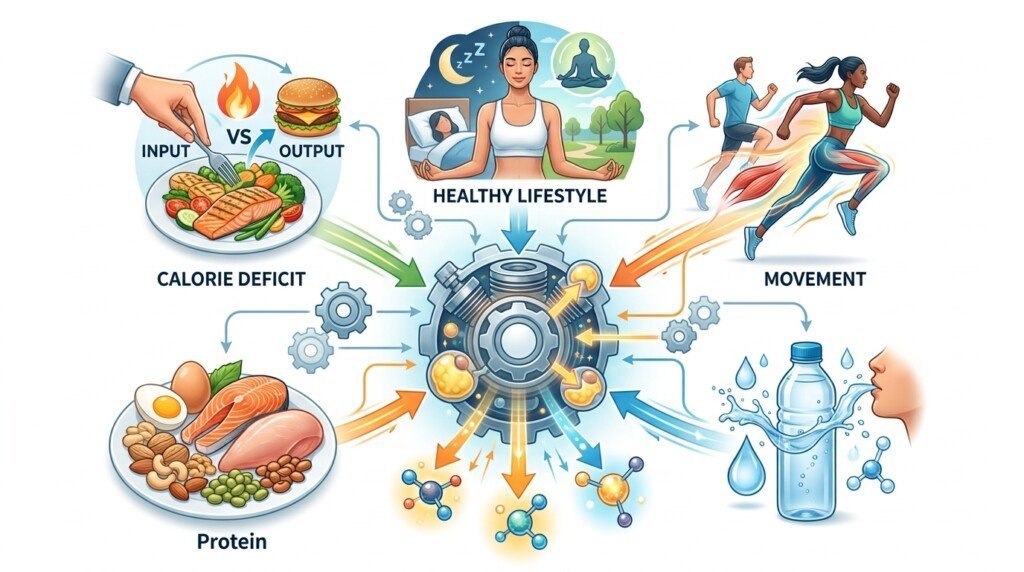
1. Maintain a Consistent Calorie Deficit
Stored body fat exists as an energy reserve.
When your body consistently uses more energy than it receives from food, it gradually increases its reliance on stored fat.
This is why maintaining an appropriate Calorie Deficit remains the foundation of long-term fat loss.
It is important to remember that a calorie deficit does not automatically mean eating as little as possible. An aggressive deficit can make it harder to maintain muscle, energy levels, and exercise performance.
Moderate, sustainable deficits generally produce better long-term results.
2. Eat Enough Protein
Protein plays several important roles during fat loss.
It helps preserve lean muscle while reducing hunger and increasing the thermic effect of food, meaning your body uses slightly more energy digesting protein compared with carbohydrates or fat.
Good protein sources include:
- Chicken
- Fish
- Eggs
- Greek yogurt
- Cottage cheese
- Lentils
- Tofu
Readers looking for practical food ideas may also find High-Protein Foods That Burn Fat useful.
3. Move More Throughout the Entire Day
Many people focus only on workouts while overlooking daily movement.
Walking through the office, climbing stairs, gardening, standing while working, carrying groceries, and household chores all increase energy expenditure.
These everyday activities are commonly called NEAT (Non-Exercise Activity Thermogenesis).
Although each activity burns only a small number of calories, the total accumulated throughout the day can become surprisingly significant.
Small movement repeated consistently often contributes more than occasional intense workouts.
Does Building Muscle Improve Fat Burning?
One of the smartest long-term strategies for improving fat burning is preserving or increasing lean muscle mass.
Muscle is metabolically active tissue.
Although muscle does not “burn fat” directly, it requires energy to maintain, increasing your body’s overall energy needs throughout the day.

4. Prioritize Resistance Training
Resistance training encourages muscle maintenance during fat loss.
Whether you use machines, free weights, resistance bands, or bodyweight exercises, regularly challenging your muscles helps preserve lean tissue.
Maintaining muscle becomes especially important during weight loss because losing muscle can reduce daily energy expenditure over time.
Readers interested in this relationship can also explore Muscle and Metabolism, which explains why lean tissue matters beyond appearance.
5. Support Recovery After Training
Muscles grow and recover outside the gym.
Recovery allows damaged muscle fibers to repair while supporting long-term training consistency.
Good recovery includes:
- Adequate sleep
- Balanced nutrition
- Hydration
- Rest days when needed
Recovery should not be viewed as taking time off. It is part of the process that allows continued progress.
Can Exercise Increase Fat Oxidation?
Exercise increases energy demand, giving the body more opportunities to use stored fat over time.
Different forms of exercise contribute in different ways, but no single workout deserves all the credit.

6. Combine Cardio With Strength Training
Aerobic exercise and resistance training complement one another.
Cardio increases total calorie expenditure while resistance training helps preserve lean muscle.
Together, they support healthier body composition than relying exclusively on one type of exercise.
The goal is consistency rather than constantly changing workout styles.
7. Include Higher-Intensity Sessions When Appropriate
Higher-intensity exercise can increase total energy expenditure during and after activity.
However, this does not mean every workout should be extremely intense.
Recovery, fitness level, age, and personal goals all influence the appropriate training intensity.
Instead of chasing exhaustion, focus on sustainable progress.
Detailed training methods belong in a dedicated discussion of HIIT for Fat Burning, where different interval approaches can be compared more thoroughly.
8. Never Underestimate Walking
Walking remains one of the most practical ways to increase daily energy expenditure.
Unlike demanding workouts, walking is accessible to most people, places less stress on the joints, and can be performed consistently.
Over weeks and months, increasing daily steps contributes meaningfully to overall fat loss while supporting cardiovascular health.
Walking also encourages long-term adherence because it fits naturally into everyday life.
Which Daily Habits Support Fat Burning?
Many of the habits that improve fat burning happen outside the gym.
Daily routines often determine whether healthy behaviors become sustainable over the long term.

9. Stay Properly Hydrated
Water supports nearly every metabolic process in the body.
Although drinking water does not magically burn fat, proper hydration supports exercise performance, circulation, temperature regulation, and normal metabolism.
Even mild dehydration may reduce physical performance, making consistent activity more difficult.
10. Manage Daily Stress
Chronic stress can indirectly affect fat loss by influencing sleep quality, appetite, motivation, and recovery.
Stress management does not need to be complicated.
Helpful approaches include:
- Walking outdoors
- Deep breathing
- Meditation
- Reading
- Spending time with family
- Enjoying hobbies
Supporting mental health often makes physical health habits easier to maintain.
Does Sleep Affect Fat Burning?
Many people focus on food and exercise while overlooking one of the most influential recovery tools available: sleep.
Sleep is not simply a period of rest. It is an active biological process during which your body regulates hormones, repairs tissues, restores energy, and prepares for the next day.
Consistently poor sleep can make fat loss more difficult, even when nutrition and physical activity are well managed.

11. Prioritize Quality Sleep Every Night
Getting enough quality sleep supports the hormones involved in appetite regulation, recovery, and energy balance.
When sleep is consistently disrupted, people often experience:
- Increased hunger
- Lower energy levels
- Reduced exercise performance
- Slower recovery
- Greater cravings for calorie-dense foods
These effects do not stop fat burning altogether, but they can make maintaining healthy habits much more challenging.
Improving sleep quality often supports better decision-making throughout the day, creating a positive cycle that benefits long-term fat loss.
Readers interested in this connection can also explore Sleep and Weight Loss, which examines how sleep influences body weight and overall health.
12. Stay Consistent Instead of Looking for Shortcuts
Perhaps the most effective fat-burning strategy is consistency.
Your body adapts to the habits you repeat every day.
Small improvements maintained for months usually produce greater results than extreme routines followed for only a few weeks.
Consistency includes:
- Eating balanced meals regularly
- Staying physically active
- Preserving muscle
- Sleeping well
- Managing stress
- Drinking enough water
These habits may not sound exciting, but together they create the environment where fat burning becomes more efficient over time.
Which Mistakes Slow Fat Burning?
Sometimes improving fat burning is less about adding new habits and more about avoiding common mistakes.
Many people unintentionally reduce their progress by focusing on quick fixes instead of sustainable behaviors.
Expecting Rapid Results
Fat loss is a gradual biological process.
Trying to force dramatic weekly changes often leads to frustration and unsustainable habits.
Healthy progress usually develops steadily rather than overnight.
Losing Muscle During Weight Loss
Aggressive dieting without resistance training or sufficient protein increases the risk of losing lean muscle.
Because muscle contributes to daily energy expenditure, preserving it helps support long-term fat burning.
Ignoring Recovery
Exercise creates the stimulus for adaptation.
Recovery allows those adaptations to occur.
Without enough rest, fatigue accumulates, motivation declines, and training quality often suffers.
Sitting for Long Periods
Even individuals who exercise regularly can benefit from increasing movement throughout the rest of the day.
Breaking up long periods of sitting with short walks or standing breaks helps increase overall daily energy expenditure.
Chasing Every New Trend
Social media constantly introduces new “fat-burning” tricks.
Most disappear because they offer little lasting benefit.
Building habits supported by research is usually far more effective than following every new trend.
Which Strategies Actually Have Scientific Support?
Among the many recommendations available online, some consistently receive stronger scientific support than others.
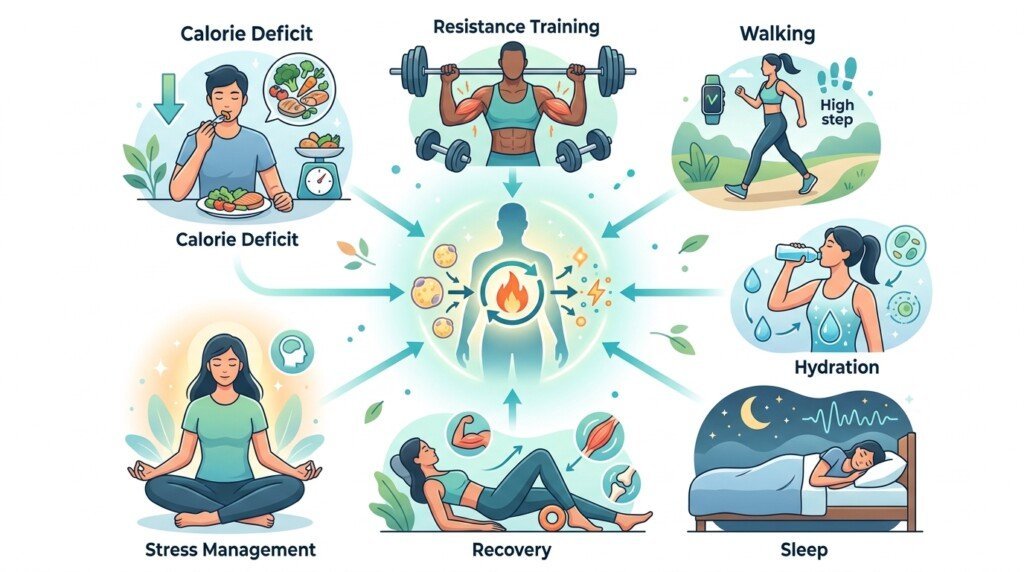
The following strategies have the strongest evidence for supporting fat oxidation and long-term fat loss.
| Strategy | Evidence |
|---|---|
| Maintain a calorie deficit | Strong |
| Preserve lean muscle | Strong |
| Resistance training | Strong |
| Daily movement (NEAT) | Strong |
| Walking regularly | Strong |
| Adequate protein intake | Strong |
| Quality sleep | Strong |
| Hydration | Moderate |
| Stress management | Moderate |
| Combining cardio and strength training | Strong |
| Consistent recovery | Strong |
| Sustainable lifestyle habits | Strong |
One pattern becomes clear.
The most effective strategies are not complicated.
They are the habits people can maintain consistently for months and years.
Putting the 12 Strategies Together
Rather than trying to apply every recommendation at once, consider building them gradually.
For example:
Week 1
Focus on increasing daily movement and drinking enough water.
Week 2
Add resistance training two or three times each week.
Week 3
Improve sleep consistency.
Week 4
Increase protein intake while maintaining a realistic calorie deficit.
By stacking healthy habits one at a time, they become easier to maintain without feeling overwhelming.
This gradual approach also aligns well with the principles of Sustainable Weight Loss, where long-term consistency matters far more than short bursts of perfection.

Frequently Asked Questions
1. Can you speed up fat burning?
Yes. While you cannot dramatically accelerate fat burning overnight, maintaining a calorie deficit, preserving muscle, staying active, sleeping well, and following healthy lifestyle habits can improve fat oxidation over time.
2. Does drinking water burn fat?
Water does not directly burn fat, but proper hydration supports metabolism, exercise performance, and the body’s normal fat-burning processes.
3. Can walking increase fat burning?
Yes. Walking increases daily energy expenditure and contributes to greater fat utilization when performed consistently.
4. Does building muscle improve fat burning?
Maintaining lean muscle increases overall energy expenditure, making it easier for the body to use stored fat over time.
5. Is resistance training important for fat loss?
Yes. Resistance training helps preserve muscle during weight loss while supporting healthy body composition.
6. Does sleep affect fat burning?
Poor sleep may negatively influence appetite, recovery, energy levels, and adherence to healthy habits, making fat loss more difficult.
7. Which daily habit has the biggest impact on fat burning?
Maintaining a calorie deficit while preserving muscle through regular activity and balanced nutrition remains one of the most effective long-term strategies.
8. What slows fat burning the most?
Common obstacles include losing muscle, inadequate sleep, chronic inactivity, poor recovery, and inconsistent healthy habits.
9. Can stress affect fat burning?
Yes. Chronic stress may indirectly influence fat loss by affecting appetite, motivation, recovery, and sleep quality.
10. What is the best long-term approach to faster fat burning?
The most reliable approach combines consistent physical activity, balanced nutrition, quality sleep, adequate hydration, stress management, and sustainable lifestyle habits.
Conclusion
Understanding How to Speed Up Fat Burning is less about finding one powerful shortcut and more about improving the everyday habits that influence how your body uses energy. Fat burning is governed by energy balance, muscle preservation, movement, recovery, hydration, sleep, and overall metabolic health. While none of these factors produces dramatic overnight results, their combined effect can significantly improve fat oxidation over time.
The strongest research continues to support a simple message: consistency beats intensity. Maintaining a realistic calorie deficit, preserving lean muscle, staying active throughout the day, prioritizing recovery, and building sustainable routines create an environment where your body can rely more effectively on stored fat for energy. Instead of chasing temporary solutions, focus on habits you can maintain for the long term, because lasting fat loss is built on consistent choices rather than quick fixes.
Disclaimer:
This post may contain affiliate links. If you purchase through them, we may earn a small commission at no extra cost to you. Also, this content is for informational purposes only and does not substitute professional medical advice.
Ready to Start Your Journey?
Use our free 7-in-1 Weight Loss Toolkit to calculate your numbers and build your plan in minutes.
Open Free Tools →